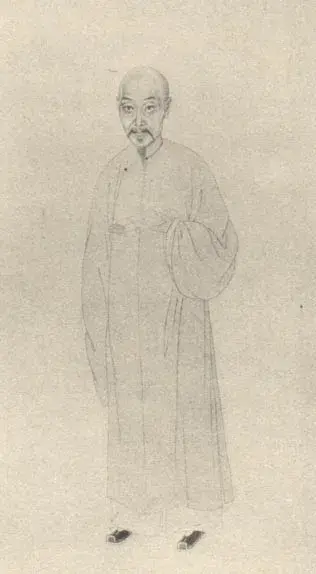
Biography
Illustrious Heritage and Childhood Privation
On February 20, 1749 (the 4th day of the 1st lunar month in the 14th year of the Qianlong reign), Huang Jingren was born in the official county school residence of Gaochun, Jiangning Prefecture, Jiangsu Province. The Huang lineage traced its ancestry back to Huang Tingjian, the revered master of the Jiangxi Poetic School during the Northern Song dynasty, and had flourished in Wujin, Changzhou, as an esteemed literati family for centuries. His grandfather Huang Dale had served as an educational instructor in Gaochun, and his father Huang Mao was a distinguished classical scholar.
However, calamity struck early. In 1752, when Huang Jingren was only four years old, his father died prematurely in his twenties. The family was plunged into destitution. In 1755, seven-year-old Huang Jingren accompanied his grandfather back to the ancestral residence along Baiyun Brook in Changzhou. Over the next decade, tragedy compounded: his grandfather died in 1760, his grandmother Lady Lv passed away in 1761, and his elder brother Huang Gengling died prematurely in 1764. Before he reached adulthood, three generations of male relatives had perished, leaving young Huang Jingren and his widowed mother entirely alone.
Amidst this poverty, his grandmother and mother supervised his education with classical rigor. Endowed with poetic genius, at age nine he composed verses spontaneously while resting under a bedquilt during an examination. In 1764, at age sixteen, Huang sat for the Changzhou prefectural youth examinations, placing first among thousands of candidates. Both Prefect Pan Xun and Magistrate Wang Zusu praised his examination script, establishing his reputation as a prodigy across the region.
Longcheng Studies and the Taibai Pavilion Triumph
In 1765, at age seventeen, Huang Jingren attained the status of government student (xiucai). The following year, he met Hong Liangji in Changzhou, establishing a lifelong friendship. Both scholars shared impoverished backgrounds and literary ambitions, resolving to revitalize classical Chinese poetry.
In 1767, at age nineteen, Huang married Lady Zhao. That same year, the prominent Changshu scholar Shao Qitao was engaged as principal of the Longcheng Academy in Changzhou. Moved by Huang's solitary dedication to verse without a formal teacher, Shao invited him into the academy. Shao instructed him in ancient prose principles and Du Fu's somber resonance, expanding Huang's creative horizons. However, in 1770, Shao Qitao died prematurely. Shattered by the loss of his intellectual mentor, Huang felt unmoored and commenced more than a decade of itinerant wanderings.
In 1769, Huang traveled through Hangzhou, Huizhou, and Yangzhou, joining the secretarial staff of Hunan Judicial Commissioner Wang Taiyue in winter. The following spring, he climbed Mount Heng, composing grand hymns to its peaks. In 1771, his eldest son Huang Yisheng was born; in the winter, he traveled to Dangtu, Anhui, to call upon Education Commissioner Zhu Yun, who engaged him to collate rare texts.
On the third day of the third lunar month in 1772, Zhu Yun convened an assembly of scholars at the Taibai Pavilion on Caishi Cliff. Clad in a plain white jacket, the twenty-four-year-old Huang Jingren stood under the sun, instantly drafting hundreds of lines of regulated verse. His lines exhibited such majestic momentum that older scholars laid down their brushes in awe. Hundreds of students taking civil examinations gathered beneath the pavilion, pleading with servants for copies of the white-clad youth's verses, establishing his renown across the empire.
Wandering across Rivers and Secretarial Life
Although his triumph at Taibai Pavilion brought fame, it failed to alleviate his economic privation. Bound by filial duty to maintain his ailing mother and growing family, Huang spent the following years traveling as an itinerant secretarial assistant (muyou).
Accompanying Zhu Yun across Anhui between 1772 and 1774, he journeyed through Xuanzhou, Anqing, Liuan, Yinzhou, and Fengyang, exploring the granite peaks of Mount Huang, Baiyue, and Mount Jiuhua. These landscapes expanded his poetic style, infusing his writing with the imaginative power of Li Bai. In the summer of 1774, he made a pilgrimage to Mount Yu in Changshu, weeping before the tomb of his former teacher Shao Qitao.
Yet within the civil examination system, Huang faced consecutive defeats. Between 1767 and 1774, he failed the Jiangnan provincial examinations four times, as examiners favored rigid eight-legged formulas. In official yamens, he endured condescension from superiors; in rented rooms, he faced hunger and pawned garments to purchase rice. This clash between literary genius and material destitution produced a sequence of poignant verses.
Northern Journey and the Wuying Palace
In the winter of 1775, believing his verse lacked the rugged vigor of the northern frontiers, Huang departed the south for Beijing. Prior to his departure, he organized his youthful poetry into the sixteen-volume Liangdangxuan Ji while lecturing at the Zhengyang Academy in Shouzhu.
In the spring of 1776, Emperor Qianlong embarked on an inspection tour to Dezhou, Shandong, convening special examinations for literati. Traveling from Beijing to Dezhou, Huang competed before the throne, placing second. The emperor bestowed two bolts of silk and appointed him Book-Titler in the Wuying Palace, granting the nominal rank of Assistant County Magistrate.
This appointment permitted him to participate in transcribing the monumental Siku Quanshu. In 1777, Huang borrowed funds to bring his mother and family to Beijing. In 1778, he became a student of the antiquarian scholar Wang Chang. However, his official stipend was inadequate to meet high living costs in the capital. He sat for the Shuntian provincial examinations in 1777, 1779, and 1780, failing three times. Reluctantly, in 1780, he was compelled to escort his family back to Changzhou.
Debts, Illness, and Passing in Shanxi
In the autumn of 1781, stranded alone in Beijing awaiting an official posting, Huang faced financial collapse. Encouraged by friends, he traveled west to Xi'an to seek patronage from Bi Yuan, the Governor of Shaanxi. Bi Yuan received him with honors and provided several hundred taels of silver to purchase an upgraded appointment as an Assistant County Magistrate, hoping to expedite his posting.
Returning to Beijing, Huang waited for placement from the Ministry of Personnel. However, bureaucratic procedures were protracted and required substantial under-the-table fees. Huang possessed no savings, while debts accrued to maintain his family mounted.
In the early spring of 1783, hearing that his official appointment remained remote, creditors surrounded his lodgings day and night. Broken in health, Huang borrowed a horse and fled Beijing into the snowy mountain passes of the Taihang range, seeking aid from his old friend Shen Yefu, the Salt Distribution Commissioner of Hedong stationed in Jiezhou, Shanxi.
The winter trail across the mountains aggravated his chronic pulmonary illness, causing him to cough blood on horseback. Arriving at Shen Yefu's yamen in Jiezhou, his condition deteriorated rapidly. On May 25, 1783 (the 25th day of the 4th lunar month in the 48th year of the Qianlong reign), Huang Jingren passed away at the age of thirty-five. Grieved by the news, Hong Liangji rushed to Shanxi to conduct the burial, provide for Huang's orphan, and publish his collected works, preserving the Liangdangxuan Ji for posterity.
Major Achievements
Pioneer of Individualist Lyricism in the High Qing
In the history of Qing dynasty poetry, Huang Jingren was an exceptional master who broke through the formal constraints of the Evidential School and Shen Deqian's conservative courtly poetics.
During the Qianlong period, poetry was polarized between Shen Deqian's didactic court verse and the academic faction led by Weng Fanggang, which crowded poetry with antiquarian footnotes. Huang Jingren championed the banner of authentic emotion, insisting that poetry must express authentic life experience.
Stylistically, he combined Li Bai's imaginative momentum with Du Fu's tragic resonance, while absorbing Li Shangyin's nuanced romantic melancholy. Free from pedantic affectation, his verse was clear, melodic, and emotionally transparent. His ancient-style poems—exemplified by Reflections at Taibai Pavilion—displayed sweeping power, while his regulated verses such as Sixteen Poems on Cherished Memories conveyed intimate sorrow, celebrated as summits of High Qing lyricism.
Compiling the Immortal Liangdangxuan Ji
Although Huang Jingren died at thirty-five, his surviving collection Liangdangxuan Ji in sixteen volumes erected a monument in Chinese literature.
The collection preserves over one thousand poems composed between his fifteenth year and his death, deriving its title from his ancestral library. The work charts his spiritual journey from youthful confidence to tragic disillusionment.
Celebrated lines permeate the collection. In Miscellaneous Feelings, his declaration that nineteen out of twenty deserve cold looks, for of a hundred things, a scholar is of no practical use, offered a critique of scholar marginalization under imperial rule. In New Year's Eve in 1773, his portrait of poverty captured the clash between filial love and harsh reality. In Cherished Memories, his line beneath stars that belong not to yesterday, for whom do I stand through the midnight dew remains an enduring masterpiece of Chinese romantic poetry.
Lyrical Masterpieces in Song Lyrics
Beyond shi poetry, Huang Jingren attained exceptional distinction in ci lyric poetry. His collection Liangdangxuan Ci in one volume is paired by critics alongside Nalan Xingde as the dual peaks of Qing lyric verse.
Inheriting the refined grace of Northern Song masters Yan Jidao and Zhou Bangyan alongside Southern Song masters Jiang Kui and Zhang Yan, he infused the desolation of Yu Xin's Rhapsody on Lamenting Jiangnan into the genre. Composed during his wanderings and struggles in Beijing, pieces set to tunes such as Niannu Jiao and Jinlv Qu captured displacement and spiritual longing.
Critics commended his lyrics for profound melancholy, melodic polish, and absence of superficial sentiment, demonstrating a rare emotional purity that broadened the psychological boundaries of Qing lyricism.
Leadership of the Seven Scholars of Piling
Huang Jingren served as the creative core of the "Seven Scholars of Piling," an intellectual society that revitalized Jiangnan literati culture during the Qianlong era.
Centering in Changzhou, the group gathered talents including Hong Liangji, Sun Xingyan, Zhao Huaiyu, Yang Lun, Lv Xingyuan, and Xu Shushou. Among these peers, Huang was universally acknowledged as the supreme poetic genius.
His talent crossed social hierarchies in an era of bureaucratic stratification. Masters of empirical scholarship and imperial governors including Bi Yuan, Zhu Yun, Wang Chang, and Shao Qitao recognized and aided him. This collective literary circle resisted dry academic pedantry, restoring emotional authenticity to late imperial verse.
Exposing Social Injustice beneath Imperial Splendor
Huang Jingren's poetry achieved historical significance through its honest portrayal of social contradictions beneath the veneer of the High Qing era.
Living at the height of the Qianlong reign, Huang experienced the hardships confronting a Han scholar without aristocratic patronage: childhood isolation, examination barriers, humiliation within secretarial circles, and death driven by debt.
Rather than participating in courtly panegyrics, Huang recorded the survival struggles of scholars and commoners under taxation, inflation, and usury. His verse served not merely as a personal memoir, but as an elegy for scholars on the eve of imperial decline, possessing enduring sociological and historical value.
Poetic Integrity amidst the Evidential Scholarship Wave
Amid the intellectual dominance of the Qianlong-Jiaqing Evidential School, Huang Jingren maintained the aesthetic integrity and emotional warmth of classical poetry.
While scholars followed Dai Zhen and Hui Dong into phonology and philological collation, turning verse into dry displays of erudition, Huang lived among prominent philologists like Zhu Yun and Bi Yuan without succumbing to pedantry. He maintained that poetry divorced from authentic feeling was merely an empty skeleton.
This fusion of personal suffering and historical consciousness inspired later generations. Late Qing thinker Gong Zizhen drew inspiration from his work, inheriting his blend of martial energy and melancholic sensitivity in the Yihai Zashi. In the modern era, author Yu Dafu adopted Huang as a literary idol, composing the historical novella Caishi Cliff in homage, ensuring that Huang's poetic spirit continues to illuminate Chinese literature.