Birth in Changshu
Born on the 15th day of the 8th month in Ziyou Lane, Changshu, original surname Lu, given name Jian.
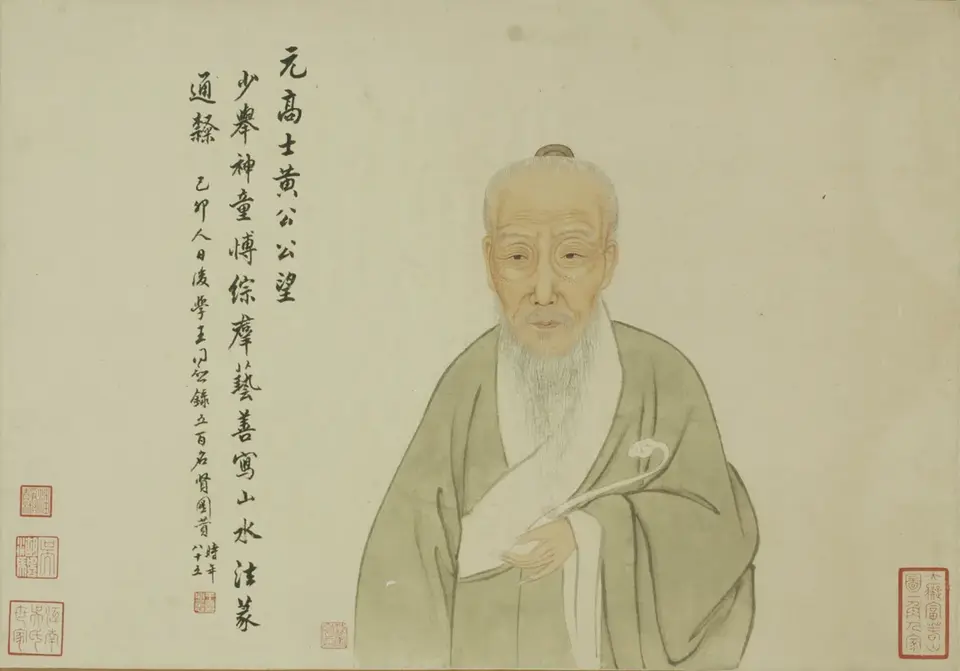
黄公望
Huang Gongwang (黄公望, September 12, 1269 – November 10, 1354), original surname Lu, given name Jian, later adopted by the Huang family of Pingyang and renamed Huang Gongwang with the courtesy name Zijiu and art names Dachi Daoren and Yifeng Daoren, was a native of Changshu, Pingjiang Route. He was a preeminent landscape painter, calligrapher, and Daoist scholar of the mid-to-late Yuan dynasty, revered as the foremost of the…
Huang Gongwang (黄公望, September 12, 1269 – November 10, 1354), original surname Lu, given name Jian, later adopted by the Huang family of Pingyang and renamed Huang Gongwang with the courtesy name Zijiu and art names Dachi Daoren and Yifeng Daoren, was a native of Changshu, Pingjiang Route. He was a preeminent landscape painter, calligrapher, and Daoist scholar of the mid-to-late Yuan dynasty, revered as the foremost of the Four Masters of the Yuan alongside Wu Zhen, Ni Zan, and Wang Meng, occupying a paramount position in the history of classical Chinese literati landscape painting. Endowed with exceptional intellect from youth, Huang mastered the Confucian classics, philosophical treatises, classical poetry, and music. In his early years, he served as a clerk in the Western Zhejiang Surveillance Commission and the Jiangzhe Branch Secretariat. In 1315, he was unjustly implicated and imprisoned for several years in the fiscal extortion scandal of Grand Councilor Zhang Lu. Following his release, Huang severed all ties with worldly politics and entered the Quanzhen School of Daoism at around age fifty. He adopted the religious title Dachi Daoren, wandering throughout Hangzhou, Suzhou, and Songjiang as an itinerant diviner, channeling his spiritual detachment into landscape painting, poetry, and wine. Huang excelled in calligraphy and musical theory, but achieved his greatest glory in landscape painting. Drawing upon Dong Yuan and Juran while receiving personal instruction from Yuan master Zhao Mengfu, Huang integrated calligraphic brushwork into natural depiction. In his later years, he settled along the scenic Fuchun River in Zhejiang, closely observing shifting mists and seasonal vistas. He pioneered the "light ochre landscape" (qianjiang shanshui) technique, combining moist hemp-fiber strokes with warm washes to create atmospheric tranquility. His monumental handscroll Dwelling in the Fuchun Mountains is venerated as the supreme masterpiece of Chinese ink landscape painting. His theoretical treatise Secrets of Landscape Painting (Xie Shanshui Jue) synthesized literati landscape principles, exerting an immeasurable influence on Dong Qichang, the Four Wangs of the early Qing, and subsequent generations of painters.
Born on the 15th day of the 8th month in Ziyou Lane, Changshu, original surname Lu, given name Jian.
Orphaned and destitute, adopted by ninety-year-old Huang Le of Pingyang residing in Changshu; renamed Huang Gongwang.
Appointed clerk in the Western Zhejiang Surveillance Commission by Xu Yan; relocated to Hangzhou and studied poetry and art.
Implicated in the extortion scandal of Chancellor Zhang Lu during the agrarian survey; suffered years of harsh imprisonment.
Renounced official career, joined the Southern lineage of Quanzhen Daoism as a registered cleric, adopting the title Dachi Daoren.
Established the Hall of the Three Teachings in Songjiang, interacting closely with Yang Weizhen, Zhang Yu, and Ni Zan.
Retreated to the Fuchun River and Mount Yu; mastered landscape painting techniques that captivated southeastern China.
Traveled with Daoist companion Master Wuyong to Fuchun River; settled at Shaoji Spring and commenced Dwelling in the Fuchun Mountains.
After years of dedicated labor, largely completed Dwelling in the Fuchun Mountains and dedicated the scroll to Master Wuyong.
Passed away peacefully on the 25th day of the 10th month at Shengjing Hermitage, Mount Yu, aged eighty-six.
Huang Gongwang was born into the Lu family in Ziyou Lane within the walled town of Changshu on September 12, 1269. The Lu clan had been a prominent local lineage, but had fallen into severe poverty by his father's generation. Orphaned at an early age when both parents died in quick succession, young Lu Jian faced absolute destitution. Around the age of ten, an elderly scholar named Huang Le, a native of Pingyang Commandery in Wenzhou residing at the base of Mount Yu in Changshu, was over ninety years old and had no male heir. Struck by Lu Jian's bright countenance and keen intellect, the elder adopted him as his legitimate son.
Overjoyed by the adoption, the elderly Huang Le exclaimed: "Old Master Huang has hoped for a son for a long time!" (Huang gong wang zi jiu yi). Consequently, he renamed the boy Huang Gongwang and bestowed upon him the courtesy name Zijiu. Huang Le provided him with rigorous classical training under distinguished tutors. Exhibiting precocious brilliance, young Huang memorized classical texts upon a single reading, delving deeply into the Confucian classics, pre-Qin philosophers, and the Hundred Schools of Thought, while displaying exceptional flair for poetry, musical rhythm, and lyrical ballads. Following the Mongol conquest of the Southern Song, Huang gained early prominence in Jiangnan literary circles for his broad scholarship.
In 1294, at the age of twenty-six, Huang was recruited by Xu Yan, the newly appointed Surveillance Commissioner of Western Zhejiang, to serve as a legal clerk in the Surveillance Commission. He relocated with his superior to Hangzhou, the political and cultural metropolis of southern China. In Hangzhou, Huang interacted with imperial officials, Mongol aristocrats, and eminent men of letters, making the acquaintance of Zhang Lu, an ambitious bureaucrat who later rose to high ministerial power. During this period, Huang once appeared in Daoist robes to deliver official reports, which drew sharp reprimand from Xu Yan and led to his early departure from clerical duties.
Struggling under the restricted social mobility available to southern Chinese scholars under Mongol rule, Huang spent the years between 1295 and 1310 visiting the residences of prominent dignitaries in Hangzhou to seek career advancement. During this decade, he had the rare privilege of witnessing Zhao Mengfu, then serving as Intendant of Confucian Schools for Jiangzhe, execute magnificent paintings and received direct personal instruction from him.
Huang held Zhao Mengfu in supreme veneration, later reflecting in an inscription: "In those years I personally witnessed the Master brandishing his brush, a humble schoolboy in the Pine Snow Studio." Zhao's emphasis on classical antiquity and the unity of painting and calligraphy deeply inspired Huang. Hanlin Academician Liu Guan later praised Huang's painting: "Among the inner disciples of Wuxing, how many could wield the chisel without shedding blood?" This invaluable mentorship established Huang's foundational aesthetic commitment to infusing calligraphic energy into painting and reviving the understated elegance of Jin and Tang masters.
During the Huangqing and Yanyou eras, Zhang Lu was appointed Grand Councilor of the Jiangzhe Branch Secretariat, enforcing a draconian agrarian resurvey policy to extract revenues from southern landholders, sparking widespread popular indignation. Huang served as a clerical secretary in Zhang Lu's administration. In 1315, Zhang Lu's ruthless corruption provoked armed peasant uprisings in Ganzhou, Jiangxi, prompting Emperor Renzong to order a comprehensive imperial investigation. Zhang Lu was disgraced and arrested, and Huang was innocently implicated and thrown into prison. In the dark, damp cells, Huang endured years of grueling interrogation and physical humiliation. This traumatic ordeal shattered his illusions about political power, exposing the venality and fragility of worldly ambition.
Released from prison in his late forties, Huang decisively renounced bureaucratic aspirations. Disillusioned with secular success, he turned to religious cultivation for spiritual liberation. At that time, the Southern Golden Elixir lineage of Quanzhen Daoism was flourishing across Jiangnan. Huang formally entered the Quanzhen order, receiving ordination as a Daoist priest. He adopted the religious titles Dachi Daoren ("The Great Dolt") and Yifeng Daoren ("Hermit of the Lone Peak"), utilizing the moniker "Dachi" to convey profound spiritual wisdom concealed beneath apparent foolishness.
To sustain himself, Huang set up divination stalls in the public markets of Hangzhou, Suzhou, and Songjiang, predicting fortunes to earn modest coins for daily meals. Unfettered by worldly convention, he wore a simple hemp robe and straw sandals, wandering among the scenic rivers and mountains of the Three Wu regions. In Songjiang, he established the Hall of the Three Teachings, lecturing publicly on the harmonious synthesis of Daoism, Confucianism, and Buddhism to numerous disciples.
During his travels, Huang maintained close ties with prominent Quanzhen masters Mo Yueding, Leng Qian, and Zhang Sanfeng, holding administrative responsibilities at the Wanshou and Kaiyuan Daoist temples. In addition to internal alchemy, he possessed remarkable musical skill, particularly in playing the iron flute and stringed ruan. On moonlit nights, he would drift alone in a skiff across rivers and lakes, strumming his instrument and singing to the open skies. Literary luminaries such as Yang Weizhen and Zhang Yu, alongside painters Ni Zan and Wu Zhen, treasured his eccentric companionship, gathering in rustic boats and bamboo huts for poetic and spiritual communion.
Although Huang had practiced painting from his youth, he dedicated his entire creative lifeblood to landscape painting only after converting to Daoism at fifty. By his seventies, his artistic technique had attained transcendent maturity. Deeply understanding the principle of learning from nature, Huang consistently traveled with paper, inkstones, and brushes in his travel pouch, walking with straw sandals and a bamboo cane across the peaks of Jiangnan. Whenever he encountered dramatic cliffs or shifting atmospheric mists, he sat on the mossy rocks to sketch from nature, absorbing the spirit of the mountains into his heart.
In 1347, at the venerable age of seventy-nine, Huang sailed along the Fuchun River in Zhejiang with his Daoist companion Master Wuyong (Zheng Chu). The emerald ridges, limpid waters, and solitary fishermen along the riverbanks captivated Huang's soul, prompting him to settle at Shaoji Spring beside the river. During his sojourn, he carried a leather pouch filled with painting tools, sitting on secluded crags to sketch dynamic mists and winding valleys directly onto paper.
Throughout his years in the Fuchun mountains, Huang lived in intimate communion with seasonal changes, engaging in daily spiritual dialogues and artistic deliberations with Master Wuyong. In this tranquil environment, he commenced the execution of the monumental handscroll Dwelling in the Fuchun Mountains. Huang never rushed his creative process: whenever inspiration struck, he added a few brushstrokes; if the mood subsided, he set the scroll aside for contemplative meditation, carrying the unfinished masterpiece in his boat across years of travel.
In 1350, after years of meticulous conception and layered ink washes, the handscroll was largely completed. Huang inscribed a prominent colophon at the end of the scroll, formally presenting this immortal masterpiece to his Daoist brother Master Wuyong. Spanning hundreds of miles of early autumn scenery along the Fuchun River, the work synthesized the heritage of Dong Yuan and Juran while forging a revolutionary path, establishing an unmatched monument in Chinese landscape painting.
During his final years, octogenarian Huang remained physically robust and mentally lucid. He moved freely between the Fuchun River, Hangzhou, and his native retreat on Mount Yu in Changshu, painting without interruption and producing masterpieces such as Nine Peaks After Snow, Jade Trees on Red Cliffs, and Stone Cliff at Tianchi. In addition to his brushwork, Huang distilled a lifetime of practical wisdom into Secrets of Landscape Painting, systematically formulating the core aesthetic principles of literati landscape composition, brushwork, coloring, and spiritual resonance.
On November 10, 1354 (25th day of the 10th month, 14th year of Zhizheng), Master Huang Gongwang passed away peacefully at Shengjing Hermitage on Mount Yu, aged eighty-six. On the day of his funeral, hundreds of Daoist brethren, scholars, and local admirers gathered in solemn procession to inter his remains at the foot of Mount Yu. Through his transcendent Daoist detachment and sublime brushwork, Huang became the supreme embodiment of classical literati integrity and aesthetic mastery.
Huang Gongwang's most significant contribution to Chinese painting was the creation and perfection of the "light ochre landscape" (qianjiang shanshui) system within literati art. Prior to Huang, traditional landscape painting predominantly relied on heavy mineral pigments (blue-and-green landscape) or pure monochrome ink washes. Building upon the moist, undulating hemp-fiber strokes (pima cun) of Five Dynasties masters Dong Yuan and Juran, Huang innovatively applied subtle washes of warm ochre and mineral blue over layered ink brushwork, establishing an integrated tonal palette that captured the humid, organic vitality of southern mountains.
Huang advocated the technique of building compositions through successive light ink washes before delineating focal structures with dark, concentrated ink. His light ochre landscapes achieved an effortless fusion of color and ink, conveying the soft earth and verdant vegetation of Jiangnan hills with luminous clarity. Ming theorist Dong Qichang praised his brushwork as possessing "a diamond pestle at the brush tip," embodying both inner tensile strength and gentle restraint. Huang's innovation broke away from the decorative rigidity of academic workshops, elevating literati landscape coloring to a new expressive pinnacle and becoming the canonical model for the Wu School and the Four Wangs of the Qing dynasty.
The monumental handscroll Dwelling in the Fuchun Mountains is Huang Gongwang's crowning masterpiece, universally acclaimed as the supreme monument of Chinese monochrome landscape art. In 1347, approaching eighty, Huang established his hermitage along the Fuchun River, embarking on this handscroll measuring over six hundred centimeters in length. Working without haste, he kept the scroll in his traveling gear for years, adding brushstrokes only when deeply moved by natural scenery.
Completed around 1350, the scroll unfolds across an expansive panoramic composition depicting the myriad moods of early autumn along the river. Beginning with rolling hills and gentle riverbanks, the terrain ascends into dramatic mountain precipices before dissolving into infinite watery horizons. The interplay of dry and moist brushwork, dense dots of moss, and rhythmic hemp-fiber strokes translates tangible topography into a transcendent spiritual realm.
In handling the medium, Huang maximized the absorbent qualities of Yuan raw xuan paper, harmonizing long hemp-fiber strokes with calligraphic running-script energy, creating a style both dense and airy. Ming masters Shen Zhou and Dong Qichang revered the scroll as a sacred treasure. In 1650, owner Wu Hongyu attempted to burn the scroll on his deathbed as a funerary sacrifice; his nephew Wu Jing'an bravely rescued it from the flames. The partially scorched scroll was subsequently divided into two sections—The Remaining Mountain and The Master Wuyong Scroll—treasured today as supreme cultural treasures of Chinese civilization.
Huang Gongwang was not only an incomparable painter but also a profound art theorist whose concise treatise Secrets of Landscape Painting (Xie Shanshui Jue) bridged the Yuan and Ming aesthetic traditions. Spanning roughly a thousand characters, the text systematically articulates the foundational technical and philosophical laws of landscape composition.
In Secrets of Landscape Painting, Huang pioneered the emphasis on sketching directly from nature, instructing artists to carry brushes in their pouches to record inspiring natural phenomena on the spot. He analyzed Dong Yuan's methods, formulating specific structural principles: "Trees must interlock, waters must flow, and stones must exhibit three visible planes." Furthermore, he sternly cautioned painters against the "four flaws: depravity, sweetness, vulgarity, and servility," championing an unadorned, antique elegance (hunhou huazi).
Additionally, Huang innovatively reinterpreted Northern Song master Guo Xi's "Three Distances" theory, proposing that continuous horizontal ranges rising from valley floors constituted the true essence of "level distance" (pingyuan) in Jiangnan scenery. Regarding ink usage, he detailed the method of building tonal depth through gradual washes before adding concentrated accents, reminding artists that "painting is nothing more than conveying spiritual intent." His treatise provided subsequent generations with a definitive aesthetic guide.
Beyond his artistic renown, Huang was a significant figure in the historical development of the Quanzhen Daoist School during the Yuan dynasty. Following his release from prison, he embraced internal alchemy under Southern Quanzhen masters, studying the Book of Changes, the Daodejing, and the Zhuangzi. He advocated the harmonious convergence of Confucianism, Daoism, and Buddhism, employing Daoist tranquility to cultivate the self, Confucian benevolence to engage society, and Buddhist emptiness to liberate the mind.
In Songjiang and Hangzhou, Huang established and led the Hall of the Three Teachings, teaching spiritual cultivation to diverse disciples. He seamlessly united religious meditation with artistic creation, viewing landscape painting as an act of spiritual purification (chenghuai weixiang). His moral stature and mystical serenity earned universal respect among contemporary intellectual elites, infusing Chinese literati painting with an enduring ethos of Daoist transcendence.
FIGURES ASSOCIATED WITH THIS DYNASTY