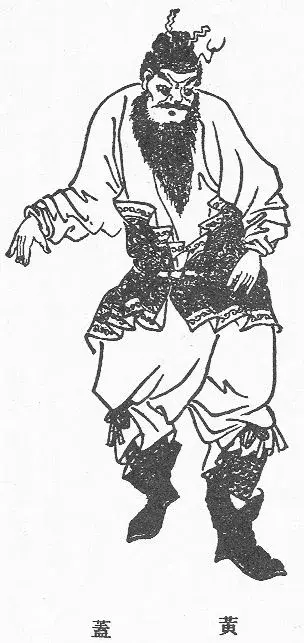
黄盖
Historical portrait of Huang Gai
Image creditsUnknown authorUnknown author · Public domainImage source

Historical figure

Huang Gai (黄盖)

黄盖

Huang Gai (黄盖, fl. 190–215 CE), courtesy name Gongfu, a native of Quanling County, Lingling Commandery (modern Lingling District, Yongzhou, Hunan), was an illustrious military general of the late Eastern Han dynasty and a foundational veteran commander of the state of Eastern Wu. Serving three successive generations of the Sun family—Sun Jian, Sun Ce, and Sun Quan—Huang Gai was orphaned in his youth and endured extreme…

Late Eastern Han dynasty, Eastern Wu of the Three Kingdoms

PROFILE

Huang Gai (黄盖, fl. 190–215 CE), courtesy name Gongfu, a native of Quanling County, Lingling Commandery (modern Lingling District, Yongzhou, Hunan), was an illustrious military general of the late Eastern Han dynasty and a foundational veteran commander of the state of Eastern Wu. Serving three successive generations of the Sun family—Sun Jian, Sun Ce, and Sun Quan—Huang Gai was orphaned in his youth and endured extreme poverty. While laboring as a woodcutter, he diligently studied military strategy and administrative law in his spare time. He entered official service as a judicial clerk in Lingling before joining Sun Jian's righteous campaign against Dong Zhuo, fighting with distinction across northern and southern China. During Sun Ce's pacification of the Jiangdong region, Huang Gai participated in crushing warlords Liu Yao, Yan Baihu, and Wang Lang, and played a decisive role in the defeat of Huang Zu at Shaxian. In the early years of Sun Quan's reign, when mountain banditry and rebellions erupted across newly subdued commanderies, Sun Quan routinely appointed Huang Gai as magistrate of the most turbulent counties. Governed with unwavering discipline and impartial justice, all nine counties under his tenure achieved rapid pacification. At the decisive Battle of Red Cliffs in 208 CE, facing Cao Cao's overwhelming naval invasion, Huang Gai proposed the winning strategy of a fire attack to commander-in-chief Zhou Yu. He personally executed the perilous feigned surrender, piloting twenty flammable assault ships directly into Cao Cao's chained fleet, igniting a catastrophic conflagration that routed Cao Cao's forces and laid the foundation for the Three Kingdoms tripartite division. Later, as Major-General and Administrator of Wuling, he crushed a massive indigenous uprising with only five hundred elite soldiers. Celebrated for his personal courage, strict governance, and deep rapport with his troops, Huang Gai was revered as a pillar of the Sun Wu state.

Courtesy Name
Gongfu (公覆)
Period
Late Eastern Han dynasty, Eastern Wu of the Three Kingdoms
Ancestral Home
Quanling County, Lingling Commandery (present-day Lingling District, Yongzhou, Hunan)
Highest Office
Major-General (Pian Jiangjun), concurrently Administrator of Wuling
Major Official Posts
Judicial Clerk of Lingling Commandery, Separate Division Major, Acting Colonel of Martial Vanguard, Military Commandant of Danyang, Major-General, Administrator of Wuling
Historical Status
Renowned military general of the late Eastern Han dynasty, founding veteran general of Eastern Wu across three generations

LIFE TIMELINE

Relationship graph

BIOGRAPHY

Chronology

  • 190 CE (1st Year of Chuping) | Joining the Anti-Dong Coalition | Resigned his county judicial clerkship to join Sun Jian's army, serving as Separate Division Major against bandits and Dong Zhuo's forces.
  • 191 CE (2nd Year of Chuping) | Retreat from Xiangyang | Fought alongside Sun Jian in Jing Province; after Sun Jian died at Mount Xian, Huang Gai and Cheng Pu escorted young Sun Ce to Jiangdu.
  • 195 CE (2nd Year of Xingping) | Pacification of Jiangdong | Accompanied Sun Ce across the Yangtze, subjugating Liu Yao, taking Qu'e, pacifying Wu and Kuaiji commanderies, and becoming Acting Colonel of Martial Vanguard.
  • 199 CE (4th Year of Jian'an) | Victory at Shaxian | Advanced with Sun Ce and Zhou Yu against Huang Zu at Shaxian, routing his naval fleet and capturing thousands of war vessels.
  • 200 CE (5th Year of Jian'an) | Governing Difficult Counties | Following Sun Ce's assassination, served under Sun Quan as magistrate across nine turbulent counties, eradicating corrupt officials and pacifying local tribes.
  • 208 CE (13th Year of Jian'an) | Fire Attack at Red Cliffs | Suggested the fire assault to Zhou Yu, delivered a feigned letter of surrender to Cao Cao, and led fire vessels into the enemy fleet to achieve total victory.
  • 209 CE (14th Year of Jian'an) | Siege of Jiangling | Advanced with Zhou Yu against Cao Ren after recovering from arrow wounds sustained at Red Cliffs; promoted to Major-General and Administrator of Wuling.
  • 211 CE (16th Year of Jian'an) | Quelling the Wuling Revolt | Besieged by thousands of Wuximan rebels, opened city gates to lure enemies inside before counterattacking with five hundred elite troops, decisively crushing the revolt.

Life

Early Poverty and Studious Youth

Huang Gai was born in Quanling, Lingling Commandery. His distant ancestor was Huang Zilian, who had served as Administrator of Nanyang during the Western Han dynasty. As clan branches multiplied over generations, his grandfather relocated to Lingling in Jing Province. Huang Gai was orphaned at a tender age and tasted the bitter hardships of poverty and displacement.

Despite his destitution and humble social standing, Huang Gai harbored lofty ambitions and refused to resign himself to a mediocre existence. He earned his livelihood by gathering and selling firewood in the mountains. During brief intervals between strenuous physical labor, he seized every spare moment to study classical documents, legal statutes, and ancient military treatises.

Upon reaching adulthood, Huang Gai was recruited as a judicial clerk (Juecao Yuan) in the government of Lingling Commandery due to his legal erudition and sharp intellect. In this judicial role, he investigated crimes with penetrating discernment, upheld impartial justice, and established an early reputation throughout the region.

Fighting under Sun Jian and Subduing Jiangdong

In the first year of Chuping (190 CE), Sun Jian, the Administrator of Changsha, raised an army to join the regional coalition campaigning against Dong Zhuo. Admiring Sun Jian's heroic valor, Huang Gai discarded his civil post to enlist in Sun Jian's ranks and was appointed Separate Division Major.

Throughout the campaign against Dong Zhuo, Huang Gai spearheaded frontline assaults clad in heavy armor. He accompanied Sun Jian south to suppress mountain bandits and north to Yangren near Luoyang, where they routed Dong Zhuo's forces and defeated Lu Bu amidst heavy arrow fire. In the second year of Chuping (191 CE), Sun Jian fell in an ambush during the battle of Mount Xian in Xiangyang. Huang Gai, alongside veteran commanders Cheng Pu and Han Dang, loyally escorted the adolescent Sun Ce to find refuge under Yuan Shu in Huainan.

In the second year of Xingping (195 CE), Sun Ce broke away from Yuan Shu and led an expeditionary force south across the Yangtze to conquer Jiangdong. Huang Gai followed Sun Ce in continuous combat, subduing Inspector Liu Yao of Yang Province, taking Qu'e, and eliminating warlords Yan Baihu in Wu Commandery and Wang Lang in Kuaiji. In the fourth year of Jian'an (199 CE), serving as Acting Colonel of Martial Vanguard, Huang Gai took part in the campaign against Huang Zu at Shaxian. Charging on horseback amidst thunderous war drums alongside Sun Ce and Zhou Yu, Huang Gai contributed to a crushing victory over Huang Zu's naval forces, capturing over six thousand war vessels and slaying twenty thousand enemy combatants.

Restoring Order in Nine Counties

In the fifth year of Jian'an (200 CE), Sun Ce was assassinated, and the nineteen-year-old Sun Quan succeeded to the leadership of Jiangdong. At that time, the southern territories remained turbulent: Shanyue tribes resisted administrative taxation, and powerful local bandits entrenched themselves in mountain fortresses. In remote districts, rebel factions routinely drove out or assassinated county magistrates.

Recognizing that Huang Gai was resolute, incorruptible, and experienced in legal governance, Sun Quan appointed him to govern counties plagued by acute unrest whenever civil authority broke down. Huang Gai successively governed nine volatile counties, including Shicheng and Chungu.

Upon arriving in Shicheng, Huang Gai anticipated that entrenched clerks would attempt to exploit his unfamiliarity. On his first day, he summoned the two senior chief clerks and issued an unmistakable warning: "As your new magistrate, I must rely upon you to manage daily affairs. You must strictly observe legal statutes and perform your duties. Should you engage in bribery or illegality, I will punish you by law without clemency!" The clerks, misinterpreting his calm manner as administrative weakness, continued their embezzlement and judicial extortion.

A few months later, having secretly gathered incontrovertible evidence of their corruption, Huang Gai convened an assembly of all county officials and publicly executed the two corrupt clerks on the spot. The entire county was awed into submission. Lawlessness ceased, local gentry curbed their excesses, and civic order was firmly restored. Acknowledging his administrative triumphs, Sun Quan promoted Huang Gai to Military Commandant of Danyang, tasking him with pacifying Shanyue communities and eradicating mountain banditry.

The Decisive Fire Attack at Red Cliffs

In the autumn of the thirteenth year of Jian'an (208 CE), Chancellor Cao Cao conquered Jing Province and commanded a joint naval and land army numbering several hundred thousand troops down the Yangtze, aiming to obliterate Eastern Wu. While conservative civil officials urged submission, military commanders Zhou Yu, Lu Su, and Huang Gai adamantly advocated resistance.

Zhou Yu marched thirty thousand troops to Chibi, joining forces with Liu Bei to confront Cao Cao across the Yangtze at Wulin. Cao Cao's troops, unaccustomed to naval warfare, suffered heavily from pestilence. Following an initial skirmish, Cao Cao ordered his naval fleet chained together prow-to-stern, laying timber planks across decks to enable cavalry movement on water.

Observing the enemy's chained formation from the southern bank, Huang Gai immediately proposed a tactical solution to Zhou Yu: "The enemy vastly outnumbers us, and we cannot sustain a prolonged war of attrition. However, Cao Cao's warships are chained together and cannot maneuver swiftly. If we employ a fire attack, their fleet will be reduced to ashes in an instant!" Zhou Yu embraced the strategy, and the two formulated a secret plan of deceptive submission.

Huang Gai prepared twenty fast assault vessels (mengchong and doujian), packing their hulls with dry reed kindling soaked in animal tallow and fish oil, covering them with oiled canvas and hoisting white flags of surrender. Light skiffs were tied astern to serve as escape craft. Huang Gai dispatched a confidential emissary delivering a feigned letter of surrender to Cao Cao, claiming that Wu was defenseless and that he wished to defect with his squadron. Deceived by Huang's prestige and the plausibility of the pretext, Cao Cao believed the offer.

On the night of the twentieth day of the eleventh lunar month, a sudden gale blew from the southeast, churning the Yangtze waters. Huang Gai personally commanded the twenty fire ships, catching the wind and surging directly toward Cao Cao's forward naval anchorage. When two li from the enemy fleet, the crew simultaneously released sails and ignited the kindling.

Driven by fierce gales, the twenty ships transformed into raging fire dragons, crashing straight into Cao Cao's chained flotilla. The conflagration spread instantly through the chained wooden warships and jumped onto the land encampments along the shore. Within minutes, thick smoke darkened the sky and flames illuminated the night. Tens of thousands of Cao's troops perished in the flames or drowned in the river, compelling Cao Cao to abandon his fleet and retreat through the Huarong path.

During the chaotic melee, Huang Gai was struck by a stray arrow in the chest and tumbled into the freezing river. He was fished out by Wu soldiers who failed to recognize him and laid him upon an improvised privy bench. Senior commander Han Dang passed by and heard faint groans; recognizing Huang Gai's face, Han Dang wept aloud, embraced him, and urgently summoned physicians to extract the arrowhead, narrowly saving Huang Gai's life.

Pacifying Wuling and Later Life

Following the triumph at Red Cliffs, Huang Gai participated in Zhou Yu's pursuit and siege of Cao Ren at Jiangling, repeatedly distinguishing himself and earning promotion to Major-General.

Soon afterward, indigenous Wuximan tribes in Wuling Commandery in southern Jing Province rose in armed revolt, storming county seats and slaying imperial magistrates. Sun Quan appointed Huang Gai as Major-General and concurrently Administrator of Wuling, dispatching him to quell the insurrection.

When Huang Gai arrived at the commandery capital, he found only five hundred soldiers available, while rebel tribesmen surrounding the citadel numbered tens of thousands. Recognizing that direct combat was untenable, Huang Gai executed an ambush tactic. He ordered the city gates barred for several days, refusing battle, before suddenly opening the gates wide to deliberately entice the rebels into entering.

Once half of the rebel forces had rushed through the gates in disorganized plunder, Huang Gai drew his sword and led five hundred elite shock troops into a ferocious counterattack from both flanks, slaying over a hundred rebel chieftains. Thrown into disarray, the rebel host panicked and fled outward. Huang Gai pursued them relentlessly for dozens of li, capturing their base camps.

Subsequently, Huang Gai instituted a lenient policy toward tribes that offered submission, punishing only ringleaders while providing grain relief to commoners. Awed by his valor and justice, tribal chieftains throughout Wuling surrendered hostages and pledged loyalty, pacifying southern Jing Province. Rebels in Yiyang of Changsha Commandery also surrendered upon hearing his name. Huang Gai governed Wuling peacefully for several years, ultimately dying in his official residence.
Major Accomplishments

Foundational Pillar Across Three Generations of Sun Wu

Huang Gai served as an indispensable pillar during the formative decades of the Eastern Wu state under Sun Jian, Sun Ce, and Sun Quan.

From the anti-Dong Zhuo campaigns in the north to the conquest of Jiangdong and the defense of the Yangtze, Huang Gai spearheaded vanguard operations for decades. He was not merely a ferocious frontline combatant but an elder statesman who stabilized the regime during perilous transitions of leadership, earning the profound respect of the court through his unswerving loyalty.

Mastermind of the Red Cliffs Fire Assault

Huang Gai's decisive contribution at the Battle of Red Cliffs was a defining masterstroke of ancient Chinese military history.

At a moment when Eastern Wu faced annihilation against Cao Cao's overwhelming host, Huang Gai identified the structural vulnerability of Cao's chained fleet and executed the fire assault at tremendous personal peril. The destruction of Cao Cao's naval armada preserved the autonomy of the southern states and directly created the tripartite division of the Three Kingdoms, establishing Huang Gai's fame as one of history's greatest naval tacticians.

Restoring Civil Authority and Frontier Pacification

Huang Gai excelled not only in naval warfare but in administrative crisis management and tribal pacification.

Confronted with endemic banditry and hostile Shanyue uprisings across Jiangdong, he pioneered a governing method that combined decisive punishment of corrupt elites with benevolent rehabilitation of common folk. His dramatic routing of tens of thousands of Wuximan rebels with merely five hundred soldiers exemplified his mastery of asymmetric warfare, securing the stability and economic development of the southern frontier.

Personal Relationships

  • First Lord: Sun Jian, General Who Smashes the Bandits, under whom Huang Gai began his military career against Dong Zhuo.
  • Second Lord: Sun Ce, General Who Overthrows the Rebellious, whom Huang Gai accompanied in the pacification of Jiangdong.
  • Third Lord: Sun Quan, Emperor Da of Wu, who promoted Huang Gai to Major-General and Administrator of Wuling.
  • Naval Commander-in-Chief: Zhou Yu, Grand Commander of Eastern Wu, who adopted Huang Gai's fire attack proposal at Red Cliffs.
  • Comrade-in-Arms: Han Dang, senior veteran general of Eastern Wu, who recognized and saved the wounded Huang Gai from a privy bench at Red Cliffs.
  • Senior Peer: Cheng Pu, senior veteran commander of Sun Wu who served across all three generations alongside Huang Gai.
  • Supreme Adversary: Cao Cao, Chancellor of Han and King of Wei, whose fleet was destroyed by Huang Gai's fire ships at Red Cliffs.

Historical Evaluations

Chen Shou evaluated him in the Records of the Three Kingdoms (Sanguozhi): "Huang Gai conducted himself with humility and prudence, taking delight in caring for his men; the troops under his command were thoroughly devoted to him. Even while in military encampments, he never neglected civil or military pursuits, proving himself an illustrious general of his era."

Sun Quan repeatedly commended him before the court: "Huang Gongfu possesses fierce valor and resourceful strategy; whenever confronting perilous crises, nothing can withstand his advance, and his merits cover the river lands."

Song dynasty literary master Su Shi immortalized the battle in his verse Memories of the Past at Red Cliff, and later historians celebrated Huang Gai's heroic initiative. Ming scholar Li Zhi commented in Continuation of the Book to be Hidden: "Regarding the fire at Red Cliffs, had Huang Gai not presented that memorial and ignited that flame, Zhuge Liang and Zhou Yu would have had no stage upon which to display their brilliance, and Jiangdong would have fallen!"

Related Entries

  • Sun Jian
  • Sun Ce
  • Sun Quan
  • Zhou Yu
  • Battle of Red Cliffs
  • Battle of Wulin
  • Han Dang
  • Cheng Pu

FIGURES ASSOCIATED WITH THIS DYNASTY

Bibliography

  • Records of the Three Kingdoms, Volume 55, Book of Wu, Biographies of Cheng Pu, Huang Gai, and Han Dang
  • Records of the Three Kingdoms, Volume 46, Book of Wu, Biographies of Sun Jian and Sun Ce
  • Records of the Three Kingdoms, Volume 47, Book of Wu, Biography of Sun Quan
  • Records of the Three Kingdoms, Volume 54, Book of Wu, Biographies of Zhou Yu, Lu Su, and Lu Meng
  • Zizhi Tongjian, Volume 65, Han Annals 57
  • Zizhi Tongjian, Volume 66, Han Annals 58