Noble Birth
Born into the illustrious Huangfu clan of Anding; great-grandson of Grand Commandant Huangfu Song.
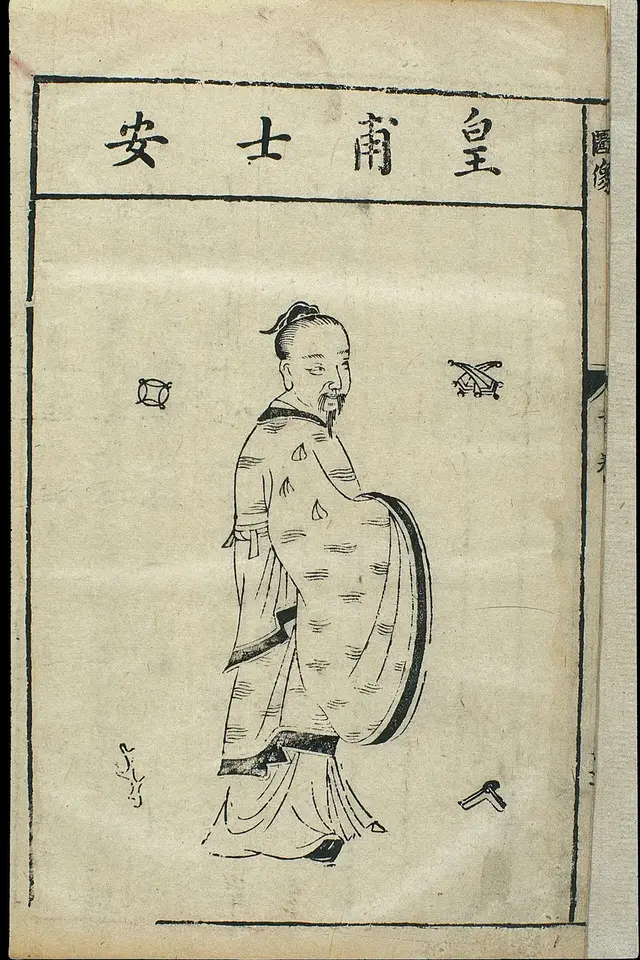
皇甫谧
Huangfu Mi (215–282), courtesy name Shi'an, childhood name Jing, and self-styled Master Xuan'an, was a native of Chaona County, Anding Commandery (modern Lingtai County, Gansu Province), later relocating to Xin'an (modern Yima, Henan Province). He was the great-grandson of celebrated Eastern Han Grand Commandant Huangfu Song. A titan of scholarship spanning Cao Wei and Western Jin, Huangfu Mi was a physician, chronological…
Huangfu Mi (215–282), courtesy name Shi'an, childhood name Jing, and self-styled Master Xuan'an, was a native of Chaona County, Anding Commandery (modern Lingtai County, Gansu Province), later relocating to Xin'an (modern Yima, Henan Province). He was the great-grandson of celebrated Eastern Han Grand Commandant Huangfu Song. A titan of scholarship spanning Cao Wei and Western Jin, Huangfu Mi was a physician, chronological historian, and philosopher, globally revered as the "Founding Father of Acupuncture." Born into an eminent military lineage that had fallen into poverty, Huangfu Mi led a dissolute youth until age twenty, when his aunt Lady Ren tearfully admonished him. Profoundly moved, he reformed his conduct, committing himself to unremitting study and mastering the classics, philosophies, and canonical medicine. Detached from wealth and political office, he repeatedly declined appointments from both Cao Wei and Western Jin. Emperor Wu of Jin sought to recruit him as Gentleman of the Imperial Secretariat, Director of Imperial Physicians, and Erudite of the National University, yet Huangfu Mi steadfastly declined due to illness. When he petitioned to borrow imperial palace books, Emperor Wu sent him an entire carriage of texts, a gesture celebrated in Chinese scholarly history. In middle age, Huangfu Mi suffered from severe paralytic rheumatism (fengbi), which left him partially paralyzed. In an effort to treat his illness and alleviate human suffering, he studied canonical medical works, collating the Yellow Emperor's Inner Canon: Basic Questions, Acupuncture Canon (Lingshu), and Essential Canon of the Bright Hall Points. He compiled the twelve-volume Systematic Classic of Acupuncture and Moxibustion (Zhenjiu Jiayi Jing), China's earliest specialized acupuncture text, establishing 349 acupoints and foundational clinical protocols. Furthermore, he composed landmark historical works including Chronological Records of Emperors and Kings, Biographies of Eminent Recluses, and Biographies of Heroic Women. In 282, Huangfu Mi passed away in Xin'an at sixty-eight.
Born into the illustrious Huangfu clan of Anding; great-grandson of Grand Commandant Huangfu Song.
Rebuked by his aunt Lady Ren at age twenty; transformed into a dedicated scholar.
Retired to rural Xin'an, declining all provincial summons to dedicate himself to history and medicine.
Completed Chronological Records of Emperors and Kings, establishing ancient chronological historiography.
Declined appointments as Gentleman of the Secretariat; Emperor Wu granted him a carriage of palace archives.
Combating chronic paralysis, collated canonical medicine and authored the landmark Systematic Classic of Acupuncture.
Composed Discourse on Auspicious Demise mandating modest burial; died at age sixty-eight.
Huangfu Mi was born into the prominent Huangfu family of Chaona in Anding Commandery. His great-grandfather Huangfu Song had earned empire-wide renown by suppressing the Yellow Turban Rebellion as Grand Commandant, while his grandfather Huangfu Ling served as Administrator of Anding. However, following the collapse of the Eastern Han, the clan was dispossessed by regional warfare. Having lost his mother in childhood, Huangfu Mi was adopted by his paternal uncle and raised in Xin'an near Luoyang.
In his youth, Huangfu Mi was reckless and undisciplined. He spent his days wandering the market with catapults, hunting birds, and gambling with local youths. By age twenty, he had mastered no trade and acquired no classical learning, provoking contempt among neighbors.
One day, Huangfu Mi gathered fresh wild melons and offered them to his aunt Lady Ren. Mourning the decline of the family, Lady Ren wept and cast the fruit to the ground: "The Book of Songs teaches that virtues are gifts, not mere fruit. You are twenty years old, yet uneducated and reckless! Without virtue, even offering luxurious delicacies is no different from the behavior of beasts!"
Her words struck Huangfu Mi with profound clarity. Overwhelmed by remorse, he abandoned his dissolute habits, sought guidance from classical teachers, and immersed himself in canonical texts. Working in the fields or traveling on foot, he kept scrolls in hand. Within years, his encyclopedic mastery of canonical commentaries, astronomy, and medicine was recognized across the empire.
During the Zhengshi era of Cao Wei, factional purges between the Sima clan and Cao regent Cao Shuang destabilized the court. Perceiving the moral perils of office, Huangfu Mi embraced Daoist naturalism, resolving to dedicate his life to scholarship.
Throughout the reigns of Cao Fang and Cao Mao, commandery magistrates repeatedly nominated him as Filial and Incorrupt, while Grand General Sima Zhao summoned him to the ministerial council. Huangfu Mi steadfastly declined all summonses. He tilled his own plots in poverty, wearing coarse garments and finding contentment in classical research, styling himself Master Xuan'an.
In 265, Emperor Wu established the Western Jin dynasty. Eager to recruit eminent scholars, Emperor Wu issued decrees offering Huangfu Mi the offices of Gentleman of the Imperial Secretariat, Director of Imperial Physicians, and Erudite of the National University. Knowing the unpredictability of autocratic power, Huangfu Mi submitted humble memorials pleading chronic illness.
In his memorial, Huangfu Mi requested permission to borrow books from the imperial archives. Deeply moved by his scholarly dedication, Emperor Wu dispatched a carriage loaded with imperial books directly to his rural residence. Overjoyed, Huangfu Mi spent subsequent years transcribing, collating, and annotating this archival hoard, providing the empirical foundation for his scholarship.
In middle age, Huangfu Mi's health deteriorated severely. Decades of sedentary study and the improper consumption of Cold-Food Powder (Hanshisan) brought about a severe case of paralytic rheumatism (fengbi). He suffered partial hemiplegia, muscle contractures, and chronic joint pain, leaving him unable to walk without support.
Refusing to surrender to physical agony, Huangfu Mi directed his intellect toward medicine. Observing that contemporary practitioners were careless and medical manuals fragmented, he resolved to systematize acupuncture.
He gathered and analyzed three foundational ancient treatises: the physiological Basic Questions, the meridian-based Lingshu, and the topographical Essential Canon of the Bright Hall Points. Finding their terminology contradictory and anatomical descriptions corrupt, Huangfu Mi tested needle insertions on his own body, verifying sensations and mapping meridian lines.
Through years of empirical labor, he synthesized these classical texts into the twelve-volume, 128-chapter Systematic Classic of Acupuncture and Moxibustion (Zhenjiu Jiayi Jing). The work mapped 349 specific acupoints (49 single points and 300 paired points), clarifying meridian circulation, puncture depths, and clinical indications, establishing the canonical framework for Chinese acupuncture.
In historiography, Huangfu Mi observed that Sima Qian's Records of the Grand Historian and Ban Gu's Book of Han contained chronological gaps regarding pre-Qin dynasties. Collating the Bamboo Annals and classical commentaries, he authored the thirty-two-volume Chronological Records of Emperors and Kings (Diwang Shiji), providing a systematic chronological framework from legendary sovereigns through Cao Wei.
Furthermore, seeking to elevate moral integrity in an aristocratic age, he created Biographies of Eminent Recluses (Gaoshi Zhuan) in three volumes and Biographies of Heroic Women (Lienü Zhuan). Prominent scholars such as Zhi Yu and Shu Xi studied at his academy.
In his final years, his physical condition worsened. Prepared for death, he composed Discourse on Auspicious Demise (Duzhong Lun), opposing costly burials and instructing his family to bury him in plain clothes within a deep grave without stone vaults, tumuli, or evergreen plantings. In 282, Huangfu Mi passed away peacefully in Xin'an at the age of sixty-eight.
Huangfu Mi's foremost contribution to global medicine was The Systematic Classic of Acupuncture and Moxibustion (Zhenjiu Jiayi Jing). Prior to his work, acupuncture was practiced through disparate oral traditions. Huangfu Mi synthesized anatomical observation and meridian theory, standardizing 349 specific acupoints and clinical methods. His work served as the core textbook for the Imperial Medical Bureaus of the Tang and Song dynasties and was transmitted to Japan, Korea, and the Arab world, cementing his international standing as the "Father of Acupuncture."
In historiography, Chronological Records of Emperors and Kings established an indispensable foundation for ancient Chinese historical chronology. Through rigorous textual criticism of pre-Qin bronze inscriptions and bamboo manuscripts, Huangfu Mi established chronological genealogies for the Three Sovereigns and Five Emperors, filling the historiographical void preceding the Xia dynasty and serving as a foundational reference for later works such as Li Daoyuan's Commentary on the Water Classic.
Huangfu Mi originated the biographical tradition of hermits by compiling Biographies of Eminent Recluses (Gaoshi Zhuan). While official histories focused on court politicians, Huangfu Mi commemorated over ninety historical recluses who refused to compromise their integrity for royal favor, from Xu You and Chaofu down to Bo Yi and Guan Ning. This work founded the recluse genre in Chinese historiography, celebrating the moral autonomy of the intellectual.
In intellectual history, Huangfu Mi authored Discourse on Releasing Admonition and Discourse on Auspicious Demise. Rejecting worldly vanity, he argued that human mortality was an organic cosmic transition comparable to the alternation of day and night. His insistence on plain burial in unmarked earth delivered a profound critique against the aristocratic funerary extravagances of his day.
During the Wei-Jin period, the consumption of Cold-Food Powder (Hanshisan) became an aristocratic fad, precipitating widespread toxic psychosis and fatal organ failure. Huangfu Mi was the first scholar-physician in Chinese medical history to systematically investigate the toxicology of mineral powder poisoning. Having suffered severe toxic reactions in his youth, he recorded its pathological effects on internal organs and the nervous system, denouncing the mixture as lethal poison and formulating specific acupuncture protocols to purge heat toxicity, founding clinical toxicology in early medieval Chinese medicine.
FIGURES ASSOCIATED WITH THIS DYNASTY