Birth in Fujian
Born into the prominent Wang lineage of Changle in Fuzhou, displaying early spiritual wisdom and disinterest in worldly affairs.
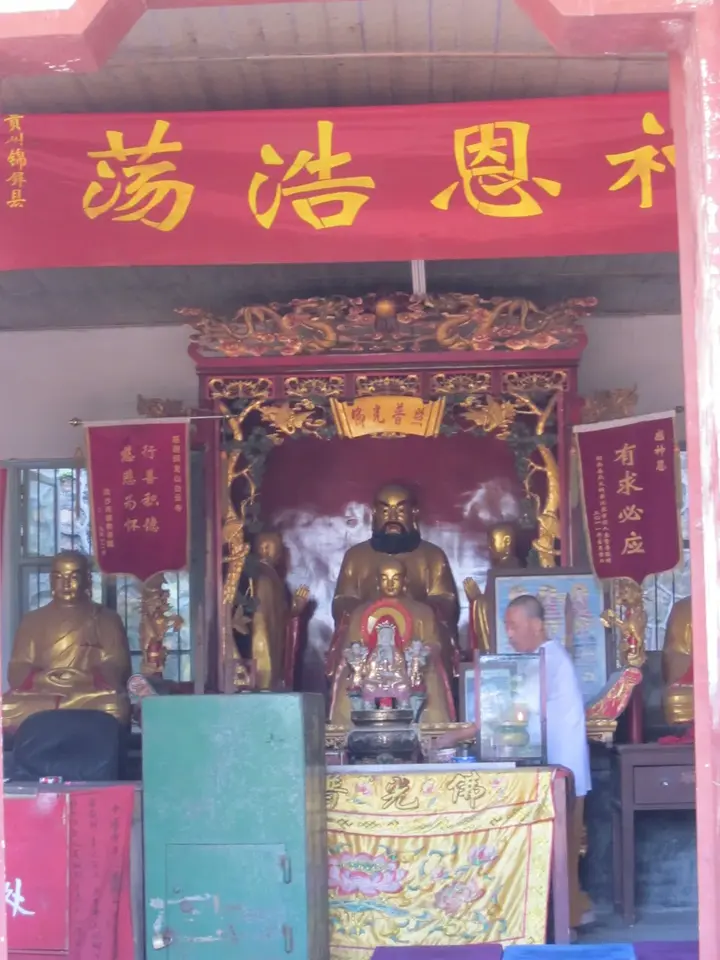
怀海
Huaihai (怀海, 749–814), secular surname Wang (王), widely revered in Buddhist history as Baizhang Huaihai (百丈怀海) and posthumously honored by Emperor Muzong as Chan Master Dazhi (大智禅师), was a preeminent Chan master of the Tang dynasty and the organizational pillar of the Hongzhou school, originating from Changle in Fuzhou. Showing natural spiritual inclination from childhood, he was ordained under Master Huizhao at Xishan in…
Huaihai (怀海, 749–814), secular surname Wang (王), widely revered in Buddhist history as Baizhang Huaihai (百丈怀海) and posthumously honored by Emperor Muzong as Chan Master Dazhi (大智禅师), was a preeminent Chan master of the Tang dynasty and the organizational pillar of the Hongzhou school, originating from Changle in Fuzhou. Showing natural spiritual inclination from childhood, he was ordained under Master Huizhao at Xishan in Chaoyang, received full monastic ordination from Vinaya Master Falang on Mount Heng, and subsequently spent years in solitary study at Fucha Monastery in Lujiang, mastering the Tripitaka across sutras, vinaya, and treatises. Hearing of Mazu Daoyi's teaching in Jiangxi during the early Dali era, Huaihai traveled to join him, serving as his personal attendant for years and receiving the mind-seal transmission; alongside Xitang Zhizang and Nanquan Puyuan, he was celebrated as one of the Three Great Masters of the Mazu gate. Following his enlightenment, Huaihai accepted the patronage of scholar Gan Zhen to establish a permanent monastic community at Mount Baizhang in Hongzhou. Confronting the socioeconomic crisis precipitated by mid-Tang tax reforms and traditional Vinaya restrictions against agrarian labor, Huaihai pioneered a revolutionary institutional reform by compiling the Chan Monastic Regulations (Baizhang Qinggui). This landmark code established independent Chan monasteries free from Vinaya oversight, instituted the communal agrarian model known as the fusion of farming and meditation, and enforced the celebrated communal rule: "A day without work is a day without food." Passing away in 814 at age sixty-six, his lineage gave rise to Weishan Lingyou and Huangbo Xiyun, who subsequently fathered the Weiyang and Linji traditions of the Five Houses of Chan, exercising a transformative influence on the Sinification of East Asian Buddhism.
Born into the prominent Wang lineage of Changle in Fuzhou, displaying early spiritual wisdom and disinterest in worldly affairs.
Shaved his head under Master Huizhao in Chaoyang, received full ordination from Vinaya Master Falang, and studied the Tripitaka at Fucha Monastery.
Joined Mazu Daoyi at Gonggong Mountain in Nankang, serving as his personal attendant and receiving the direct Chan mind-seal.
Honored alongside Xitang Zhizang and Nanquan Puyuan as the Three Great Masters of the Mazu school, teaching widely in Jiangxi.
Received the donation of Mount Baizhang from patron Gan Zhen, establishing an independent Chan monastery and attracting hundreds of monks.
Synthesized Mahayana principles to compile the Chan Monastic Regulations, establishing agrarian communal monasticism.
Transmitted the profound dharma to celebrated disciples Weishan Lingyou and Huangbo Xiyun, solidifying the prestige of the Hongzhou school.
Entered final nirvana on the seventeenth day of the first month at age sixty-six; posthumously honored as Chan Master Dazhi by Emperor Muzong in 821.
Huaihai was born into the esteemed Wang clan of Changle along the coastal frontier of Fuzhou. From his earliest boyhood, he exhibited an instinctive affinity for the Buddhist dharma, delighting in visiting local shrines and showing deep reverence before sacred images. While other youths pursued secular education or commerce, Huaihai was drawn toward monastic life, resolved to transcend the impermanence of worldly affairs. In his adolescence, he bade farewell to his parents and traveled south to Xishan in Chaoyang, placing himself under the spiritual tutelage of Master Huizhao, where he underwent formal tonsure and mastered monastic etiquette.
Upon reaching adulthood, Huaihai traveled to the sacred peak of Mount Heng in Hunan, receiving full monastic ordination under the celebrated Vinaya Master Falang. To ground his practice in the textual heritage of the faith, Huaihai journeyed north to Fucha Monastery in Lujiang, Anhui. In the quiet scriptorium of Fucha, he spent years in rigorous textual study, reading through the entirety of the Tripitaka. Through unremitting discipline, he achieved comprehensive mastery across all three divisions of Buddhist learning—sutras, vinaya, and abhidharma—providing the doctrinal foundation that later enabled him to boldly reform monastic discipline without departing from core Buddhist ethics.
During the early Dali era of Emperor Daizong, the revolutionary Chan master Mazu Daoyi was establishing his teaching center at Gonggong Mountain in Nankang and subsequently across the Hongzhou region of Jiangxi. Mazu revolutionized Tang dynasty Buddhism by teaching that ordinary mind is the Way and that Buddha-nature is immediately present within daily activity. Attracted by these radical teachings, Huaihai traveled to Jiangxi to sit at Mazu's feet, eagerly volunteering to serve as his personal attendant.
During his years of personal attendance, Huaihai experienced profound enlightenment through direct, intuitive encounters with his master. In one famous encounter, Mazu and Huaihai observed a flock of wild ducks flying across the sky. When Mazu asked what they were, Huaihai replied that they were wild ducks. When asked where they had gone, Huaihai replied that they had flown away. Mazu immediately reached out and twisted Huaihai's nose with such force that Huaihai cried out in pain. Mazu shouted: "When have they ever flown away!" In that instant of visceral pain, Huaihai was liberated from dualistic concepts of coming and going, awakening to the ever-present reality of unconditioned nature. Thereafter, Huaihai was recognized alongside Xitang Zhizang and Nanquan Puyuan as one of the Three Great Masters of the Mazu gate, assisting in the rapid dissemination of Hongzhou Chan.
Following Mazu's passing, Huaihai initially taught at Puhua Cloister on Mount Xiaoxiong in Xinxu, Hongzhou. The local magistrate and landed patron Gan Zhen, hearing of Huaihai's spiritual depth, traveled to the mountain to seek instruction. Deeply moved by Huaihai's radiant wisdom, Gan Zhen resolved to donate his entire family mountain estate at Daxiong Mountain (popularly known as Mount Baizhang) to the sangha, personally acting as guide to lead Huaihai and his disciples up the rugged peak.
Upon ascending Mount Baizhang, Huaihai cleared mountain forests and constructed a modest assembly hall, naming the sanctuary Baizhang Monastery. Unlike earlier generations of Chan teachers who operated as temporary guests within state-sponsored Vinaya monasteries, Huaihai established Baizhang as a completely autonomous spiritual sanctuary. News of his uncompromising teaching style spread rapidly throughout the empire, drawing between four and five hundred dedicated monks to live and practice beneath the precipitous crags of Mount Baizhang, transforming the remote mountain into the central engine of the Chan movement in southern China.
Following the nationwide implementation of the Two-Tax System in 780, the imperial state faced chronic fiscal shortfalls and revoked traditional tax exemptions on monastic property. Buddhist monasteries across China, long dependent on aristocratic patronage and imperial land grants, were plunged into an existential struggle for economic survival. Simultaneously, orthodox Indian Vinaya codes strictly forbade Buddhist monks from performing agricultural labor, classifying digging soil, cutting trees, and clearing land as impure livelihoods.
Recognizing that Indian monastic customs were unsuited to Chinese socioeconomic realities, Huaihai instituted the historic Chan Monastic Regulations (Baizhang Qinggui). He formally severed Chan practice from Vinaya institutions, designing an innovative communal structure centered on the Dharma Hall and the Sangha Hall rather than ornate image halls. Crucially, Huaihai established the revolutionary model of agrarian monasticism, leading the community into the fields to cultivate rice, harvest tea, and chop timber. By making economic self-sufficiency a primary spiritual discipline, Huaihai ensured that Chan institutions remained autonomous from secular political interference and economically resilient amidst dynastic turmoil.
Throughout his long tenure as abbot, Huaihai maintained unbroken discipline, working in the fields alongside his disciples even in advanced age. On the seventeenth day of the first month in 814, having completed his institutional and spiritual missions, the master gathered his assembly and passed peacefully into nirvana at the age of sixty-six. In 821, Emperor Muzong bestowed upon him the imperial posthumous title Chan Master Dazhi and named his stupa Great Precious Wheel of Victory. In subsequent centuries, Emperor Huizong of Song honored him as Chan Master Juezhao, while the Yuan court added the title Chan Master of Expansive Lineage and Wondrous Practice.
Huaihai's spiritual influence radiated throughout East Asia through his foremost disciples, Weishan Lingyou and Huangbo Xiyun. Lingyou established the great monastic complex on Mount Wei in Hunan, combining with his disciple Yangshan Huiji to create the Weiyang school, the first of the Five Houses of Chan. Huangbo Xiyun, inheriting Huaihai's fierce pedagogical methods, passed the mind seal to Linji Yixuan, who founded the Linji school in northern China, which grew into the most influential lineage in Zen history. Huaihai's combination of institutional self-reliance and profound spiritual directness ensured that Chan survived the catastrophic Great Anti-Buddhist Persecution of 845, establishing itself as the dominant tradition of Chinese Buddhism.
Huaihai's most revolutionary achievement was his creation of the Chan Monastic Regulations (Baizhang Qinggui), the first comprehensive institutional code designed specifically for autonomous Chan monastic life. Prior to Huaihai, Chan monks had no distinct physical monasteries of their own; they lived in separate cloisters within larger Vinaya establishments, where they were subject to the administrative authority and disciplinary codes of Vinaya specialists.
Huaihai broke with this institutional subservience. In his Pure Rules, he eliminated the traditional Buddha hall, replacing it with the Dharma Hall where the abbot directly instructed the assembly, symbolizing that living enlightenment was superior to the veneration of clay statues. He designed the communal Sangha Hall where monks slept, ate, and meditated in common order, abolishing individual private cells to eliminate vanity and factionalism. He established functional monastic offices including the Prior, Director of Work, and Kitchen Master, creating a self-governing communal democracy. This institutional blueprint transformed Chan from an informal spiritual movement into a mature, organized denomination that reshaped the landscape of medieval Chinese religion.
Huaihai was the champion and personal embodiment of the agrarian monastic ethic. Confronting traditional taboos against manual labor, Huaihai asserted that physical toil was not an impediment to spiritual realization, but rather the most direct arena for expressing unconditioned Buddha-nature. He coined the immortal maxim: "A day without work is a day without food."
Huaihai led by personal example, consistently being the first to take up farming tools in the morning and the last to leave the mountain fields at dusk. Historical accounts record that when Huaihai reached his sixties, his disciples, concerned for his frail health, hid his agricultural tools to force him to rest. In response, Huaihai refused to take any meals, fasting in his quarters until the distressed monks returned his implements. Resuming his meals, he reminded his followers that monks had no moral right to consume the offerings of the faithful unless they contributed their own labor to society. This ethic of self-reliant labor protected the sangha from parasitism and ensured the survival of Chan monasteries through centuries of dynastic upheavals.
In his spiritual pedagogy, Huaihai inherited Mazu Daoyi's direct, non-conceptual methods, using sudden shouts and daily encounters to dismantle intellectual illusions. His most celebrated doctrinal contribution is preserved in the famous Wild Fox koan recorded in The Gateless Gate (Wumen Guan).
According to the classical account, an elderly man attended Huaihai's lectures every morning. One day, the old man remained behind and confessed that in a past cosmic age, a disciple had asked him whether an enlightened practitioner is subject to karmic causality. The old man had mistakenly replied: "He does not fall into causality," an error of nihilistic detachment that condemned him to be reborn as a wild fox for five hundred lifetimes. The spirit begged Huaihai for liberating guidance. When the old man repeated the question, Huaihai roared the decisive words: "He does not obscure causality!" Hearing this phrase, the old man experienced awakening and was liberated from the fox body. Through this encounter, Huaihai clarified the profound relationship between ultimate emptiness and moral responsibility, warning all subsequent practitioners never to confuse spiritual freedom with ethical antinomianism.
Huaihai was an incomparable teacher of spiritual leaders, identifying and cultivating the two greatest Chan masters of the mid-Tang: Weishan Lingyou and Huangbo Xiyun.
With Weishan Lingyou, who served as monastic cook, Huaihai tested his insight by asking him to stir the cold ashes of the fireplace; when Lingyou unearthed a tiny glowing cinder, Huaihai confirmed that his inner awareness was ever-luminous, commissioning him to establish the monastery on Mount Wei that blossomed into the Weiyang school. With the towering Huangbo Xiyun, Huaihai subjected him to intense verbal and physical encounters, transmitting to him what ancient texts describe as the "great dynamic function" of the dharma. Huangbo subsequently trained Linji Yixuan, whose uncompromising lightning-and-thunder style founded the Linji school. Through these two patriarchal streams, Huaihai's lineage spread across China, Korea, Japan, and Vietnam, shaping Zen practice for over a thousand years.
FIGURES ASSOCIATED WITH THIS DYNASTY