Birth in Jianghuai
Hua Shou is born in Yizhen, displaying exceptional literary memory and intellect from youth.
滑寿
Hua Shou (滑寿, c. 1304–1386), courtesy name Boren, self-styled Master Yingning (Yingning Sheng), was an ancestral native of Xiangcheng (modern Xiangcheng County, Henan Province), who relocated to Yizhen (modern Yizheng, Jiangsu Province) and later settled in Yuyao (modern Zhejiang Province), celebrated as a paramount medical master of the late Yuan and early Ming periods. He made pioneering historical contributions to…
Hua Shou (滑寿, c. 1304–1386), courtesy name Boren, self-styled Master Yingning (Yingning Sheng), was an ancestral native of Xiangcheng (modern Xiangcheng County, Henan Province), who relocated to Yizhen (modern Yizheng, Jiangsu Province) and later settled in Yuyao (modern Zhejiang Province), celebrated as a paramount medical master of the late Yuan and early Ming periods. He made pioneering historical contributions to acupuncture channel theory, pulse diagnostics, and classical medical philology. Born into an educated gentry household, Hua was accomplished in Confucian classical canons and Yuefu poetry from youth. He studied medical classics under Wang Juzhong in Jingkou, scrutinizing the Plain Questions (Suwen) and the Classic of Difficult Issues (Nanjing). Subsequently, he synthesized the doctrines of Zhang Zhongjing, Liu Wansu, and Li Dongyuan. He later studied needle techniques under the acupuncture master Gao Dongyang in Dongping, mastering dynamic acupuncture methods. Practicing throughout Jiangnan for decades, patients clamored for his care, and he earned wide praise for treating the poor and wealthy alike without demanding payment. In his medical achievements, Hua revived acupuncture and meridian scholarship during an era when needle arts had fallen into neglect, authoring the monumental three-volume treatise Elaboration on the Fourteen Channels (Shisijing Fahui). He demonstrated that the Conception Vessel and Governing Vessel among the Eight Extraordinary Vessels possess their own independent acupoints, arguing they should be grouped alongside the Twelve Regular Channels to form the Fourteen Channels. He meticulously verified the anatomical locations and indications of 657 acupoints, laying the foundation for later acupuncture theory. He also authored Readings in the Plain Questions Abstracted, True Meaning of the Classic of Difficult Issues, and Essentials for Pulse Diagnosticians, exerting an enduring influence on Chinese and East Asian medicine.
Hua Shou is born in Yizhen, displaying exceptional literary memory and intellect from youth.
Apprentices himself to physician Wang Juzhong in Jingkou, analyzing the Plain Questions and Classic of Difficult Issues.
Studies under acupuncture master Gao Dongyang in Dongping, acquiring secret techniques of channel transmission.
Completes the landmark treatise Elaboration on the Fourteen Channels, establishing the fourteen-channel system.
Wandering south to Mazhu in Yuyao, he revives an apparently dead woman in a coffin and settles there to practice.
Completes True Meaning of the Classic of Difficult Issues in two volumes and Readings in the Plain Questions Abstracted in three volumes.
Authors Essentials for Pulse Diagnosticians (Zhenjia Shuyao), classifying twenty-nine pulse patterns.
Passes away peacefully in Yuyao at over eighty years of age, leaving an illustrious medical legacy.
Hua Shou's ancestral family originated from Xiangcheng in Henan. Following the Mongol unification of southern China, his grandfather was appointed to an administrative post in the Yangtze-Huai region, establishing the household in Yizhen (modern Yizheng, Jiangsu Province). Hua showed acute intellect from early childhood, memorizing over a thousand characters daily under local scholar Han Shuo. Gifted in literary prose and ancient Yuefu ballads, Hua passed the local civil service qualifying examinations in his youth. However, observing dynastic corruption and wartime chaos, he renounced bureaucratic ambitions, dedicating his life to medicine to alleviate civilian suffering.
Embarking upon medical scholarship, Hua entered the clinic of Wang Juzhong, an eminent physician in Jingkou (modern Zhenjiang). Under Wang's tutelage, Hua immersed himself in the Inner Canon of the Yellow Emperor, the Classic of Difficult Issues, and classical formularies. Observing that the transmitted text of the Plain Questions had suffered textual corruption and misplaced bamboo slips over centuries of transcription, Hua reorganized its core passages into twelve thematic categories: Viscera, Meridians, Pulses, Diseases, Health Preservation, Therapeutics, Complexion and Pulse, Acupuncture, Yin and Yang, Root and Manifestation, Five Movements and Six Climates, and Miscellaneous Compilations. He published this work as Readings in the Plain Questions Abstracted (Du Suwen Chao) in three volumes. Later, he collated variant manuscripts of the Classic of Difficult Issues, authoring the two-volume commentary True Meaning of the Classic of Difficult Issues (Nanjing Benyi).
Having mastered ancient medical canons, Hua examined contemporary Jin and Yuan medical doctrines, integrating Zhang Zhongjing's classical pharmacology, Liu Wansu's cold-clearing methods, and Li Dongyuan's spleen-stomach theories into a comprehensive therapeutic repertoire. At the time, southern physicians relied heavily on oral decoctions, neglecting meridian acupuncture and allowing needle manipulation techniques to fall into disuse.
Convinced that channels and acupuncture were foundational to clinical medicine, Hua traveled north to apprentice himself to Gao Dongyang, an acupuncture master from Dongping. Recognizing Hua's dedication, Gao transmitted his techniques, including needle manipulation, channel qi guidance, tonification and purgation, as well as secret bronze-figure acupoint diagrams. Combining this oral lineage with clinical practice, Hua spent days and nights verifying meridian pathways and acupuncture indications, mastering the subtleties of channel theory.
During the chaotic Zhizheng era of the late Yuan dynasty, as peasant uprisings spread across Jiangnan, Hua fled southward with his family and medicine chest. While passing through Hejiata Village in Mazhu, Yuyao, Zhejiang, he encountered a funeral procession carrying a wooden coffin from which fresh blood dripped onto the road. Suspecting the deceased was still alive, Hua halted the procession, pleading with relatives to open the coffin.
While opening a coffin was considered a grave desecration, the mourning family was moved by Hua's earnest demeanor and allowed him to examine the body. Inspecting the pulse, Hua recognized that the young woman had collapsed into a coma from prolonged, obstructed labor and physical exhaustion. Hua swiftly inserted acupuncture needles into the Guanyuan and Sanyinjiao points, applying moxibustion and administering herbal broth. Within moments, the woman opened her eyes, and a healthy infant was delivered safely. News of the miraculous resuscitation spread rapidly. Grateful community leaders persuaded Hua to remain, and local gentry arranged his marriage to Wang Ruchun, a virtuous lady of a prominent local lineage. Hua established his permanent clinic in Mazhu, practicing there for the rest of his days.
In Yuyao, Hua's medical reputation spread throughout eastern Zhejiang. Officials, scholars, and commoners sought his consultations, observing that having Hua examine a patient and determine life or death left them without regret. Hua maintained high medical ethics, treating poor and wealthy patients with equal diligence and refusing to accept fees from destitute families.
Alongside clinical work, Hua maintained a rigorous writing routine. In 1341, he published Elaboration on the Fourteen Channels (Shisijing Fahui), transforming the study of acupuncture. In 1364, he completed Essentials for Pulse Diagnosticians (Zhenjia Shuyao), categorizing twenty-nine distinct pulse patterns. He also authored Materia Medica Elucidated, Guide to Medicine, and Hua's Medical Rhymes.
In his later years, Hua called himself Master Yingning, conversing on poetry and philosophy with leading Ming scholars such as Song Lian, Dai Liang, Ding Henian, and Zhu You. The History of Ming recorded that in his seventies, his complexion remained youthful as an infant's, his stride was vigorous, and his capacity for wine remained undiminished. In 1386, Hua passed away peacefully in Yuyao at over eighty years of age.
Hua Shou's foremost contribution to traditional Chinese medicine was his systematization of the Fourteen-Channel System, resolving centuries of ambiguity surrounding acupuncture channel theory. Prior to Hua, traditional literature separated the meridian system into the Twelve Regular Channels and the Eight Extraordinary Vessels. Conventional doctrine viewed the extraordinary vessels as secondary conduits lacking independent status, leaving practitioners without standardized anatomical guidelines.
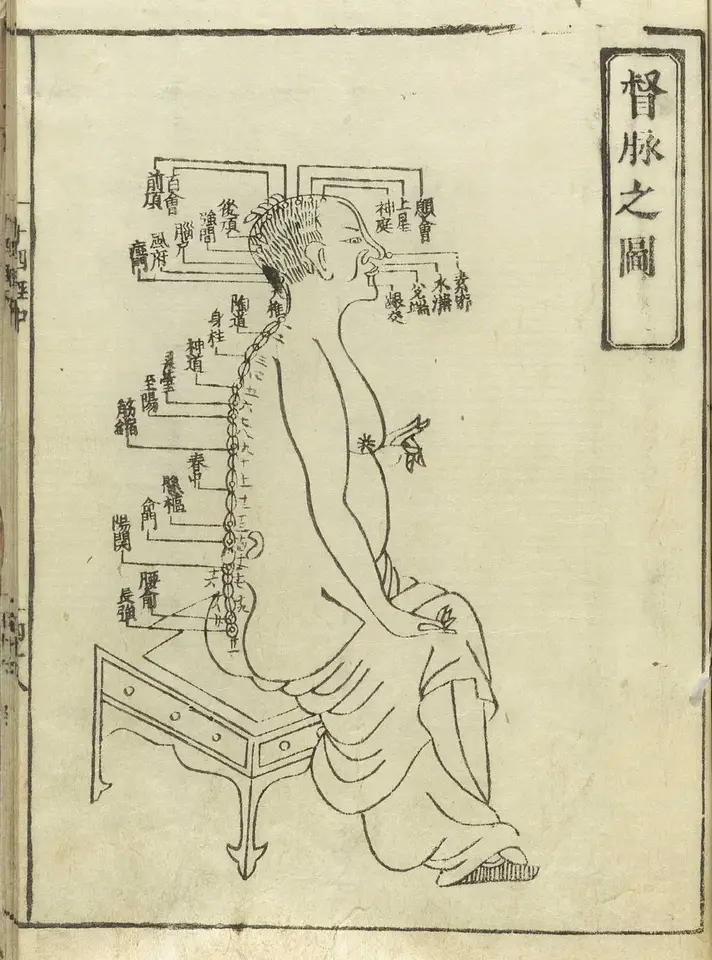
Through decades of anatomical study and clinical practice based on the Spiritual Pivot (Lingshu), Hua made a breakthrough: he demonstrated that among the Eight Extraordinary Vessels, the Conception Vessel (Renmai) running along the anterior midline and the Governing Vessel (Duma) running along the posterior midline possess clearly demarcated courses and their own independent, fixed acupoints (twenty-four on the Conception Vessel and twenty-eight on the Governing Vessel). Therefore, their physiological roles and pathological manifestations functioned as independent regular channels, distinct from the other six extraordinary vessels that lacked dedicated points.
In Elaboration on the Fourteen Channels, Hua integrated the Conception and Governing Vessels with the Twelve Regular Channels to establish the Fourteen-Channel Framework. He verified the precise anatomical locations, bone measurements, flow sequences, and channel origins of 657 acupoints, producing detailed channel diagrams. This system became the standardized model for acupuncture education throughout the Ming and Qing dynasties and spread to Japan during the Muromachi period, becoming a cornerstone of traditional East Asian medicine.
Hua was an accomplished medical philologist. Confronting the disordered condition of the Plain Questions caused by ancient scribal corruptions, Hua brought Confucian textual scholarship to bear on the text. In Readings in the Plain Questions Abstracted (Du Suwen Chao), he reorganized the canon's eighty-one chapters into twelve structural divisions, allowing students to navigate its foundational doctrines with unprecedented clarity.
For the Classic of Difficult Issues, attributed to the Warring States master Qin Yueren, Hua authored the two-volume commentary True Meaning of the Classic of Difficult Issues (Nanjing Benyi). He rectified textual corruptions, elucidated eighty-one complex diagnostic queries, and analyzed visceral yin-yang dynamics, pulse origins, and the Triple Burner. Ming and Qing scholars regarded his commentary as the most rigorous and reliable interpretation in medical history, preserving it in both the Ming Daoist Canon and the Complete Library of the Four Treasuries.
In pulse lore, Hua's monograph Essentials for Pulse Diagnosticians (Zhenjia Shuyao) stands alongside Wang Shuhe's Pulse Classic as a milestone of diagnostic theory. Distressed by the crude mnemonics of popular formularies that misled practitioners, Hua sought to re-establish pulse analysis on sound physiological principles.
In his treatise, Hua standardized twenty-nine distinct clinical pulse patterns: floating, deep, slow, rapid, slippery, rough, large, small, tight, moderate, string-like, hollow, hidden, leather, firm, long, short, empty, full, faint, scattered, intermittent, soggy, weak, hurried, fine, stirred, running, and bound. He provided clinical descriptions of tactile sensations under the examining fingers, along with their physiological mechanisms and combined manifestations.
Hua placed emphasis on recognizing pulse spirit and stomach qi, declaring that a pulse devoid of stomach qi indicates fatal depletion. He insisted that pulse analysis must be correlated with complexion, bodily constitution, and seasonal influences. His concise formulations advanced Chinese pulse lore toward greater clinical precision.
FIGURES ASSOCIATED WITH THIS DYNASTY