Birth in Deqing
Born into a scholar-gentry family in Deqing, Huzhou Prefecture, Zhejiang Province.
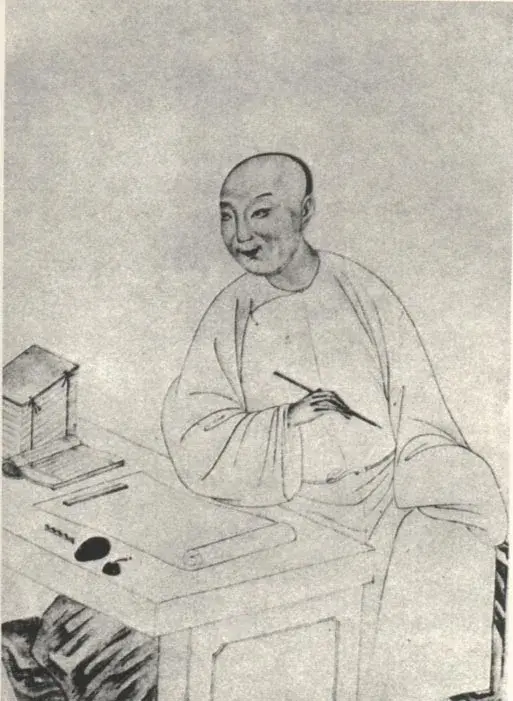
胡渭
Hu Wei was an eminent classicist, historical geographer, and Yijing scholar during the Kangxi reign of the Qing dynasty, recognized as a pivotal pioneer of the Qianlong-Jiaqing evidential scholarship movement (Qianjia Kaozheng Xue). Alongside Gu Yanwu, Yan Ruoju, and Huang Zongxi, he stood as a towering pillar of early Qing practical learning. Throughout his long life, he eschewed the official civil service, devoting himself…
Hu Wei was an eminent classicist, historical geographer, and Yijing scholar during the Kangxi reign of the Qing dynasty, recognized as a pivotal pioneer of the Qianlong-Jiaqing evidential scholarship movement (Qianjia Kaozheng Xue). Alongside Gu Yanwu, Yan Ruoju, and Huang Zongxi, he stood as a towering pillar of early Qing practical learning. Throughout his long life, he eschewed the official civil service, devoting himself entirely to classical exegesis and teaching as a commoner, celebrated by scholar Wang Zhong as one of the "Six Eminent Scholars of the Qing Dynasty" (Guochao Liu Ru). Hu's methodology emphasized narrow, exhaustive research on specific ancient texts to rectify the speculative, empty metaphysical debates of the late Ming period. In 1690, he joined the compilation bureau of the Da Qing Yitong Zhi (Comprehensive Gazetteer of the Great Qing) at Dongting Mountain under grand secretary Xu Qianxue, collaborating with Yan Ruoju, Gu Zuyu, and Huang Yi. In 1697, after decades of dedicated research, he completed the monumental twenty-volume historical geography treatise Yugong Zhuizhi (A Humble Guide to the Tribute of Yu), accompanied by forty-seven detailed analytical maps. The work surveyed the ancient waterways and territorial boundaries of China's nine ancient provinces, earning high praise from the editors of the Siku Quanshu Zongmu Tiyao as the supreme commentary on the Yugong since the Song dynasty. In classical studies, Hu published the ten-volume Yitu Mingbian (Clarification of the Yijing Diagrams), systematically demonstrating that cosmological diagrams such as the Yellow River Chart (Hetu), Luoshu, and Great Ultimate Diagram were esoteric Daoist inner alchemy charts popularized by Song Daoist Chen Tuan, rather than authentic Confucian teachings. His rigorous philological debasement of mystical cosmology won praise from Liang Qichao, who declared his scholarly contribution equal to the flood-quelling labors of Yu the Great. In 1705, the Kangxi Emperor personally granted him an imperial audience, bestowing an imperial plaque bearing the inscription "Dedicated Scholarship in Advanced Age" (Qi Nian Du Xue).
Born into a scholar-gentry family in Deqing, Huzhou Prefecture, Zhejiang Province.
Lost his father at age twelve; fled Ming-Qing dynastic upheavals with his mother into Mount Mogan, persevering in classical studies.
Placed first in the local academy examinations at age fifteen; the examiner praised his comprehensive geographic knowledge.
Frustrated in provincial examinations, entered the Imperial Academy; declined Grand Secretary Feng Pu's lucrative offer of twenty silver taels monthly.
Invited by Xu Qianxue to join the editorial bureau at Dongting Mountain in Suzhou, directing historical geography for Da Qing Yitong Zhi.
Published the twenty-volume masterwork Yugong Zhuizhi with forty-seven maps, establishing early modern Chinese historical geography.
Penned Yitu Mingbian in ten volumes, demolishing mystical Song cosmological charts and restoring original Confucian Yijing philosophy.
Presented Yugong Zhuizhi and his poetic treatise Pingcheng Song to the court, earning the praise of the Kangxi Emperor.
Received by the Kangxi Emperor during his southern inspection tour in Hangzhou; granted an imperial plaque reading "Dedicated Scholarship in Advanced Age."
Passed away at his Deqing residence on the ninth day of the first lunar month at the age of eighty-two.
Hu Wei was born in 1633 in Wenchangfang, Deqing County, Huzhou Prefecture, Zhejiang Province. The Hu clan had long been respected local scholars upholding strict Confucian traditions. However, in 1644, when Hu was twelve years old, the Ming dynasty collapsed. As Qing armies swept into Jiangnan, his father died prematurely, plunging the family into destitution.
Amid the chaos of warfare and banditry, Hu's mother, Lady Shen, demonstrated extraordinary resilience. Binding her small feet, she carried young Hu through rugged wilderness, seeking sanctuary in the remote valleys of Mount Mogan. Living in impoverished huts, Lady Shen spun cloth night and day to purchase lamp oil and grain, overseeing her son's daily recitation. Sheltered in the mountains, Hu read the Thirteen Classics and early philosophers by lamplight.
In 1647, fifteen-year-old Hu emerged from the mountains to take the county civil examination, earning the rank of government student (shengyuan) with top honors. In testing geographic mastery of rivers and commanderies, Hu cited ancient texts with astonishing precision, leading the chief examiner to remark: "This youth discusses the strategic waterways of the realm as if he had traversed all nine provinces in person!"
Despite his precocious erudition, Hu experienced persistent frustration in the imperial civil service examinations. Between the Shunzhi and Kangxi reigns, he sat for the Zhejiang provincial examinations six consecutive times, failing each time because his profound textual insights deviated from rigid eight-legged examination formulas. Realizing the superficiality of examination essays, Hu abandoned bureaucratic ambitions, entering the Imperial Academy as an imperial student to devote himself to evidential classical scholarship.
In 1666, Grand Secretary Feng Pu of the Wenhua Palace, having heard of Hu's scholarship, prepared valuable gifts and offered a handsome salary of twenty taels of silver per month to hire Hu as tutor for his sons. Facing extreme poverty, Hu declined the offer, choosing to remain in his rural village, teaching local students and attending to his elderly mother on modest stipends.
Hu maintained a disciplined routine: rising at dawn, washing his face with cold well water, and meditating over burning incense before opening his books. He transcribed millions of classical passages by hand, refusing to accept any historical or geographic assertion without rigorous textual proof.
In 1690, retired Grand Secretary Xu Qianxue established an editorial bureau at Dongting Mountain in Lake Tai, Suzhou, by imperial order to compile the monumental national gazetteer Da Qing Yitong Zhi. Seeking top scholars, Xu invited Hu Wei to join the bureau.
At Dongting Mountain, Hu resided alongside foremost evidential scholars including Yan Ruoju, Gu Zuyu, and Huang Yi. The bureau housed hundreds of thousands of rare volumes. Hu was tasked with verifying administrative boundary changes, river courses, and strategic passes across historical dynasties. Collaborating with Yan Ruoju on ancient classics and with Huang Yi on cartographic methods, Hu contributed to the rigor of the national gazetteer while bringing his own research to full maturity.
Drawing upon decades of research on the Yugong (Tribute of Yu) chapter of the Book of Documents, Hu recognized that post-Han commentators had frequently relied on subjective speculation, mistakenly projecting Ming and Qing canals onto ancient antiquity.
Retreating to Deqing after leaving the bureau, Hu spent years in absolute scholarly seclusion, completing the twenty-volume Yugong Zhuizhi with forty-seven hand-drawn maps in 1697. Soon after, he completed Yitu Mingbian in ten volumes, dismantling the cosmological diagrammatic traditions of Song Neo-Confucians. Both works established his reputation across Jiangnan.
In 1704, when the Kangxi Emperor ordered the collection of rare books, local officials submitted Yugong Zhuizhi and Hu's Pingcheng Song to the throne. Having personally studied hydraulic engineering and river defense, Kangxi commended Hu's geographic analysis.
In the spring of 1705, during his fifth southern inspection tour in Hangzhou, Kangxi summoned the seventy-three-year-old commoner scholar. The emperor discussed ancient river systems with Hu and personally brushed an imperial plaque inscribed "Dedicated Scholarship in Advanced Age" (Qi Nian Du Xue). The honor celebrated Hu's position as a revered master of the early Qing scholarly world.
In his final years, celebrated scholars and officials traveled to Deqing to seek his instruction, yet Hu remained unpretentious in his ancestral home, surrounded by bookshelves. In his seventies and eighties, he authored Hongfan Zhenglun (Correct Treatise on the Great Plan) and Daxue Yizhen, continuing his evidential research until his final days.
On February 23, 1714 (the ninth day of the first lunar month), the eighty-two-year-old master passed away peacefully in his Deqing study. Scholars across Zhejiang mourned his passing, laying him to rest in his native Deqing. His works laid the foundation for modern Chinese historical geography and the Qianjia school of evidential philology.
Hu Wei's crowning achievement was Yugong Zhuizhi (twenty volumes with forty-seven maps), widely regarded as the foundational masterpiece of Chinese historical geography. As China's earliest geographical text, the Yugong had accumulated hundreds of conflicting commentaries across two millennia.
Hu systematically reconstructed the ancient text using hundreds of classical sources, including the Shanhaijing, Shiji, Hanshu, and Li Daoyuan's Shuijingzhu. He formulated the cross-referencing method, verifying textual records against physical river courses, and documented the complex history of the Yellow River's southward avulsions. The editors of the Siku Quanshu Zongmu Tiyao praised it: "Among the dozens of scholars who have annotated the Yugong since the Song dynasty, this work stands supreme for precision and exhaustive erudition." Liang Qichao observed: "This work is the foremost achievement in ancient geography during the Qing dynasty."
Hu achieved another milestone in classical studies by publishing Yitu Mingbian (ten volumes), which dismantled the cosmological diagrammatic tradition that had dominated Song and Ming Yijing studies. Since Northern Song scholars Chen Tuan, Shao Yong, and Zhu Xi, mystical charts like the Hetu, Luoshu, and Great Ultimate Diagram had been revered as divine revelations embodying the ultimate essence of the I Ching.
Employing rigorous historical philology, Hu traced Tang and Song Daoist esoterica, demonstrating that these diagrams originated from Chen Tuan's inner alchemy charts rather than the ancient sages Fu Xi, King Wen, or Confucius. His research stripped mystical cosmology from classical Confucian philosophy, restoring the Yijing to historical textual analysis. Liang Qichao lauded this feat, declaring that "in purging a millennium of sediment from Yijing studies, his merit was equal to that of Yu the Great."
Hu departed from superficial encyclopedic breadth to pioneer the modern research model of "conducting narrow, deep, and exhaustive investigations on a single specialized problem." Liang Qichao summarized his methodology: "Hu Dongqiao did not pursue superficial breadth, but focused on narrow and deep research on specific subjects, opening numerous pathways for subsequent scholars."
In spatial cartography, Hu built upon early Qing cartographer Huang Yi's techniques, adopting the specialized method of drawing separate maps for each river system. In Yugong Zhuizhi, he produced forty-seven maps correlating ancient river systems with contemporary geography, integrating spatial maps with philological texts. This methodological synthesis influenced later historical geographers including Yang Shoujing.
During his tenure at Xu Qianxue's editorial bureau in 1690, Hu collaborated with Gu Zuyu and Yan Ruoju to establish standards for official geographical compendia, integrating evidential philology with strategic military analysis.
Hu's methodology established him alongside Gu Yanwu, Yan Ruoju, and Huang Zongxi as one of the founders of Qing evidential scholarship. Scholar Wang Zhong numbered Hu among the "Six Eminent Scholars of the Qing Dynasty" (alongside Gu Yanwu, Yan Ruoju, Mei Wending, Hui Dong, and Dai Zhen), praising him for illuminating ancient wisdom and guiding future scholarship. In his Hanxue Shicheng Ji, Jiang Fan placed Hu among the orthodox leaders of evidential Han Learning.
FIGURES ASSOCIATED WITH THIS DYNASTY