Birth in Yugan
Born into a farming and scholarly household in Yugan, displaying severe moral dignity from early youth.
胡居仁
Hu Juren (胡居仁, 1434–1484), courtesy name Shuxin and pseudonym Jingzhai, was an eminent Neo-Confucian philosopher, thinker, and educator of the mid-Ming Dynasty from Yugan County, Raozhou Prefecture, revered alongside Chen Xianzhang as one of the two philosophical pillars of the early-to-mid Ming era. Studying under the renowned master Wu Yubi in Chongren, Hu devoted his life to defending and preserving the orthodox Cheng-Zhu…
Hu Juren (胡居仁, 1434–1484), courtesy name Shuxin and pseudonym Jingzhai, was an eminent Neo-Confucian philosopher, thinker, and educator of the mid-Ming Dynasty from Yugan County, Raozhou Prefecture, revered alongside Chen Xianzhang as one of the two philosophical pillars of the early-to-mid Ming era. Studying under the renowned master Wu Yubi in Chongren, Hu devoted his life to defending and preserving the orthodox Cheng-Zhu Neo-Confucian tradition. Methodical, austere, and deeply pious, he adopted "abiding in reverent attentiveness" (zhujing) as the core practice of personal cultivation, resolutely rejecting the speculative antinomianism of Chan Buddhism and subjective idealism. Hu never held government office, withdrawing to Mount Meiyan in Yugan to lead a life of rustic poverty, agrarian labor, and classical contemplation. During the Chenghua reign, he was invited to supervise the Bailudong Academy (White Deer Grotto Academy) at Mount Lu, where he restored Zhu Xi's ancient codes and disciplined literati culture. His disciples compiled his teachings and philosophical jottings into the eight-volume classic Juye Lu (Record of Dwelling in Moral Undertakings). In 1584, an imperial edict decreed Hu Juren's enshrinement in the Confucian Temple as an orthodox Confucian worthy, cementing his preeminent standing in Chinese intellectual history.
Born into a farming and scholarly household in Yugan, displaying severe moral dignity from early youth.
Traveled on foot to Chongren to study under master Wu Yubi, combining field farming with canonical research.
Failed the provincial examinations and resolved never to enter civil examinations again, dedicating himself to moral truth.
Built a thatched hermitage at Mount Meiyan, engaging in manual farming and deep meditation on Cheng-Zhu philosophy.
Invited to direct the White Deer Grotto Academy at Mount Lu, enforcing rigorous academic discipline and Confucian rites.
Passed away peacefully at his hermitage in Yugan at age fifty-one, mourned by hundreds of regional scholars.
Posthumously granted enshrinement in the Imperial Confucian Temple as a preeminent Confucian master.
Hu Juren was born in 1434 in Yugan County, Raozhou Prefecture, into an agrarian family dedicated to Confucian study. From early childhood, he showed unusual reserve and seriousness, conducting himself with the deliberate solemnity of an adult. At age fifteen, hearing of the Neo-Confucian teachings of Wu Yubi (Master Kangzhai) in Chongren, Hu journeyed hundreds of miles on foot to enroll in Wu's academy.
In Chongren, Hu demonstrated unwavering tenacity. Among his fellow students were figures such as Chen Xianzhang, founder of the Jiangmen School of Mind, and Lou Liang. Wu Yubi's pedagogical method required students to engage in rigorous physical labor alongside intellectual study, stressing cultivation through both quiet reflection and active work. Hu tilled fields and hauled water by day, spending nights poring over classical commentaries by candlelight. Among all of Wu's disciples, Hu Juren adhered most strictly and faithfully to the orthodox philosophy of the Cheng brothers and Zhu Xi. His mastery of "reverent mindfulness" earned deep admiration from Wu Yubi, who remarked that Hu would one day serve as a moral compass for the entire realm.
In 1453, the twenty-year-old Hu sat for the provincial civil service examination in Nanchang. Although his philosophical exposition was profound, his unyielding style failed to appeal to conventional examiners. Viewing the examination system as an engine of careerism that distracted scholars from genuine self-perfection, Hu took the resolute vow to abandon civil examinations entirely, choosing to live as a private scholar pursuing moral wisdom.
In 1461, Hu established a modest retreat at the foot of Mount Meiyan, northeast of Yugan, naming his study Jingzhai (The Studio of Reverence). In this mountain retreat, Hu lived in extreme frugality, subsisting on simple grains and wearing coarse hemp garments. Surrounded by thousands of classical volumes, he spent his days in quiet reflection and textual study, analyzing the Analects, the Mencius, the Great Learning, the Doctrine of the Mean, and Zhu Xi's collected commentaries. He famously proclaimed: "The way of the sages consists wholly in two words: abiding in reverence. To be reverent is to maintain unswerving focus and constant internal wakefulness." He monitored every breath and moral intention, exhibiting such flawless rectitude that visitors were overcome with spontaneous veneration.
In 1473, Education Intendant Li Ling sought to revitalize intellectual mores in Jiangnan by reviving the famed White Deer Grotto Academy (Bailudong Shuyuan) at Mount Lu, where Zhu Xi had taught during the Southern Song. Recognizing Hu's spotless virtue and philosophical authority, Li traveled in person to Mount Meiyan to plead with Hu to assume the directorship of the academy. Motivated by a desire to revive orthodox Neo-Confucian transmission, Hu accepted the appointment.
Upon assuming leadership, Hu reinstated the ancient Rules of the White Deer Grotto Academy formulated by Zhu Xi, establishing the five primary human relationships as the core framework of education. He sternly prohibited academy licentiates from using lecture gatherings to cultivate official connections, insisting that students begin each dawn with formal ablutions, donning proper caps and robes to pay homage before Confucius before engaging in textual analysis. Lecturing from the podium with meticulous clarity, he expounded canonical principles while categorically barring Buddhist and Daoist metaphysical speculations. Hundreds of scholars flocked to Mount Lu to hear his discourses, restoring to the academy a level of intellectual majesty unseen since the Song Dynasty.
After directing the academy for several years and seeing scholarly discipline firmly established, Hu Juren resigned his post to return to his beloved retreat at Mount Meiyan. On October 1484, he succumbed to illness at the age of fifty-one.
Throughout his lifetime, Hu adhered strictly to Zhu Xi's doctrines, eschewing novel philosophical jargon designed to startle the public. His lifelong aphorisms, interpretive notes, and correspondence with disciples were compiled into the eight-volume masterwork Juye Lu (Record of Dwelling in Moral Undertakings). The work was celebrated for its sober, elegant prose and profound philosophical coherence, serving as one of the most authoritative syntheses of Cheng-Zhu Neo-Confucianism in the Ming Dynasty. His core tenet—that the human mind must abide in reverence to investigate principles—provided a sturdy defense of rationalist orthodoxy against creeping antinomianism.
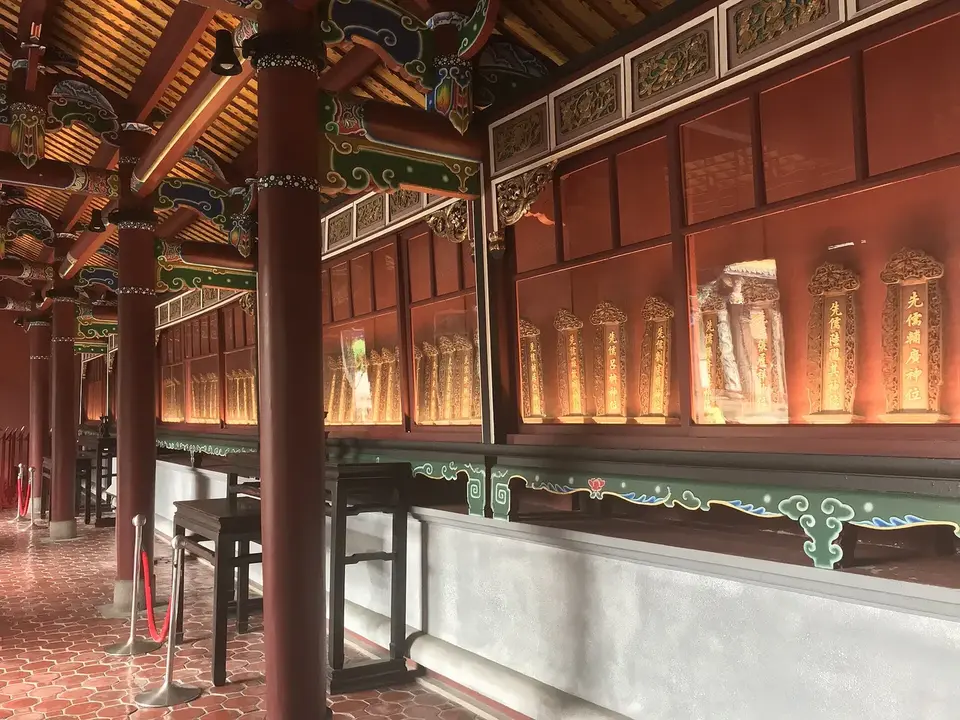
In 1584, the Wanli Emperor ordered an imperial review of Confucian sages. Acknowledging Hu Juren's spotless moral purity and vital service to Confucian education, the emperor issued an imperial patent conferring upon him enshrinement in the western hall of the Imperial Confucian Temple. Alongside Xue Xuan and Wang Yangming, Hu stands as one of the few Ming thinkers officially recognized as an orthodox Confucian worthy.
FIGURES ASSOCIATED WITH THIS DYNASTY