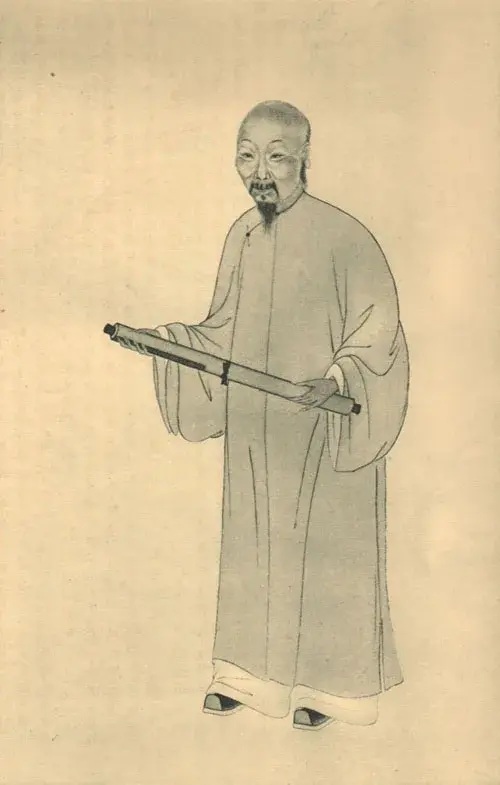
Biography
Illustrious Lineage and Youthful Genius
Hou Fangyu was born into one of the most prominent families in Guide Prefecture. His grandfather Hou Zhipu had risen to Chief Minister of the Court of Imperial Sacrifices in the Wanli reign, famed for unbending moral outspokenness. His father Hou Xun served as an outspoken censor during the Tianqi era, being dismissed by the eunuch dictator Wei Zhongxian, before being recalled in 1628 under the Chongzhen Emperor to serve as Vice Minister of War and later Minister of Revenue.
Endowed with sparkling intelligence and a voracious appetite for reading, Hou Fangyu mastered multiple classical texts each day. In 1633 (the 6th year of the Chongzhen era), sixteen-year-old Hou accompanied his father to Beijing and became a disciple of the eminent scholar and statesman Ni Yuanlu. In 1634 (the 7th year of the Chongzhen era), confronted with dynastic financial collapse and peasant uprisings, the sixteen-year-old prodigy drafted a ten-thousand-word memorial on agricultural military colonies for his father, articulating ten pragmatic categories of agricultural colonization that stunned the imperial capital.
In 1636 (the 9th year of the Chongzhen era), Senior Grand Secretary Wen Tiren launched a vicious political purge against Donglin leaders, inciting censors to impeach Hou Xun for alleged military supply mismanagement. Hou Xun was thrown into imperial prison, and Hou Fangyu spent subsequent years tirelessly lobbying to save his father.
Nanjing Examinations and Restoration Society
In 1638 (the 11th year of the Chongzhen era), Hou Fangyu sat the provincial examination in Nanjing, but was rejected by conservative examiners because his policy discourse attacked contemporary political abuses. Undeterred, he returned to Shangqiu and formed the Xueyuan Literary Society with Jia Kaizong and five other scholars, thereafter styling himself "Hou of Xueyuan".
In 1639 (the 12th year of the Chongzhen era), Hou returned to Nanjing to sit the examinations again, associating intimately with Fang Yizhi, Mao Xiang, and Chen Zhenhui, earning renown as the Four Young Gentlemen of the Late Ming. Along the Qinhuai River, Hou fell passionately in love with the virtuous courtesan Li Xiangjun. During this period, the disgraced eunuch partisan Ruan Dacheng attempted to rehabilitate his reputation by secretly offering lavish funds and jade hairpins to sponsor Hou's expenses. Upon discovering the source, Li Xiangjun vehemently insisted on returning the gifts. Encouraged by her righteousness, Hou joined Wu Yingji and Chen Zhenhui in authoring the famous Nanjing Anti-Subversion Manifesto, publicly exposing Ruan's treacherous history and expelling him from elite literati circles.
Military Crisis in Henan and Flight to Yixing
In 1641 (the 14th year of the Chongzhen era), Hou Xun was released from prison, while Hou Zhipu passed away. Soon after, Li Zicheng's rebel armies captured Nanyang and besieged Kaifeng. The Ming court appointed Hou Xun as Vice Minister of War to coordinate relief armies. Although General Zuo Liangyu possessed the largest regional army, he was insubordinate and arrogant. The relief forces suffered a crushing defeat at Zhuxianzhen, and the breaching of the Yellow River dikes submerged Kaifeng. The furious Chongzhen Emperor stripped Hou Xun of all ranks.
In 1643 (the 16th year of the Chongzhen era), a routed Zuo Liangyu moved his troops downstream to Jiujiang, threatening to march on Nanjing for grain. Nanjing Minister of War Xiong Mingyu pleaded with Hou Fangyu to write to Zuo Liangyu in his father's name, successfully persuading Zuo to halt his advance. Ruan Dacheng exploited this episode to spread venomous rumors that Hou was secretly coordinating a mutiny. Warned late at night by his friend Yang Wencong, Hou penned the searing Letter to Court Official Ruan on Leaving Nanjing and fled aboard a skiff to Yixing to hide in Chen Zhenhui's estate.
Service Under Shi Kefa and Dynastic Fall
In March 1644 (the 17th year of the Chongzhen era), Beijing fell to Li Zicheng, and the Chongzhen Emperor hanged himself on Coal Hill. In the southern capital of Nanjing, the Southern Ming Hongguang regime was established, but power quickly fell into the hands of Ma Shiying and Ruan Dacheng, who immediately orchestrated arrests against Restoration Society members, imprisoning Chen Zhenhui. Hou Fangyu scrambled desperately, providing substantial funds to Lian Guoshi to secure Chen's release.
Simultaneously, Hou fled to Yangzhou to join the military headquarters of Grand Secretary Shi Kefa. Entrusted by Shi, Hou drafted the legendary Reply to Dorgon, which eloquently asserted the Ming Dynasty's moral righteousness and rejected the Qing regent's patronizing surrender overtures. In April 1645 (the 1st year of the Hongguang era), Yangzhou fell after a heroic siege, and Shi Kefa was martyred. Disguised as a commoner, Hou escaped across Lake Tai and eventually returned to his ancestral home in Shangqiu.
The Shunzhi Examination and "Hall of Deep Regret"
After consolidating control over north and central China, the Qing court implemented harsh decrees coercing prominent Han scholar-gentry lineages into examination competition. In 1646 (the 3rd year of the Shunzhi era), Hou's elder brother Hou Fangxia obtained the jinshi degree under the Qing. In 1651 (the 8th year of the Shunzhi era), under intense administrative pressure from the provincial governor to protect his extended family, the thirty-four-year-old Hou sat the Henan provincial examination and was awarded a pass on the supplementary roll.
This compromise provoked scathing criticism from surviving Ming loyalists and inflicted agonizing torment upon Hou Fangyu's conscience. Condemning himself for betraying his former loyalty and integrity, he adamantly refused to accept any Qing governmental appointment. In his Shangqiu compound, he erected a two-story timber pavilion and named it Zhuanghui Tang, vowing to remain in strict seclusion and dedicate his remaining days to writing. He compiled his literary works and authored The Biography of Mistress Li to memorialize Li Xiangjun. In 1655 (the 12th year of the Shunzhi era), Hou Fangyu succumbed to grief and chronic illness in Shangqiu at the young age of thirty-eight.
Major Achievements
Revival of Classical Prose and Leadership of Early Qing Literature
Hou Fangyu's foremost contribution to Chinese literary history was his reinvigoration of classical prose. During the late Ming, the individualistic aesthetics of the Gong'an and Jingling schools had degenerated into shallow, frivolous trifles, while the mechanical archaism of the Former and Latter Seven Masters lacked genuine vitality. Hou Fangyu advocated returning to the robust classical traditions of Tang and Song masters Han Yu and Ouyang Xiu, while drawing stylistic grandeur from the Zuozhuan, Zhan Guo Ce, and Sima Qian's Shiji.
Hou's prose combined dramatic structural dynamics with profound historical substance. Prominent Qing scholar Wang Wan observed that Hou's essays possessed "a soaring, heroic vigor that surges like thunder and hailstones, coming to a sudden halt under an immense azure sky." Together with Wei Xi and Wang Wan, he was celebrated as one of the Three Great Masters of the Early Qing, establishing the stylistic foundation for the subsequent Tongcheng School of classical prose.
Masterpieces of Biographical Literature
Biographical prose represents the crowning glory of Hou Fangyu's artistic oeuvre. Synthesizing Sima Qian's historical realism with the dramatic storytelling of Tang-Song romances, Hou created vivid portraits of complex historical figures caught in dynastic collapse.
His celebrated Biography of Mistress Li praised the integrity of the courtesan Li Xiangjun, who fiercely scorned corrupt officials and defended righteous moral standards, serving as the direct inspiration for Kong Shangren's drama The Peach Blossom Fan. In The Biography of Actor Ma, he used an acting competition between two theatrical masters in Nanjing to satirize the deceitful flattery of Senior Grand Secretary Gu Bingqian. In The Biography of Liu Jingting, he captured the weathered wisdom and social insight of the legendary folk storyteller. These works remain celebrated classics of traditional Chinese biographical prose.
Political Activism and Defiant Manifestos
Hou Fangyu was also a courageous political spokesman for the late Ming scholar-gentry. The Nanjing Anti-Subversion Manifesto, drafted under his leadership, demonstrated the moral courage of Ming intellectuals combating corrupt remnants of the eunuch faction.
Similarly, his Reply to Dorgon, composed on behalf of Shi Kefa, stood as a magnificent testament to dynastic loyalty and dignified defiance during an era of catastrophic national tragedy, embodying the Confucian ideal of moral rectitude in the face of inevitable doom.