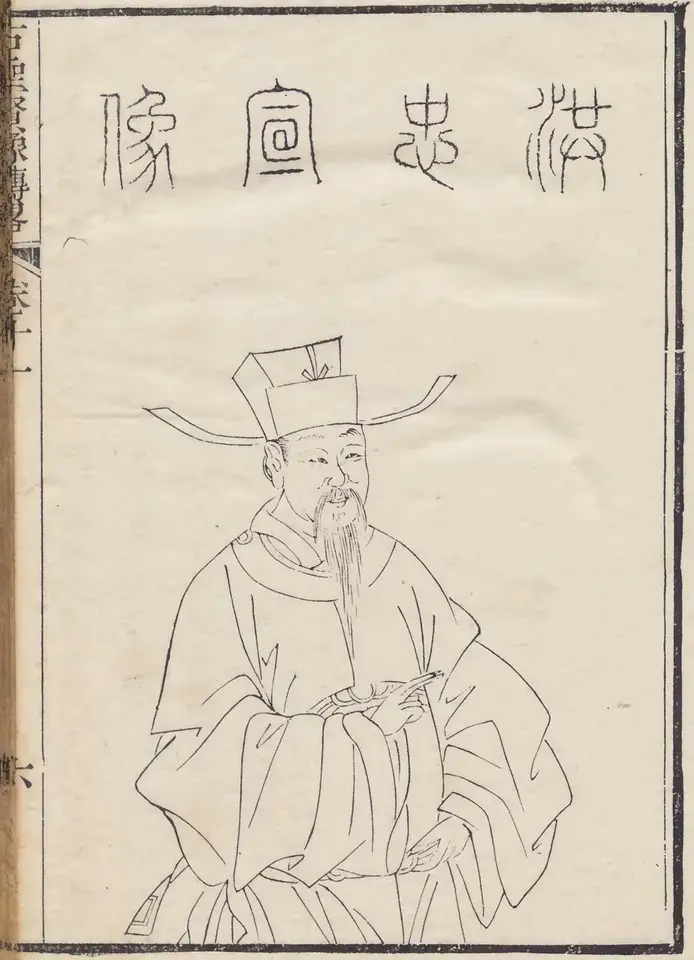
Biography
Early Career and Humanitarian Relief in Xiuzhou
Hong Hao displayed remarkable intellect and high moral character from his youth. Passing the imperial examinations in 1115, he was assigned to local posts in coastal Jiangnan. During the Xuanhe reign, while serving as an administrative officer in Xiuzhou (modern Jiaxing, Zhejiang), eastern China was engulfed in catastrophic floods followed closely by the massive social devastation of the Fang La rebellion. Granaries were depleted, and tens of thousands of starving refugees gathered along city walls facing imminent death.
Confronted with official regulations that forbade distributing granary grain without prolonged bureaucratic approvals from the central court, Hong Hao acted with extraordinary moral courage. Proclaiming that a true minister must risk his own life to preserve the people, he boldly broke the seals on imperial granaries and distributed tens of thousands of bushels of rice to the starving populace. Furthermore, he compelled local merchant boats carrying southern tributary grain to unload and feed local inhabitants. His resolute humanitarian action rescued upwards of one hundred thousand people, earning him the lifelong veneration of the southeastern population.
Dynastic Crisis and Embassy to the Jurchen Jin
In 1127, the Jin armies sacked Kaifeng and captured Emperors Huizong and Qinzong, plunging the Central Plains into immense sorrow. Emperor Gaozong established the Southern Song court in southern China. In the third year of Jianyan (1129), with hostilities continuing unabated and official diplomatic channels completely severed, Emperor Gaozong sought courageous envoys to journey to the Jin empire to inquire after the two captive emperors and deliver state letters.
Knowing full well that such an embassy was essentially a death sentence, Hong Hao stepped forward and petitioned the throne to serve as the lead imperial envoy. Appointed Drafting Official of the Secretariat and Chief Diplomatic Envoy, he departed Nanjing (modern Shangqiu, Henan) with a small delegation. As he crossed the Huai River, regional warlords and roving rebel armies roamed unchecked, and companions deserted out of sheer terror. Hong Hao pressed northward relentlessly, upholding his diplomatic credentials and vowing to honor the dignity of the Song empire even at the cost of his own life.
Defiance along the Huai River and Moral Stance at Yunzhong
In the autumn of 1130, Hong Hao was escorted under heavy armed guard to Yunzhong (modern Datong, Shanxi), the military command center of Wanyan Zonghan (Nianhan), the supreme commander of Jin's western armies. The Jurchen military leadership, having established the puppet regime of Da Qi headed by the turncoat Liu Yu, attempted to force Hong Hao to serve as Liu Yu's Minister of Revenue (Hubu Shangshu) in order to induce widespread surrender among Southern Song officials.
Hong Hao categorically rejected the appointment, declaring: 'I am an accredited envoy sent by the rightful Emperor of Song. I would rather be torn to pieces than serve a traitorous puppet!' Enraged by his refusal, Zonghan drew his sword, pressed the gleaming steel against Hong Hao's throat, and threatened him with immediate decapitation and dismemberment. Facing imminent execution, Hong Hao stood motionless with head held high and replied calmly: 'To die for my country is my highest duty; proceed with your blade!' Awed by his absolute intrepidity and majestic composure, Zonghan stayed his hand and spared his life, but sentenced him to perpetual exile in the farthest subarctic northern borders.
The Fifteen-Year Ordeal and Subterranean Life in Lengshan
Hong Hao was marched to Lengshan, a desolately remote settlement over one hundred miles north of the Jin Upper Capital (modern Acheng, Heilongjiang). Located in the frigid northern expanse, the region suffered severe frost, with snow blanketing the earth for eight months of the year and permafrost remaining rock solid year-round. The local inhabitants, predominantly Jurchen clansmen belonging to Prince Wanyan Xiyin, survived by digging underground pits and dwelling subterraneanly to avoid the biting blizzards.
For fifteen agonizing years, Hong Hao endured unimaginable privations. Clad only in ragged hemp smocks in subzero temperatures, with cracked and bleeding feet, he gathered wild mountain herbs and dried animal dung across the frozen tundra to maintain a modest campfire for survival. Recognizing his profound moral authority and vast erudition, Wanyan Xiyin engaged him as a private tutor for his sons. Yet Hong Hao never parted with his imperial diplomatic staff, sleeping with it as his pillow and kneeling toward the south on every new and full moon to offer weeping prayers for the Song dynasty.
Learning that the captured Emperors Huizong and Qinzong were imprisoned in Wuguocheng (modern Yilan, Heilongjiang), Hong Hao gathered his modest teaching earnings to secretly hire trustworthy frontier couriers. He dispatched them with dried foods and personal memorials to the royal captives, detailing Emperor Gaozong's ascension and the resurgence of the Southern Song state. The captive emperors wept upon reading his reports, with Huizong exclaiming that such noble loyalty was beyond human imagination. When news arrived in 1135 that Huizong had passed away in captivity, Hong Hao turned south, wept blood, and conducted complete state mourning rites in the frozen wilderness.
During his prolonged exile in Lengshan, Hong Hao observed that local Jurchen hunters and captive Song subjects frequently suffered from severe frostbite and epidemics without access to medicine. Well-versed in traditional healing, he braved snowstorms to gather medicinal herbs in the primeval forests, preparing decoctions to treat ailments for all without asking for compensation. Deeply moved by his benevolent deeds, northern tribesmen revered him as a living Bodhisattva, through which he demonstrated the moral uprightness and humanity of the Song state across the northern frontier.
Throughout the harsh years in Lengshan, Hong Hao maintained strict ethical standards and discipline among his remaining attendants. Every morning, they straightened their robes and performed customary court rites, adhering unswervingly to Confucian virtues of integrity and honor. Even when the Jin cut off food supplies to force submission, the Song cohort refused to compromise or steal from locals, winning immense respect from surrounding tribes. Local Jurchen chieftains often sought Hong Hao to arbitrate tribal disputes, relying on his fairness to resolve conflicts peacefully.
Covert Intelligence Operations and Wax-Pellet Dispatches in Yanjing
In 1140, internal power struggles at the Jin court culminated in Emperor Xizong executing Wanyan Xiyin. Hong Hao, along with Xiyin's household dependents, was transferred south to Yanjing (modern Beijing). In this northern metropolis, where Jurchen nobility, Han bureaucratic elites, and captive Song intellectuals intermingled, Hong Hao immediately recognized an invaluable opportunity to render strategic service to his homeland.
Concealing his diplomatic intentions behind an unassuming exterior, Hong Hao cultivated friendships with northern Han ministers, disaffected Jin generals, and merchants traversing border trade routes. He meticulously collected crucial military intelligence, including Jin army deployment strengths, troop logistics, political divisions among the Jurchen royalty, and strategic vulnerabilities. He painstakingly penned these classified summaries on miniature sheets of silk, encased them in wax pellets, and recruited daring frontier couriers to smuggle them across border patrol lines directly into Lin'an. His intelligence provided General Yue Fei and the Southern Song court with invaluable strategic foresight during the crucial campaigns of 1140.
Triumphant Return to Lin'an and Empress Dowager's Audience
Following the conclusion of the Shaoxing Peace Accord of 1141 and the return of Emperor Huizong's imperial coffin and Empress Dowager Wei in 1142, Hong Hao's release was negotiated. In the autumn of 1143, after fifteen long years of captivity in the northern wilderness, Hong Hao finally crossed the Huai River and returned to Southern Song soil.
Upon arriving at the capital of Lin'an, Hong Hao was granted an immediate imperial audience. Emperor Gaozong rose from the throne in personal greeting, emotionally declaring: 'Your steadfast loyalty over fifteen years in northern captivity rivals the ancient exemplar of Su Wu; you have brought immortal glory to our state!' During a subsequent private audience, Empress Dowager Wei ordered her attendants to roll up the imperial palace screen to receive Hong Hao as an honored savior, personally informing Emperor Gaozong that had it not been for Hong Hao's tireless diplomacy and secret support in the north, she would never have survived to return to Jiangnan.
Court Remonstrance and Uncompromising Defiance of Qin Hui
Recognizing Hong Hao's unmatched prestige, Grand Councilor Qin Hui immediately attempted to recruit him into his political faction. Qin Hui arranged for Hong Hao to be promoted to Drafting Official of the Secretariat and offered him immense bureaucratic authority, expecting him to publicly endorse the Shaoxing Peace Accord and praise Qin Hui's appeasement diplomacy.
However, Hong Hao was an unbending statesman dedicated to the national interest. In his official policy memorials and palace discussions, he vehemently opposed the humiliating concessions of the peace treaty, directly pointed out that the Jin court was unreliable, and refused to compose flattering diplomatic imperial edicts on behalf of Qin Hui. Hong Hao's outspoken integrity infuriated Qin Hui, who viewed Hong Hao's moral stature as an existential threat to his absolute political supremacy.
Banishment to Yingzhou and Compilation of the Songmo Jiwen
Unable to bend Hong Hao's will, Qin Hui engineered false charges against him in 1144, demoting him to Prefect of Raozhou before banishing him even further into the malaria-ridden regions of Lingnan as an administrative controller in Yingzhou (modern Yingde, Guangdong). Hong Hao spent nine years in exile in the deep south, enduring tropical disease and political surveillance with the same serenity he had shown in the frozen north.
During his banishment in Yingzhou, Hong Hao devoted his waking hours to scholarship. Relying on his meticulous notes and astonishing photographic memory, he compiled his monumental historical and geographical work, Songmo Jiwen (Record of the Pine and Desert). The work provided an unparalleled, firsthand account of early Jurchen tribal customs, administrative institutions, geographic terrain, and the domestic life of captive Song royals.
Imperial Pardon, Northward Return, and Posthumous Honors
In the tenth month of 1155, the tyrannical Grand Councilor Qin Hui passed away, ending over a decade of factional terror at the Southern Song court. Emperor Gaozong immediately issued imperial decrees rescinding the banishment of upright ministers. Hong Hao received a full imperial pardon and was restored to his former official rank, being ordered to return northward to the court.
However, after enduring more than two decades of extreme hardships in both the subarctic north and the tropical south, Hong Hao's health was completely shattered. In the eleventh month of 1155, while traveling through Nanxiong in Guangdong on his northward journey, Hong Hao passed away peacefully at the age of sixty-eight. Upon receiving the news, Emperor Gaozong was plunged into deep grief, conferring upon him posthumous honors, substantial estate endowments, and the prestigious posthumous name Zhongwen ('Loyal and Cultured'). His three sons—Hong Shi, Hong Zun, and Hong Mai—subsequently attained the highest scholastic and political achievements, becoming immortalized as the 'Three Hongs.'
Major Achievements
Fifteen Years of Unyielding Loyalty in Northern Captivity
Hong Hao's fifteen-year captivity across the northern wastes stands as one of the most celebrated epics of diplomatic loyalty in Chinese imperial history. Facing physical torture, subarctic freezing conditions, and imminent execution, he preserved his imperial diplomatic talisman and absolute loyalty to the Song dynasty without a single moment of wavering, providing a sublime moral beacon for the Chinese nation during a time of existential crisis.
Secret Intelligence Dispatches Coordinating the Southern Song Front
Operating behind enemy lines in Yanjing, Hong Hao established an effective covert intelligence apparatus. By transmitting crucial military and political assessments via wax-pellet couriers across heavily patrolled frontlines, he provided the Southern Song court and frontline commanders with vital intelligence, rendering decisive contributions to the defense of southern China.
Pioneering Ethnography with Record of the Pine and Desert
Hong Hao's masterwork, Songmo Jiwen (Record of the Pine and Desert), represents the earliest systematic, firsthand ethnographic and institutional account of the Jurchen people and the Jin dynasty. It accurately documented tribal origins, customs, marriage rituals, legal codes, and geographic conditions, correcting numerous errors in official historical compilations and providing indispensable primary material for subsequent generations of historians.
Lacking basic writing materials in the frigid wilderness of Lengshan, Hong Hao used birch bark as paper and charred wood as charcoal pencils. Drawing on his extraordinary memory, he transcribed classic Confucian canons including the Analects and Mencius into multiple volumes, using them to teach both young Jurchen tribesmen and captured Han scholars. He thoroughly documented northern customs, native geography, and shamanistic rituals, later compiling these scattered records during his southern exile into the invaluable Songmo Jiwen.
Opening Granaries to Save Starving Populations in Xiuzhou
During his early tenure in Xiuzhou, Hong Hao dared to defy imperial bureaucratic prohibitions by opening local granaries to feed tens of thousands of starving refugees during widespread famine and wartime devastation. His decisive humanitarian intervention preserved upwards of one hundred thousand lives, establishing an enduring standard of civil administrative virtue.
Standing Firm Against Qin Hui and Preserving Integrity in Exile
Returning to Lin'an at the height of his prestige, Hong Hao adamantly refused to compromise his principles or collaborate with Qin Hui's appeasement regime. Enduring a second nine-year exile to the subtropical frontiers of Yingzhou, he demonstrated that unbending moral integrity cannot be compromised by political intimidation or bureaucratic bribery.
Family Learning and the Cultural Prominence of the Three Hongs
Hong Hao's exemplary moral character and profound scholarship laid the foundation for the legendary scholarly prominence of his family. His three sons—Hong Shi (Grand Councilor and Epigrapher), Hong Zun (State Councilor and Numismatist), and Hong Mai (Grand Academician and Author of Yijian Zhi)—all became preeminent literary figures and statesmen of the Southern Song, creating the celebrated cultural legacy of the 'Three Hongs of Poyang.'
Perfect Unity of Loyalty, Filial Piety, and Ancestral Precepts
Hong Hao's life embodied the highest Confucian ideals of harmonizing state loyalty with familial devotion. Even in the deepest despair of Lengshan, he held regular ancestral commemorations and guided his distant sons through preserved letters and moral instructions, establishing a family tradition that produced top-tier scholars across successive generations.
Confronting Treason and Condemning Appeasement at All Costs
Throughout his official career, Hong Hao steadfastly opposed corrupt and capitulatory political currents. Whether staring down the drawn broadswords of Jurchen generals in northern fortresses or denouncing Qin Hui's tyrannical peace policies before the Southern Song throne, he remained an unwavering defender of national dignity and Confucian righteousness.