Biography
Upbringing in the Ducal Residence and Precocious Erudition
He Yan belonged to the aristocratic He clan of Nanyang, tracing his descent to He Jin, the General-in-Chief who commanded the imperial forces of the Eastern Han. During the warfare of the Chuping and Xingping eras, the He family suffered severe political downfall. In the Jian'an era, when Cao Cao served as Minister of Works, he took He Yan's mother, Lady Yin, into his inner quarters as a consort following the subjugation of Wan County. Recognizing young He Yan's exceptional wit, Cao Cao took the boy into his residence and raised him with the same tender care bestowed upon his own biological sons.
At that time, Qin Lang, the son of Qin Yilu, was also raised within Cao Cao's residence alongside his mother, Lady Du. While Qin Lang was cautious and reserved, He Yan was spirited, charismatic, and intellectually dazzling. By the age of seven or eight, He Yan could recite classical texts upon a single reading and write polished prose. Deeply fond of his intellect, Cao Cao considered formally adopting him and bestowing the imperial surname Cao upon him.
Aware of his delicate status as a stepson, young He Yan drew a small square on the courtyard ground with lime, remaining seated within it throughout the day. When attendants asked for an explanation, the child composedly replied: "This is the residence of the He clan." Astounded by the boy's dignity, pride, and self-possession, Cao Cao abandoned his intention to change He Yan's surname, allowing him to maintain his paternal ancestral line and educating him alongside the royal princes in the ducal academy.
As he reached adulthood, He Yan was renowned for his extraordinary handsomeness, possessing skin as white and lustrous as polished jade. Suspicious that He Yan's pale complexion was artificially produced by heavy cosmetics, Emperor Wen (Cao Pi) once summoned him to the palace on a sweltering summer day, presenting him with a bowl of steaming hot noodles. Perspiring profusely, He Yan wiped his face with his sleeve, yet his complexion appeared even more radiant, pure, and luminous. Capital literati were deeply amazed, giving rise to the popular appellation "Powder-Adorned Gentleman He."
However, He Yan was excessively preoccupied with personal ornamentation and luxurious display. He walked with measured poise, carrying powder cloths and cosmetics at all times to admire his reflection in mirrors. Moreover, presuming upon his noble pedigree and Cao Cao's affection, he frequently wore garments and robes that mimicked the styles reserved for the crown prince. Unlike the modest Qin Lang, He Yan's arrogance and ostentation provoked the visceral disgust of Cao Pi, who despised him, consistently addressing him as "pseudo-son" rather than using his courtesy name Pingshu.
Suppression for Superficiality and Metaphysical Synthesis
Toward the close of the Jian'an era, Cao Cao arranged the marriage of his daughter, Princess Jinxiang, to He Yan. He Yan was thus elevated to imperial son-in-law, appointed Commandant of Consorts, and granted the hereditary noble title of Marquis Within the Passes. Nevertheless, after Cao Pi founded the Cao Wei dynasty as Emperor Wen, the sovereign's long-standing resentment prevented He Yan from receiving any substantive administrative appointment throughout his seven-year reign.
During the Taihe era of Emperor Ming (Cao Rui), capital youths formed exclusive literary salons, establishing mutual praising circles to evaluate reputations and monopolize prestige. He Yan, Xiahou Xuan, Zhuge Dan, Deng Yang, and Li Sheng were celebrated as the preeminent leaders of this metropolitan fashion. Emperor Ming, who favored rigorous legalistic governance, despised this salon culture of philosophical posturing and political lobbying, warning that such cliques resembled blossoms that bore no fruit. In 230 CE (the fourth year of Taihe), Emperor Ming promulgated a sweeping decree stripping these frivolous scholars of their official appointments, banishing He Yan into private retirement for more than a decade.
During this protracted period of political exile, He Yan turned his brilliant intellect toward profound philosophical inquiry and classical exegesis. Recognizing that Han dynasty Confucianism had degenerated into rigid pedantry and superstitious apocrypha, He Yan returned to the foundational Daoist texts of the Daodejing and Zhuangzi, integrating their concepts with the Confucian I Ching. He formulated the cosmological ontology of "Exalting Nothingness," arguing that "Nothingness" (Wu) constituted the fundamental root from which all phenomenal existence arose.
He Yan composed the philosophical treatises On the Dao (Daolun) and On Virtue (Delun), demonstrating that the moral codes of Confucianism were rooted in the spontaneous order of nature. Furthermore, he initiated the celebrated debate on "Whether the Sage Possesses Emotions." He Yan maintained that the ancient Sage, attuned to ultimate Nothingness, harbored no private attachments or emotional biases, thus asserting that "the Sage is devoid of joy, anger, sorrow, or pleasure." The brilliant young philosopher Wang Bi countered that the Sage's spiritual discernment surpassed common men, causing him to experience emotions in response to external reality, yet his mind remained unencumbered by emotional residue.
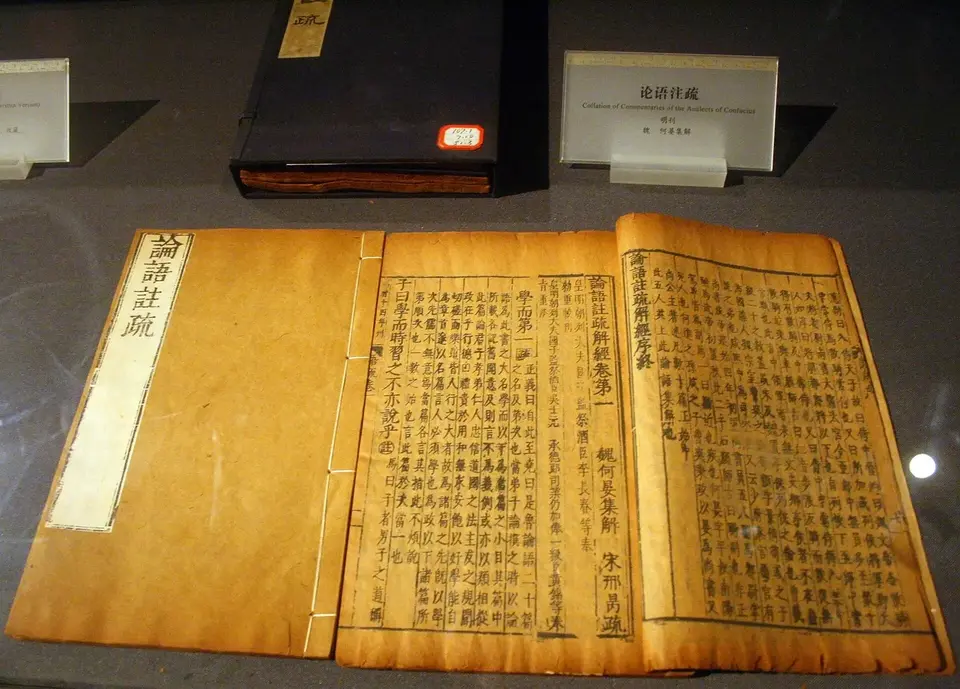
He Yan admired Wang Bi's philosophical genius, exclaiming: "Confucius remarked that the youth should be regarded with awe; this man is truly capable of speaking on the boundary between Heaven and humanity!" He Yan incorporated Wang Bi's profound interpretations, coordinating with eminent scholars such as Sun Yong, Zheng Chong, Cao Xi, and Xun Yi to compile the monumental ten-volume Collected Explanations of the Analects. This masterwork synthesized the finest textual insights of Han and Wei scholars, liberating classical studies from pedantic fragmentation and establishing a foundational textbook for generations of scholars.
Regent Cao Shuang and Directing the Personnel Ministry
In January 239 CE (the third year of Jingchu), Emperor Ming passed away after entrusting the guardianship of the eight-year-old child-emperor Cao Fang to General-in-Chief Cao Shuang and Grand Commandant Sima Yi. Lacking administrative depth, Cao Shuang was eager to consolidate power and neutralize Sima Yi's entrenched prestige as a three-reign military patriarch.
Having shared intimate bonds with He Yan and Xiahou Xuan since youth, Regent Cao Shuang turned to these intellectual allies to staff the government. In 240 CE (the first year of Zhengshi), Cao Shuang recalled He Yan to public life as Cavalier Regular Attendant, quickly advancing him to Palace Attendant. In 244 CE (the fifth year of Zhengshi), He Yan was appointed Minister of Personnel, granting him total executive control over civil official appointments, evaluations, and bureaucratic promotions across the entire empire.
As Minister of Personnel, He Yan abolished the rigorous examination protocols and anti-salon bans established by Emperor Ming. He made philosophical sophistication, rhetorical elegance, and loyalty to Cao Shuang the paramount criteria for bureaucratic advancement. Scholars belonging to his Xuanxue circle were rapidly installed across the Imperial Secretariat and provincial governorships, while stern Confucian statesmen like Minister of Works Lu Yu, Minister of Justice Gao Rou, and Sun Li were marginalized.
In metropolitan society, He Yan, Ding Mi, and Deng Yang were known as Cao Shuang's "Cabinet Brain Trust." To strip Sima Yi of military command, He Yan and Ding Mi petitioned the throne to elevate Sima Yi to the honorable rank of Grand Tutor, depriving him of actual command over the capital garrisons. Aware of the regent faction's aggressive momentum, Sima Yi feigned catastrophic illness and withdrew into seclusion in 247 CE, secretly organizing loyal retainers and former officers for an inevitable confrontation.
The Five Minerals Powder and the Portentous Divination
During his decade at the apex of imperial authority, He Yan exerted a profound influence on elite material and spiritual culture. He was a passionate proponent of Five Minerals Powder (Cold-Food Powder), a medicinal compound of stalactite, sulfur, quartz, and ochre. When consumed, the drug elevated body temperature and induced heightened mental stimulation, requiring the user to wear loose garments, take brisk walks in the cold air to dissipate the heat, and drink warm wine. He Yan famously proclaimed: "Consuming Five Minerals Powder not only cures illness, but also makes the spiritual intellect wonderfully luminous and clear."
Under He Yan's personal endorsement, taking Five Minerals Powder evolved into an elite social ritual signifying unconventionality, refined aestheticism, and transcendence of mundane Confucian decorum, initiating the celebrated "Neo-Daoist Bohemianism" of the Wei-Jin period. However, as his political power reached its height, He Yan increasingly indulged in personal enrichment, accepting lavish gifts, annexing state properties, and taking palace maidservants into his private household, which alienated upright ministers.
In the winter of 248 CE (the ninth year of Zhengshi), the renowned divination master Guan Lu arrived in Luoyang. He Yan and Deng Yang hosted an elaborate banquet for Guan Lu at the Ministry of Personnel. During the gathering, He Yan asked Guan Lu to interpret an omen: "Last night I had an unusual dream in which dozens of blue-green flies gathered upon the tip of my nose, refusing to be driven away. What does this portent signify?"
Guan Lu, recognizing the arrogance and peril surrounding He Yan's faction, replied candidly: "The nose represents the mountain of the face, the highest and most honorable feature. That filthy blue-green flies should swarm upon it portends supreme misfortune. Your Excellency occupies the highest ministerial office, yet you lack deep virtue and indulge in luxury. This is the posture of the 'arrogant dragon having cause to repent.' I pray Your Excellency reflects upon the cosmic law of waxing and waning, yielding advantage to others and withdrawing from peril, that you might escape destruction." Although He Yan laughed off Guan Lu's warning as tedious moralizing, he remained privately shaken.
The Gaoping Tomb Coup and Execution of the Clan
On the sixth day of the first month in 249 CE (the tenth year of Zhengshi), Emperor Cao Fang departed Luoyang accompanied by Cao Shuang, Cao Xi, and their military entourage to offer sacrifices at Emperor Ming's tomb at Gaoping. Seizing this long-awaited opportunity, Grand Tutor Sima Yi mobilized his clandestine forces, staging the Gaoping Tomb Coup.
Fabricating an imperial decree from the Empress Dowager Guo, Sima Yi closed the gates of Luoyang, seized the central armory, and stationed elite troops across the Luo River bridge, formally declaring Cao Shuang guilty of high treason. Left behind in Luoyang, He Yan was paralyzed by panic. When Grand Minister of Agriculture Huan Fan escaped the capital to urge Cao Shuang to take the Emperor to Xuchang and summon loyal armies, Cao Shuang hesitated, ultimately accepting Sima Yi's false pledge by the Luo River that his life and noble rank would be spared if he surrendered authority.
Upon Cao Shuang's return to the capital, Sima Yi placed the regent under house arrest and moved to systematically crush his network. To disarm He Yan psychologically and extract legal confessions, Sima Yi deliberately appointed He Yan as the chief judicial magistrate to oversee the treason trial against Cao Shuang. Sima Yi coldly instructed He Yan: "Rebels have plotted against the state, and imperial law demands the extermination of eight clans. Let Minister He investigate the conspirators with utmost rigor!"
Believing that Sima Yi intended to spare his life in exchange for his cooperation, He Yan conducted the interrogations with brutal thoroughness, torturing his former companions Ding Mi, Deng Yang, Li Sheng, and Bi Gui to extract confessions that substantiated the treason charges. When He Yan presented the completed dossiers of the seven condemned families and tremblingly inquired about the identity of the eighth, Sima Yi shouted: "The eighth family is none other than you, He Yan Pingshu!"
He Yan was immediately seized, shackled, and thrown into prison. On the tenth day of the first month in 249 CE, Emperor Cao Fang issued an edict decreeing the execution of He Yan, Cao Shuang, Ding Mi, and Deng Yang in the public marketplace of Luoyang. He Yan was executed at the age of approximately fifty-four, and his three-generation lineage was eradicated. Only his young son born to Princess Jinxiang was spared through the intervention of Prince Cao Lin. Thus ended the life of the foundational master of Xuanxue amidst the violent dynastic transition of the Three Kingdoms.
Major Achievements
Founding the Zhengshi Xuanxue Movement
He Yan's foremost historical contribution was his pioneering role in inaugurating the Zhengshi Xuanxue movement, which marked a major intellectual epoch in Chinese philosophy. Disillusioned by the fragmentation of Han dynasty Confucian exegesis and apocrypha, He Yan returned to the classic texts of Laozi, Zhuangzi, and the I Ching, constructing an original ontological philosophy centered on "Exalting Nothingness."
He Yan maintained that ultimate Nothingness (Wu) was the ontological source of the cosmos; the Dao possessed no material form, yet encompassed and generated all phenomenal things. He harmonized Daoist naturalism with Confucian moral philosophy, proposing that worldly moral institutions were rooted in the spontaneous order of nature. His innovative philosophical lectures in Luoyang shattered centuries of pedantic commentary, establishing the theoretical framework for Wang Bi and shaping the intellectual sensibilities of Chinese scholar-officials for centuries.
Bureaucratic Appointments and Personnel Reorganization
During his tenure as Palace Attendant and Minister of Personnel, He Yan directed the civil administration of the Cao Wei Empire. Challenging the entrenched patronage networks of senior aristocratic families aligned with Sima Yi, He Yan used his executive power to recruit talented young scholars who demonstrated philosophical acumen and literary sophistication.
Under He Yan's leadership, the Cao Wei state attempted to construct an intellectualized administrative elite capable of transcending rigid legalistic codes. However, his recruitment policies favored philosophical companions at the expense of experienced commanders and practical administrators, alienating elder statesmen and rendering the Cao Shuang regime fragile when confronted by Sima Yi's decisive military coup.
Initiating Bohemian Aesthetics and Five Minerals Culture
As an arbiter of taste and cultural practice, He Yan left an indelible mark on medieval Chinese literati culture. His enthusiastic promotion and consumption of Five Minerals Powder popularized the distinctive lifestyle of taking the drug, walking in cold weather, wearing billowing robes, and pursuing introspective contemplation.
While the consumption of Five Minerals Powder caused severe physiological damage and later faced ethical and medical condemnation, He Yan's pursuit of inner spontaneity, aesthetic refinement, and liberation from societal conventions catalyzed the spirit of the Seven Sages of the Bamboo Grove and Eastern Jin cultural aesthetics, leaving an enduring cultural symbol in the intellectual history of traditional China.