Birth in Kuaiji
Born into an eminent Confucian scholar-official family in Shanyin, Kuaiji, as the great-grandson of General He Qi.
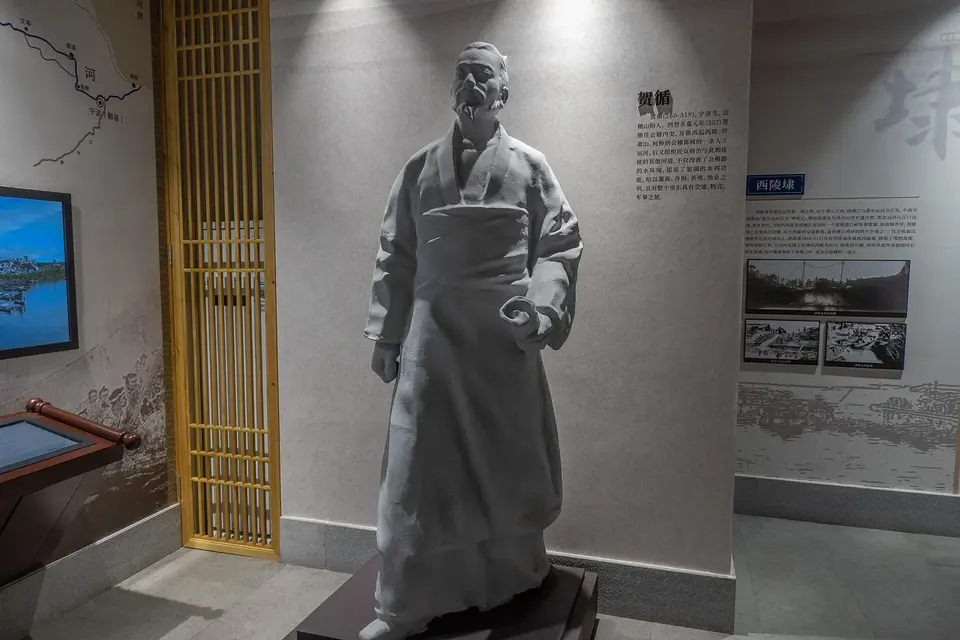
贺循
He Xun (260 – August 28, 319), courtesy name Yanxian, was a native of Shanyin County, Kuaiji Commandery. He was a descendant of Qing Pu, a renowned Western Han scholar of the Classic of Poetry (Qi tradition) and the Rites, the great-grandson of the Eastern Wu general He Qi, and the son of He Shao, Palace Secretariat Director. He was a prominent statesman, preeminent master of Confucian ritual protocols, and hydraulic…
He Xun (260 – August 28, 319), courtesy name Yanxian, was a native of Shanyin County, Kuaiji Commandery. He was a descendant of Qing Pu, a renowned Western Han scholar of the Classic of Poetry (Qi tradition) and the Rites, the great-grandson of the Eastern Wu general He Qi, and the son of He Shao, Palace Secretariat Director. He was a prominent statesman, preeminent master of Confucian ritual protocols, and hydraulic engineering pioneer of the late Western Jin and early Eastern Jin dynasties, acclaimed alongside Ji Zhan, Min Hong, Gu Rong, and Xue Jian as one of the "Five Talents of Jiangnan." Born into an eminent southern aristocratic lineage, He Xun suffered severe family tragedy in his youth when his father was executed by Sun Hao, the last emperor of Eastern Wu, leading to the family's exile to coastal Linhai. Following the Western Jin conquest of Eastern Wu in 280, he returned to his ancestral home. Serving successively as Magistrate of Yangxian and Magistrate of Wukang, he governed through moral transformation, reformed extravagant burial practices, and earned widespread administrative acclaim. Recommended by Lu Ji, he entered central court service as Sheren to the Crown Prince. Amidst the tumultuous War of the Eight Princes, He Xun steadfastly maintained moral integrity, pleading illness to refuse office from the usurper Sima Lun, dislodging rebel forces under Shi Bing through persuasive proclamations, and feigning insanity while taking cold-food powder to reject commands from the insurgent Chen Min. In 307, when Sima Rui (later Emperor Yuan of Jin) was assigned to garrison Jianye, He Xun and Gu Rong responded to his invitation, leading southern aristocratic clans to pledge allegiance and securing the sociopolitical foundation of the Eastern Jin dynasty. During his tenure as Administrator of Wu Commandery and Kuaiji, He Xun directed the excavation of the fifty-kilometer Xixing Canal, linking Kuaiji to the Qiantang River and establishing a durable hydraulic network across eastern Zhejiang. Following the formal founding of the Eastern Jin dynasty, He Xun was appointed Minister of Ceremonies (Taichang Qing), where he systematized state rituals, imperial temple ceremonies, ancestral suburban sacrifices, and court vestments, earning universal acclaim as the foremost Confucian ritual authority of his era. In 318, he was appointed Acting Grand Tutor to the Crown Prince. He passed away in 319 at the age of sixty and was posthumously honored as Minister of Works (Sikong) with the posthumous title "Mu."
Born into an eminent Confucian scholar-official family in Shanyin, Kuaiji, as the great-grandson of General He Qi.
His father He Shao was executed by Emperor Sun Hao; the family was banished to the remote coastal border of Linhai Commandery.
Western Jin conquered Eastern Wu; He Xun returned to Kuaiji, dedicating himself to profound classical learning.
Nominated as Cultivated Talent (Xiucai) and appointed Magistrate of Yangxian, then Magistrate of Wukang, prohibiting wasteful burial customs.
Following an official memorial by Writer Lu Ji, he was summoned to the imperial capital as Sheren to the Crown Prince.
Prince Sima Lun usurped the throne and offered He Xun an Attendant Censor post; He Xun claimed illness and withdrew to his hometown.
Rebel Shi Bing invaded Yangzhou; He Xun issued an official proclamation in Kuaiji, breaking enemy morale and declining personal rewards.
Rebel general Chen Min seized Jiangnan and issued commands; He Xun took cold-food powder, stripped his garments, and feigned paralysis to resist.
Sima Rui arrived in Jianye; He Xun accepted his call, served as Administrator of Wu Commandery, and excavated the Xixing Canal.
Following Gu Rong's death, Sima Rui sought to entrust He Xun with military duties; He Xun repeatedly declined and was made Advisory Libationer.
Appointed Minister of Ceremonies (Taichang Qing), establishing dynastic ceremonial institutions and ancestral sacrifice codes.
Appointed Acting Grand Tutor to the Crown Prince (Xing Taizi Taifu) upon the marriage of Crown Prince Sima Shao.
Succumbed to illness on August 28; posthumously granted the title Minister of Works (Sikong) and the posthumous name "Mu."
He Xun was a descendant of Qing Pu, the prominent Western Han classicist who established the Qing tradition of ritual scholarship. During the reign of Emperor An of the Eastern Han dynasty, his lineage ancestor He Chun, an Imperial Attendant, altered the surname from Qing to He to observe the naming taboo of Liu Qing, Prince Xiao of Qinghe and biological father of Emperor An. During the Three Kingdoms era, He Xun's great-grandson He Qi served Eastern Wu with distinguished military merit, rising to Senior General, Shepherd of Xu Province, and Marquis of Shanyin. His grandfather He Jing served as Bandit-Suppressing Colonel, while his father He Shao rose to Palace Secretariat Director and Grand Tutor to the Crown Prince under Sun Hao, acclaimed for his integrity and fearless admonitions.
In 260, He Xun was born in Shanyin County, Kuaiji Commandery. In 275, He Shao suffered a stroke that rendered him mute and unable to speak. The suspicious tyrant Sun Hao suspected him of feigning illness to evade duty, had him cast into prison, and subjected him to brutal floggings and interrogation. He Shao refused to utter a single plea and was tortured to death at the age of forty-nine. Sun Hao subsequently confiscated the family estate and banished He Xun's entire family to the remote coastal region of Linhai Commandery. Though only sixteen years of age, He Xun endured the exile with filial devotion, maintaining rigorous moral composure while immersing himself in the Three Ritual Classics and ancestral scholarship.
In 280, the Western Jin dynasty conquered Eastern Wu, restoring territorial unity. He Xun and his kin received imperial pardon and returned to Kuaiji. Celebrated for his noble bearing, moral integrity, and adherence to ritual propriety, He Xun gained widespread renown across the Jiangnan region. He was honored alongside Ji Zhan, Min Hong, Gu Rong, and Xue Jian as one of the "Five Talents of Jiangnan." Ding Yi, Chancellor of Kuaiji Principality, engaged him as Five Offices Assistant and Acting Section Director.
In the late Taikang era, Governor Ji Xi of Yangzhou recommended He Xun as a Cultivated Talent, leading to his appointment as Magistrate of Yangxian. In office, He Xun governed through benevolence, conciliation, and moral elevation rather than excessive administrative evaluation, winning immense public trust. Later transferred to Magistrate of Wukang, he observed that local Wu customs were heavily steeped in superstitious practices, lavish burials, and geomantic taboos. Families frequently delayed burials for months or decades if unlucky astrological signs appeared. He Xun enacted clear prohibitions and patiently educated the local population on classical filial rites, eradicating the neglect of unburied coffins and transforming local customs. Neighboring counties widely emulated his model.
Nevertheless, because central appointments were heavily dominated by northern aristocratic lineages and He Xun lacked patrons in Luoyang, he remained in local posts for years without advancement. Writer Lu Ji submitted a formal memorial to the throne, praising He Xun's deep moral capacity, refined perception, and rigorous conduct, arguing that his talents merited an appointment as Bureau Director in the Department of State Affairs. Following considerable delay, the court summoned He Xun to serve as Sheren to the Crown Prince.
In 301, Prince Sima Lun of Zhao launched a palace coup, deposed Emperor Hui, and usurped the imperial throne. To court public esteem, Sima Lun appointed He Xun as Attendant Censor. Deeply conscious of dynastic loyalty, He Xun refused to legitimize the usurper's regime, pleading illness to resign and retreat to the countryside. When the court later designated him Chief Clerk to the General of the Southern Garrison, he persistently declined the appointment.
In 303, the displaced vagrant rebel Zhang Chang launched an uprising in Jiangxia, and his subordinate general Shi Bing invaded Yangzhou, capturing commanderies and driving imperial forces into flight. Shi Bing stormed Kuaiji, ousted Chancellor Zhang Jing, appointed his partisan Cheng Chao to govern the commandery, and made Chief Clerk Zai Yu acting magistrate of Shanyin. In the twelfth month, prominent Jiangnan leaders Zhou Qi and Gu Mi raised troops to suppress Shi Bing, rallying nine commanderies. He Xun promptly raised forces in Kuaiji in coordinated response.
Shi Bing's formidable general Kang Chong garrisoned several thousand elite troops at the local academy. He Xun drafted a persuasive manifesto outlining the political stakes, strategic consequences, and moral imperatives of loyalty versus rebellion, dispatching it to Kang Chong's camp. Shattered in morale, Kang Chong fled under cover of night, while Cheng Chao and Zai Yu surrendered to He Xun, restoring Kuaiji Commandery without bloodshed. He Xun immediately escorted Chancellor Zhang Jing back to his office, disbanded his troops, closed his doors to visitors, and resolutely refused any military rewards or promotions.
In 305, General of the Right Chen Min staged a rebellion in Liyang, forged imperial edicts, and attempted to coerce prominent southern gentry into accepting administrative offices, appointing He Xun as Internal Administrator of Danyang. Resolutely refusing complicity with the rebels, He Xun claimed severe leg paralysis and inability to hold a writing brush. He regularly ingested cold-food powder, disheveled his hair, undressed, and lay semi-conscious on his bed to feign total physical collapse. Intimidated by He Xun's moral stature and unyielding resolve, Chen Min dared not press him further. While many southern aristocrats bowed to Chen Min's pressure, He Xun and Zhu Dan of Wu Commandery remained entirely uncompromised.
In 307, after the suppression of Chen Min, General Zhou Fu recommended He Xun to govern Kuaiji and subsequently Wu Commandery, while the imperial court dispatched official carriages to summon him as Worthy and Excellent, but He Xun declined on grounds of illness. In the ninth month of the same year, Prince Sima Rui of Langya was stationed at Jianye. At that juncture, northern migrants were newly arrived, southern gentry stood aloof in observation, and administrative authority was weak. Chief Clerk Wang Dao counseled Sima Rui that Gu Rong and He Xun represented the true spiritual leaders of the southern elite, and securing their cooperation would rally all Jiangnan clans.
Sima Rui dispatched Wang Dao in person to He Xun's residence with formal invitations. Discerning the broader historical necessity of preserving dynastic continuity in the south amidst northern collapse, He Xun and Gu Rong accepted the call. He Xun was appointed Internal Administrator of Wu Commandery and entered Sima Rui's inner council. With He Xun's arrival, southern figures including Ji Zhan, Zhou Qi, and Xue Jian rallied to Sima Rui's standard, consolidating the political legitimacy of the nascent Eastern Jin state.
In 311, Sima Rui was promoted to Senior General of the Eastern Garrison. Following the death of Military Adjutant Gu Rong, Sima Rui sought to appoint He Xun to take charge of military advisory affairs. He Xun presented more than ten memorials pleading severe physical frailty and refusing military duties, whereupon Sima Rui designated him Advisory Libationer. Despite He Xun's attempts to remain secluded, Sima Rui issued urgent decrees commanding his presence. He Xun, frail and ailing, was carried into the palace on a rope litter. Deeply moved, Sima Rui conferred court garments directly by his bed and bestowed an estate, carriages, and fine furnishings, all of which He Xun declined and returned to state storehouses.
In 317, following the capture and execution of Emperor Min in Chang'an, Sima Rui assumed the title Prince of Jin. During this founding period, administrative and ceremonial institutions were severely disrupted. Sima Rui sought to appoint He Xun as Palace Secretariat Director with the concurrent rank of Cavalier Regular Attendant. He Xun declined the central political office due to advanced age and chronic disease, prompting Sima Rui to appoint him Minister of Ceremonies (Taichang Qing). The office of Minister of Ceremonies supervised suburban sacrifices, ancestral shrines, court music, and ceremonial protocols, perfectly matching He Xun's scholarly erudition. Whenever the court faced perplexing matters regarding imperial ancestral rites, altar layouts, or official insignia, it sought He Xun's definitive rulings. He Xun harmonized classical precedents with contemporary needs, winning universal acclaim as the foremost Confucian master of his era.
In 318, upon the marriage of Crown Prince Sima Shao, Emperor Yuan appointed He Xun Acting Grand Tutor to the Crown Prince. When the Emperor visited the Imperial Academy, He Xun accompanied the procession despite his frail health; the sovereign paid profound homage, and the entire court displayed immense reverence.
In 319, He Xun's chronic ailments intensified, and he petitioned for retirement. Understanding his condition, Emperor Yuan granted his release. On August 28, 319 (Yichou day, 7th month, 2nd year of Taixing), He Xun passed away in his Jiankang residence at the age of sixty. Emperor Yuan mourned him deeply, suspended court sessions, and posthumously conferred the title Minister of Works (Sikong) with the posthumous name "Mu."
During the Yongjia era, while serving as Internal Administrator of Wu Commandery and acting administrator of Kuaiji, He Xun addressed the geographical isolation between Kuaiji and the Qiantang River. The natural waterways were scattered and prone to shoals, forcing passenger boats and grain cargo to navigate treacherous shallows or arduous mountain paths, causing severe transportation bottlenecks and frequent agricultural floods and droughts.
He Xun surveyed the regional terrain and mobilized local manpower to excavate an artificial waterway extending from the Ying'en Gate on the western perimeter of Kuaiji County through Keqiao, Qianqing, and Xiaoshan to the Xixing Ferry on the banks of the Qiantang River, spanning over fifty kilometers. This canal, later known as the Xixing Canal or the western section of the Eastern Zhejiang Canal, was integrated with the Jianhu Lake drainage system through sluice gates and reservoirs. It formed a comprehensive hydraulic network that regulated floodwaters, provided irrigation, and facilitated grain and commercial shipping, benefiting eastern Zhejiang for centuries.
During the upheaval of the Yongjia era, classical court ceremonies were completely shattered. In the early days of Sima Rui's administration and the founding of Eastern Jin, court rituals were rudimentary, lacks of clear precedents for imperial suburban sacrifices, state altars, ancestral shrines, and court attire caused widespread confusion.
As Minister of Ceremonies, He Xun gathered surviving ritual fragments, synthesised the Western Han Qing tradition with the commentaries of Zheng Xuan and Wang Su, and established comprehensive ceremonial protocols for imperial sacrifices, state altars, royal audiences, and princely weddings. He authored the one-volume Mourning Garments Chart (Sangfu Pu) and the ten-volume Essential Records of Mourning Garments (Sangfu Yaoji), defining the precise degrees of filial and administrative mourning. By prioritizing moral reverence over ostentatious display, He Xun firmly anchored the southern court in legitimate classical tradition and provided a stable ritual framework for the dynasty.
He Xun led a life of remarkable austerity and integrity. Despite holding high ministerial office across two dynasties, he distributed his salary among impoverished relatives and needy scholars, keeping only coarse clothing and simple food for himself, and residing in a modest dwelling that barely sheltered against wind and rain. He repeatedly declined royal gifts of fine treasures, and his carriages and furnishings remained worn without replacement. Emperor Yuan frequently praised him as being pure as ice and translucent as jade, serving as a moral compass for the age.
When Chamberlain for Law Enforcement Zhang Kai abused his authority by constructing a private gate across a public street near his market residence—shutting it early and opening it late, thereby severely obstructing commoners and merchants—the local magistrates dared not intervene. The distressed citizens appealed to He Xun at Pogang. He Xun refrained from overt condemnation; instead, he carried their petition to Zhang Kai in private, quietly mentioning their long-standing family friendship. Filled with shame, Zhang Kai immediately dismantled the gate and went out to apologize. He Xun's subtle moral influence set a powerful standard of restraint for powerful southern clans.
FIGURES ASSOCIATED WITH THIS DYNASTY