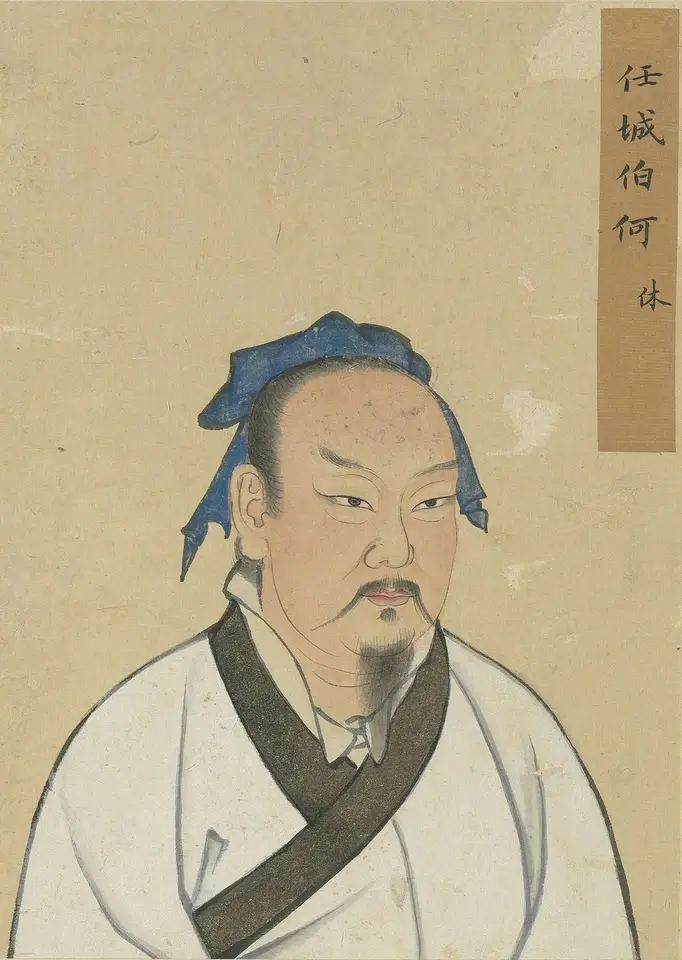
PROFILE
He Xiu (何休, 129–182 CE), courtesy name Shaogong, a native of Fan County in Rencheng Kingdom (modern Luqiao Town, Weishan County, Jining, Shandong Province), was an eminent late Eastern Han classicist, philosopher, and bibliographer. He is universally recognized as the grand synthesizer of the New Text classical school and the Gongyang tradition during the two Han dynasties. Descended from an illustrious ministerial family, his father He Bao served as Chamberlain for the Palace Revenues, one of the Nine Ministers. Endowed with exceptional intellectual gifts, He Xiu mastered the Six Classics, astronomical calculations, and apocryphal charts, attaining peerless mastery in the Gongyang Commentary on the Spring and Autumn Annals. During the Yanxi and Jianning eras, he entered civil administration under Grand Tutor Chen Fan. Following Chen Fan's defeat and death in his anti-eunuch coup of 168 CE, He Xiu was implicated in the Partisan Prohibitions and subjected to political house arrest for seventeen years.
During his prolonged confinement, He Xiu maintained his moral convictions, never setting foot outside his residential gates. Observing that the New Text Gongyang tradition was being overshadowed by the rising popularity of the Old Text Zuo Zhuan, he resolved to revitalize the esoteric doctrines of Confucius, Huwu Sheng, and Dong Zhongshu. Over seventeen years of intensive study, he completed the twelve-chapter Exegesis of the Spring and Autumn Gongyang Commentary (Chunqiu Gongyang Jiegu). The work formulated a comprehensive philosophy of historical evolution grounded in the concepts of "Connecting the Three Epochs" and "Displaying the Three Ages" (the Age of Disorder, the Age of Approaching Peace, and the Age of Universal Peace). It survives as the sole intact commentary of the Han New Text classical tradition, preserved in the Thirteen Classics with Commentaries and Subcommentaries. He Xiu also authored the Impregnable Defense of the Gongyang, Incurable Malady of the Zuo Tradition, and Rehabilitating the Crippling Defects of the Guliang Tradition, sparking the celebrated Han classical polemic with Zheng Xuan. In 180 CE, following the lifting of partisan bans, he was appointed Gentleman Consultant and subsequently Grandee Remonstrant, passing away in 182 CE. His evolutionary theory was revived by the late Qing Changzhou school, serving as a philosophical catalyst for Kang Youwei, Liang Qichao, and the Hundred Days' Reform.
- Courtesy Name
- Shaogong
- Native Place
- Fan County, Rencheng Kingdom (modern Luqiao Town, Weishan County, Jining, Shandong Province)
- Date of Birth
- 129 CE (4th year of Yongjian, Emperor Shun of Han)
- Date of Death
- 182 CE (5th year of Guanghe, Emperor Ling of Han)
- Age at Death
- 54
- Highest and Major Offices
- Grandee Remonstrant (formerly Gentleman Consultant, Subordinate to the Grand Tutor)
- Identity
- Celebrated Eastern Han classicist, master of the Gongyang school, grand synthesizer of New Text classical scholarship
BIOGRAPHY
Chronology
- 129 CE (4th year of Yongjian, Emperor Shun of Han) | Birth in Rencheng | Born into an elite ministerial household in Fan County; his father served as Chamberlain for the Palace Revenues.
- c. 150s CE (Yuanjia to Yongxing eras, Emperor Huan) | Classical Studies | Maintained an austere lifestyle, studying under Yang Bi, mastering the Six Classics, calendrical mathematics, and Gongyang precedents.
- c. 165 CE (8th year of Yanxi, Emperor Huan of Han) | Appointment under Chen Fan | Renowned as a leading classicist, summoned by Grand Tutor Chen Fan to serve as subordinate in the central administration.
- 168 CE (1st year of Jianning, Emperor Ling of Han) | The Partisan Calamity | Chen Fan was executed following a failed coup against palace eunuchs; He Xiu was dismissed and placed under house arrest for seventeen years.
- 169–180 CE (Jianning to Guanghe eras, Emperor Ling) | Composition of the Exegesis | Living in complete domestic seclusion, he composed the twelve-chapter Exegesis of the Gongyang Commentary and polemical treatises.
- 180 CE (3rd year of Guanghe, Emperor Ling of Han) | Imperial Recall | Partisan bans were relaxed; recommended by General-in-Chief He Jin, appointed Gentleman Consultant and promoted to Grandee Remonstrant.
- 182 CE (5th year of Guanghe, Emperor Ling of Han) | Demise in Office | Passed away in office as Grandee Remonstrant at the age of fifty-four, leaving behind the definitive New Text classical synthesis.
Biography
Family Heritage and Early Devotion to Classical Studies
He Xiu was born in the fourth year of the Yongjian era under Emperor Shun of Han (129 CE) in Fan County of Rencheng Kingdom (modern Luqiao Town, Weishan County, Jining, Shandong Province). Rencheng was situated in the cultural heartland of ancient Lu, where Confucian traditions flourished and generations of scholars preserved canonical teachings. He Xiu belonged to a prominent bureaucratic household; his father He Bao held the rank of Chamberlain for the Palace Revenues, managing imperial fiscal revenues and palace goods.
Growing up within this affluent family, He Xiu received an extensive classical education. Characterized by a quiet demeanor and unyielding resolve, he rejected the ostentatious socializing pursued by aristocratic peers. He Xiu spoke with a slight stammer, avoiding public verbal sparring, but possessed an analytical intellect capable of penetrating subtle textual nuances. He studied under the regional classicist Yang Bi, mastering the Six Classics alongside astronomy, celestial calendars, and mathematical harmonics.
Among classical traditions, He Xiu dedicated himself to the Gongyang Commentary on the Spring and Autumn Annals. Under Emperor Wu of Western Han, Dong Zhongshu had utilized Gongyang doctrines to establish the Grand Unity, elevating New Text Confucianism to state orthodoxy. By the mid-Eastern Han, however, Old Text scholarship advanced rapidly as scholars embraced the narrative detail of the Zuo Zhuan, while New Text adherents grew entangled in pedantic word-counting and apocryphal omens. As scholars declared that the Zuo Zhuan should replace the Gongyang, He Xiu lamented the decline of canonical principles, vowing to restore the esoteric wisdom of Confucius and early Han masters.
Summoned by Chen Fan and the Calamity of the Partisan Prohibitions
During the Yanxi era of Emperor Huan, the Han government deteriorated under the corrupt dominance of imperial eunuch factions following the fall of the consort clan. In response, reformist scholars and Grand Academy students led by Grand Tutor Chen Fan and Minister of Works Li Ying launched the Pure Critique protest movement. Seeking upright talents, Chen Fan summoned He Xiu to serve as a subordinate in the Grand Tutor's administrative bureau.
He Xiu entered court service hoping to assist in administrative reform. In Chen Fan's office, he provided policy advice, drafting memorials that invoked Spring and Autumn principles of suppressing tyranny and upholding royal rectitude to check regional abuses by eunuch relatives. However, in 168 CE, following the accession of the young Emperor Ling, Chen Fan and General-in-Chief Dou Wu attempted a preemptive strike against the eunuchs. The plan leaked, prompting eunuch leaders to seize the sovereign and stage a palace counter-coup; Chen Fan was slain fighting within the palace gates.
Following Chen Fan's demise, the eunuch faction launched the Second Partisan Prohibition. Imperial edicts proscribed the associates and disciples of Chen Fan and Dou Wu, subjecting their lineages to perpetual civil disqualification. As a trusted member of Chen Fan's staff, He Xiu was stripped of office and confined to his native district under permanent surveillance, commencing seventeen years of political house arrest.
Seventeen Years of Seclusion and Tireless Scholarly Production
While ordinary scholars might have yielded to despair, He Xiu regarded his confinement as an opportunity for uninterrupted scholarship. Returning to his modest ancestral compound in Fan County, he severed all social ties. As recorded in the Book of the Later Han, he immersed himself in deep study and never stepped outside his gates for seventeen years.
Throughout this long seclusion, He Xiu channeled his political convictions and philosophical reflections into the textual analysis of the Three Commentaries. He undertook a rigorous critique of contemporary Gongyang scholarship, recognizing that New Text classicists had invited external condemnation by departing from foundational principles, producing verbose annotations that failed to explain core doctrines.
Following the methodological precedents of Huwu Sheng and integrating Dong Zhongshu's cosmological insights, He Xiu applied canonical interpretive rules to elucidate the Gongyang Commentary. Over seventeen years of unremitting labor, he produced the twelve-chapter Exegesis of the Spring and Autumn Gongyang Commentary. The work swept away superstitious accretions, presenting a systematic vision of historical progress from primitive conflict toward universal peace, standing as the definitive synthesis of Han New Text philosophy.
The Great Polemic with Zheng Xuan and Scholarly Convergence
Simultaneously, He Xiu composed three polemical treatises defending the New Text tradition: the Impregnable Defense of the Gongyang (asserting that Gongyang doctrines were impenetrable like Mozi's defensive fortifications), the Incurable Malady of the Zuo Tradition (diagnosing the Zuo Zhuan as fatally defective in moral legislation despite its historical detail), and Rehabilitating the Crippling Defects of the Guliang Tradition (criticizing the Guliang as pedantic and fragmented).
He Xiu argued that while the Zuo Zhuan recorded alliances and military campaigns, Zuo Qiuming was not a direct disciple of Confucius, resulting in a narrative that confused historical anecdotes with sacred legislation. These treatises challenged the academic establishment. In response, Zheng Xuan, the preeminent master of Old Text synthesis who was likewise living in political retirement, drafted three counter-tracts: Breaching the Impregnable Defense, Acupuncture for the Incurable Malady, and Curing the Crippling Defects.
Zheng Xuan utilized philological documentation and institutional cross-referencing to defend the complementary nature of the Three Commentaries, initiating the most famous scholarly debate in Han intellectual history. When He Xiu read Zheng Xuan's counter-arguments, he admired his rival's learning, remarking to his students: "Zheng Kangcheng has entered my hall, seized my own spear, and turned it against me!" His magnanimous response demonstrated the objective spirit of a dedicated scholar.
Return to Court and Untimely Demise
In 180 CE, confronted by mounting popular discontent and frontier crises, Emperor Ling issued a general amnesty lifting the Partisan Prohibitions. Once restored to civic status, He Xiu's reputation was recognized by high officials, including General-in-Chief He Jin, who petitioned the throne to employ him as an imperial counselor.
The Han court summoned He Xiu, appointing him Gentleman Consultant to advise on ritual reforms, before promoting him to Grandee Remonstrant. Returning to the capital, He Xiu observed the continued entrenchment of palace corruption, the rapacity of local governors, and the impending collapse of public order. He submitted multiple memorials urging the removal of corrupt favorites, reduction of agricultural taxes, and the recruitment of upright scholars to avert catastrophe.
However, Emperor Ling remained preoccupied with palace entertainments, disregarding the warnings of senior ministers. Powerless to arrest the dynastic decline, He Xiu's health broke under the strain of lifelong study and political grief. In the fifth year of the Guanghe era (182 CE), he passed away in office at the age of fifty-four. Two years later, the Yellow Turban Rebellion erupted, plunging the empire into civil war. He Xiu's classical treatises survived as the final masterpiece of Han New Text scholarship.
Major Achievements
Authorship of the Exegesis of the Gongyang Commentary as the Zenith of Han Exegesis
He Xiu's primary monument in Chinese intellectual history was his twelve-chapter Exegesis of the Spring and Autumn Gongyang Commentary, the culmination of seventeen years of research. It stands as the definitive synthesis of Western and Eastern Han Gongyang scholarship and the sole complete New Text canonical commentary to survive intact from antiquity.
In his preface, He Xiu articulated his methodology. He maintained that Confucius composed the Spring and Autumn Annals not merely as a chronicle of Lu history, but as moral legislation for future sovereigns, encoding institutional designs within sparse prose. Observing that contemporary classicists had fragmented this doctrine into millions of words of inconsistent trivia, He Xiu structured the commentary according to the foundational rules of Huwu Sheng, integrating rigorous philology with systemic philosophy.
He Xiu elucidated canonical principles through an apparatus of praise and blame, subtle phrasing, and structural precedents, demonstrating how Confucius used verbal choices to uphold cosmic and moral order. When Kong Yingda compiled the Correct Meaning of the Five Classics under the Tang dynasty and Ruan Yuan engraved the Thirteen Classics with Commentaries and Subcommentaries under the Qing, He Xiu's text was selected as the sole canonical standard for the Gongyang Commentary, establishing his status alongside Zheng Xuan and Kong Yingda in Confucian scholastic history.
Formulation of the Doctrine of the Three Ages and Evolutionary Philosophy
Within the Exegesis of the Gongyang Commentary, He Xiu's most innovative contribution was his formulation of the "Doctrine of the Three Ages" (San Shi Shuo). In contrast to mainstream Confucian tendencies that idealized high antiquity and viewed history as cyclical or degenerative, He Xiu derived a three-stage progressive model of human social development from the chronological progression of the Annals.
He Xiu defined three stages of human evolution: the Age of Disorder (approaching the home state while keeping other Chinese states distant), during which fragmented states engaged in interstate warfare and governance focused on internal preservation; the Age of Approaching Peace (approaching all Chinese states while keeping peripheral tribes distant), during which central political unity and legal order pacified the Central Plains while cultural boundaries remained with the frontier; and the ultimate Age of Universal Peace (where far and near, great and small, are unified as one), an egalitarian global order in which regional, ethnic, and social divisions dissolved into universal harmony and shared moral civilization.
This formulation introduced an evolutionary paradigm into early Chinese philosophy. Rather than binding human potential to ancient precedents, He Xiu's theory posited an open, progressive historical horizon. Rediscovered by the Changzhou school during the 19th century, this doctrine provided Kang Youwei with the theoretical foundation for his Book of Great Unity and the reformist arguments of the Hundred Days' Reform, leaving a lasting imprint on modern Chinese political thought.
Articulation of the Great Unity and Connecting the Three Epochs
In political philosophy, He Xiu systematized two foundational concepts: the "Great Unity" (Da Yitong) and "Connecting the Three Epochs" (Tong Santong). Interpreting the opening phrase of the Annals—"In the first year, spring, the King's first month"—He Xiu posed the canonical question: "Why does it say the King's first month? To signify the Great Unity!"
He Xiu elevated political unity into a cosmic and ethical law. He argued that the sovereign received Heaven's mandate to establish uniform administrative authority, legal statutes, moral education, and calendrical systems across the realm. He opposed feudal fragmentation, contending that centralized imperial administration was essential to shield the populace from warfare and secure social peace. His formulation provided a key theoretical justification for national territorial integrity across two millennia.
To prevent imperial unification from degenerating into unbridled autocracy, He Xiu paired it with the doctrine of Connecting the Three Epochs. He asserted that a new dynasty, upon receiving the mandate, must preserve the lineages of the two preceding ruling houses as honored guests, granting them territories to maintain ancestral sacrifices, rituals, and regalia. This concept asserted the continuity of human civilization, reminding rulers that imperial power was contingent upon moral virtue and the welfare of the people.
Commentary on the Classic of Filial Piety and Technical Mathematical Calculations
Beyond his work on the Spring and Autumn Annals, He Xiu made significant contributions to moral education and technical sciences. He authored a commentary on the Classic of Filial Piety, arguing that filial devotion was the root of human virtue and social order. In this work, he rejected contemporary omen-mongering, using philological analysis to trace the progression from filial duty within the home to political loyalty in imperial service. Archaeological discoveries among the Dunhuang manuscripts have preserved fragments of He Xiu's commentary, confirming its broad circulation during the medieval period.
Furthermore, He Xiu possessed an advanced understanding of mathematical astronomy, calendrical computation, and acoustics. During the late Eastern Han, court debates raged over the relative merits of the Quarter-Day Calendar and the Three Epochs Calendar. He Xiu authored specialized treatises, such as Institutions of King Wen's Seven Years, examining Zhou calendrical mathematics, solstice shadow measurements, and pitch-pipe resonances.
His empirical approach to calendrical calculation grounded classical study in natural observation, countering the uncritical acceptance of astrological omens. His work earned the praise of contemporary scholars such as Cui Shi and Cai Yong, demonstrating his capacity to bridge humanist philosophy with technical computation.
Revival by the Late Qing Changzhou School and Modern Reformist Enlightenment
The historical resonance of He Xiu's thought extended far beyond the Han and Wei eras. Following the rise of Old Text scholarship in imperial examinations during the Tang and Song dynasties, New Text doctrines were largely confined to academic libraries. However, during the Qianlong and Jiaqing reigns of the Qing dynasty, when political sclerosis and Western encroachment confronted China with systemic crises, scholars of the Changzhou school turned back to He Xiu's texts.
Qing scholar Liu Fenglu authored Exposition of the Precedents in Master He's Spring and Autumn Gongyang Commentary and Defending Master He Against Master Zheng, reviving He Xiu's core concepts of the Three Ages and the Great Unity. Liu demonstrated that He Xiu's evolutionary paradigm provided a justification for institutional reform against conservative inertia. Later, Gong Zizhen and Wei Yuan utilized these concepts to diagnose the Qing empire as an "Age of Decay" requiring structural transformation.
During the late 19th-century reform movement, Kang Youwei and Liang Qichao adopted He Xiu's framework as their primary theoretical weapon. In An Examination of the Forged Classics of the Xin Period and Confucius as a Reformer of Institutions, Kang Youwei mobilized the Doctrine of the Three Ages to argue that China was destined to advance from imperial autocracy through constitutional governance toward universal peace.
In History of Classical Studies, the late Qing scholar Pi Xirui observed that the intellectual renaissance of the 19th century was rooted in the rediscovery of He Xiu's commentary, which liberated intellectuals from the apolitical philology of the Qianlong-Jiaqing era. Liang Qichao concurred in Intellectual Trends in the Qing Period, remarking that the vibrant thought of late imperial China traced its lineage back to He Xiu. Formulated in isolation during seventeen years of house arrest, He Xiu's philosophy served millennia later as an indigenous catalyst for China's transition to modernity.
Personal Relationships
- Father: He Bao (Chamberlain for the Palace Revenues under Emperor Shun, one of the Nine Ministers, who provided He Xiu with an extensive classical education).
- Patron and Political Mentor: Chen Fan (Grand Tutor and renowned Han statesman who summoned He Xiu to his staff before perishing in the anti-eunuch coup).
- Intellectual Precursor: Huwu Sheng (Western Han Gongyang master whose structural precedents guided He Xiu's commentary).
- Intellectual Precursor: Dong Zhongshu (Western Han philosopher who articulated the Great Unity, whose thought informed He Xiu's exegesis).
- Scholarly Rival and Intellectual Partner: Zheng Xuan (Eastern Han master of Old Text synthesis who engaged He Xiu in the famous polemic over the Three Commentaries).
- Recommending Minister: He Jin (General-in-Chief who petitioned for He Xiu's imperial recall following the end of the Partisan Prohibitions).
- Qing Intellectual Successor: Liu Fenglu (prominent scholar of the Changzhou school who composed Defending Master He Against Master Zheng, reviving He Xiu's thought).
- Modern Political Inheritor: Kang Youwei (leader of the Hundred Days' Reform who applied He Xiu's Three Ages doctrine in the Book of Great Unity).
Historical Appraisals
- Fan Ye, Book of the Later Han, "Biographies of Confucian Scholars": "He Xiu, courtesy name Shaogong, was a native of Fan in Rencheng. His father Bao served as Chamberlain for the Palace Revenues. Xiu was unpretentious and spoke with a stammer, but his deep reflections never ventured outside his door; he investigated the Six Classics and examined the hundred masters. Summoned to the staff of Grand Tutor Chen Fan, he was dismissed and proscribed for seventeen years when Fan fell. He then composed the Exegesis of the Spring and Autumn Gongyang Commentary, laboring for seventeen years, and wrote the Impregnable Defense of the Gongyang, Incurable Malady of the Zuo Tradition, and Rehabilitating the Crippling Defects of the Guliang Tradition."
- Fan Ye, Book of the Later Han, "Biographies of Confucian Scholars": "Zheng Xuan composed Breaching the Impregnable Defense, Acupuncture for the Incurable Malady, and Curing the Crippling Defects. Xiu read them and sighed: 'Kangcheng has entered my hall, seized my own spear, and turned it against me!' He was summoned as Gentleman Consultant, promoted to Grandee Remonstrant, and died."
- Pi Xirui, History of Classical Studies: "Han classical learning comprised both New Text and Old Text traditions. The New Text school looked to Dong Zhongshu and He Xiu as its foundational masters, elucidating profound principles and clarifying the Three Epochs and the Three Ages. He Xiu's Exegesis is the sole surviving exemplar and summit of Han New Text scholarship, an achievement imperishable across a thousand years."
- Liang Qichao, Intellectual Trends in the Qing Period: "The intellectual vigor of the late Qing period was conceived within the Changzhou Gongyang school. The fountainhead of that school's theories was none other than Master He Shaogong of the Han dynasty. Master He's Exegesis expounded the Three Ages, advancing from disorder to approaching peace and thence to universal peace, presenting a comprehensive evolutionary theory."
- Zhang Taiyan, Book of Urgency: "Among Eastern Han classicists, many adhered stubbornly to literalisms; only He Xiu articulated a grand theory grounded in the evolution of the Three Ages, demonstrating an expansive vision that surpassed his peers. Though he engaged in fierce polemics with Zheng Kangcheng, his scholarly bearing was dignified, preserving the legacy of contending philosophers from antiquity."
Related Entries
- Gongyang Commentary on the Spring and Autumn Annals
- Exegesis of the Spring and Autumn Gongyang Commentary
- Zheng Xuan
- Chen Fan
- Partisan Prohibitions