Life and Career
Enlistment on the Frontier and Promotion by Yuan Chonghuan
He Kegang was born in the garrison outpost of Guangning in Liaodong. Raised amid border conflict, he mastered mounted archery and battlefield tactics from early youth. He was known among comrades for his quiet demeanor, strict adherence to duty, and contempt for personal gain.
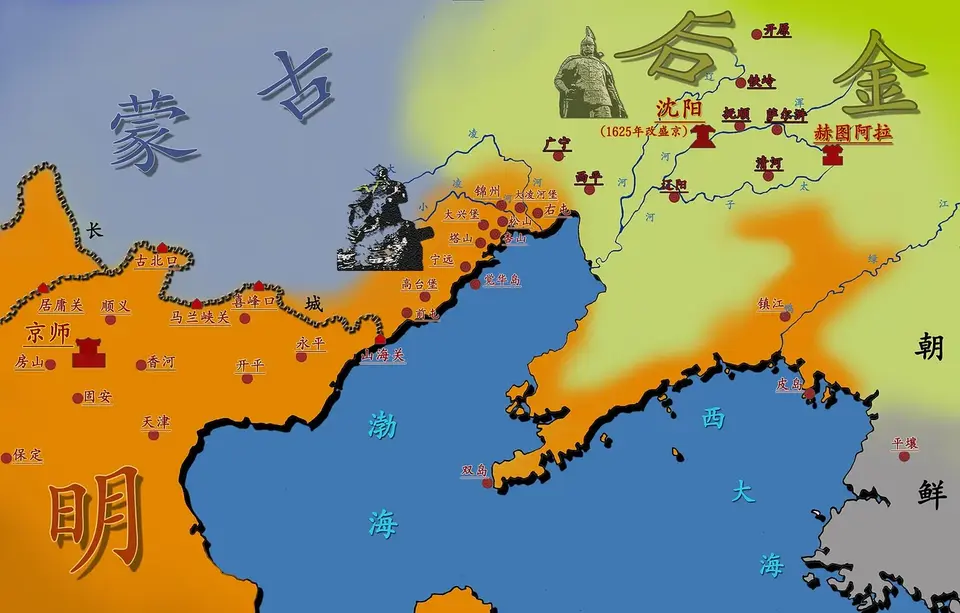
Following the fall of Shenyang and Liaoyang to Later Jin forces, Ming Grand Coordinator Yuan Chonghuan arrived to establish the forward defense line at Ningyuan. Recognizing He Kegang's scrupulous discipline, Yuan Chonghuan elevated him to his inner operational council. In early 1626, Nurhaci led over one hundred thousand Eight Banner troops to besiege Ningyuan. He Kegang mounted the ramparts alongside Yuan Chonghuan, directing heavy red-coat cannons that shattered enemy assault corridors and secured the historic Defense of Ningyuan. He Kegang was rewarded with promotion to Assistant Commander.
In May 1627, Hong Taiji launched a massive attack against Jinzhou. He Kegang fought alongside Zhao Shuijiao and Zu Dashou, holding the battlements through fifteen continuous days of fierce bombardment before launching counter-sorties that routed the besiegers, achieving the Great Victory of Ningjin. He was subsequently elevated to Senior Assistant Commander.
Fiscal Reform and Frontier Command
In 1628, the Chongzhen Emperor assumed the throne and recalled Yuan Chonghuan to supervise northeastern defense. Facing massive military expenditure and rampant padding of muster rolls by mercenary captains, Yuan Chonghuan entrusted the auditing of Ningyuan's army to He Kegang.
He Kegang personally inspected every barracks, cross-referencing troop registers against actual personnel and horses. He punished embezzling officers and discharged thousands of phantom listings, saving the imperial treasury over several hundred thousand taels of silver each year. Yuan Chonghuan petitioned the throne: "Among all generals, He Kegang combines humanity with valor, incorruptibility with unceasing diligence. He possesses no selfish ambition and is an invaluable pillar of the realm." The Chongzhen Emperor appointed He Kegang Assistant Commissioner-in-Chief and Vice Commander-in-Chief of Liaodong.
When Yuan Chonghuan was wrongfully imprisoned during the Jisi Incident of 1629, panic gripped the border army, and Zu Dashou withdrew eastward in dismay. He Kegang acted with profound statesmanship, helping Grand Preceptor Sun Chengzong pacify the Guanning cavalry and preventing the collapse of the northern defenses.
The Epic Defense of Dalinghe and Final Martyrdom
In August 1631, Sun Chengzong ordered Zu Dashou and He Kegang to construct a forward stronghold at Dalinghe to shield Jinzhou. As the fortification neared completion, Hong Taiji launched a surprise envelopment with ten thousand Eight Banner troops, constructing concentric lines of trenches and ramparts that completely sealed the fortress.
Zu Dashou and He Kegang led dozens of desperate breakouts, but every assault was halted by deep enemy entrenchments. A relief army of forty thousand Ming troops under Zhang Chun was annihilated thirty miles outside the perimeter. Dalinghe was starved for over three months. The garrison slaughtered all horses and mules, boiled saddles and leather armor for sustenance, and ultimately descended into horrifying cannibalism.
On the twenty-eighth day of the tenth month, Hong Taiji sent envoys offering high offices and hereditary titles if the garrison capitulated. Broken by despair, Zu Dashou and the surviving captains resolved to open the gates and surrender. He Kegang alone vehemently refused, rejecting all entreaties to abandon his sovereign. Drawing his sword, He Kegang proclaimed: "My family has received imperial favor for generations, and I hold the high rank of Vice Commander-in-Chief. If you wish to surrender, do so; I have only my death to offer the realm!"
He Kegang adjusted his official robes and armor, walked calmly to the sacrificial altar of Dalinghe, and faced south toward the imperial palace in Beijing. Bowing three times while weeping, he declared: "My strength is exhausted; I offer my life to repay Your Majesty!" He then submitted to execution with serenity. Deeply moved by his inflexible fidelity, Hong Taiji personally inspected his remains and ordered his elite guards to provide a cedar coffin, burying him with solemn ceremonial honors beside the Daling River. In 1776, the Qianlong Emperor conferred upon him the posthumous title of Liemin (Heroic and Commiserated).
Key Achievements
Critical Artillery Command at Ningyuan and Ningjin
Serving as Yuan Chonghuan's trusted tactical assistant, He Kegang directed devastating artillery barrages during the battles of Ningyuan and Ningjin, twice turning back full-scale Eight Banner invasions.
Anti-Corruption Military Reorganization at Ningyuan
Tasked with rectifying frontier finances, He Kegang audited troop rosters, eradicated fraudulent pay claims, and conserved hundreds of thousands of silver taels annually for the state treasury.
Uncompromising Martyrdom at Dalinghe
Surrounded and starved at Dalinghe, He Kegang stood completely alone in rejecting capitulation alongside Zu Dashou, dying an immortal martyr to uphold Confucian military honor.