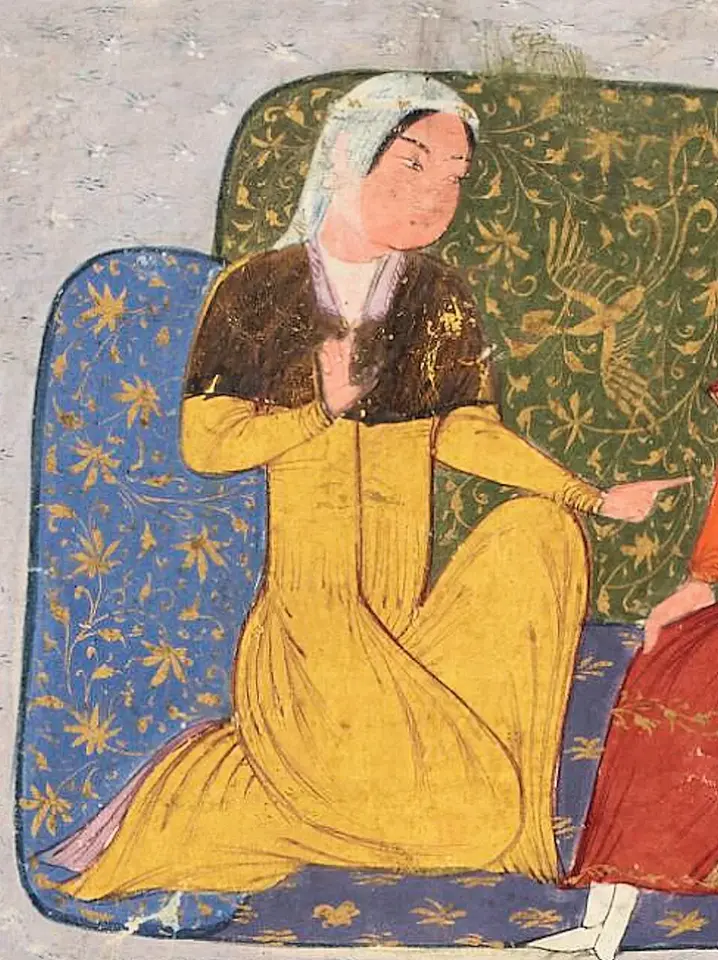
Biography
Abduction on the Steppe and the Birth of Temujin
Hoelun belonged to the aristocratic Olkhonud clan of the Onggirat tribe, celebrated for grace, beauty, and wisdom. During the Huangtong era, Chiledu, a noble warrior of the Merkit tribe, traveled to the Olkhonud to marry Hoelun. As the bridal carriage traveled along the Onon River toward the Selenga, Yesugei Baghatur of the Kiyad Mongols spotted the carriage while hunting with falcons. Struck by her beauty, Yesugei rode back to camp, returning with his brothers Nekun Taishi and Daritai Otchigin in pursuit.
Realizing that escape was impossible, Hoelun urged Chiledu to flee: 'They seek me, not you. If you remain, you will be slain! As long as you preserve your life, you can find another maiden across the steppe; flee swiftly!' She threw her blue undershirt to Chiledu as a farewell token. Chiledu galloped away, and Yesugei placed Hoelun in his carriage, escorting her to the Kiyad camp to become his principal wife.
In autumn 1162, Yesugei defeated the Tatars, capturing chieftain Temujin-Uge. Upon returning, Hoelun gave birth to a son at Deluun Boldog along the Onon River. In commemorative honor of the martial triumph, Yesugei named the infant Temujin. Over subsequent years, Hoelun gave birth to Jochi Qasar, Qachi'un, Temuge Otchigin, and her daughter Temulun, becoming the revered first lady of the Kiyad clan.
Abandonment in the Wilderness and Maternal Heroism
In 1171, Yesugei escorted nine-year-old Temujin to arrange a betrothal with the Onggirat, but was poisoned on his return journey by Tatars. Following his death, Targhutai Kiriltuk and fellow chieftains of the Tayichi'ud clan resolved to seize leadership of the Borjigin confederation before Yesugei's sons could reach adulthood.
The following spring, during ancestral sacrificial ceremonies, Tayichi'ud noblewomen intentionally excluded Hoelun from the distribution of sacrificial meats, inflicting severe public humiliation. The next morning, the Tayichi'ud incited the Kiyad subjects to strike camp and migrate northward, deserting the widows and orphans. When elders protested, they were silenced by drawn spears. Infuriated by this treachery, Hoelun mounted a warhorse, seized Yesugei's white-tailed standard, and rode alone after the fleeing tribesmen, shaming half of the deserters into returning. However, under renewed threats from Targhutai, the clansmen soon slipped away again.
Hoelun was left along the Onon River with Yesugei's secondary wife Sochigel, six young sons, and an infant daughter. In the face of freezing blizzards and prowling wolves, Hoelun displayed legendary maternal heroism. Girding her skirts and wielding a sharpened juniper stick, she gathered wild garlic, onions, mountain lilies, and roots daily. In winter, she chopped through thick river ice, teaching her sons to weave willow fish-traps to catch salmon and loaches. Through pure resilience and foraging, this indomitable mother preserved the future rulers of the Mongol Empire.
Family Precepts and Moral Instruction
Throughout years of isolation, Hoelun nurtured her sons with uncompromising moral precepts. She recounted ancestral histories, instilling the sacred duty of restoring the Kiyad clan and demanding unbreakable solidarity among brothers. When Temujin and Qasar shot their half-brother Bekter over a hunting dispute, Hoelun was devastated. She fiercely rebuked them: 'You rebellious sons! You act like vicious dogs leaping at their own shadows, like savage panthers attacking their own kin! Before our Tayichi'ud enemies are vanquished, you slaughter your own flesh and blood!' Her thunderous tears shamed Temujin and Qasar into swearing a solemn oath never again to harm their brothers.
As Temujin unified the steppe, Hoelun managed the rear encampments. Exhibiting boundless compassion, she adopted four war orphans rescued from defeated tribes: Kuku from the Merkit, Shigi Qutuqu from the Tatars, Kokochu from the Besüt, and Borokhul from the Jurkin. Nurturing them as her own sons, she raised them to become the renowned 'Four Adopted Sons,' who served as Supreme Justices and senior marshals of the realm.
Defending Qasar and Late Imperial Honors
Upon founding the Mongol Empire in 1206, Genghis Khan honored his mother as Queen Mother, apportioning ten thousand subjects and extensive pasturelands to Hoelun and Prince Temuge. Soon after, chief shaman Teb Tenggeri sought to undermine the royal house, slandering Qasar by claiming heaven favored him for the throne. Genghis Khan imprisoned Qasar, stripping him of his belt and cap.
Informed of the crisis at midnight, the nearly seventy-year-old Hoelun harnessed a white camel cart and raced through the freezing night to Genghis Khan's camp. Entering the yurt at dawn as the interrogation proceeded, the Queen Mother unveiled her bared breasts, demanding: 'Temujin! Look upon these breasts! These are the very breasts that nourished you both! From this breast you drew wisdom and courage, while Qasar drew strength and archery prowess! When enemies surrounded us, without Qasar's bow, could you possess this throne? Now that the empire is established, you heed a wicked sorcerer to destroy your own brother!'
Overcome with shame, Genghis Khan fell to his knees in apology: 'I have sinned! Let my mother cease her wrath!' He released Qasar immediately. Hoelun's dramatic intervention shattered the shaman's conspiracy, preserving the unity of the imperial family.
In 1221, while Genghis Khan campaigned in Central Asia, Hoelun passed away peacefully along the Onon River at age eighty. In 1266, Kublai Khan enshrined her as Empress Xuanyi.