Defense of Huaishuo
The Six Garrisons Rebellion erupted; defended Huaishuo Garrison alongside his father and brothers
?–544 CE
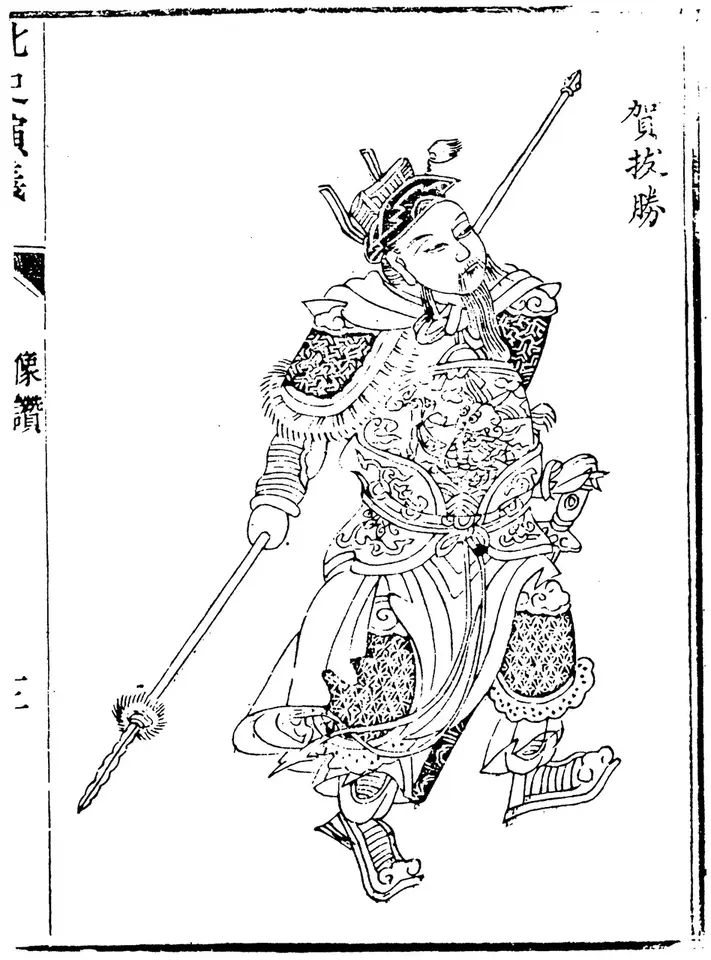
贺拔胜
Heba Sheng (贺拔胜, ?–544), courtesy name Pohu, was a native of Jianshan in Shenwu (present-day Shenchi County, Shanxi) who registered his household at Wuchuan Garrison. He was an eminent supreme military commander and founding pillar of the Western Wei dynasty during the Northern and Southern Dynasties, the second son of Wuchuan Garrison Commander Heba Duba and the elder brother of Guanlong commander Heba Yue. Celebrated across…
Heba Sheng (贺拔胜, ?–544), courtesy name Pohu, was a native of Jianshan in Shenwu (present-day Shenchi County, Shanxi) who registered his household at Wuchuan Garrison. He was an eminent supreme military commander and founding pillar of the Western Wei dynasty during the Northern and Southern Dynasties, the second son of Wuchuan Garrison Commander Heba Duba and the elder brother of Guanlong commander Heba Yue. Celebrated across the northern frontiers in his youth for his equestrian archery, audacity, and chivalric honor, he defended Huaishuo Garrison during the Six Garrisons Rebellion alongside his father and brothers, leading a daring cavalry breakout to seek relief and subsequently slaying the insurgent leader Wei Kegu. Joining the service of Erzhu Rong, he helped enthrone Emperor Xiaozhuang (Yuan Ziyou) in Luoyang and was created Duke of Zhending County. In 529, he accompanied Erzhu Zhao on a night crossing of the Yellow River at Xiashi to destroy Yuan Hao, being appointed General of Martial Defense. Following the destruction of the Erzhu faction in 532, he pledged allegiance to Emperor Xiaowu and was appointed Regional Inspector of Jingzhou and Left Vice Director of the Southern Route Branch Secretariat, consolidating imperial control across the Han River basin. When Northern Wei fractured in 534, Heba Sheng mobilized his southern armies to defend Emperor Xiaowu against Gao Huan, but his headquarters were overrun in a rear assault by Hou Jing, compelling him to seek temporary asylum in Southern Liang. Deeply impressed by his unbending integrity, Emperor Wu of Liang permitted him to return north in 536. Reaching Chang'an, Heba Sheng was appointed Grand Preceptor and Manager of the Affairs of the Imperial Secretariat and created Duke of Langye Commandery, governing the Western Wei state alongside Chancellor Yuwen Tai. He subsequently spearheaded battlefield victories at Xiaoguan, Shayuan, Heqiao, and Yubi. During the Battle of Mount Mang in 543, Heba Sheng personally led an elite cavalry strike to chase Gao Huan for several li, nearly impaling the Eastern Wei dictator before his mount was killed by a stray arrow. In vengeance, Gao Huan massacred all of Heba Sheng's sons remaining in Eastern Wei. Overcome by grief and indignation, Heba Sheng fell critically ill and passed away in 544. He was posthumously honored as Grand Chancellor and Manager of the Affairs of the Imperial Secretariat with the posthumous name Zhenxian, and was later accorded ancestral temple enshrinement alongside Yuwen Tai.
The Six Garrisons Rebellion erupted; defended Huaishuo Garrison alongside his father and brothers
Led thirteen elite horsemen to break through encirclement to seek relief from Yuan Yu, returning through enemy lines
Ambushed and decapitated the insurgent general Wei Kegu with his father; appointed Wave-Subduing General
Separated from his kin amidst fighting in Hengzhou; rode south to join Erzhu Rong's standard
Accompanied Erzhu Rong into Luoyang to enthrone Emperor Xiaozhuang; created Duke of Zhending County
Crossed the Yellow River at night to crush Yuan Hao's army; promoted to General of Martial Defense
Refused to join the Erzhu rebellion after Erzhu Rong's execution; galloped to Emperor Xiaozhuang's defense
Surrendered to the throne after Hanling; appointed Regional Inspector of Jingzhou and Southern Route Director
Advanced north to aid Emperor Xiaowu; after Hou Jing took his rear base, he retreated into Southern Liang
Permitted by Emperor Wu of Liang to depart; trekked thousands of li through mountain ravines to reach Chang'an
Aided Yuwen Tai in slaying Dou Tai at Xiaoguan and routed Gao Huan's army of two hundred thousand at Shayuan
Commanded shock cavalry to break the Eastern Wei frontline at Heqiao, capturing thousands of enemy troops
Appointed Vanguard Grand Commander-in-Chief to pursue Gao Huan's retreating armies north of the Fen River
Led three thousand shock cavalry to spear Gao Huan, chasing him for miles before his mount was killed
Succumbed to illness after Gao Huan murdered his sons in the east; posthumously honored as Grand Chancellor
Heba Sheng, courtesy name Pohu, traced his ancestral roots to Jianshan in Shenwu. His lineage belonged to an illustrious military family of Tiele descent that settled at Wuchuan Garrison along the northern frontier under the Northern Wei dynasty. His grandfather, Heba Ertou, was celebrated for his exceptional equestrian archery and mobility, entering frontier service as a warrior from a respectable house. During the reign of Emperor Xianwen (Tuoba Hong), Rouran raiders frequently pillaged the northern border. Ertou led light cavalry into the northern wastes on reconnaissance over eighty times, identifying enemy ambush corridors and deterring nomad incursions, for which he was granted the noble title Marquis of Longcheng. His father, Heba Duba, was resolute and proficient in weapons, serving successively as Garrison Commander and Unit Commander at Wuchuan.
Born amidst frontier alarms, Heba Sheng was quiet, reflective, and endowed with lofty ambitions and unwavering integrity. He was celebrated across the northern borders not only for his ability to shoot with either hand from galloping horseback but also for his cool-headed tactical audacity. He and his brothers—elder brother Heba Yun and younger brother Heba Yue—were renowned for their immense physical strength, chivalric generosity, and martial skill, attracting numerous frontier warriors to their banner. In March 523, nomadic soldiers led by Poluohan Baling rebelled at Woye Garrison against the extortion of frontier officials, sparking the catastrophic Six Garrisons Rebellion. The insurgents overran Woye and converged upon Huaishuo and Wuchuan. Recognizing the extraordinary martial talents of the Heba family, Yang Jun, the garrison commander of Huaishuo, promoted Heba Duba to Garrison Commander and appointed all three brothers as Unit Commanders to defend the mountain passes.
In 524, Wei Kegu, a subordinate general of Poluohan Baling, encircled Huaishuo Garrison with tens of thousands of insurgent troops. Isolated in the northern wastes without provisions or external communication, the garrison held out for more than a year under extreme deprivation. Garrison commander Yang Jun fell critically ill from exhaustion and convened his officers to request a volunteer to break through the encirclement to petition the imperial court for relief. Confounded by the surrounding enemy masses, the assembled commanders remained silent. Though only in his early twenties, Heba Sheng stepped forward to undertake the mission. Selecting thirteen fearless horsemen from his personal guard, Heba Sheng lowered his detachment from the battlements under cover of darkness. Muffling their mounts, they charged through enemy patrols, cut through multiple cordons of cavalry, and galloped night and day across hundreds of li to reach Bingzhou, where Heba Sheng presented an impassioned plea to Prince of Linhuai Yuan Yu. Impressed by his imposing physique and articulate loyalty, Yuan Yu promised immediate military relief.
Fearing for the survival of his father and brothers, Heba Sheng refused to await the slow assembly of the relief army and immediately turned back toward Huaishuo with his thirteen riders. Reaching the outskirts of the besieged fortress, they found the enemy lines even denser than before. Heba Sheng let out a fierce battle cry, charged headlong through the rebel formations, cut down dozens of enemy horsemen, and fought his way back inside the citadel. The beleaguered defenders wept with joy, their morale instantly revived. However, the imperial relief columns hesitated to advance, and Huaishuo finally succumbed to starvation in May. Heba Sheng and his kin withdrew to Wuchuan, which was likewise overwhelmed by Wei Kegu, resulting in the capture of Heba Duba and his sons. In captivity, the Heba family feigned submission while secretly coordinating with Yuwen Hong and former officers of Prince of Guangyang Yuan Yuan. In the winter of 524, noticing that Wei Kegu had relaxed his bodyguard during an inspection tour, Heba Duba and Heba Sheng ambushed the rebel chieftain. Heba Sheng charged from concealment with spear in hand, slaying Wei Kegu and scattering his followers. Although Heba Duba was mortally wounded during the melee, Heba Sheng's triumph reversed the northern military situation. The imperial court acknowledged his valor, commissioning him as Garrison Commander and Wave-Subduing General.
Following the demise of Wei Kegu, northern border conditions deteriorated further. In the autumn of 525, Poluohan Baling regrouped his insurgent forces and swept south, forcing Yuan Yuan to retreat. Heba Sheng was separated from his brothers during the confusion of combat. Breaking out alone to Sizhou, he learned that Erzhu Rong was gathering prominent northern warriors in Xiurongchuan and rode to offer his sword. Having long admired the martial reputation of the Heba brothers, Erzhu Rong welcomed Heba Sheng with open arms, placing him in charge of his bodyguard as General of Far-Reaching Pacification and Infantry Colonel.
In April 528, Empress Dowager Hu poisoned Emperor Xiaoming, plunging the court at Luoyang into chaos. Erzhu Rong seized the opportunity to march south. Heba Sheng accompanied the advance, assisting in the enthronement of Yuan Ziyou as Emperor Xiaozhuang. Following the tumultuous Heyin Incident, Heba Sheng was ennobled as Count of Yiyang County with a fief of five hundred households. In September, Yuan Hao advanced toward Hulao backed by Southern Liang forces, throwing Luoyang into panic. Serving as Grand Commander-in-Chief, Heba Sheng engaged the rebel vanguard at Henai and was promoted to Duke of Zhending County with an augmented fief of one thousand households.
In the summer of 529, Yuan Hao occupied Luoyang under the protection of Southern Liang general Chen Qingzhi, forcing Emperor Xiaozhuang to flee north. Erzhu Rong marched south to recover the capital, but found his crossing blocked along the Yellow River by heavy southern fortifications. Confronting food shortages, Erzhu Rong contemplated retreat. Operating on the frontlines alongside Grand Commander-in-Chief Erzhu Zhao, Heba Sheng reconnoitered the northern bluffs and identified a hidden crossing at the precipitous cliffs of Xiashi. Overseeing the assembly of timber rafts, Heba Sheng led hundreds of shock troops across the roaring river under cover of a torrential nocturnal storm. Scaling the southern cliffs, Heba Sheng launched a surprise assault on Yuan Hao's river encampment, routing the defenders and enabling the main army to cross and recapture Luoyang. For his decisive tactical initiative, Emperor Xiaozhuang appointed Heba Sheng as General of Martial Defense and General of the Right Guard to command the metropolitan garrison.
In September 530, Emperor Xiaozhuang executed Erzhu Rong in the Mingguang Palace. Erzhu Shilong and Erzhu Zhao mobilized forces to besiege the imperial palace. Stationed in an exterior encampment, Heba Sheng received messengers from Erzhu Shilong demanding his participation in the uprising. Refusing to violate his dynastic oaths, Heba Sheng led his troops away from the rebels and marched directly into the Northern Palace to defend the emperor. Deeply moved, Emperor Xiaozhuang took his hand and declared that with Heba Sheng present, the throne had no fears, promptly appointing him Palace Attendant, Agile Cavalry Grand General, and Central Army Grand Commander-in-Chief.
However, the imperial garrison was heavily outnumbered, and Erzhu Zhao captured Luoyang in December, murdering Emperor Xiaozhuang and placing Heba Sheng under arrest. Remembering their past comradeship and fearing the influence of the Heba clan, Erzhu Zhao refrained from executing him and kept him on military staff. In 531, Gao Huan revolted against the Erzhu clan at Xindu. In 532, at the decisive Battle of Hanling, Gao Huan routed the combined Erzhu armies. Recognizing that the Erzhu cause was doomed, Heba Sheng defected on the battlefield with his divisions, facilitating Gao Huan's entry into Luoyang.
In April 532, Gao Huan enthroned Yuan Xiu as Emperor Xiaowu, establishing his autocratic headquarters at Jinyang. Determined to resist becoming a figurehead, Emperor Xiaowu sought allies among provincial commanders. With Heba Sheng's younger brother Heba Yue already commanding the western armies in Guanlong, the emperor required a powerful ally along the southern corridor to counterbalance Jinyang. In January 533, Emperor Xiaowu appointed Heba Sheng as Commander-in-Chief of Military Affairs in Seven Southern Provinces, Agile Cavalry Grand General, Regional Inspector of Jingzhou, and Left Vice Director of the Southern Route Branch Secretariat. Operating from Wancheng, Heba Sheng revitalized local agriculture, accommodated displaced northern refugees, and repelled Southern Liang frontier raids, forming a strategic pincer with his brother Heba Yue against Gao Huan.
In February 534, Gao Huan orchestrated the assassination of Heba Yue in Guanlong through Houmochen Yue. However, Yuwen Tai quickly assumed command of Heba Yue's army, eliminated the assassin, and preserved the western defensive axis. Devastated by his brother's murder, Heba Sheng swore vengeance against Gao Huan. In June, Emperor Xiaowu broke openly with Gao Huan and issued a secret decree summoning Heba Sheng to lead his southern divisions north to Luoyang for a joint offensive.
Heba Sheng immediately mobilized his troops. Staff officer Lu Rou presented strategic options, urging him either to march with all available troops directly to Luoyang or to consolidate Jingzhou while coordinating with Guanlong. Choosing immediate loyalty, Heba Sheng pushed forward with his vanguard. However, before he reached Xiyang, Gao Huan's cavalry broke across the Yellow River, forcing Emperor Xiaowu to flee west to Chang'an. Concurrently, Gao Huan dispatched Hou Jing on a lightning raid against Wancheng, overrunning Heba Sheng's rear base. Surrounded and cut off, Heba Sheng was forced to lead his remaining troops across the Han River into Southern Liang territory.
Emperor Wu of Liang received Heba Sheng with the highest state honors in Jiankang, bestowing private estates and domestic attendants. During his three years in the southern capital, Heba Sheng lived austerely, dressed in military garments, and repeatedly petitioned Emperor Wu for several tens of thousands of southern troops to march north against Gao Huan. Although diplomatic constraints prevented Emperor Wu from launching a joint campaign, the Liang sovereign deeply admired his unswerving fidelity to his fallen dynasty, promising to facilitate his return once geopolitical conditions allowed.
In 536, Yuwen Tai enthroned Yuan Baoju as Emperor Wen of Western Wei in Chang'an, while Gao Huan established Eastern Wei at Yecheng. Eager to return north, Heba Sheng and his officers petitioned through Liang courtier Zhu Yi. With Yuwen Tai actively dispatching envoys to negotiate his repatriation, Emperor Wu kept his word and permitted Heba Sheng to depart.
Fearing Heba Sheng's military talent, Gao Huan ordered Hou Jing to deploy thousands of cavalry along the Xiangyang corridors to assassinate him. Realizing that the main highways were blocked, Heba Sheng and Lu Rou abandoned their boats and plunged into the mountainous wilderness along the Han River. Trekking through relentless autumn rains and swollen mountain torrents, they carried provisions on foot across hundreds of li. More than half of their retainers succumbed to starvation and exposure, but Heba Sheng pressed onward, successfully crossing the Eastern Wei blockades to arrive in Chang'an. Emperor Wen and Chancellor Yuwen Tai rode outside the metropolitan walls to receive him with tears of joy. In the winter of 536, Heba Sheng was appointed Grand Preceptor and Manager of the Affairs of the Imperial Secretariat and created Duke of Langye Commandery.
Having held superior military prestige and seniority over Yuwen Tai during their early frontier careers, Heba Sheng initially treated the chancellor with cold formality. Yuwen Tai handled the tension with supreme tact, treating Heba Sheng with the deference due to an elder brother and teacher. During an imperial excursion at Kunming Lake, Yuwen Tai observed a pair of wild ducks swimming in the water and handed his composite bow to Heba Sheng, asking him to demonstrate his archery. Drawing the bow, Heba Sheng released a single arrow that pierced the necks of both birds simultaneously. Amidst thunderous applause from the assembled generals, Heba Sheng lowered his bow and bowed deeply to Yuwen Tai, declaring that he wished to serve the chancellor in exterminating the enemies of the state just as his arrow had struck the target. Yuwen Tai embraced him, and from that moment Heba Sheng dedicated himself unreservedly to Western Wei.
In early 537, Eastern Wei general Dou Tai launched a surprise offensive toward Tongguan. Heba Sheng accompanied Yuwen Tai on a rapid counter-march through Xiaoguan, personally slaying Dou Tai in the frontline assault and being promoted to Central Army Grand Commander-in-Chief. In October 537, Gao Huan invaded with two hundred thousand troops, advancing to Shayuan. Yuwen Tai concealed his outnumbered forces in the dense marshes. When the battle opened, Heba Sheng commanded the armored cavalry on the right wing, cutting the extended Eastern Wei line in half and inflicting thousands of casualties. Following the victory, Heba Sheng pursued the retreating enemy to Puban, capturing enemy general Xue Chongli and securing the eastern bank of the Yellow River.
In 538, Heba Sheng commanded shock cavalry at the Battle of Heqiao, shattering the Eastern Wei vanguard and securing thousands of prisoners. In 542, when Gao Huan failed to take the fortress of Yubi and retreated, Heba Sheng was appointed Vanguard Grand Commander-in-Chief, pursuing the northern army north of the Fen River.
In March 543, Western and Eastern Wei clashed in the cataclysmic Battle of Mount Mang near Luoyang. With the western formations wavering under intense pressure, Yuwen Tai spotted Gao Huan's crimson banner across the field. Selecting three thousand elite shock cavalry, Yuwen Tai entrusted command to Grand Preceptor Heba Sheng with orders to execute a decapitation strike. Donning polished armor and grasping an eighteen-foot steel cavalry spear, Heba Sheng led the cavalry into the heart of Gao Huan's headquarters. Skewering dozens of imperial bodyguards, Heba Sheng came face to face with Gao Huan, shouting his defiance as he spurred his mount forward. Terrified, Gao Huan fled on horseback with Heba Sheng in pursuit for several li, the spearhead brushing the back of the dictator's cloak. Just as Heba Sheng prepared to strike, Eastern Wei marksman Duan Shao fired an arrow from the flank that pierced the throat of Heba Sheng's horse, bringing it down. By the time a remount was brought forward, Gao Huan had escaped into his defensive lines. Heba Sheng struck the ground with his spear, lamenting that fate had intervened to spare his mortal enemy.
Having narrowly escaped death at Mount Mang, Gao Huan harbored pathological hatred toward Heba Sheng and feared his vengeance. To eliminate all future threats from the Heba lineage, Gao Huan ordered the extermination of all of Heba Sheng's sons and close kin remaining in Eastern Wei territory.
When news of the slaughter reached Chang'an, Heba Sheng collapsed in agony. Having spent his entire life in military campaigns, he was devastated by the murder of his family. He wept day and night, falling into deep physical and emotional exhaustion. Despite personal visits from Emperor Wen and Yuwen Tai and the attention of the foremost imperial physicians, his condition deteriorated steadily. In 544, Heba Sheng passed away in his Chang'an residence.
The Western Wei court suspended all imperial assemblies. Emperor Wen and Yuwen Tai attended his funeral in person, posthumously conferring the offices Envoy Holding the Tally, Palace Attendant, Grand Chancellor, Manager of the Affairs of the Imperial Secretariat, Commander-in-Chief of Military Affairs in Ten Provinces, and Regional Inspector of Dingzhou, granting the posthumous name Zhenxian. Following the founding of the Northern Zhou dynasty, Emperor Ming issued an imperial decree in 558 conferring upon Heba Sheng the honor of ancestral temple enshrinement alongside Emperor Wen (Yuwen Tai).
In 524, during the siege of Huaishuo Garrison, Heba Sheng volunteered to break through dense rebel lines with thirteen riders to seek imperial relief in Bingzhou. After securing military commitments, he galloped back through enemy cordons into the isolated citadel, restoring the morale of the defenders and establishing an enduring legend of martial audacity.
Following the fall of Wuchuan, Heba Sheng coordinated with his father to stage an armed uprising from within captivity. Striking with surprise against superior numbers, he personally slew insurgent supreme leader Wei Kegu, disintegrating the northern rebel coalition and turning the tide of the early northern rebellion.
In 529, when the imperial reconquest of Luoyang was stymied by the Yellow River, Heba Sheng reconnoitered the treacherous bluffs of Xiashi, constructed timber rafts, and led shock troops across the river at night. Scaling the cliffs, he surprised Yuan Hao's encampments, securing a crossing that enabled the recovery of the imperial capital.
Governing Wancheng during the closing years of Northern Wei, Heba Sheng developed local agricultural reserves, integrated displaced populations, and pushed back Southern Liang frontier forces across the Han River basin, constructing a formidable strategic defense that protected Emperor Xiaowu's southern flank.
Refusing luxurious retirement in Southern Liang, Heba Sheng traversed thousands of li on foot through mountain ravines and swollen rivers, braving starvation and enemy ambushes to reach Chang'an, demonstrating unmatched loyalty to the dynastic cause.
Upon arriving in Chang'an, Heba Sheng demonstrated his marksmanship by shooting down two swimming wild ducks with a single arrow at Kunming Lake. This feat symbolized his total reconciliation with and commitment to Yuwen Tai, providing the foundational cohesion for the Guanlong military leadership.
During the critical confrontation at Shayuan in 537, Heba Sheng commanded the right-wing cavalry strike that severed Gao Huan's two-hundred-thousand-strong host, capturing tens of thousands of prisoners and securing Western Wei's survival.
At Mount Mang in 543, Heba Sheng led three thousand shock cavalry into the enemy center, engaging in single-handed pursuit of Gao Huan for miles. His spear nearly reached the dictator's back before his horse was shot down, demonstrating an extraordinary standard of personal martial courage.
Throughout thirty years of command, Heba Sheng shared identical rations and exposure with his soldiers, never entering his tent until the camp was established and personally guarding the rearguard during retreats, earning the absolute devotion of his troops.
Heba Sheng's early military support and moral prestige were instrumental in establishing Western Wei and shaping the Guanlong aristocracy. In recognition of his foundational contributions, Northern Zhou granted him temple enshrinement alongside Yuwen Tai.
During three years in Jiankang, Heba Sheng resisted all southern inducements, persistently requesting troops to campaign north, leaving an inspiring historical standard of unyielding ministerial fidelity.
By subordinating his superior seniority to Yuwen Tai, Heba Sheng unified the northern frontier factions and local elite houses, forging the political and military cohesion that enabled Western Wei to withstand Eastern Wei and pave the way for the Sui and Tang reunifications.
Heba Sheng was celebrated across early medieval China as the supreme practitioner of mounted archery and heavy cavalry tactics, combining bilateral precision archery with heavy lance charges to establish the classic warrior archetype of the northern dynasties.
FIGURES ASSOCIATED WITH THIS DYNASTY