Captivity in Childhood
Captured at age six during Khitan border incursions into Jizhou; claimed by Shulü Ping's brother Yuwen, and subsequently brought into Yelü Abaoji's tent as a dowry attendant.
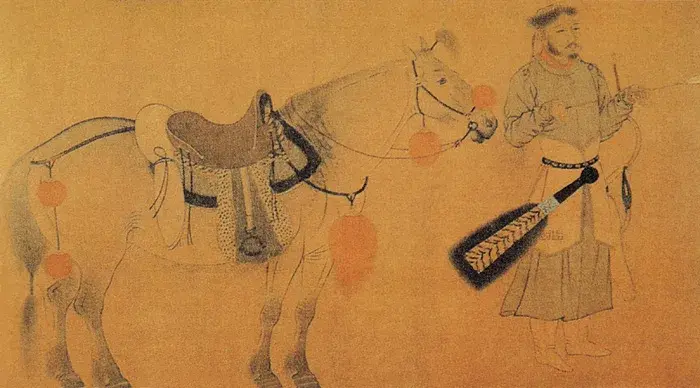
韩知古
Han Zhigu (韩知古, c. 880s – 926–937), a native of Yutian, Jizhou (modern Yutian County, Hebei Province), was a preeminent founding statesman, chancellor, political strategist, and institutional innovator of the Liao Dynasty. He served as a trusted advisor and leading founding meritorious official to Emperor Taizu of Liao (Yelü Abaoji). Born into a Chinese gentry household in Jizhou, he was captured at the age of six during…
Han Zhigu (韩知古, c. 880s – 926–937), a native of Yutian, Jizhou (modern Yutian County, Hebei Province), was a preeminent founding statesman, chancellor, political strategist, and institutional innovator of the Liao Dynasty. He served as a trusted advisor and leading founding meritorious official to Emperor Taizu of Liao (Yelü Abaoji). Born into a Chinese gentry household in Jizhou, he was captured at the age of six during border raids by the Khitans and assigned as a dowry attendant to Shulü Ping when she wed Yelü Abaoji of the Yila tribe. Endowed with extraordinary strategic foresight and broad vision, Han eventually won Abaoji's deep trust, rising to become the premier architect of the nascent Khitan state's bureaucratic transition. During the foundational era of the Liao Dynasty, Han Zhigu played an indispensable role in transforming nomadic tribal customs into an imperial autocracy. He decisively persuaded Abaoji to abolish the traditional tribal practice of vacating the khaganate every three years, establishing a hereditary imperial monarchy and adopting imperial era names. As Commissioner in Charge of Han Affairs, he directed the construction of the Zhangwu Army commandery at Bazhou in Liucheng, successfully settling thousands of displaced Han and Xi populations and securing an agrarian economic base. Combining Chinese classical precedents with Khitan nomadic customs, he formulated the dynasty's hybrid court rituals and diplomatic protocols. In the decisive campaign that conquered the Bohai Kingdom, Han co-commanded Han auxiliary forces to victory and was elevated to Director of the Chancellery. The Yutian Han clan he established became the most influential Han aristocratic lineage in the Liao Dynasty, ranking immediately below the imperial Yelü and consort Xiao clans.
Captured at age six during Khitan border incursions into Jizhou; claimed by Shulü Ping's brother Yuwen, and subsequently brought into Yelü Abaoji's tent as a dowry attendant.
Long unacknowledged despite his strategic talents, escaped to work as a common hired laborer; later recommended to Abaoji by his son Han Kuangsi and appointed Military Staff Advisor.
Accompanied Abaoji in subduing northern tribes; commissioned to clear congested judicial dockets and erected a victory stele at Daguang Temple in Longhuazhou; promoted to Left Vice Director.
Joined fellow Han officials in urging Abaoji to reject tribal replacement and assume imperial titles; supervised construction of the Zhangwu Army at Liucheng; appointed Military Commissioner.
Placed in supreme charge of the Han Affairs Bureau and tasked with codifying court and foreign protocol, synthesizing Han rites and Khitan customs into official state protocol.
Co-commanded the main body of Han infantry and cavalry forces during the eastward conquest of the Bohai Kingdom; elevated to Director of the Chancellery for military merits.
Passed away during the Tianxian era of Emperor Taizong; granted the exalted title Meritorious Official of Devoted Loyalty and Exertion, ranking foremost among Taizu's founding ministers.
Han Zhigu traced his ancestry to Yutian County in Jizhou. His grandfather Han Yi was an educated local gentleman who declined public office, while his father Han Rong served as an Administrative Assistant of Jizhou during the late Tang dynasty, establishing an honorable regional administrative heritage. During the chaotic twilight of the Tang, northern frontier commanderies were repeatedly ravaged by Khitan cavalry raids. In one such destructive assault on Jizhou, six-year-old Han Zhigu was captured and assigned as a war prize to Yuwen, an influential Khitan nobleman of the Yila tribe and elder brother of future Empress Shulü Ping.
When Shulü Ping married Yelü Abaoji, the Yila tribal chieftain, Han Zhigu accompanied her retinue into Abaoji's mobile headquarters as a subordinate attendant. Despite his menial status, Han was gifted with keen strategic discernment, studying classical governance and military strategy. However, because early Khitan tribal society prioritized horsemanship and martial prowess over book learning, Han found no opportunity to present his statecraft proposals to Abaoji and grew increasingly disheartened.
Refusing to surrender to an obscure fate, Han slipped away from the encampment, taking refuge across the border marches as a day laborer to secure basic livelihood while awaiting opportunity. His young son Han Kuangsi, known for his handsome appearance and agility, served inside Abaoji's personal quarters, earning the favor of both Abaoji and Empress Shulü Ping. Finding a propitious moment, Kuangsi informed Abaoji of his father's profound intellect and statecraft mastery. Astonished, Abaoji promptly dispatched couriers to summon Han Zhigu. Engaging in an extensive dialogue on geopolitical strategy and state formation, Abaoji was deeply impressed by Han's visionary grasp of imperial governance, immediately appointing him to his inner circle of strategic advisors.
Following the total collapse of the Tang dynasty, political structures across the northern steppe experienced seismic upheaval. Traditional Khitan custom mandated that the supreme khagan be chosen triennially through an assembly of the eight tribal chieftains, known as the "three-year replacement rule." Having served as khagan for nine years, Abaoji faced fierce armed revolts from his own younger brothers and neighboring tribal chieftains, who demanded that he surrender the standard and drum of authority.
At this critical crossroads, Han Zhigu, well-versed in Chinese imperial institutions of centralized autocratic power, joined fellow Han scholar-officials in submitting urgent memorials to Abaoji. Han vigorously argued against the instability of tribal fragmentation and detailed the decisive advantages of hereditary imperial rule, urging Abaoji to reject the replacement custom, eliminate rebellious chieftains, and declare himself emperor following Chinese dynastic models. Abaoji adopted his counsel, crushed the tribal insurrections, and ascended the imperial throne in 916 as Emperor Taizu of the Great Khitan State, marking the historic transition of the Khitans from a nomadic confederation into a bureaucratic dynastic empire.
To absorb the massive influx of Han and Xi populations captured during continuous campaigns in the Yan-Ji frontier, Han Zhigu was commissioned in 916 to construct the Zhangwu Army citadel at the former site of Liucheng (modern Chaoyang, Liaoning). Han laid out urban walls, assigned homesteads, distributed grain to destitute refugees, and organized large-scale agrarian cultivation. Under his stewardship, the border territory was transformed into a prosperous farming hub that reliably provisioned Khitan armies. In recognition of his administrative accomplishments, he was invested as Military Commissioner of the Zhangwu Army.
In 918, as the territorial scope of the Liao empire broadened and the Han population expanded, Emperor Taizu placed even greater reliance on Han Zhigu, formally appointing him to head the Han Affairs Bureau. In this post, Han directed all civil registration, agricultural taxation, and judicial administration across the newly incorporated Han communities. Simultaneously, Abaoji entrusted him with the sensitive responsibility of managing foreign envoys and state protocol.
Prior to this appointment, Khitan tribal ceremonies had been notoriously rudimentary, lacking established ranks, court decorum, or diplomatic etiquette. Whenever foreign delegations arrived from neighboring states, court gatherings were chaotic and unstructured. Drawing deeply from classical Confucian ritual texts such as the Tang dynasty Kaiyuan Rites, Han skillfully pruned cumbersome pedantries while conscientiously incorporating indigenous Khitan nomadic traditions, including horse archery rituals and seasonal imperial migrations. The resulting dual-track ritual code established clear distinctions of court precedence, enhanced imperial dignity, and remained readily comprehensible to Khitan tribal subjects.
In 926, Emperor Taizu launched a massive campaign to conquer the neighboring Bohai Kingdom, an ancient state that had flourished for over two centuries with formidable mountain citadels. In this vital theater of operations, Han Zhigu and general Kang Moji were appointed to co-command the primary body of Han infantry and cavalry forces, serving as the vanguard of the imperial expeditionary army.
Throughout the grueling siege of the Bohai capital of Huhan and the capture of surrounding strategic prefectures, Han Zhigu demonstrated remarkable tactical poise, orchestrating troop movements and logistics to secure complete victory. Following the total capitulation of the Bohai Kingdom and its reorganization into the Dongdan Kingdom, Han was promoted to Director of the Chancellery (Zhongshu Ling), reaching the absolute pinnacle of ministerial power.
During the Tianxian era of Emperor Taizong, Han Zhigu passed away in office. To commemorate his monumental contributions to the foundation of the Liao dynasty, the court granted him the supreme honorific title Meritorious Official of Devoted Loyalty and Exertion, naming him among the foremost founding aides of Emperor Taizu with permanent sacrifices in the imperial ancestral temple. Rising from a captive dowry attendant to premier chancellor, Han Zhigu not only forged an enduring imperial structure but also founded the Yutian Han lineage, which would remain one of northern China's most powerful aristocratic clans for more than two centuries.
Han Zhigu's most decisive political achievement was enabling Emperor Taizu to break the entrenched Khitan custom of triennial khagan replacement, steering the regime toward centralized hereditary monarchy. In earlier Khitan confederacies, the khagan held temporary executive authority, subject to recall by council assemblies.
Facing intense armed defiance from conservative clan elders, Han advised Abaoji that with tens of thousands of Chinese agrarian subjects now under his sway, adopting a centralized bureaucratic monarchy was vital for dynastic durability. Han and fellow Chinese advisors supported Abaoji's strategic suppression of the rebellious chiefs, culminating in his assumption of the imperial throne in 916. This pivotal institutional shift replaced loose tribal alliances with a stable dynastic monarchy that endured for two centuries.
In civilian administration, Han Zhigu served as supreme director of the Han Affairs Bureau, functioning as a key pioneer of the Liao dynasty's dual-track administrative system, famously summarized as "governing Khitans with national customs and administering Han subjects with Chinese laws." Attempting to force nomadic pastoral customs upon millions of agricultural Chinese peasants would have triggered catastrophic insurrections.
Han established dedicated administrative bureaus to oversee household registration, tax revenues, grain production, and civil litigation according to Tang legal traditions, implementing benevolent taxation to reconcile the divergent interests of pastoral and farming populations. By constructing the Zhangwu Army citadel at Liucheng, he resettled war refugees into productive farming communities, creating a formidable logistical base for the dynasty's subsequent expansion into the Sixteen Prefectures of Yanyun.
In statecraft and cultural institutionalization, Han Zhigu distinguished himself by authoring the initial diplomatic and ceremonial codes of the Liao Dynasty. At the dawn of the empire, court procedures were crude and interactions with foreign emissaries were largely ad hoc.
Commissioned to oversee state protocol, Han adapted Tang ritual models to harmonize with Khitan seasonal travels, hunting assemblies, and ancestral customs. This ceremonial synthesis preserved imperial majesty while respecting steppe tribal identity, projecting imperial authority and winning diplomatic respect from neighboring realms including Goryeo, Silla, and the Later Tang.
FIGURES ASSOCIATED WITH THIS DYNASTY