韩通
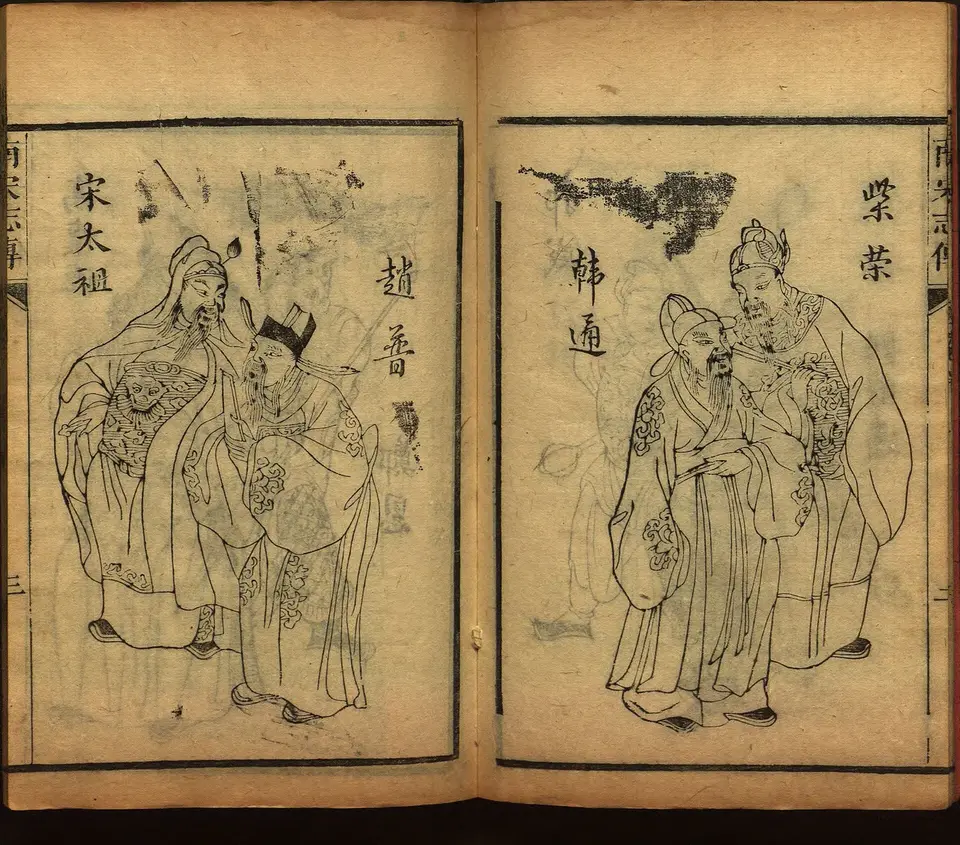
Historical portrait of Han Tong
Image credits清善成堂刻本 · Public domainImage source

Historical figure

Han Tong (韩通)

韩通

Han Tong (韩通, ?–960), courtesy name Zhongda, was a native of Taiyuan in Bingzhou (present-day Taiyuan, Shanxi). He was an illustrious military commander and a renowned loyalist martyr of the Later Zhou dynasty during the Five Dynasties and Ten Kingdoms period into the early Song dynasty. Enlisting in his youth on account of his extraordinary physical strength, he fought under Liu Zhiyuan. He was known for his unbending,…

Era not stated

PROFILE

Han Tong (韩通, ?–960), courtesy name Zhongda, was a native of Taiyuan in Bingzhou (present-day Taiyuan, Shanxi). He was an illustrious military commander and a renowned loyalist martyr of the Later Zhou dynasty during the Five Dynasties and Ten Kingdoms period into the early Song dynasty. Enlisting in his youth on account of his extraordinary physical strength, he fought under Liu Zhiyuan. He was known for his unbending, upright temperament and intimidating combat presence; because he fiercely glared at subordinates who breached discipline, soldiers respectfully and apprehensively nicknamed him "Staring Han." Emperor Taizu of Later Zhou (Guo Wei) valued him highly while governing Yedu, and upon founding the dynasty promoted him through commands including commander of the Hujie Army and military commissioner of Baoyi Army. Following the accession of Emperor Shizong (Chai Rong), Han Tong was appointed Police Inspector of the Imperial Metropolitan Cavalry and Infantry to overhaul palace military discipline following the Battle of Gaoping. Demonstrating immense organizational talent in engineering and military logistics, he supervised the flood-control embankments of the Yellow River and directed the construction of the new outer walls of Kaifeng, earning Shizong's deep trust through strict timeliness and flawless execution. During the three campaigns against Southern Tang and the northern offensive against the Liao dynasty, Han Tong commanded elite ground troops and riverine fleets to smash enemy lines, rising to Deputy Supreme Commander of the Imperial Metropolitan Cavalry and Infantry, Jointly Manager of Affairs with the Secretariat-Chancellery, and Military Commissioner of Zhaoyi Army, serving alongside Palace Inspector-General Zhao Kuangyin as one of the two paramount commanders of the imperial armies. In the first month of 960, Zhao Kuangyin staged the Chenqiao Mutiny, donning the yellow robe and leading his army back to Kaifeng. Amid the panic and passive capitulation of the central chancellors and civil officials, only Han Tong refused to yield. Galloping from the imperial palace, he sought to muster his loyal troops to crush the mutineers and defend the dynastic altars. Pursued by Zhao Kuangyin's cavalry officer Wang Yansheng, Han Tong was assassinated before he could organize a defense, and his family was slaughtered. After ascending the throne to found the Song dynasty, Emperor Taizu admired his unyielding integrity, posthumously conferring upon him the office of Director of the Chancellery and burying him with the grand honors of an imperial chancellor.

Courtesy Name
Zhongda
Native Place
Taiyuan, Bingzhou (present-day Taiyuan, Shanxi)
Date of Death
960 (Seventh year of the Xiande era, Later Zhou / First year of the Jianlong era, Song)
Highest and Primary Offices
Deputy Supreme Commander of the Imperial Metropolitan Cavalry and Infantry, Jointly Manager of Affairs with the Secretariat-Chancellery, Military Commissioner of Zhaoyi Army, posthumously Director of the Chancellery
Accurate Identity Orientation
Senior statesman, general, and supreme palace guard commander of Later Zhou; only commander to offer armed resistance and die a martyr during the Chenqiao Mutiny

LIFE TIMELINE

Relationship graph

BIOGRAPHY

Chronology

  • ca. 908 (Tianyou era of Tang) | Military Enlistment | Born in Taiyuan, Bingzhou, joining the army as an archer-cavalryman under Liu Zhiyuan due to martial prowess.
  • 948 (First year of the Qianyou era, Later Han) | Service at Yedu | Appointed Supreme Officer of Cavalry and Infantry in the Tianxiong Army upon Guo Wei's petition, enforcing strict discipline.
  • 951 (First year of the Guangshun era, Later Zhou) | Command of Hujie Corps | Promoted to Right Wing Commander of the Hujie Army upon Later Zhou's founding, later serving as Military Commissioner of Baoyi Army.
  • 954 (First year of the Xiande era, Later Zhou) | Imperial Guard Overhaul | Appointed Police Inspector of the Metropolitan Guards following the Battle of Gaoping under Emperor Shizong.
  • 955 (Second year of the Xiande era, Later Zhou) | Hydraulic and Wall Works | Directed the containment of Yellow River breaches and oversaw the building of Kaifeng's new outer walls and canal transport.
  • 956 (Third year of the Xiande era, Later Zhou) | Huainan Campaigns | Led frontline ground and river forces during Shizong's expeditions against Southern Tang, repeatedly defeating enemy forces.
  • 958 (Fifth year of the Xiande era, Later Zhou) | Chancellor and Deputy Commander | Elevated to Deputy Supreme Commander of Imperial Metropolitan Forces, Chancellor, and Military Commissioner of Zhaoyi Army.
  • 959 (Sixth year of the Xiande era, Later Zhou) | Northern Expedition Vanguard | Commanded the northern naval vanguard during Shizong's campaign against the Liao, swiftly capturing Mozhou and Yingzhou.
  • 960 (Seventh year of the Xiande era, Later Zhou) | Martyrdom Resisting Mutiny | Galloped from court to rally troops against the Chenqiao Mutiny; assassinated at his residence and posthumously granted Director of the Chancellery.

Life and Career

Resolute Soldier and Service under Zhou Taizu

Han Tong was born in Taiyuan, Bingzhou. From an early age, he possessed a towering stature, immense physical strength, and exceptional mastery of heavy weaponry and powerful composite bows. During the incessant warfare of the late Five Dynasties, the young Han Tong enlisted in the regional garrison of Hedong, quickly rising through the ranks by virtue of his valor in combat.

In command and combat, Han Tong exhibited an unyielding, severe character. Whenever soldiers breached military law or wavered in battle, he would glare with wide, blazing eyes, striking fear into observers. The rank-and-file respected his strength and impartiality while dreading his strictness, privately calling him "Staring Han."

During the Tianfu era of Later Jin, Liu Zhiyuan governed Jinyang. Recognizing Han Tong's strict discipline and combat audacity, Liu appointed him an officer and later vice commander of the personal escort corps. When Liu Zhiyuan founded Later Han, Han Tong was granted the titular rank of Rectified Left Vice Director of the Department of State Affairs. In 948, when Privy Councilor Guo Wei was dispatched to govern Tianxiong Commandery (Yedu), Guo specifically requested Han Tong to serve as Supreme Officer of Cavalry and Infantry in the Tianxiong Army. At Daming, Han Tong assisted Guo Wei in forging a disciplined field army, building profound trust.

Distinguished Commander under Shizong and City Engineering

In 951, Guo Wei replaced Later Han and established the Later Zhou dynasty. As a founding veteran, Han Tong was named Right Wing Commander of the Hujie Army, soon transferring to the left wing and holding defense commissions in Yongzhou and Muzhou. Toward the close of the Guangshun era, he was promoted to Military Commissioner of the Baoyi Army at Shanzhou.

In 954, Emperor Shizong (Chai Rong) ascended the throne. When an invasion by Northern Han and Liao armies struck southward, Chai Rong personally led imperial forces into the desperate Battle of Gaoping. Following the victory, Shizong thoroughly purged corrupt military ranks and promoted stalwart leaders; Han Tong was recalled to the capital and appointed Police Inspector of the Imperial Metropolitan Guards, becoming a core commander of the metropolitan troops.

In the spring of 955, the old Tang-era outer ramparts of Kaifeng were dilapidated, and constant breaches of the Yellow River threatened defense and canal transit. Emperor Shizong overcame court objections and resolved to build a massive new outer city wall around Kaifeng, entrusting the canal dredging and Yellow River dike construction entirely to Han Tong.

Han Tong lived on-site day and night to supervise the operations. He instituted strict engineering standards and safety codes, organizing tens of thousands of corvee laborers and engineering soldiers with clear rewards and penalties. Under his capable direction, the new walls rose high and sturdy, while the river embankments were fortified, shielding Kaifeng from flooding and laying the physical foundations for the imperial capital. Shizong inspected the fortifications in person and praised Han Tong's administrative genius.

Southern and Northern Expeditions with High Military Fame

Beginning in 956, Emperor Shizong launched three massive military campaigns against Southern Tang in Huainan. Relying on the defensive water networks of the Yangtze and Huai rivers, Southern Tang deployed numerous warships, hindering cavalry advances. Han Tong was assigned to direct both field ground forces and naval flotillas.

At the frontlines of Shouzhou and Haozhou, Han Tong personally supervised shipbuilding and amphibious training. Braving arrows and artillery stones, he led assaults across waterways, repeatedly smashing Southern Tang riverine squadrons and securing supply corridors for the main army. In 958, Shizong elevated him to Chancellor, Deputy Supreme Commander of the Imperial Metropolitan Cavalry and Infantry, and Military Commissioner of Zhaoyi Army. At this point, Han Tong and Palace Inspector-General Zhao Kuangyin stood together as the supreme commanders of Later Zhou's armed forces.

In the summer of 959, Shizong launched a grand northern expedition to recover the Sixteen Prefectures ceded to the Khitan. Han Tong again served as vanguard naval commander, sailing an armada northward from Cangzhou along inland waterways. Moving with remarkable speed, he swept aside Liao defensive outposts, capturing Mozhou and Yingzhou without bloodshed. However, Shizong fell gravely ill in camp, forcing the army to withdraw, and the emperor died shortly thereafter.

Lone Resistance to Usurpation and Gallant Martyrdom

Following Shizong's death, the seven-year-old child emperor Chai Zongxun (Emperor Gong) ascended the throne. The political atmosphere grew turbulent, and power steadily gravitated toward Zhao Kuangyin, who controlled the Palace Corps. Meanwhile, veteran Han Tong maintained strict vigilance from within the Metropolitan Guard command, striving to preserve imperial balance.

In the first month of 960, false intelligence arrived in Kaifeng reporting a joint invasion by Northern Han and Liao forces. Prime Minister Fan Zhi hurriedly dispatched Zhao Kuangyin with the main palace forces to meet the threat. On the evening of the third day, at Chenqiao Courier Station, Zhao's officers staged a mutiny, draped him in the imperial yellow robe, and turned the army back toward Kaifeng.

On the morning of the fourth day, news of the mutiny exploded like thunder across Kaifeng. Pandemonium gripped the palace. Chancellors Fan Zhi and Wang Pu froze in despair, while civil and military officials prepared to submit to the new ruler.

Only Han Tong, commanding the Metropolitan Guard, erupted in fury. Fully aware that Zhao Kuangyin commanded overwhelming force, Han Tong resolved to defend the dynastic altars out of gratitude for the favors of Guo Wei and Chai Rong. He vaulted onto his warhorse and spurred from the palace, attempting to reach the Metropolitan Guard barracks to organize a desperate defense.

However, Zhao Kuangyin's vanguard cavalry officer Wang Yansheng had already infiltrated the inner city and pursued Han Tong relentlessly. Just as Han Tong reached his private residence, before he could summon troops, Wang Yansheng broke through the gates. Han Tong drew his blade and fought fiercely, but overwhelmed by numbers, he was cut down. Wang Yansheng subsequently slaughtered Han Tong's eldest son, Han Shoujun, and his entire household.

In the Chenqiao Mutiny, while the entire court capitulated, Han Tong stood as the sole commander who shed blood to defend the Later Zhou dynasty. After ascending the throne, Emperor Taizu of Song severely reprimanded Wang Yansheng for the unauthorized killing, admiring Han Tong's unwavering loyalty. Taizu issued a decree posthumously granting Han Tong the title of Director of the Chancellery and ordering his burial with full prime ministerial honors.
Key Achievements

Renowned Military Discipline and Fearless Demeanor

Rose from an enlisted recruit under Liu Zhiyuan, becoming famous as "Staring Han" for his strict martial discipline and intimidating gaze. Honored by Guo Wei to train the Tianxiong Army, helping build the military backbone of Later Zhou.

Building Outer Capital Walls and Regulating Waterways

Directed the massive construction of Kaifeng's new outer fortifications and flood-control embankments along the Yellow and Bian rivers in 955, providing lasting defensive and hydraulic infrastructure for Later Zhou and Song.

Victorious Southern and Northern Campaigns

Commanded land and naval forces in Chai Rong's three Huainan campaigns, shattering Southern Tang lines. Led the northern naval vanguard in 959, capturing Mozhou and Yingzhou, rising to Deputy Supreme Commander and Chancellor.

Solitary Resistance and Martyrdom in the Chenqiao Mutiny

Stood as the sole senior commander in Kaifeng who rode out to rally troops against Zhao Kuangyin's mutiny in 960. Cut down by rebel general Wang Yansheng at his residence, dying a martyr with his household, posthumously honored as Director of the Chancellery.

Personal Relationships

  • Founding Benefactor: Guo Wei (Emperor Taizu of Later Zhou, who promoted Han Tong to high command at Yedu).
  • Martial Sovereign: Chai Rong (Emperor Shizong of Later Zhou, who entrusted Han Tong with major engineering projects, campaigns, and imperial chancellorship).
  • Orphan Emperor: Chai Zongxun (Emperor Gong of Later Zhou, the child monarch whom Han Tong died attempting to defend).
  • Colleague and Rival: Zhao Kuangyin (Palace Inspector-General of Later Zhou, who co-commanded the imperial armies and seized the throne via the Chenqiao Mutiny).
  • Assassin: Wang Yansheng (Subordinate commander of Zhao Kuangyin, who hunted down and killed Han Tong and his family).
  • Martyred Eldest Son: Han Shoujun (Han Tong's eldest son, murdered alongside his father during the Chenqiao Mutiny).

Historical Appraisals

  • Tuotuo in History of Song: "At the fall of the Zhou house, Han Tong, as Chancellor commanding the Metropolitan Guards, alone stood firm in his integrity and died at his post as a heroic martyr! Emperor Taizu posthumously granted him Director of the Chancellery, which was entirely fitting."
  • Sima Guang in Zizhi Tongjian: "During the Chenqiao Mutiny, all palace commanders and chancellors bowed their heads in obedience; only Han Tong attempted to summon troops to offer resistance, dying at the hands of Wang Yansheng. Regarding the imperial favor of Shizong, Han Tong truly did not betray it."
  • Wang Fuzhi in On the Comprehensive Mirror for Aid in Government: "In the Five Dynasties, scholar-officials routinely sought survival through opportunistic surrender. Only Han Zhongda glared with fury and spurred his horse to wash away national disgrace; though he perished beneath his roof, he shone like pure gold refined in the crucible of that dark age!"

Related Entries

  • [[Chai Rong]]
  • [[Guo Wei]]
  • [[Zhao Kuangyin]]
  • [[Wang Yansheng]]
  • [[Chenqiao Mutiny]]
  • [[History of Song: Biographies of Three Zhou Loyalists]]

FIGURES ASSOCIATED WITH THIS DYNASTY

Bibliography

  • History of Song, Volume 484, "Biographies 243: Three Zhou Loyalists (Han Tong)"
  • Old History of the Five Dynasties, Volume 119, "Zhou Biographies 9"
  • New History of the Five Dynasties, Volume 54, "Miscellaneous Biographies 42"
  • Long Draft of the Comprehensive Mirror for Aid in Government, Continued, Volume 1, "First Year of Jianlong"
  • Comprehensive Mirror for Aid in Government (Zizhi Tongjian), Volume 294, "Later Zhou Chronicle 5"
  • Brief History of the Eastern Capital (Dongdu Shilve), Volume 20, "Biographies of Zhou Ministers"