Birth in Quanjiao
Born on the 12th day of the 10th month in Quanjiao County, Jinling Prefecture, secular surname Cai.
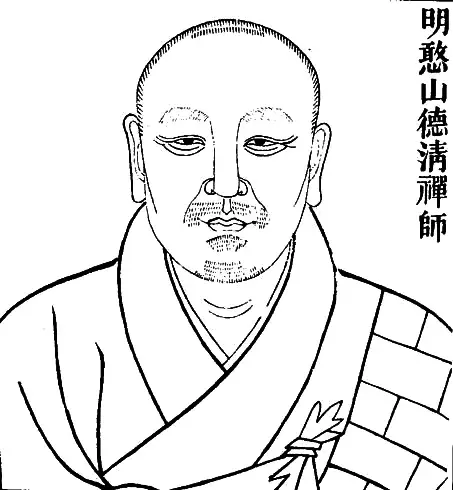
憨山德清
Hanshan Deqing (憨山德清, 1546–1623), secular surname Cai, monastic Dharma name Deqing, courtesy name Chengyin, art name Hanshan, and posthumously honored as Chan Master Hongjue, was a native of Quanjiao County, Southern Zhili (modern-day Quanjiao County, Chuzhou, Anhui Province). He was an illustrious Buddhist master, profound thinker, and celebrated calligrapher of the middle and late Ming Dynasty, venerated alongside Yunqi…
Hanshan Deqing (憨山德清, 1546–1623), secular surname Cai, monastic Dharma name Deqing, courtesy name Chengyin, art name Hanshan, and posthumously honored as Chan Master Hongjue, was a native of Quanjiao County, Southern Zhili (modern-day Quanjiao County, Chuzhou, Anhui Province). He was an illustrious Buddhist master, profound thinker, and celebrated calligrapher of the middle and late Ming Dynasty, venerated alongside Yunqi Zhuhong, Zibo Zhenke, and Ouyi Zhixu as one of the "Four Great Masters of the Late Ming." In his youth, Deqing left his family to enter the Grand Bao'en Temple in Nanjing, studying under Abbot Xilin Yongning and later Chan Master Yungu Fahui at Mount Qixia, gaining mastery over Buddhist sutras as well as Confucian classics and Daoist treatises. During the early Wanli reign, he traveled north to Mount Wutai for ascetic practice, adopting the art name Hanshan after its northern peak. Later, he withdrew to Mount Lao (Laoshan) along the eastern coast to build a hermitage at the Narayana Cave, where his spiritual virtue earned the deep veneration of Empress Dowager Cisheng, mother of the Wanli Emperor, who granted him an imperial Tripitaka and financed the construction of Haiyin Temple. In 1595, ensnared in imperial court factional strife and palace politics, Deqing was arrested and banished to Leizhou, Guangdong, on the nominal charge of illegally founding a monastery. During his military exile in the south, he propagated the Dharma, buried thousands of victims of drought and pestilence, and revitalized Buddhism in the Lingnan region. Later, invited by local officials to assume the abbacy of Nanhua Temple at Caoxi—the ancestral cradle of the Sixth Patriarch Huineng—he promulgated strict monastic codes, rebuilt dilapidated halls, established a monastic academy, and ordained monks, earning the revered title of "Resurgence Patriarch of Caoxi." In his twilight years, he dwelt beneath Wuru Peak at Mount Lu and Mount Heng to compose extensive commentaries. In 1623, he passed away in meditative posture at Caoxi; his incorrupt body was lacquered and preserved as a whole-body relic, enshrined beside Sixth Patriarch Huineng at Nanhua Temple. In Buddhist philosophy, Hanshan Deqing was deeply learned in Buddhism, Daoism, and Confucianism, energetically advocating the synthesis of the Three Teachings and the dual cultivation of Chan and Pure Land. He taught practitioners to recite the Buddha name to awaken their self-nature, bridging Yogacara analysis, Huayan metaphysics, and Chan direct realization. His prolific writings include Hanshan Laoren Mengyou Ji (Dream Travels of Old Man Hanshan), Lengyan Tongyi (General Exposition of the Surangama Sutra), Fahua Tongyi (General Exposition of the Lotus Sutra), and Guan Laozhuang Yingxiang Lun (Treatise on the Harmony and Difference of Laozi and Zhuangzi). His powerful running and cursive calligraphy was widely admired, exerting an enduring influence on Chinese Buddhism, intellectual history, and cultural life.
Born on the 12th day of the 10th month in Quanjiao County, Jinling Prefecture, secular surname Cai.
At age twelve, took leave of his parents to join Grand Bao'en Temple in Nanjing under Abbot Xilin Yongning, studying sacred scriptures and classical literature.
Visited Chan Master Yungu Fahui at Mount Qixia to study Chan contemplation, received full monastic ordination at Bao'en Temple, and adopted the courtesy name Chengyin after hearing the Huayan Xuan Tan.
Traveled north to Beijing to study the Lotus Sutra and Yogacara doctrines, seeking instruction from eminent Chan masters Bianrong Zhenyuan and Xiaoyan Debao.
Climbed Mount Wutai in Shanxi, and inspired by the lofty scenery of its northern peak, took the monastic art name Hanshan.
Retreated to Mount Lao along the eastern seashore, residing at Narayana Cave to meditate and preach Dharma to local coastal inhabitants.
Empress Dowager Cisheng bestowed an imperial woodblock Tripitaka and financed the construction of Haiyin Temple on Mount Lao for him.
Sucked into palace succession conflicts, arrested by imperial decree on charges of illicitly building a monastery, stripped of monkhood, and banished to Leizhou in Guangdong.
Invited by regional authorities to take charge of Nanhua Temple at Caoxi, instituting monastic discipline and reviving the ancestral seat of Sixth Patriarch Huineng.
The Second Sedition Book Case erupted in Beijing; his close friend Zibo Zhenke died in prison, and Deqing was implicated and escorted back to military confinement in Leizhou.
Following the birth of the Wanli Emperor's first imperial grandson, a general amnesty was proclaimed; Deqing was officially pardoned and returned to Caoxi to direct reconstruction work.
Left Caoxi and traveled north to Wansheng Temple in Hengyang, subsequently building a hermitage below Wuru Peak at Mount Lu in Jiangxi to compose philosophical treatises.
Acceding to earnest petitions from regional dignitaries and the monastic assembly, returned to Nanhua Temple in northern Guangdong.
Passed away peacefully in meditative posture at Nanhua Temple on the 11th day of the 10th month at age seventy-eight; his preserved whole-body relic was venerated by later generations, and he was posthumously granted the title Chan Master Hongjue.
Hanshan Deqing was born on the 12th day of the 10th month in the 25th year of the Jiajing reign (November 15, 1546) in Quanjiao County, Southern Zhili. His father Cai Yangao and mother Madame Hong were virtuous and upright commoners. It was recorded that his mother was an ardent devotee of Guanyin Bodhisattva who conceived Deqing after dreaming that the Bodhisattva presented her with an infant boy. Deqing was quiet, reflective, and remarkably perceptive from early childhood. When he was seven, his beloved uncle passed away; witnessing the sudden departure of a close kin, the young boy became deeply absorbed in questioning the ultimate nature of life, death, and human mortality. By age nine, he accompanied his mother to village temples to offer incense and recite prayers, committing the entire Universal Gate Chapter of Guanyin to memory with reverent devotion.
In the 36th year of the Jiajing reign (1557), at the tender age of twelve, Deqing made the firm resolve to renounce secular family ties. Bidding farewell to his parents, he journeyed to Grand Bao'en Temple in Nanjing to place himself under the tutelage of Abbot Xilin Yongning. Within the monastic community, he applied himself diligently to memorizing Buddhist scriptures, while simultaneously studying Confucian classics, ancient history, and poetry. Endowed with extraordinary mental clarity, he could recite the entire Lotus Sutra within a few years and read widely across pre-Qin philosophers and Daoist works of Laozi and Zhuangzi, establishing a broad intellectual foundation for his later integration of the Three Teachings.
In the 43rd year of the Jiajing reign (1564), at age nineteen, Deqing traveled to Mount Qixia outside Nanjing to seek spiritual guidance from Chan Master Yungu Fahui. During his contemplation there, he perused the Zhongfeng Guanglu composed by Yuan Dynasty master Zhongfeng Mingben, suddenly tasting the profound taste of meditative samadhi and resolving irrevocably to dedicate his entire life to the realization of Chan enlightenment. Returning to Grand Bao'en Temple, he formally shaved his head and received the full monastic precepts. Soon afterward, while listening to an elder lecture on the Huayan Xuan Tan by Tang Dynasty master Qingliang Chengguan, upon reaching the passages explaining the Ten Mysterious Gates and the oceanic reflection of phenomenal reality, Deqing experienced a breakthrough into the boundless interfusion of the Dharmadhatu. Profoundly inspired by Chengguan's vast wisdom, he assumed the courtesy name Chengyin.
In the 5th year of the Longqing reign (1571), Deqing took up his pilgrim staff and journeyed north to expand his doctrinal horizon. Arriving in the imperial capital of Beijing, he attended in-depth lectures on the Lotus Sutra and Yogacara consciousness-only doctrine, and paid humble visits to preeminent Chan luminaries Bianrong Zhenyuan and Xiaoyan Debao, seeking essential pointers on the ancestral gate. Through rigorous austerities and scholarly immersion in northern monastic circles, his moral discipline and profound learning earned widespread respect among monastic peers and scholar-officials.
In the 1st year of the Wanli reign (1573), Deqing undertook a pilgrimage to Mount Wutai in Shanxi Province. Ascending its northern summit, he beheld its solitary cliffs, deep valleys, and pristine springs; moved by its austere beauty, he adopted the name of the northern peak, Hanshan ("Cold Mountain"), as his lifelong art name. Returning to the western hills of Beijing, he made the acquaintance of prominent literary figures including Wang Shizhen, Wang Daokun, and Ou Daren, engaging in poetry exchanges that elevated his stature among the capital's intellectual elite.
In the 2nd year of the Wanli reign (1574), Hanshan traveled westward through Songshan and Luoyang to Puzhou in Shanxi, where he joined Chan Master Miaofeng Fudeng. The two companions ascended Mount Wutai together, erecting a primitive dwelling amid the snowfields of Longmen on the northern terrace to practice intensive Chan meditation. In 1576, Chan Master Yunqi Zhuhong visited Mount Wutai, conversing with Hanshan continuously for five days and nights; their mutual resonance cemented Hanshan's enduring commitment to uniting Chan discipline with Pure Land recitation. In 1582, Hanshan delivered extensive public discourses on the Huayan Xuan Tan on the mountain, drawing an assembly of nearly ten thousand listeners. Concurrently, he conducted a great non-discriminating assembly to pray for the birth of an imperial heir for the young Wanli Emperor; when the emperor's eldest son Zhu Changluo was born that same year, both court and public attributed the auspicious event to Hanshan's spiritual efficacy.
In 1583, wishing to withdraw from swelling public fame, Hanshan traveled to the rugged seashore of Shandong Province, establishing a quiet hermitage inside Narayana Cave on Mount Lao (Laoshan). Nestled between mountains and ocean waves, he engaged in deep scriptural study and converted local fishing communities away from rough livelihoods toward Buddhist morality.
In the 14th year of the Wanli reign (1586), the Wanli Emperor ordered fifteen sets of the imperial woodblock Tripitaka distributed to famous monastic peaks across the empire. The emperor's birth mother, Empress Dowager Cisheng, having long admired Hanshan's virtue, dispatched a special imperial courier to deliver a full set of the sacred canon to Mount Lao. Because there was no suitable edifice on the mountain to store the immense canon, the Empress Dowager allocated private palace treasury funds and commissioned imperial eunuch overseers to construct a splendid monastery, formally naming it Haiyin Temple. That same year, Chan Master Zibo Zhenke visited Mount Lao with his disciples, staying with Hanshan for more than twenty days to plan the monumental restoration of the Fangshan stone sutras and the carving of the Jiaxing Buddhist Canon.
In 1590, Empress Dowager Cisheng sent an emissary to summon Hanshan to the capital to receive imperial rewards for his past prayer ceremonies. Hanshan steadfastly declined. When the Empress Dowager offered a grant of three thousand taels of treasury silver, Hanshan politely demurred, requesting instead that the entire sum be redirected to relieve devastating famine in Shandong. His compassion saved tens of thousands of starving refugees, but his close connection to the imperial court unavoidably entangled him in perilous factional tensions between the inner palace and outer court bureaucracy.
In 1592, Hanshan met Zibo Zhenke at Mount Fangshan near Beijing, visiting the stone sutras carved by Sui master Jingwan. Discovering that Jingwan's pagoda compound had been illegally sold by unscrupulous monks, Zibo financed its repurchase, and Hanshan composed the commemorative inscription to safeguard the sacred historical site.
In the 23rd year of the Wanli reign (1595), friction between the Wanli Emperor and his mother reached a climax over the designation of the crown prince (the "State Foundation Controversy"). Displeased with the Empress Dowager's lavish expenditure on Buddhist patronage, and spurred by accusations from local Quanzhen Daoist priests at Mount Lao alleging that Haiyin Temple had encroached upon Daoist properties, the emperor directed his wrath at Hanshan. Hanshan was arrested by imperial decree and cast into the dreaded prison of the Imperial Bodyguard in Beijing. Subjected to severe interrogation and beatings, he maintained unruffled composure and inner mindfulness. Finding no political treason, the imperial court sentenced the fifty-one-year-old monk to forfeiture of his monastic status and banished him as an ordinary soldier to remote Leizhou in Guangdong.
In October of that year, Hanshan set out on the arduous southward journey in convict attire, accompanied by his devoted attendant Fushan. While passing the Yangtze River near Nanjing, his elderly mother Madame Hong hurried to the riverside to see him off. The reunion between mother and son was serene and joyous, completely devoid of lamentation. His mother admonished him to cherish spiritual truth and sacrifice himself for the Dharma without fretting over her advanced age. Profoundly touched, Hanshan composed his famous Inscription on Mother and Son to honor her transcendent perspective.
Arriving at Leizhou in the spring of 1596, Hanshan encountered devastating drought, widespread starvation, and virulent pestilence, with unburied corpses littering roadsides. Moved by deep sorrow, he mobilized local magistrates and gentry to collect and inter several thousand human remains, and established solemn ritual assemblies to dedicate spiritual merits to the deceased. In autumn of that year, regional officials, deeply impressed by his noble character, invited him to reside in Guangzhou. Though wearing military exile garb, Hanshan ascended Dharma thrones to lecture on Buddhist scriptures, sparking a dramatic revival of spiritual inquiry throughout the Lingnan frontier.
In the 28th year of the Wanli reign (1600), Zhu Gong, the Military Defense Circuit Intendant of Nanshao, along with regional literati, lamented that Nanhua Temple at Caoxi—the historic cradle where Sixth Patriarch Huineng had established southern Chan—had deteriorated into a ruin over centuries of neglect, plagued by local ruffians and corrupt elements. They formally invited Hanshan Deqing to assume the leadership of the sacred mountain.
Upon his arrival at Caoxi, Hanshan implemented systematic reforms. He reclaimed temple boundaries through formal legal channels, expelled squatters, established rigorous monastic regulations based on ancestral standards, selected novices for strict precept ordination, opened a monastic school to cultivate educated clerics, and collected donations to restore the ancestral halls and the stupa of the Sixth Patriarch. Within a single year, Caoxi was revitalized into a disciplined, thriving spiritual sanctuary, leading contemporaries and future generations to hail Hanshan as the "Resurgence Patriarch of Caoxi."
In the 31st year of the Wanli reign (1603), the Second Sedition Book Case shook the political foundations of Beijing. Suspicious of clandestine plots among courtiers and religious figures, imperial authorities initiated widespread purges. Zibo Zhenke was arrested and died tragically under torture in prison; Hanshan, owing to his intimate friendship with Zibo, was again implicated and summarily remanded to Leizhou. During this second exile, Hanshan sailed across the Qiongzhou Strait to Hainan Island to visit the historical dwellings of the Song Dynasty poet Su Shi, authoring his evocative Qionghai Tanqi Ji (Record of Exploring Wonders in the Qiong Sea).
In August of the 34th year of the Wanli reign (1606), following the birth of the Wanli Emperor's first imperial grandson Zhu Youxiao, a nationwide general amnesty was promulgated. Hanshan was officially freed from military servitude and regained his freedom. Returning to Caoxi, he threw himself into organizing the reconstruction of the main shrine hall of Nanhua Temple, personally traveling to the hazardous gorges of Duanzhou to procure massive timber logs. However, envious and corrupt local monks whose illicit privileges had been curtailed fabricated false charges, accusing Hanshan of embezzling building funds and lodging formal complaints before the provincial surveillance commission. Hanshan was forced to live aboard a small boat on the Furong River for two agonizing years awaiting trial, falling gravely ill. Though the investigation ultimately exonerated him completely, Hanshan resigned his abbacy at Caoxi and departed for Changchun Hermitage in Guangzhou to teach scriptures in quietude.
In the 41st year of the Wanli reign (1613), at age sixty-eight, Hanshan departed Guangdong and traveled north to Hengyang in Hunan, staying at Wansheng Temple near Lake Ling. Grateful monastic and lay disciples constructed the Tanhua Hermitage beside the temple to support his contemplative life. There, he organized his lifelong teachings and completed the masterworks Lengyan Tongyi (General Exposition of the Surangama Sutra) and Fahua Tongyi (General Exposition of the Lotus Sutra).
In 1616, Hanshan moved eastward to Mount Lu in Jiangxi, establishing a thatched hermitage beneath Wuru Peak. Emulating the historic Pure Land fellowship founded by Jin Dynasty master Huiyuan, he engaged in intensive writing, meditation, and Pure Land recitation, attracting earnest scholars from all quarters. During this productive period, he authored landmark comparative treatises including Guan Laozhuang Yingxiang Lun, commentaries on the Zhaolun, and Daxue Gangmu Jueyi, fully articulating his harmonized worldview of the Three Teachings.
In the 2nd year of the Tianqi reign (1622), regional officials and the monastic community of Caoxi, feeling that the ancestral sanctuary could not thrive without its spiritual guide, dispatched repeated deputations to Mount Lu pleading for his return. Despite his seventy-seven years, Hanshan undertook the long journey south to Caoxi to comfort his followers.
On the 11th day of the 10th month in the 3rd year of the Tianqi reign (November 5, 1623), Hanshan Deqing manifested slight illness, gathered his monastic disciples for final instructions on guarding the Dharma, bathed, donned fresh robes, and passed away peacefully sitting in cross-legged meditation at Nanhua Temple, having lived seventy-eight years with fifty-nine years in monastic orders. After his passing, his body showed no decay through changing seasons; disciples treated his form with natural lacquer and gold leaf, preserving his incorrupt relic. His sacred mummified body was enshrined in the ancestral hall of Nanhua Temple side by side with the Sixth Patriarch Huineng. During the Chongzhen reign, the imperial court posthumously bestowed upon him the honorary title Chan Master Hongjue.
Hanshan Deqing's most enduring intellectual contribution lay in his comprehensive philosophical harmonization of Buddhism, Daoism, and Confucianism. Living in an era marked by the radicalization of the Taizhou school and rampant syncretic debates, Hanshan formulated his famous dictum: "There are three essentials in learning: without understanding the Spring and Autumn Annals, one cannot navigate the secular world; without mastering Laozi and Zhuangzi, one cannot forget the world; without practicing Chan, one cannot transcend the world." He argued that the Three Teachings were not antagonistic rivals, but complementary rungs on a single ladder of spiritual evolution: Confucianism establishes moral order and social ethics as the foundation of worldly conduct; Daoism dispels worldly ambition and cleanses mental fixations; while Buddhism pierces through all delusions of self and phenomena through dependent origination and emptiness, revealing ultimate liberation.
To ground this theoretical framework, Hanshan authored Guan Laozhuang Yingxiang Lun (Treatise on the Harmony and Difference of Laozi and Zhuangzi), Daode Jing Jie, Zhuangzi Neipian Zhu, and Daxue Gangmu Jueyi. Applying Yogacara psychological analysis and Prajnaparamita dialectics, he reinterpreted ancient Daoist concepts, identifying Laozi's concept of "non-being" with the subtle darkness of the eighth alaya consciousness which yet harbored subtle seeds of rebirth, while aligning Confucian virtues with the Buddhist five precepts. This philosophical synthesis elevated Buddhist prestige among the late Ming literati class and provided rigorous conceptual depth to late imperial Chinese thought. His voluminous writings, collected by disciples into the fifty-five-fascicle Hanshan Laoren Mengyou Ji, stand as an indispensable monument of late Ming Buddhist philosophy.
As the ancestral sanctuary where Sixth Patriarch Huineng founded the Southern School of Chan, Nanhua Temple at Caoxi had fallen into profound decay by the late sixteenth century. Decades of neglect and local encroachment had stripped the monastery of its landholdings, while worldly merchants, butchers, and thieves occupied the temple grounds. Following his installation at Caoxi in 1600, Hanshan launched decisive structural reforms to restore its sacred character.
First, he petitioned judicial authorities to survey temple lands, expelling dozens of illegal commercial dwellings and reclaiming over a thousand mu of alienated monastic farmland to guarantee economic self-sufficiency. Second, drawing from the classical Baizhang Pure Regulations, he compiled the Caoxi Nanhua Temple Regulations, strictly prohibiting meat consumption, alcohol, gambling, and factional intrigue. Third, recognizing that the decline of Buddhism stemmed from uneducated clergy, he established a monastic academy inside Nanhua Temple, personally delivering lectures on the Avatamsaka Sutra, Surangama Sutra, and Sutra of Complete Enlightenment, while hiring learned masters to instruct novices in classical scholarship. Fourth, he mobilized donations across southern China to rebuild the Hall of the Sixth Patriarch, the Grand Main Hall, the Tripitaka Pavilion, and ancestral stupas. His organizational vision and spiritual integrity transformed a desecrated site back into an exemplary Chan training monastery, earning him the undisputed title of "Resurgence Patriarch of Caoxi."
In monastic cultivation, Hanshan addressed the rampant degeneration of Chan into wild, undisciplined intellectual chatter by championing the harmonious integration of Chan insight and Pure Land recitation. He insisted that the true goal of Chan was to awaken to the original face before birth, while reciting the Buddha's name was the most reliable, grounded method to pacify discursive mental habits and realize the Amitabha inherent in one's own nature. He popularized the practice of investigating "who is reciting the Buddha's name," turning the invocation of the holy name into an intensive critical phrase (huatou) until the subject reciting and the object recited dissolve into indivisible oneness.
Hanshan counseled disciples and lay followers never to confuse genuine realization with sterile nihilism or textual pedantry, emphasizing that spiritual cultivation required unbending commitment and rigorous introspection in daily life. Wherever he traveled—whether enduring hardship in Leizhou, preaching in Guangzhou, or meditating on Mount Lu—he founded Pure Land societies and exhorted all fourfold assemblies to aspire to rebirth in the Western Paradise. By grounding the lofty transcendence of Chan in the humble, accessible practice of mindfulness of the Buddha, he corrected the reckless arrogance of late Ming pseudo-Chan and laid the practical foundation for the enduring popularity of Pure Land devotion in Ming and Qing society.
Though living beyond worldly pursuits, Hanshan displayed profound bodhisattva compassion toward suffering humanity throughout his turbulent life. In 1590, when Empress Dowager Cisheng awarded him three thousand taels of silver from the imperial treasury, he refused to use a single coin for personal comfort. Witnessing the severe famine and drought devastating Shandong Province, where destitute families were driven to despair, he persuaded the imperial envoy to transport the entire sum directly into the disaster zone. He established community soup kitchens and grain depots, distributing emergency food supplies that saved tens of thousands of dying peasants and creating an enduring legacy of practical charity.
Similarly, upon his exile to Leizhou in 1596, he arrived amidst unrelenting drought and plague, with unburied skeletons strewn across the wilderness. Rather than lamenting his unjust punishment, Hanshan personally led his disciples and local volunteers into the fields to collect and bury over three thousand abandoned human corpses in communal graves. He established grand water-and-land ritual assemblies to offer prayers for the dead and organized medicinal aid for the sick, quickly bringing solace and stability to the traumatized local population. His fearless benevolence in the face of adversity won the enduring veneration of high regional officials and common peasants alike, establishing deep roots of goodwill for Buddhism across the southern borderlands.
FIGURES ASSOCIATED WITH THIS DYNASTY