Birth in the Guanzhong Basin
Hanshan is born into an affluent household in Xianyang, receiving systematic training in classical Confucian literature and martial arts.
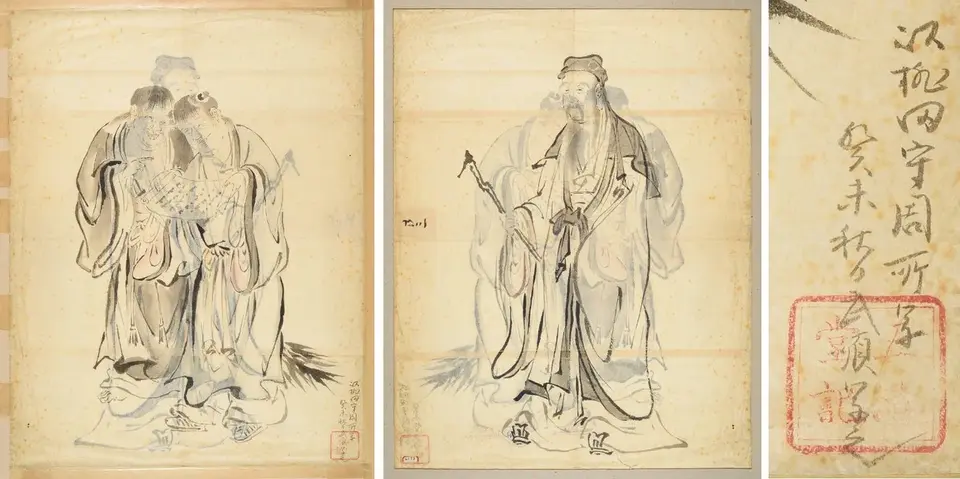
寒山
Hanshan (寒山), traditionally known as Hanshanzi ("Master of Cold Mountain"), was a celebrated poetic monk, reclusive literary figure, and preeminent representative of Tang Dynasty Chan Buddhism. Having received a classical Confucian education in his youth, he turned away from mundane officialdom after suffering bureaucratic exclusion and the devastating turmoil of the An Lushan Rebellion. Seeking spiritual refuge, he retreated…
Hanshan (寒山), traditionally known as Hanshanzi ("Master of Cold Mountain"), was a celebrated poetic monk, reclusive literary figure, and preeminent representative of Tang Dynasty Chan Buddhism. Having received a classical Confucian education in his youth, he turned away from mundane officialdom after suffering bureaucratic exclusion and the devastating turmoil of the An Lushan Rebellion. Seeking spiritual refuge, he retreated to the secluded Tiantai Mountains in eastern Zhejiang, residing for decades in mountain hermitages at Cuiping Mountain and the Cold Rock caverns. In deep seclusion, he bonded in close spiritual fellowship with the unorthodox Guoqing Monastery monks Fenggan and Shide—a trio venerated as the Three Sages of Tiantai and later revered across East Asia as the celestial immortals of harmony and union. In the history of classical Chinese poetry, Hanshan stands as the pioneering master of vernacular expression. Transcending the rigid formal meter and tonal constraints of courtly verse, his surviving corpus of over three hundred poems employed colloquial idiom to articulate profound Chan philosophical insights and vivid impressions of natural solitude. This distinct vernacular verse, dubbed the "Hanshan style," seamlessly reconciled Confucian ethics, Daoist naturalism, and Chan Buddhist enlightenment. Highly esteemed throughout the Song and Ming dynasties by literati including Wang Anshi and Su Shi, Hanshan's verse achieved global renown in the twentieth century through English translations, exerting a profound influence on the American Beat Generation and modern environmental aesthetics.
Hanshan is born into an affluent household in Xianyang, receiving systematic training in classical Confucian literature and martial arts.
Traumatized by bureaucratic rejection and family tragedy, he joins the southern refugee migration following the fall of Chang'an.
Arriving in eastern Zhejiang, he establishes a mountain hermitage at Cuiping Mountain, pursuing farming and Daoist internal cultivation.
Relocating to the remote precipices of Cold Rock, he forms an intimate spiritual fraternity with Master Fenggan and the hermit Shide.
Returning briefly to his ancestral hometown to witness the total disappearance of past ties, he achieves instantaneous spiritual awakening.
Inscribing his verses onto rocks, tree trunks, and monastery walls, he passes away peacefully in autumn at Mingyan cavern.
Full Name: Hanshan; Literary Name: Hanshanzi; Native Place: Xianyang, Jingzhao; Principal Identity: Poet, Hermit, Chan Buddhist Master;
Hanshan was born into a prosperous scholar-commoner lineage in Xianyang in the metropolitan Jingzhao region. During his youth, he enjoyed comfortable material security and immersed himself in comprehensive classical scholarship. He mastered the Confucian classics, history, poetry, and arithmetic, while also becoming proficient in equestrian archery and martial arts. Possessing exceptional intellect and literary flair, the young Hanshan aspired to achieve worldly distinction through the imperial examinations and fulfill the traditional scholar's mission of statecraft.
However, his aspirations met with repeated disappointment. Although he passed the qualifying imperial examinations after three attempts, he was disqualified four consecutive times during the Ministry of Personnel's evaluation exams due to his unconventional personal appearance and unwillingness to flatter bureaucratic examiners. These repeated rebuffs shattered his political ambitions, causing him to question the fairness and integrity of the metropolitan examination apparatus.
In addition to career frustration, Hanshan suffered catastrophic personal losses during the mid-eighth century. His elder brother squandered the family inheritance, his parents succumbed to illness, and his wife and children died prematurely during years of deepening impoverishment. The loss of his kin and the dissipation of his ancestral estate inflicted enduring emotional wounds on the sensitive poet.
In 755, the catastrophic An Lushan Rebellion erupted, with rebel forces overrunning Luoyang and Chang'an. The Guanzhong heartland was reduced to ashes. Left solitary and dispossessed, Hanshan joined the tide of fleeing refugees migrating toward southern China, drifting through Jingzhou before arriving in Shandong. In Shandong, he took up temporary menial service in a local administrative office to stave off hunger. Yet, repulsed by the endemic corruption and venality of local governance, Hanshan renounced public office permanently, resolving to seek ultimate peace far from the corrupting distractions of human society.
In 760, at the age of thirty-five, Hanshan completed his arduous journey to Mount Tiantai in eastern Zhejiang, an ancient sacred mountain celebrated for both Daoist and Buddhist monastic lineages. Initially settling at Cuiping Mountain near Tongbai, he lived as a hermit-farmer, cultivating crops, gathering herbs, and wandering amidst pine groves. Over three decades of rustic isolation, he sought consolation in Daoist scriptures, practicing meditation and longevity techniques to overcome the grief of his past.
Nevertheless, physical isolation alone did not fully deliver him from existential anxiety over mortality. In 790, Hanshan moved deeper into the wilderness, taking up residence in the rugged rock shelters of Cold Rock (Hanshishan). It was during this phase that he adopted the monastic pseudonym Hanshan. Nearby at Guoqing Monastery, he formed an extraordinary spiritual brotherhood with the abbot Fenggan and the eccentric monastery scullion Shide. Unburdened by monastic dogma, the trio roamed mountain paths, composed spontaneous poetry, and engaged in profound Chan dialogues that gradually transformed Hanshan's spiritual consciousness.
In 801, determined to resolve his lingering emotional attachment to his ancestral roots, Hanshan made a final pilgrimage north to Xianyang. Upon arrival, he discovered that his family estate had vanished into ruined mounds and that his former acquaintances and kin were all deceased. Confronted by this stark visual demonstration of temporal impermanence, Hanshan experienced a profound, sudden spiritual enlightenment. All lingering remorse and fear of mortality vanished entirely, replaced by deep, abiding inner serenity.
Returning to Tiantai, Hanshan dedicated his remaining decades to contemplative freedom and spontaneous verse. He spent long years wandering between Cold Rock and Mingyan, cloud-draped and barefoot, clad in ragged robes and a birch-bark hat. In 810, his spiritual companions Fenggan and Shide passed away, leaving Hanshan alone in the mountains. He recorded his reflections by brushing hundreds of vernacular poems onto smooth cliff faces, rocks, tree barks, and temple corridors. In the autumn of 830, Hanshan passed away peacefully at Mingyan, his mortal remains resting beneath the pine forests of Elephant Trunk Peak.
Hanshan's foremost contribution to Chinese literary history was his radical departure from the rigid tonal meters, intricate parallelism, and archaic allusions that dominated mainstream Tang elite verse. He pioneered a vivid, natural vernacular style known as the "Hanshan style." Drawing liberally upon everyday colloquial vocabulary, folk idioms, and straightforward syntactic structures, he crafted poems that were lucid, humorous, and deeply emotive.
Modern literary scholar Hu Shi praised Hanshan as one of the greatest vernacular poets in Chinese literary history, continuing and perfecting the populist tradition initiated by Wang Fanzhi. Hanshan's verse captured the living spoken Chinese language of the middle Tang period with unparalleled fidelity, representing a major democratization of classical poetic expression and providing indispensable linguistic materials for the historical study of Chinese vernacular development.
The surviving corpus of over three hundred poems left by Hanshan encompasses personal autobiographical laments, social satires of corrupt officials, descriptions of tranquil wilderness, and profound meditations on Chan Buddhist enlightenment. More than half of his verses are direct poetic vehicles for illuminating the nature of mind and sudden spiritual realization.
Hanshan harmoniously fused Confucian moral righteousness, Daoist natural spontaneity, and Chan emptiness into a unified poetic vision. He utilized plain imagery—such as the clear autumn moon shining upon a cold emerald pool—as an allegorical lens for the luminous, unconditioned Buddha-nature inherent in all sentient beings. This innovative fusion of vernacular ease with metaphysical profundity established the Chan poem (chanshi) as a premier genre in Chinese artistic culture, leaving an indelible imprint on Song Dynasty intellectuals like Wang Anshi and Su Shi.
In the realm of popular religion and cultural psychology, the legendary affection and whimsical camaraderie between Hanshan and Shide evolved into an enduring cultural archetype of fraternal harmony and reconciliation. During the Ming Dynasty, popular tradition canonized them as the "Two Immortals of Harmony and Union" (Hehe Erxian). In the Qing Dynasty, the Yongzheng Emperor formally bestowed imperial titles honoring Hanshan as the "Sage of Harmony" (Hesheng) and Shide as the "Sage of Union" (Hesheng), anchoring their legacy in mainstream Chinese social values.
In the mid-twentieth century, Hanshan's poetry was translated into English by notable figures including Gary Snyder and Arthur Waley, sparking a widespread "Cold Mountain craze" throughout Europe and the United States. His celebration of rugged wilderness, simple living, and meditative clarity profoundly resonated with the countercultural Beat Generation and contemporary ecological movements. Hanshan emerged as an internationally celebrated icon of Zen philosophy and eco-poetics, demonstrating the universal and enduring power of his mountain songs.
FIGURES ASSOCIATED WITH THIS DYNASTY