Birth in Hebei
Born in Luancheng into the hereditary patriarchal family of the White Lotus Sect.
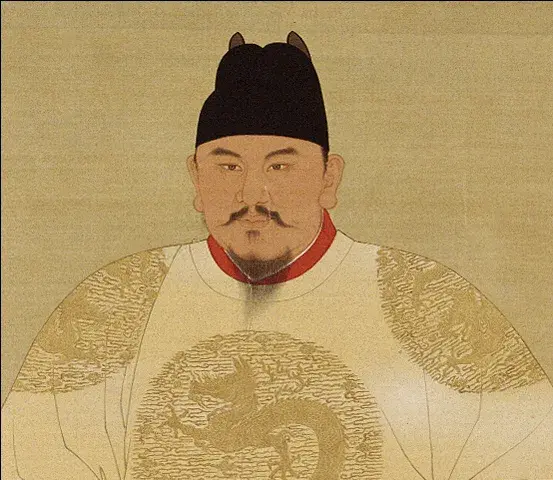
韩林儿
Han Lin'er (韩林儿) (1335–1366), commonly known as the Lesser King of Light (Xiao Mingwang), was the messianic monarch of the Han Song (Da Song) Red Turban rebel dynasty that shook the foundations of the Mongol Yuan Empire. He was the son of Han Shantong, the White Lotus patriarch who ignited the Red Turban insurrections in 1351. Following his father's martyrdom in Yingzhou, Han Lin'er hid in the Taihang Mountains until…
Han Lin'er (韩林儿) (1335–1366), commonly known as the Lesser King of Light (Xiao Mingwang), was the messianic monarch of the Han Song (Da Song) Red Turban rebel dynasty that shook the foundations of the Mongol Yuan Empire. He was the son of Han Shantong, the White Lotus patriarch who ignited the Red Turban insurrections in 1351. Following his father's martyrdom in Yingzhou, Han Lin'er hid in the Taihang Mountains until 1355, when Red Turban Generalissimo Liu Futong recovered him and proclaimed him Emperor of Da Song in Bozhou under the millenarian reign era Longfeng ("Dragon and Phoenix"). While Liu Futong exercised actual military leadership, Han Lin'er served as the sacred figurehead of the northern rebellions. From their capitals at Bozhou and later Kaifeng (Bianliang), the Han Song regime launched the legendary Three-Route Northern Expeditions, sweeping across northern China and threatening Dadu. Most anti-Yuan warlords across the south—including Zhu Yuanzhang—formally recognized Han Lin'er's suzerainty and used his Longfeng calendar. Following the fall of Kaifeng to Yuan general Chaghan Temür in 1359 and the siege of Anfeng in 1363 where Liu Futong was killed, Zhu Yuanzhang rescued Han Lin'er and placed him under house arrest in Chuzhou. In December 1366, while being transported down the Yangtze toward Nanjing by General Liao Yongzhong, Han Lin'er's vessel mysteriously overturned at Guabu, drowning thirty-two-year-old Han Lin'er. His demise paved the way for Zhu Yuanzhang to establish the Ming Dynasty.
Born in Luancheng into the hereditary patriarchal family of the White Lotus Sect.
Father Han Shantong was killed; Han Lin'er and his mother fled into the Wu'an Mountains.
Proclaimed Emperor of Da Song by Liu Futong under the era name Longfeng; styled Lesser King of Light.
Dispatched Red Turban armies across Hebei, Shaanxi, and Shandong to threaten Dadu.
Liu Futong captured the Northern Song capital of Kaifeng, relocating Han Lin'er's court.
Chaghan Temür recaptured Kaifeng; Han Lin'er retreated south to Anfeng.
Besieged by Zhang Shicheng's forces; rescued by Zhu Yuanzhang and confined at Chuzhou.
Drowned at age thirty-two when his vessel capsized on the Yangtze; Han Song dynasty extinguished.
Han Lin'er was born in 1335 in Luancheng, Hebei. For generations, his ancestors had preached White Lotus millenarianism across the Central Plains. In 1351, when the Yuan court mobilized 150,000 corvée laborers to dredge the Yellow River, his father Han Shantong organized the Red Turban Brotherhood, proclaiming himself an eighth-generation descendant of Emperor Huizong of Song and announcing the advent of the Maitreya Buddha and the King of Light (Mingwang). When imperial cavalry raided their muster camp, Han Shantong was captured and executed. Han Lin'er and his mother Lady Yang escaped into the rugged Wu'an Mountains, living in hiding for four years.
In early 1355, Red Turban general Liu Futong captured Bozhou and consolidated northern insurgent armies. Seeking sacred legitimacy, Liu Futong located Han Lin'er and enthroned the twenty-year-old youth in Bozhou as Emperor of Da Song, adopting the reign title Longfeng and revering Han Lin'er as the Lesser King of Light. Executive commands remained concentrated in the hands of Chancellor Liu Futong.
From 1355 to 1359, the Han Song regime stood as the epicentre of the anti-Yuan revolution. Southern rebel commanders, including Guo Zixing and Zhu Yuanzhang in Nanjing, and Xu Shouhui in Hubei, accepted Han Song court appointments, dated their official records by the Longfeng era, and acknowledged Han Lin'er as sovereign.
In 1357, Liu Futong launched the Three-Route Northern Expeditions: Guan Xiansheng struck into Hebei, Bai Buxin marched into Shaanxi, and Mao Gui overran Shandong, advancing within sight of Dadu. In May 1358, Liu Futong captured the ancient Northern Song capital of Kaifeng, triumphantly escorting Han Lin'er into the imperial palace.
The Han Song expeditions overextended their lines, allowing Yuan loyalist warlord Chaghan Temür to consolidate northern garrisons and counterattack. In August 1359, Chaghan Temür besieged Kaifeng, tunneling under the ramparts. As starvation set in, Liu Futong broke through enemy cordons with several hundred horsemen, escorting Han Lin'er south to the fortress of Anfeng (modern Shou County, Anhui). Han Lin'er's empress and court archives were captured and executed.
In February 1363, regional warlord Zhang Shicheng dispatched general Lü Zhen to besiege Anfeng. Liu Futong sent urgent appeals to Zhu Yuanzhang in Nanjing. Recognizing that the loss of Anfeng would expose his northern flank, Zhu Yuanzhang personally led an army to relieve the siege. While Lü Zhen was routed, Chancellor Liu Futong was killed in the fighting.
Having secured Han Lin'er, Zhu Yuanzhang did not permit him to enter Nanjing. Instead, he relocated the emperor to Chuzhou, constructing a lavish palace where Han Lin'er was kept under close surveillance, stripped of military followers.
By late 1366, Zhu Yuanzhang had crushed Chen Youliang, cornered Zhang Shicheng, and laid the foundations of an imperial dynasty. Han Lin'er's nominal sovereignty had become an obstacle. In December 1366, Zhu Yuanzhang dispatched naval commander Liao Yongzhong to escort Han Lin'er from Chuzhou to Nanjing. When the royal flotilla reached Guabu along the Yangtze River near Zhenjiang, Han Lin'er's vessel suddenly capsized in mid-river, and the thirty-two-year-old monarch drowned.
Following his death, Zhu Yuanzhang abandoned the Longfeng calendar, inaugurating the first year of Wu and proclaiming the Ming Dynasty in 1368. Historiographical tradition has long held that General Liao Yongzhong acted under covert instructions from Zhu Yuanzhang to engineer the drowning.
As the living symbol of the Red Turban movement and the Han Song dynasty, Han Lin'er provided the political and religious banner that mobilized millions of peasants across northern China, breaking the military dominance of the Yuan dynasty.
By absorbing the full military counter-blows of the Yuan armies for twelve years and legitimizing regional commanders like Zhu Yuanzhang under the Longfeng mandate, Han Lin'er cleared the path for the founding of the Ming Dynasty.
Under the Longfeng court at Bozhou and Kaifeng, the Han Song regime restored the Secretariat, Branch Secretariats, Bureau of Military Affairs, and Six Ministries, providing an institutional framework for rebel governance.
Between 1356 and 1359, armies marching under Han Lin'er's imperial commissions struck into Shaanxi, Shanxi, Shandong, and Liaodong, burning the Yuan Upper Capital at Shangdu and exhausting Mongol main forces.
Southern rebel leaders including Zhu Yuanzhang and Xu Shouhui formally used the Longfeng calendar and accepted Han Song titles, giving the anti-Yuan uprising a unified chronological and political banner.
By holding the Huai River and Central Plains front against Chaghan Temür and Köke Temür, Han Lin'er's northern forces shielded Zhu Yuanzhang's base in Nanjing during its crucial years of consolidation.
His death at Guabu in 1366 marked the shift from millenarian peasant rebellion to the orthodox dynastic statecraft of the Ming Empire.
FIGURES ASSOCIATED WITH THIS DYNASTY