Discovered by Wang Wei
Labored as a tavern boy in Chang'an; discovered sketching horses in the sand by Wang Wei, who sponsored his studies.
韩干
Han Gan (dates of birth and death unrecorded, active mid-8th century), a native of Jingzhao (present-day Xi'an, Shaanxi; alternative tradition cites Daliang/Kaifeng), was the preeminent court painter of the High Tang Dynasty and the supreme master of equine painting (Huama) in Chinese art history. Born into humble origins as an impoverished tavern laborer in Chang'an, his innate artistic talent was discovered and sponsored…
Han Gan (dates of birth and death unrecorded, active mid-8th century), a native of Jingzhao (present-day Xi'an, Shaanxi; alternative tradition cites Daliang/Kaifeng), was the preeminent court painter of the High Tang Dynasty and the supreme master of equine painting (Huama) in Chinese art history. Born into humble origins as an impoverished tavern laborer in Chang'an, his innate artistic talent was discovered and sponsored by the great poet-painter Wang Wei, enabling him to study under the celebrated equine artist Cao Ba. During the Tianbao era of Emperor Xuanzong, Han was summoned to court as an Imperial Painter-in-Attendance. When Emperor Xuanzong commanded him to emulate senior court painter Chen Hong, Han famously replied: "I have my own teachers; all the horses in Your Majesty's imperial stables are my teachers." Conducting empirical observational studies across the fourteen grand imperial stables housing tens of thousands of steeds from Fergana and the Western Regions, Han discarded mechanical graphic conventions to establish a magnificent realistic style celebrated as "harmonizing bone and flesh, radiating celestial spirit." His surviving masterpieces, including Night-Shining White (Zhaoyebai Tu), Horse and Groom (Muma Tu), and Yuhuacong, defined the visual aesthetic of the High Tang golden age, exerting profound influence upon later masters such as Li Gonglin, Zhao Mengfu, and Xu Beihong.
Labored as a tavern boy in Chang'an; discovered sketching horses in the sand by Wang Wei, who sponsored his studies.
Recommended by Wang Wei to study equine painting under master Cao Ba, mastering brushwork and composition.
Summoned to court as Painter-in-Attendance; declared the imperial stables his true masters, specializing in royal portraits of horses.
Sketched Emperor Xuanzong's favorite Fergana warhorse, creating the immortal masterwork Night-Shining White.
Escaped the fall of Chang'an during the An Lushan Rebellion; returned in later years to execute murals and paintings as a private master.
Han Gan was born into an impoverished commoner family in the Guanzhong region during the early Kaiyuan era. To support his parents, Han labored from early youth as an errand boy for a wine tavern in the Eastern Market of Chang'an, delivering wine jars across the capital's residential wards. Celebrated poet Wang Wei and his brother Wang Jin were frequent patrons of the tavern, and Han often waited outside their residence to collect payments.
During his leisure moments waiting by the gates, Han used twigs to sketch horses, soldiers, and pedestrians upon the sandy soil. Stepping outside, Wang Wei noticed the sand sketches and was astonished by their dynamic vitality and anatomical balance. Inquiring into Han's circumstances, Wang discovered the youth's passion for painting and his inability to afford formal training. Demonstrating extraordinary generosity, Wang provided Han with an annual stipend of twenty thousand copper cash and granted him access to his private collection of historical scrolls, financing over a decade of dedicated artistic study. Wang Wei's generous patronage transformed Han from a street laborer into an immortal master.
Under Wang Wei's personal recommendation, Han entered the studio of Cao Ba, the most acclaimed equine painter of the High Tang. A descendant of Cao Cao of the Three Kingdoms, Cao Ba was revered for vigorous brushwork that captured the muscular tension and skeletal nobility of steeds. Under Cao's tutelage, Han mastered traditional ink-wash techniques and mineral pigmentation.
However, Han sought to transcend inherited models. He observed that past masters depicted horses with exaggerated skeletal sharpness, resulting in static, emaciated forms that failed to convey the fluid muscularity and surging vitality of living animals. Han frequented the western livestock markets of Chang'an, studying stallions imported from Fergana, Tokharistan, and the Turkic steppes. Fusing Cao Ba's iron-wire lineament with empirical observation, Han developed an innovative aesthetic characterized by volumetric presence and dignified grace.
Beyond his celebrated equine works for the imperial palace, Han Gan executed magnificent murals across major Buddhist and Daoist monasteries in Chang'an. In the High Tang metropolis, grand temples functioned not merely as sacred religious spaces, but as grand public galleries displaying the pinnacle of contemporary visual art. According to Zhang Yanyuan's Records of Famous Painters of Successive Dynasties, Han painted extensive murals at Zisheng Monastery, Baoying Monastery, and Ci'en Monastery.
At Zisheng Monastery, Han executed panoramic murals depicting Subduing the Demons (Xiangmo Bian) and Shennong Tasting the Hundred Herbs, applying vigorous, muscular brushwork to capture both archaic imperial solemnity and terrifying celestial wrath. At Baoying Monastery, his portrayals of guardian deities and donor bodhisattvas featured layered mineral pigments and billowing ribbons reminiscent of Wu Daozi's dynamic drapery. Han's mastery across figure painting, Buddhist tableaux, and natural scenery earned him placement alongside Yan Liben and Wu Daozi in the "Divine Class" (Shenpin) of Zhu Jingxuan's Record of Famous Painters of the Tang Dynasty.
During the early Tianbao era, Emperor Xuanzong expanded the Hanlin Painting Academy. Hearing of Han's brilliance, the emperor issued an edict appointing him Painter-in-Attendance (Gongfeng). An ardent lover of horses, Xuanzong maintained fourteen grand imperial stables housing tens of thousands of prize steeds. Xuanzong initially ordered Han to study under senior palace painter Chen Hong to absorb formal court conventions.
Inspecting the studios days later, Xuanzong noted that Han's brushwork diverged radically from Chen Hong's conservative style and questioned him. Han bowed and calmly replied: "Your servant possesses his own teachers; every horse in Your Majesty's imperial stables is my teacher." Captivated by this bold declaration of naturalism, Xuanzong granted Han unrestricted access to the imperial stables to sketch from life. Immersing himself among the royal grooms, Han observed steeds galloping, rearing, resting, and drinking, achieving complete artistic communion with his subjects.
Commissioned to execute royal portraits of celebrated warhorses, Han produced Yuhuacong and Night-Shining White. Displayed in imperial pavilions, Xuanzong marveled at the vibrant realism of the paintings, and Han's fame spread across the empire, with nobles competing to acquire his works.
In the winter of 755, the catastrophic An Lushan Rebellion erupted, shattering the golden age of the High Tang. In the summer of 756, Emperor Xuanzong fled to Sichuan, and Chang'an fell to rebel forces. Amid the slaughter, Han was separated from the court and fled into the Guanzhong countryside, enduring years of privation.
Witnessing imperial steeds butchered or wandering wild amid burned ruins, Han's artistic temperament matured from opulent court decorum into profound, meditative solemnity. Surviving historical records, including Youyang Zazu and Xuanhe Huapu, record that after Tang forces recaptured the capital, Han returned to Chang'an. Living in modest retirement, he executed temple murals and private scrolls, preserving the majestic spirit of the High Tang until his passing during the reign of Emperor Dezong.
Han Gan's most profound theoretical contribution to world art history was his pioneering doctrine of drawing directly from life (xiesheng). In an artistic culture dominated by the mechanical imitation of ancient patterns, Han insisted on empirical observation of living subjects.
By analyzing living steeds in motion, Han mastered anatomical precision, capturing muscle contractions, flared nostrils, and shimmering coats. Preceding European Renaissance equine studies by seven centuries, Han established an enduring tradition of realistic observation in Chinese painting.
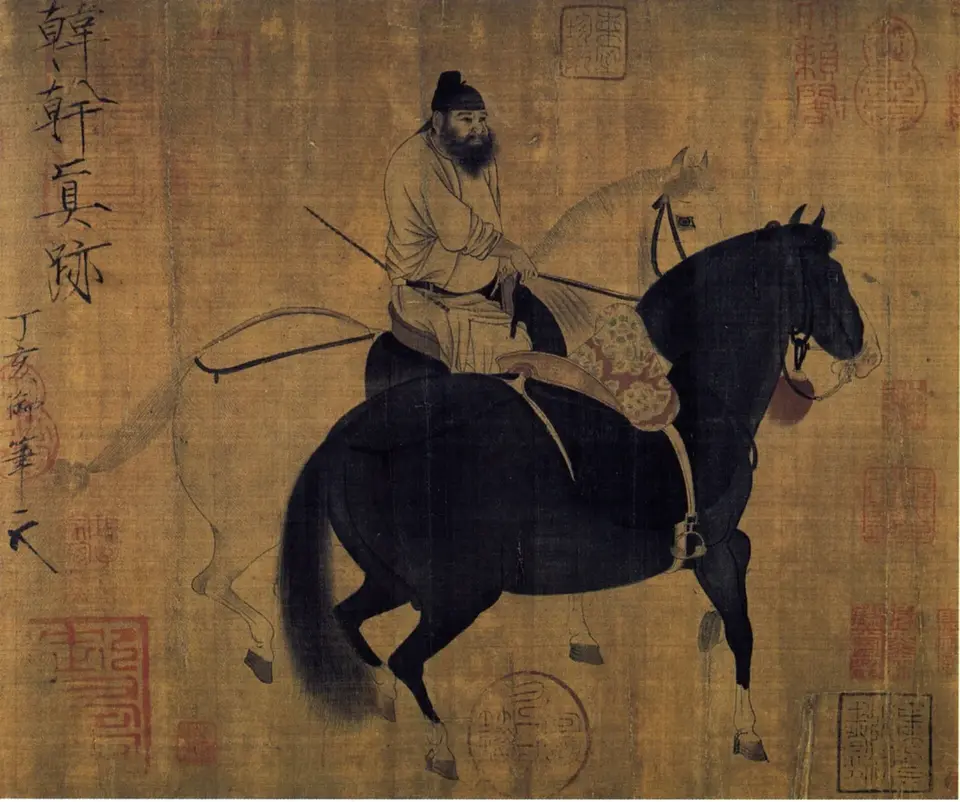
In addition to Night-Shining White, Han Gan's other immortal masterpiece is Horse and Groom (Muma Tu, preserved in the National Palace Museum, Taipei). Executed in ink and colors on silk, measuring 27.5 cm by 34.1 cm, the upper right corner bears an imperial inscription in Slender Gold script by Emperor Huizong of Song certifying it as "An Authentic Work of Han Gan." The composition depicts a bearded Central Asian groom wearing a close-fitting red robe, mounted securely upon a powerful white steed while holding the reins of an accompanying black and white warhorse.
Both horses exhibit the rounded, well-fed muscularity typical of imperial stable horses, possessing serene countenances and balanced proportions. The seamless harmony between groom and horses vividly captures the tranquility and opulence of the High Tang imperial court. Furthermore, surviving works such as Presenting the Steed (Yuren Chengma Tu) meticulously document tributary embassies from the Western Regions presenting celestial horses to the Tang emperor, serving as priceless visual records of trans-Eurasian cultural diplomacy.
During the Northern Song Dynasty, Emperor Huizong's imperial art compendium Xuanhe Illustrated Catalog of Paintings (Xuanhe Huapu) dedicated a prominent section to Han Gan, cataloging fifty-two authentic scrolls preserved in the imperial collection, including Yuhuacong, Three Horses, Five Horses, and Mounted Outing.
The imperial editors observed that those who criticized Han for "painting flesh without bone" failed to understand that Han had discarded archaic graphic conventions to capture the living, breathing essence of divine horses. Song master Su Shi famously declared: "Han Gan paints horses that are truly horses; Su Shi writes poetry that visualizes the painting." Yuan dynasty giant Zhao Mengfu and Ming master Dong Qichang studied Han Gan's brushwork throughout their lives, revering him as the unexcelled progenitor of Chinese equine painting.
Han's surviving scroll Night-Shining White (Zhaoyebai Tu, preserved in the Metropolitan Museum of Art, New York) is celebrated as one of the supreme treasures of Asian art. The painting depicts Emperor Xuanzong's favorite Fergana warhorse, famed for its snow-white coat that glowed in the darkness.
Rendered in taut, calligraphic iron-wire lines, the steed is depicted tethered to a wooden post, rearing violently with flared nostrils, blazing eyes, and a flying mane. Executed almost entirely in monochrome ink with delicate washes defining muscular volume, the work radiates untamable wild vitality, serving as the supreme visual icon of the High Tang martial spirit.
Another historic innovation in Han Gan's brushwork was his complete departure from the rigid linear outlines favored by earlier masters such as Zhan Ziqian and Yan Liben. Han developed a sophisticated technique of graded light-ink washes (danmo weihong), layering subtle ink washes to delineate the muscular contours and skeletal mass of the horse. This method conveyed the glossy texture of equine coats and the solid bone structure of hooves with extraordinary tactile realism, endowing his painted steeds with a lifelike volumetric presence that made viewers feel as though they could sense the warm breath snorting from flared nostrils.
The horses depicted by Han Gan were predominantly royal steeds raised in the imperial Feilong Stables, traditionally referred to as "trough horses" (mucao ma). Nourished on fine grain and meticulously trained by foreign grooms, these royal chargers possessed massive skeletal frames and rounded, muscular forms, exuding an aura of majestic power harmonized with courtly opulence. Han's mastery in capturing this unique physique not only established a signature aesthetic for High Tang art, but also served as a visual metaphor celebrating the peace, prosperity, and imperial strength of the Kaiyuan and Tianbao eras.
In stylistic evolution, Han successfully surpassed his master Cao Ba. While Cao depicted horses with lean, skeletal austerity, Han embraced the High Tang aesthetic of volumetric fullness, depicting rounded, powerful warhorses.
Although Du Fu famously critiqued Han's style with the verse "Han Gan paints the flesh but omits the bone, allowing the courser's noble spirit to decay," Song master Su Shi vigorously defended him in In Praise of Han Gan's Horses: "Han Gan's painted horses are true horses; Su Shi's poem visualizes them as living flesh. Without Bo Le or Han Gan, where would such divine coursers roam?" Su Shi recognized that Han's plump contours concealed formidable structural bones, an insight shared by subsequent connoisseurs including Mi Fu and Zhao Mengfu.
Han Gan's artistic legacy established the definitive aesthetic standard for Chinese equine painting across dynasties. The monochrome line drawings of Song master Li Gonglin, the archaic compositions of Yuan master Zhao Mengfu, the Sino-Western synthesis of Qing court painter Giuseppe Castiglione, and the modern dynamic ink horses of Xu Beihong all trace their lineage directly to Han Gan's pioneering vision.
FIGURES ASSOCIATED WITH THIS DYNASTY