Child Prodigy
Born in Luoyang; passed the child prodigy examination at age seven after mastering the Nine Classics.
郭忠恕
Guo Zhongshu (郭忠恕, d. 977) was an extraordinary master of architectural boundary painting (jiehua), paleographer, and scholar spanning the late Five Dynasties and early Northern Song. Born in Luoyang into an illustrious literary lineage, he exhibited precocious genius, reciting the Nine Classics and composing prose at age seven, passing the child prodigy examination (tongzike). Reaching manhood, he served in the retinue…
Guo Zhongshu (郭忠恕, d. 977) was an extraordinary master of architectural boundary painting (jiehua), paleographer, and scholar spanning the late Five Dynasties and early Northern Song. Born in Luoyang into an illustrious literary lineage, he exhibited precocious genius, reciting the Nine Classics and composing prose at age seven, passing the child prodigy examination (tongzike). Reaching manhood, he served in the retinue of Liu Yun, Prince of Xiangyin during the Later Han, and held office as Vice Director of the Court of the Imperial Clan under the Later Zhou. Following the Song dynastic foundation, Emperor Taizu, recognizing his paleographic scholarship, appointed him Registrar of the Directorate of Education. Guo Zhongshu was celebrated for an uninhibited, eccentric temperament, indulging in wine and defying social conventions, which resulted in repeated demotions and exile. In intellectual and artistic realms, he attained peerless distinction: in paleography, he scrutinized archaic seal scripts and compiled foundational treatises such as Hanjian and Peixi, preserving rare pre-Qin characters; in painting, he achieved supreme distinction in landscape and architectural boundary painting. His palaces, towers, and ships were rendered with structural perfection and mathematical precision, while his rocks and trees possessed ancient, wild vigor. The Evaluation of Famous Paintings of the Sagely Dynasty (Shengchao Minghua Ping) ranked his art as "Divine Class" (Shenpin), establishing him as an immortal master of Chinese architectural painting.
Born in Luoyang; passed the child prodigy examination at age seven after mastering the Nine Classics.
Served as retainer under Liu Yun, exploring ancient archives and studying archaic seal scripts.
Appointed Vice Director of the Court of the Imperial Clan in Later Zhou; dismissed for unruly drinking and defiance of court etiquette.
Pledged allegiance to the Song; Emperor Taizu appointed him Registrar of the Directorate of Education to collate canonical texts.
Completed his paleographic masterpieces Hanjian and Peixi, deciphering pre-Qin and tadpole script characters.
Brawled in court with Censor Fu Zhaowen while intoxicated, tearing up the impeachment memorial, and was banished to Mount Bailu.
Died of illness at Lingyan Temple near Qizhou while being marched to Dengzhou; buried by local monks.
Guo Zhongshu was born in Luoyang during the transition between the Later Tang and Later Jin. Hailing from an educated lineage, he possessed extraordinary intellectual capacity. At age seven, he could recite the Nine Classics alongside classical treatises, demonstrating mastery over the Book of Documents and the Analects. Passing the child prodigy examination with distinction, he was acclaimed across the Central Plains as a prodigy.
Reaching adulthood, Guo Zhongshu joined the staff of Liu Yun, Prince of Xiangyin, nephew of the Later Han founder. Liu Yun valued men of letters and treated Guo with immense honor. However, the Later Han quickly collapsed, leaving Guo adrift. With the establishment of the Later Zhou, he was appointed Vice Director of the Court of the Imperial Clan.
Possessing an erratic and haughty disposition, Guo Zhongshu detested bureaucratic rituals. In conversation, he addressed all acquaintances, regardless of high ministerial rank, as "cats." When intoxicated, he treated grandees with disdain. When Court Gentleman for Ceremonial Nie Chongyi presided over ritual matters, Guo ridiculed his rigid dogmatism in public audiences, alienating senior ministers and resulting in his dismissal from office, forcing him into wanderings between Shaanxi and Luoyang.
Upon establishing the Song dynasty, Emperor Taizu sought out prominent scholars to foster civil culture. Aware of Guo's deep mastery of paleography and the Six Scripts, Emperor Taizu specially summoned him to Kaifeng and appointed him Registrar of the Directorate of Education (Guozijian Zhubu), tasking him with collating editions and correcting canonical character forms.
At the Directorate, although revered for his scholarship, Guo's penchant for alcohol and eccentricity persisted. He frequently drank alongside common laborers, carpenters, and plasterers in roadside taverns, singing boisterously. While respectable scholar-officials averted their gaze in disapproval, Guo remained indifferent.
Toward the end of the Kaibao era, Investigating Censor Fu Zhaowen, offended by Guo's disheveled appearance and habitual intoxication at morning court audiences, drafted an impeachment memorial charging him with court misconduct. Learning of this at court while still drunk, Guo stepped forward, argued fiercely with Fu, snatched the memorial, and tore it to shreds on the palace floor. Court censors and councilors were horrified, demanding severe punishment for defiling court decorum. Emperor Taizu, reluctant to execute such a singular genius, stripped him of rank and banished him to Mount Bailu.
During his banishment at Mount Bailu and reclusion in Luoyang, Guo Zhongshu poured his energies into academic research and artistic creation. Lamenting that Five Dynasties warfare had corrupted classical manuscripts and distorted pre-Qin seal and tadpole characters, he gathered bronze inscriptions, stone rubbings, and palace library variants to reconstruct ancient orthography.
Over a decade of intense study, Guo authored the seven-volume Hanjian and three-volume Peixi. In Hanjian, he collected thousands of archaic characters from the archaic Book of Documents, stone drum inscriptions, and bronze vessels, categorizing and interpreting their sounds and meanings. This pioneering work established systematic methods for Song paleographical compilation. Scholars such as Zhu Xi and Wang Yinglin revered Hanjian as an indispensable key to ancient Chinese civilization.
In 976, Emperor Taizong ascended the throne and pardoned exiled scholars, allowing Guo Zhongshu to return to Luoyang. However, Guo resumed his uninhibited drinking, openly criticizing court policies in taverns. While he spurned lucrative commissions from wealthy merchants, he freely painted for impoverished friends.
In 977, an informant reported that Guo had uttered reckless critiques of court governance while drinking in Luoyang. Enraged, Emperor Taizong ordered him beaten with rods and banished to Dengzhou (present-day Penglai, Shandong). Advanced in age and weakened by exile, Guo fell mortally ill near Lingyan Temple in Qizhou. Sensing his impending demise, he asked for paper and ink, drew a solitary crag and a lonely skiff, threw down the brush with a smile, and passed away. Local villagers and monks buried him at the foot of Mount Lingyan.
Guo Zhongshu is recognized as the supreme master of architectural boundary painting (jiehua) in Chinese art history. The Evaluation of Famous Paintings of the Sagely Dynasty ranked his boundary painting as the sole work of the "Divine Class" (Shenpin), and the Xuanhe Painting Manual declared: "Throughout three centuries of Tang and the Five Dynasties, only Wei Xian achieved renown in architectural painting. When our dynasty's Guo Zhongshu appeared, Wei Xian and his peers were rendered insignificant; how could there ever be another equal to Zhongshu's height!"
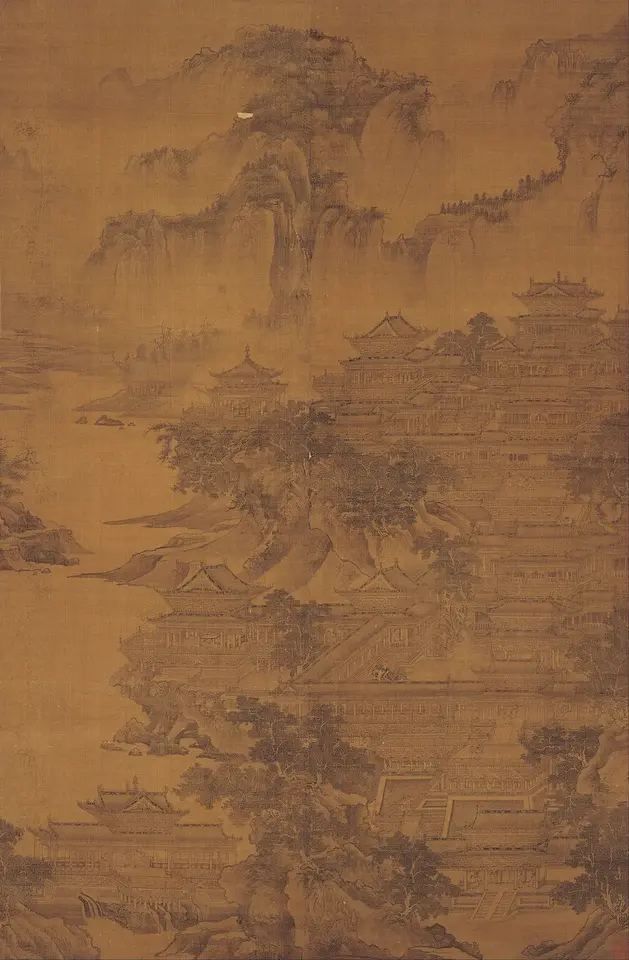
Guo Zhongshu painted pavilions, towers, and palaces entirely freehand without the use of mechanical straightedges. His lines were taut like bent iron wire and fluid like flying dragons. The bracket sets, flying eaves, carved balustrades, and multi-story corridors he depicted adhered strictly to structural mechanics and architectural proportions, rendering vast architectural complexes with microscopic precision.
His sole surviving masterpiece, River Journey in Snow (Xueji Jiangxing Tu, preserved in the National Palace Museum in Taipei), depicts massive merchant barges moored along a snowy riverbank. The rigging ropes, wooden joints, and cabin decks of the vessels are rendered with flawless mathematical accuracy, while the broad snowy expanse and distant mist convey a serene, transcendent aura. Bearing Emperor Huizong's personal inscription, it represents the pinnacle of Chinese boundary painting.
Beyond boundary painting, Guo Zhongshu's pure landscape art established an independent school. Critic Liu Daochun observed that Guo drew upon the crisp, monumental cliff structures of Tang master Li Sixun, while borrowing the sparse, poetic tree arrangements of Wang Wei, integrating the strengths of Guan Tong and Li Cheng.
He transformed the rigid opulence of Five Dynasties court painting into lofty, ink-wash landscapes imbued with the eccentric, unyielding spirit of a literatus. His dramatic cliff faces and surging mists directly inspired the stylistic breakthroughs of later Northern Song masters such as Guo Xi and Wang Shen.
Guo Zhongshu's contributions to Chinese paleography rivaled the historic significance of the Shuowen Jiezi. His seven-volume Hanjian drew upon hundreds of ancient bronze and stone epigraphic sources, establishing systematic principles for compiling ancient character variants by radical and historical derivation.
His accompanying three-volume Peixi addressed confusing homophones and graphic variants prevalent in transcribed texts, providing rigorous phonetic and morphological rectifications. Song classicists relied heavily on Guo's philological findings to clear away centuries of corruptions, laying the foundation for standard Song block-printed classical editions.
In addition to boundary painting and paleography, Guo Zhongshu was a calligrapher of the highest rank. He excelled in archaic great seal (dazhuan), eight-part small seal, and flying-white calligraphy, particularly in copying ancient seal forms with powerful brushwork and classical restraint.
He famously transcribed the Santi Yinfu Jing, carving the text in ancient seal, small seal, and clerical scripts upon a single stele, providing an exemplary copybook for Song scholars studying calligraphy and epigraphy. During his wanderings in Luoyang and Shaanxi, he inscribed massive seal characters several feet high upon temple walls, drawing crowds of admirers and providing foundational momentum for the Northern Song calligraphic archaistic revival.
FIGURES ASSOCIATED WITH THIS DYNASTY