Life Course
Early Ordination and Erudition in Scripture
Guanxiu was born in 832 in Lanxi, Wuzhou. His secular family name was Jiang and his given name was Xiu. The Jiang clan was an established scholarly lineage in Zhejiang, though by the time of Guanxiu's birth, the family had fallen into modest circumstances. From his earliest years, Guanxiu possessed an extraordinary intellect, displaying an innate distaste for worldly ambition and a spiritual drawn toward the quiet serenity of Buddhist monasteries.
In 838, at the age of seven, Guanxiu took leave of his parents and entered Hean Temple in Lanxi to serve as a monastic acolyte under the tutelage of Chan Master Yuanzhen. During his decade at Hean Temple, he exhibited a photographic memory and deep textual comprehension. He chanted both Buddhist scriptures and Confucian classics, routinely memorizing over a thousand words of the Lotus Sutra each day. Both monastic teachers and local scholars hailed him as a prodigy.
In 847, sixteen-year-old Guanxiu sought to broaden his spiritual horizon. He journeyed to the renowned Wuxie Mountain Temple in Zhuji, where he devoted himself to intensive Chan meditation, classical prosody, calligraphy, and traditional monochrome ink painting. In 851, upon reaching his twentieth year, Guanxiu was formally ordained as a full Buddhist monk at Wuxie Mountain, mastering both the Vinaya discipline and the sudden awakening teachings of Southern Chan.
Itinerant Preaching across Southern Rivers
Following his full ordination, Guanxiu adhered to the monastic tradition of wandering the empire to seek instruction from eminent masters. In 857, he traveled through eastern Zhejiang, presenting verses to the exiled scholar Duan Chengshi, author of Youyang Zazu. Duan was astonished by Guanxiu's towering literary vigor and aloof character, establishing an enduring friendship.
In 859, Guanxiu traveled up the Yangtze River into the Xiang River valley, arriving at the provincial capital of Hongzhou. Residing at Kaiyuan Temple, he delivered public lectures on the Lotus Sutra and the Awakening of Faith. His eloquent expositions drew daily audiences numbering in the hundreds, making his doctrinal authority famous throughout Jiangnan. While in Hongzhou, he also studied advanced Chan doctrine under Master Dayuan.
In 860, Guanxiu journeyed to Quzhou to converse with the Daoist master Wuxiang. Prefect Yang Fa of Wuzhou visited him, and together they climbed Mount Chisong, exchanging celebrated poetic compositions. In 863, Guanxiu settled in the secluded mountains of Zhongling, constructing a thatched cottage where he lived as a hermit for two years, producing his twenty-four Mountain Dwelling Poems. Moving to Suzhou in 868, he resided at Wanshou Temple, engaging in deep literary exchanges with prominent poets such as Lu Guimeng, Pi Rixiu, and Wu Rong.
Wartime Turmoil and Poetic Realism
In 874, the eruption of the Huang Chao Rebellion shattered the peace of the Tang Empire. Widespread military devastation swept through the central plains and the Yangtze River valley, forcing Guanxiu to abandon his quiet monastic cloisters. Joining crowds of refugees, he spent years wandering through rugged mountains in Jiangxi, Hunan, and Zhejiang.
The horrors of wartime displacement transformed Guanxiu's spiritual and artistic outlook. Moving beyond the detached quietude of his earlier verse, he began to chronicle the suffering of ordinary people and the devastation of the countryside. In famous narrative poems such as War South of the Wall and Hard Roads, he castigated the cruelty of greedy warlords and expressed profound compassion for destitute victims, producing some of the most powerful realistic verse of the Late Tang.
Uncompromising Defiance of Warlord Power
Following the collapse of the central Tang government, military governors established independent regimes. In the Zhejiang region, Qian Liu consolidated control and founded the Kingdom of Wuyue. Around 896, Guanxiu visited Hangzhou and presented a sweeping commemorative poem to Qian Liu entitled Presenting to Lord Qian. The poem contained the famous couplets:
Guests filling the hall, three thousand drunken with blossoms;
A single sword chilling fourteen prefectures with frost.
These vivid lines brilliantly captured Qian Liu's military dominance. However, Qian Liu, who harbored grand territorial ambitions, sent word demanding that Guanxiu alter the phrase fourteen prefectures to forty prefectures before he would grant an imperial audience.
Faced with this autocratic demand, Guanxiu demonstrated unwavering moral integrity. He rebuked the emissary, stating that fourteen prefectures represented the actual territory of Wuyue and could not be falsely exaggerated, concluding that both territory and poetry could never be altered. He gathered his traveling bowl, turned his back on the court, and departed Hangzhou immediately, an act celebrated by generations as an eternal symbol of literary independence.
Journey West and Royal Patronage in Shu
Departing Wuyue, Guanxiu wandered through Jiangxi, Hubei, and Hunan. Hearing that Sichuan remained peaceful and prosperous under the administration of Military Governor Wang Jian, Guanxiu decided to seek refuge in the western kingdom. In early 902, the elderly monk embarked on an arduous journey through the Three Gorges and across the treacherous mountain paths of the ancient Shu roads, arriving in Chengdu that autumn.
Upon his arrival, Guanxiu submitted a formal verse to Wang Jian praising the tranquil governance of Sichuan amidst nationwide strife. Wang Jian was profoundly moved by Guanxiu's artistic brilliance and venerable reputation. He welcomed him with imperial honors, assigning him a private cloister at Longhua Temple and providing generous provisions for his daily sustenance.
Imperial Preceptor and Peaceful Demise
In 907, the Tang Dynasty officially fell, and Wang Jian proclaimed himself Emperor of Former Shu in Chengdu. In 908, Wang Jian issued an imperial decree honoring Guanxiu with the title Master Chanyue, conferring upon him the imperial purple robe, appointing him Monastic Recorder of the Left and Right Streets, and endowing him with hereditary estates. Despite these imperial honors, Guanxiu lived modestly, distributing his imperial stipends to impoverished citizens and the renovation of monasteries.
During his final decade at Longhua Temple, Guanxiu dedicated himself to completing his artistic oeuvre, producing his immortal Sixteen Arhats paintings and engaging in frequent philosophical dialogues with Chancellor Wei Zhuang and Daoist master Du Guangting. In December 912, Guanxiu died peacefully at Longhua Temple at the age of eighty-one, having been a monk for sixty-one years. Emperor Wang Jian ordered an imperial funeral, and thousands of mourners accompanied his cortege. His disciples compiled his literary remains into the twenty-five volume Chanyue Ji, while his paintings were treasured in royal collections.
Key Achievements
Revolutionary Mastery of the Sixteen Arhats
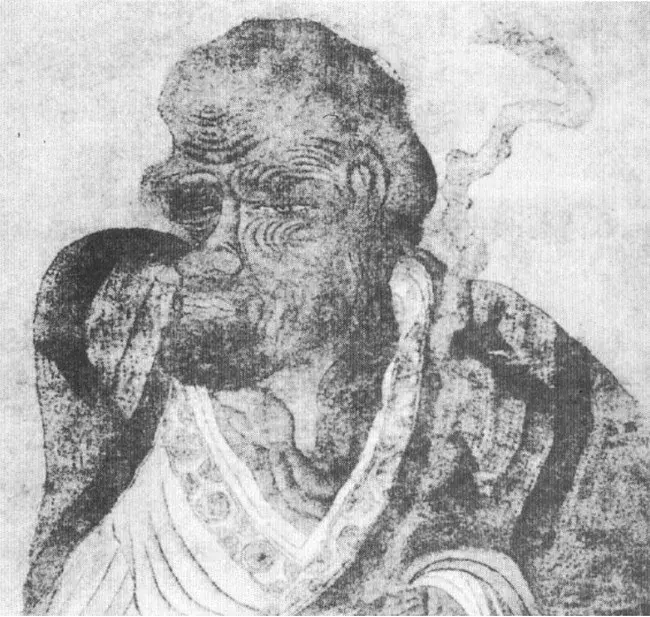
Guanxiu occupies a monumental position in global Buddhist art through his creation of the Sixteen Arhats. Prior to Guanxiu, arhats were typically depicted as subservient attendants flanking the Buddha, their features resembling ordinary Chinese monks. Guanxiu broke completely with tradition, establishing the arhats as monumental, independent subjects possessed of supreme spiritual power.
His style was characterized by foreign physiognomy, prominent brows, deep-set eyes, aquiline noses, and rugged skeletal structures. The arhats were shown seated upon ancient boulders under twisted pines, captured in deep contemplation or teaching doctrine with severe majesty. Contemporary records noted that he prayed before painting and visualized these forms in dreams. His expressive ink outlines and archaic atmosphere established the Guan style of arhat painting, which profoundly shaped East Asian Buddhist art for over a millennium.
Founder of the Jiang Style Cursive Script
Beyond painting, Guanxiu was an acclaimed master of calligraphy. His contemporaries praised his unique cursive script as the Jiang style. Proficient in seal, clerical, standard, and running scripts, he achieved greatest renown in wild cursive, drawing inspiration from the unrestrained dynamism of Master Huai Su while infusing his lines with the austere discipline of Chan meditation.
His brushstrokes resembled twisted iron wire, exhibiting vigorous momentum and bold architectural balance. Song Dynasty statesman Zhang Shangying observed that Guanxiu's cursive combined the ferocity of dragons and tigers with the quiet strength of pine trees enduring winter snows. His frequent transcriptions of the Thousand Character Classic represented a vital bridge between Tang wild cursive and Song expressive calligraphy.
Powerful Realism of the Chanyue Poetic Style
Guanxiu was a prolific poet whose surviving output exceeds seven hundred and thirty verses in Chanyue Ji, ranking alongside Qi Ji as one of the two foremost Buddhist poets of the Tang era. His poetic style, known as the Chanyue style, combined meditative detachment with fiery concern for national welfare and public suffering.
Particularly remarkable were his forty-plus frontier and military poems. In an era dominated by melancholic escapism, Guanxiu composed sweeping odes of patriotic ambition and biting critiques of feudal warfare. His poems combined intense moral outrage with rhythmic power, earning praise as the finest realist verse of the late ninth and early tenth centuries.
Exemplar of Intellectual Integrity and Fearless Spirit
Throughout his long life, Guanxiu embodied the highest ethical ideals of the independent scholar. In an era of rampant militarism where literati routinely compromised their dignity to survive, Guanxiu steadfastly preserved his spiritual autonomy.
His refusal to alter his poetry for Qian Liu demonstrated that moral truth and artistic authenticity stood far above imperial coercion. In his final years in Sichuan, despite enjoying the status of Imperial Preceptor, he maintained simple monastic discipline and consistently urged rulers to govern with compassion and reduce taxes. His life stands as an eternal model of courage, integrity, and artistic independence.