PROFILE
Guan Tong (关仝, c. 907–c. 960) was a native of Changan in Jingzhao. He was an acclaimed landscape painter of the Later Liang during the Five Dynasties and Ten Kingdoms period, serving as a principal architect of the Northern Monumental Landscape style. In his youth he studied under master Jing Hao, working tirelessly until his brushwork surpassed that of his teacher, leading critics to celebrate their tradition as the Jing-Guan school.
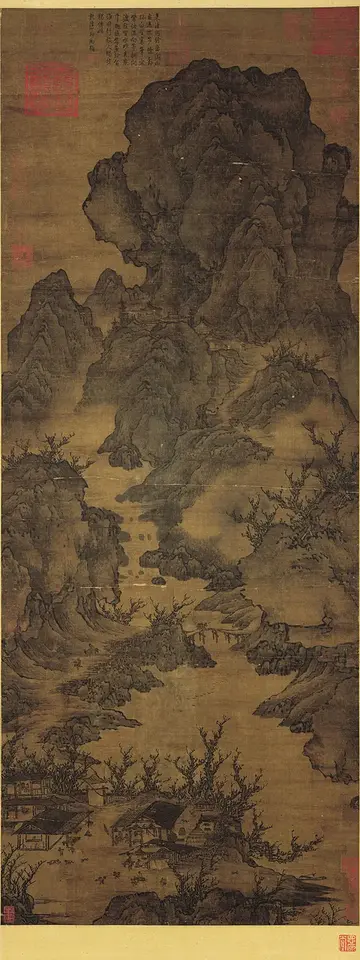
In the evolution of Chinese painting, Guan Tong is revered alongside early Northern Song titans Li Cheng and Fan Kuan as the Three Pillars of Landscape Painting. He specialized in depicting the imposing mountain ranges of Shaanxi and central China, characterized by dense rock masses, austere compositions, and powerful, concise brushwork known as the Guan family landscape.
His surviving compositions, including Travelers in Mountain Passes, Autumn Mountains in Evening Azure, and Waiting for the Ferry on a Mountain Stream, established the classical paradigm of the towering central peak, exerting an immense influence on Song masters Guo Xi, Li Tang, and subsequent landscape painting traditions.
- Native Place
- Changan, Jingzhao (modern Xian, Shaanxi)
- Identity Positioning
- Master landscape painter of Five Dynasties Later Liang, founder of the Northern Monumental Landscape style, creator of Guan family landscape
BIOGRAPHY
Chronology
- 907 (Kaiping 1, Later Liang) | Birth in Changan | Born in the ancient capital of Changan, drawn from early youth to monochrome ink painting.
- 920 (Zhenming 6, Later Liang) | Mentorship under Jing Hao | Traveled to the Taihang Mountains to study under master Jing Hao, mastering ink wash techniques.
- 925 (Tongguang 3, Later Tang) | Independent Style Emergence | Surpassed his teacher's models, adopting a more concise, vigorous brushwork that won fame in Shaanxi.
- 935 (Qingtai 2, Later Tang) | Guan Family Landscape | Formulated the Guan family landscape, featuring sheer precipices and archaic simplicity.
- 945 (Kaiyun 2, Later Jin) | Partnership with Guo Zhongshu | Collaborated closely with architectural master Guo Zhongshu, who painted buildings and figures in his scenes.
- 955 (Xiande 2, Later Zhou) | Artistic Maturity | Reached artistic zenith, producing monumental masterpieces including Travelers in Mountain Passes.
- 960 (Jianlong 1, Song) | Passing Away | Died in Shaanxi around the founding of the Song Dynasty, his authentic works treasured in the royal Xuanhe Academy.
Life Course
Changan Heritage and Mentorship under Jing Hao
Guan Tong was born in Changan during the chaotic Five Dynasties era. Surrounded by the imposing peaks of the Zhongnan and Qinling mountains, he possessed an innate reverence for monumental nature. Naturally quiet and contemplative, he avoided political ambition, devoting himself entirely to capturing the rugged topography of northern China.
During the early Five Dynasties, master Jing Hao resided as a hermit in the Taihang Mountains, establishing a new monochrome ink landscape tradition articulated in his treatise Bifa Ji. Hearing of Jing Hao's fame, Guan Tong traveled vast distances to enter his academy. Under Jing Hao's rigorous guidance, he spent years sketching mountain masses from life, mastering the principles of ink harmony and structural balance. He studied with such relentless focus that he often went without sleep, pondering the internal skeletons of rocks and crags.
Transcendence and Forging an Independent Vision
Having absorbed Jing Hao's techniques, Guan Tong realized that while his teacher excelled in atmospheric ink depth, his brushstrokes sometimes lacked direct structural bone. Guan Tong resolved to develop his own approach. Returning to Shaanxi, he took the vertical precipices of Mount Hua and the Qinling range as his true instructors.
He replaced Jing Hao's intricate texturing with a more chisel-like, vigorous stroke. His brush moved with decisive force, outlining cliffs with bold clarity. His peaks rose vertically like fortress walls, while his winter groves resembled tangled iron nets, creating an atmosphere of primeval grandeur. Contemporary critics declared that he studied Jing Hao but surpassed his teacher, prompting connoisseurs to eagerly seek his works.
The Guan Family Landscape and Artistic Synergy
By the mid-tenth century, Guan Tong's artistic fame dominated northern China. Rulers and scholar-officials across Later Tang, Later Jin, Later Han, and Later Zhou regarded owning an authentic Guan Tong hanging scroll as a mark of highest prestige. The art world formally designated his monumental, austere compositions as the Guan family landscape.
While supreme in painting crags, torrents, and rustic trees, Guan Tong recognized his limitations in depicting delicate architectural structures and tiny human figures. He formed a celebrated partnership with Guo Zhongshu, the era's greatest master of ruled-line architectural painting. Whenever Guan Tong completed a grand landscape, Guo Zhongshu supplied the palaces, watchtowers, and traveler caravans. Their harmonious collaboration elevated the Guan family landscape to its aesthetic summit.
Final Years and the Xuanhe Imperial Collection
Guan Tong spent his entire life as an uncompromised artist, living simply in Shaanxi and continuing to paint into his advanced years.
Around 960, during the transition to the Northern Song, Guan Tong passed away in Shaanxi. Following his death, his paintings were treasured by imperial collectors. Emperor Huizong's Xuanhe imperial catalogue documented ninety-four authentic scrolls by Guan Tong, the largest collection accorded to any Five Dynasties landscape master, cementing his status as a patron saint of Chinese landscape painting.
Key Achievements
The Monumental High-Distance Paradigm
Guan Tong revolutionized Chinese landscape painting by establishing the monumental, vertical high-distance composition. Prior to Guan Tong, landscapes functioned primarily as decorative backdrops for figure narratives or utilized flat planar arrangements.
Guan Tong made the mountain itself the supreme protagonist. His compositions featured a massive central peak dominating the center of the scroll, rising with imperial majesty above flanking ridges, tumbling waterfalls, and mist-veiled gorges. This structural format established the classic standard of Chinese landscape art, directly inspiring Fan Kuan's Travelers Among Mountains and Streams and Guo Xi's Early Spring.
Bold Axe-Cut Texturing and Brush Economy
In brush technique, Guan Tong pioneered a style characterized by brush economy and structural strength, summarized by critics as: the simpler the brushwork, the more powerful the spirit.
He outlined rock strata with firm center-tip strokes, applying dry, angled texture strokes that conveyed the dense weight of northern granite. His branches bristled like iron antlers, eschewing delicate prettiness. This emphasis on expressive, calligraphic economy anticipated the later literati aesthetic of Ni Zan.
The Three Pillars of Landscape Art
Song critics Liu Daochun and Guo Ruoxu canonized Guan Tong alongside Li Cheng and Fan Kuan as the Three Pillars of Landscape Painting, establishing an enduring aesthetic standard.
Traditional theory asserted that Guan Tong captured the bone of mountains, Li Cheng captured their mist-veiled presence, and Fan Kuan captured their atmospheric spirit. Guan Tong's masculine, uncompromising energy formed the foundational cornerstone for the Southern Song academy of Li Tang and the later Zhe School.
Personal Relationships
- Master: Jing Hao, Five Dynasties founder of northern landscape painting who trained Guan Tong.
- Collaborator: Guo Zhongshu, master of architectural ruled-line painting who painted buildings and figures in Guan Tong's landscapes.
- Pillar Contemporary: Li Cheng, Northern Song master landscape painter who formed the Three Pillars with him.
- Pillar Contemporary: Fan Kuan, Northern Song master who inherited the northern monumental style.
- Successor: Guo Xi, Song imperial court painter whose atmospheric high-distance compositions drew upon Guan Tong.
Historical Evaluation
- Liu Daochun, Evaluations of Song Dynasty Famous Painters: Guan Tong studied under Jing Hao, but his brushwork surpassed him. In his landscapes, rocks are dense, groves lush, pavilions archaic, and figures tranquil. The simpler his brush, the more grand his spirit. (Evaluations of Song Dynasty Famous Painters, Volume 2)
- Guo Ruoxu, Experiences in Painting: In landscape painting, antiquity cannot match the Five Dynasties. Only Li Cheng, Guan Tong, and Fan Kuan possessed divine genius, standing as three pillars that establish the standard for a hundred generations. (Experiences in Painting, Volume 1)
- Emperor Huizong of Song, Xuanhe Painting Catalogue: Guan Tong excelled in landscapes, depicting autumn mountains and frozen groves with archaic serenity, capturing the true spirit of creation. The imperial collection holds ninety-four scrolls, peerless under heaven. (Xuanhe Painting Catalogue, Volume 11)
- Tang Hou, Huajian: Guan Tong's mountain peaks are steep, his brushwork archaic, and his rocks dense and profound, unmatched by later generations. (Huajian)
- Dong Qichang, Huachanshi Suibi: Guan Tong, Li Cheng, and Fan Kuan were northern masters whose works possess immense power and spiritual vitality, serving as teachers for all generations. (Huachanshi Suibi)
Related Entries
- Jing Hao
- Li Cheng
- Fan Kuan
- Xuanhe Painting Catalogue
- Travelers in Mountain Passes
- Northern Landscape School
FIGURES ASSOCIATED WITH THIS DYNASTY