Birth in Wuxing
Born in Guancun, Wucheng County, into an aristocratic family claiming lineage from Guan Zhong.
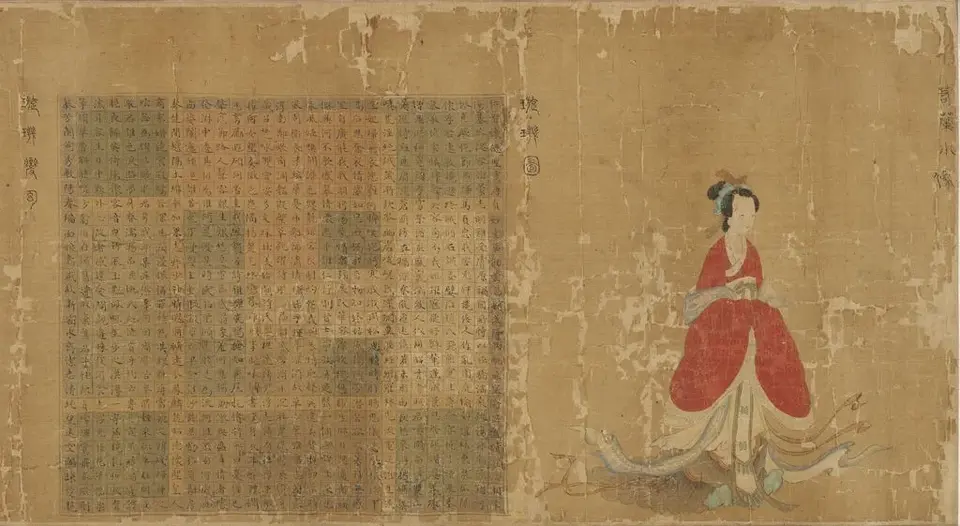
管道昇
Guan Daosheng (管道昇, 1262–May 29, 1319 CE, alternative tradition 1271–1319 CE), courtesy name Zhongji (仲姬), was a native of Wucheng, Wuxing (modern Huzhou, Zhejiang), claiming descent from the illustrious Spring and Autumn period statesman Guan Zhong. She was a preeminent female painter, calligrapher, lyricist, and artistic connoisseur of the Yuan dynasty. Conferred the imperial titles Lady of Wuxing Commandery and…
Guan Daosheng (管道昇, 1262–May 29, 1319 CE, alternative tradition 1271–1319 CE), courtesy name Zhongji (仲姬), was a native of Wucheng, Wuxing (modern Huzhou, Zhejiang), claiming descent from the illustrious Spring and Autumn period statesman Guan Zhong. She was a preeminent female painter, calligrapher, lyricist, and artistic connoisseur of the Yuan dynasty. Conferred the imperial titles Lady of Wuxing Commandery and subsequently Lady of Wei by Emperor Renzong, she is reverently commemorated by posterity as Lady Guan (Guan Furen). Born into a prestigious and wealthy southern literary family, Guan Daosheng exhibited exceptional precocity, mastering classical prose, poetry, and painting without formal instruction. In 1288 CE (the twenty-fifth year of the Zhiyuan era), at age twenty-seven, she married Zhao Mengfu, a scion of the Song imperial house and the leading calligraphic and pictorial master of the era. United by shared aesthetic genius, husband and wife engaged in lifelong artistic collaboration, studying ancient Jin and Tang dynasty brush methods, collecting antiquities, and pioneering the literati landscape and monochrome ink aesthetic that defined Yuan visual culture, standing as one of the most celebrated intellectual partnerships in Chinese cultural history. In Chinese art history, Guan Daosheng is universally revered as one of the few supreme female masters of calligraphy and painting. Her calligraphy excelled in small standard script (xiaokai) and running script, featuring rounded, supple brushstrokes anchored by firm interior bone-structure, earning her comparison with Eastern Jin calligrapher Lady Wei (Wei Shuo) as one of the "Two Ladies of the Calligraphic World." Emperor Renzong was so impressed by her talent that he ordered works by Zhao Mengfu, Guan Daosheng, and their son Zhao Yong mounted together as an imperial scroll, proclaiming that future generations should know that the dynasty possessed an incomparable female calligrapher. In painting, Guan Daosheng pioneered the depiction of sunlit bamboo (qingzhu), utilizing pure centered brushwork (zhongfeng) and an innovative "flying-swallow" technique for bamboo leaves. Her masterpieces, including Water and Bamboo (Shuizhu Tu) and Bamboo and Rock (Zhushi Tu), are preserved as Grade-One National Treasures in Beijing and Taipei. Her celebrated poem Song of You and Me (Wo Nong Ci) transformed personal domestic devotion into an immortal masterpiece of spousal equality and affection. She passed away aboard a riverboat in Linqing, Shandong, during her return journey to Huzhou in 1319 CE.
Born in Guancun, Wucheng County, into an aristocratic family claiming lineage from Guan Zhong.
Dedicated herself to Buddhist and artistic studies; transcribed dozens of copies of the Diamond Sutra in fine standard script.
Married Zhao Mengfu at age twenty-seven in Wuxing, beginning three decades of shared artistic and intellectual devotion.
Traveled to the northern capital of Dadu with Zhao Mengfu, managing the household and educating her sons and daughters.
Penned the celebrated lyric poem Wo Nong Ci, peacefully defusing a domestic marriage crisis through sublime romantic metaphor.
Painted the landmark handscroll Water and Bamboo, pioneering sunlit bamboo rendering during a river voyage south.
Conferred the noble rank of Lady of Wei by Emperor Renzong, who ordered her calligraphic scrolls preserved in the imperial archives.
Succumbed to chronic illness on May 29 aboard a boat in Linqing, Shandong, while returning to Huzhou at age fifty-eight, and was subsequently interred at Mount Dongheng with an epitaph by Zhao Mengfu.
Guan Daosheng was born in 1262 CE (the third year of the Jingding era under Emperor Lizong of the Southern Song; an alternative scholarly tradition dates her birth to 1271 CE). Her ancestral home was Guancun in Wucheng County, Wuxing (modern Huzhou, Zhejiang). According to the Epitaph for the Lady of Wei, née Guan authored by Zhao Mengfu, the Wuxing Guan family claimed direct patrilineal descent from Guan Zhong (Guan Yiwu), the renowned chancellor of Qi during the Spring and Autumn period, whose descendants migrated south to Wuxing during the Han and Tang dynasties.
Guan Daosheng's father, Guan Shen (courtesy name Yangyuan), was a cultured, benevolent local gentleman who recognized his daughter's extraordinary intellect. Guan Daosheng demonstrated natural poetic and calligraphic aptitude without formal instruction, easily assimilating historical records, musical theory, and antique connoisseurship. In her adolescence, she embraced Buddhist contemplative practice, transcribing dozens of complete scrolls of the Diamond Sutra in meticulous, luminous small standard script, distributing them to renowned Buddhist monasteries across southern China. Her early calligraphy earned astonishment from literati connoisseurs across Jiangnan.
Because of Guan Daosheng's elevated intellect and refined artistic standards, her father sought a suitor of commensurate brilliance, delaying her marriage until she reached her late twenties. In 1288 CE, at age twenty-seven, she was united in marriage with Zhao Mengfu, a distinguished scholar-official from Wuxing and an eleventh-generation descendant of Emperor Taizu of Song.
Zhao Mengfu was already celebrated as a leading cultural genius of Jiangnan, while Guan Daosheng possessed matching poetic and calligraphic mastery. Their union became a benchmark of marital harmony and intellectual partnership. In their Wuxing studio, they passed days cross-examining ancient rubbings of the two Wangs (Wang Xizhi and Wang Xianzhi), studying Five Dynasties landscape paintings by Dong Yuan and Juran, and transcribing poetry together. Guan Daosheng's brushwork absorbed Zhao Mengfu's structural vigor, while Zhao Mengfu's landscapes gained atmospheric tenderness from her artistic intuition.
Following Zhao Mengfu's appointment to the Yuan imperial court in Dadu (modern Beijing), Guan Daosheng accompanied him north. As a descendant of the fallen Song dynasty serving a Mongol regime, Zhao Mengfu faced constant factional scrutiny and moral anguish. Guan Daosheng provided steadfast emotional support and prudent advice, navigating the complex aristocratic environment of Dadu with exemplary grace.
She oversaw the education of her children, personally training her second son Zhao Yong and youngest son Zhao Yi in classical letters and painting. Both sons subsequently rose to prominence as court scholars and artists, establishing the Zhao family of Wuxing as one of the paramount cultural lineages of the Yuan dynasty.
During this period, when the practice of taking secondary concubines was fashionable among Dadu's high officials, Zhao Mengfu tentatively hinted at such inclinations through playful verse. Rather than reacting with bitter confrontation, Guan Daosheng composed the immortal Song of You and Me (Wo Nong Ci): "You and I possess so much love; / Our passion burns like raging fire! / Take a lump of clay, fashion a you, sculpt a me; / Then shatter both of us together, and mix with water; / Re-mold a you, re-sculpt a me. / In my clay there is you, in your clay there is me: / In life we shall share a single quilt, in death a single tomb!" Overcome with remorse and profound admiration for his wife's unyielding devotion and moral dignity, Zhao Mengfu completely abandoned his concubine ambitions, cherishing her with undivided love for the remainder of their lives.
In 1317 CE (the fourth year of the Yanyou era), Emperor Renzong appointed Zhao Mengfu as Chief Academician of the Hanlin Academy (Hanlin Xueshi Chengshi). Appreciating Guan Daosheng's exceptional artistic virtue, the emperor issued an imperial rescript conferring upon her the highest female aristocratic honor, creating her Lady of Wei (Wei Guo Furen).
Emperor Renzong was an avid connoisseur of calligraphy and painting. During an imperial gathering, he ordered that calligraphic handscrolls executed by Zhao Mengfu, Guan Daosheng, and their son Zhao Yong be brought together and mounted as a single magnificent three-generation scroll. Storing it in the imperial inner archives, the emperor proudly proclaimed to his ministers: "Let posterity know that our dynasty possesses not only men of peerless calligraphy, but also a woman of supreme calligraphic mastery—this is truly a miraculous rarity under heaven!"
Living for decades in the dry, harsh climate of the northern capital, Guan Daosheng developed severe rheumatic illnesses affecting her limbs, accompanied by chronic pulmonary coughing. Longing for the gentle waters of Jiangnan, she urged her husband to seek retirement. Deeply concerned for her deteriorating health, Zhao Mengfu submitted a heartfelt memorial to Emperor Renzong in April 1319 CE, begging permission to escort his ailing wife home.
Emperor Renzong granted the request, and on April 25, the couple boarded a vessel to travel south via the Grand Canal. However, as the boat reached Linqing in Shandong, Guan Daosheng's condition suddenly worsened. On May 29, 1319 CE (the tenth day of the fifth lunar month), she passed away peacefully on the canal vessel at the age of fifty-eight.
Zhao Mengfu was plunged into inconsolable grief, lamenting that half of his soul had been torn away. Escorting her coffin back to Huzhou, he composed the moving Epitaph for the Lady of Wei, née Guan, detailing her lifelong virtue and brilliance. In September 1320 CE, Guan Daosheng was interred at the southern foot of Mount Dongheng in Deqing. Two years later, Zhao Mengfu died and was buried beside her, fulfilling the sacred vow of their Wo Nong Ci.
Guan Daosheng occupies a paramount position in the history of Chinese calligraphy as the preeminent female calligraphic master of the Yuan dynasty.
Her small standard script inherited the classical equilibrium of Zhong Yao and Wang Xizhi. Her characters were characterized by horizontal breadth, supple kinetic agility, and interior structural strength, completely devoid of the fragile, superficial decorative mannerisms often associated with traditional boudoir scripts. Her running script displayed fluid momentum and elegant poise, closely harmonizing with Zhao Mengfu's classical revivalism while preserving a delicate, feminine gentleness. Her surviving small standard script works, such as the Diamond Sutra, Ode to the Sounds of Autumn, and Song of Everlasting Sorrow, are revered for their flawless stroke discipline. Imperial historians linked her name with Lady Wei (Wei Shuo), the Eastern Jin calligrapher who instructed the young Wang Xizhi, celebrating them jointly as the "Two Ladies of the Calligraphic World."
In painting, Guan Daosheng was an innovator who redefined monochrome ink bamboo painting (mobu).
While Northern Song masters like Wen Tong and Su Shi excelled at wind-blown and snow-laden bamboo, Guan Daosheng pioneered the depiction of "sunlit new bamboo" (qingzhu). Utilizing upright, centered brushwork (zhongfeng), she rendered bamboo canes and shoots with clean, resilient strokes executed in a single breath, minimizing muddy layered ink washes in favor of luminous tonal gradations that captured the fresh translucence of young bamboo leaves bathed in morning sunlight. Furthermore, she invented the "flying-swallow style" (yanfei shi) for bamboo leaves, where strokes flared outward like the wings of banking swallows, creating an organic sense of breeze and vitality. Her masterworks Water and Bamboo (Palace Museum, Beijing) and Bamboo and Rock (National Palace Museum, Taipei) remain canonical milestones in Chinese ink painting.
In literary history, Guan Daosheng's Song of You and Me (Wo Nong Ci) stands as an enduring monument to female agency, emotional sincerity, and marital equality.
In a patriarchal society where male polygyny was institutionalized and female grievances were typically silenced in passive despair, Guan Daosheng's poem deployed colloquial folk imagery—the mutual blending of broken clay figurines—to articulate a radical vision of mutual identity and indissoluble spiritual unity. The work completely transformed traditional boudoir lyricism, demonstrating that profound moral resolve and romantic devotion could overcome institutional gender subjugation.
Guan Daosheng was a devout practitioner of Mahayana Buddhism, whose spiritual practice enriched the Buddhist visual culture of the Yuan dynasty.
She extensively studied the Diamond Sutra, Lotus Sutra, and Heart Sutra, integrating meditative tranquility into her daily artistic work. She embroidered and painted numerous images of Bodhisattvas, including the Embroidery of Buddha in the Mountain Pavilion and portraits of Guanyin, noted for their compassionate solemnity. Her lifelong transcription of Buddhist sutras helped foster the synthesis of literati ink painting and Chan meditation that characterized late imperial intellectual culture.
FIGURES ASSOCIATED WITH THIS DYNASTY