Birth in Changshu
Born into a scholarly family in Changshu, Jiangsu; his father Gu Rouqian was an eminent Confucian scholar.
顾祖禹
Gu Zuyu (1631–1692), courtesy name Jingfan, art names Chuchong and Wanxi, was a native of Changshu, Jiangsu, with ancestral roots in Wuxi. He was an eminent historical and military geographer during the Ming-Qing transition and a foremost exemplar of practical statecraft scholarship, standing alongside contemporary luminaries Gu Yanwu, Huang Zongxi, and Wang Fuzhi. His 130-volume magnum opus Dushi Fangyu Jiyao (*Essentials…
Gu Zuyu (1631–1692), courtesy name Jingfan, art names Chuchong and Wanxi, was a native of Changshu, Jiangsu, with ancestral roots in Wuxi. He was an eminent historical and military geographer during the Ming-Qing transition and a foremost exemplar of practical statecraft scholarship, standing alongside contemporary luminaries Gu Yanwu, Huang Zongxi, and Wang Fuzhi. His 130-volume magnum opus Dushi Fangyu Jiyao (Essentials of Geography for Reading History) is revered as the supreme masterpiece of Chinese military historical geography. Born into an erudite scholarly family, Gu Zuyu witnessed the cataclysmic collapse of the Ming dynasty in his youth. His father Gu Rouqian, grieving that late Ming literati had indulged in empty metaphysical speculation while remaining utterly ignorant of defensive topography, charged Zuyu on his deathbed to devote his entire life to geographical statecraft. Honoring this paternal injunction, Gu lived as a Ming loyalist recluse, vowing never to participate in Qing civil examinations. From 1659 onward, across more than thirty years of severe material privation, he consulted twenty-one dynastic histories, over a hundred local gazetteers, and countless archives, personally inspecting strategic passes and waterways to produce Dushi Fangyu Jiyao. In Dushi Fangyu Jiyao, Gu articulated the profound strategic doctrine that "the essence of military command lies in understanding topographical barriers and discerning geographical advantages." He meticulously traced shifts in administrative boundaries, surveyed river networks, dissected operational victories and defeats, and rectified centuries of errors in previous geographical treatises. In his twilight years, he directed the compilation of the Comprehensive Gazetteer of the Great Qing (Da Qing Yitong Zhi) alongside Yan Ruoju. Gu Zuyu's monumental scholarship permanently elevated Chinese historical geography into an empirical and strategic discipline.
Born into a scholarly family in Changshu, Jiangsu; his father Gu Rouqian was an eminent Confucian scholar.
Witnessed the fall of Beijing and the Manchu conquest at age fourteen, resolving to shun Qing examinations and study statecraft.
Received his dying father's solemn instruction to devote his life to historical geography and strategic military terrain.
Formally began writing Dushi Fangyu Jiyao, gathering dynastic histories and gazetteers from across the realm.
The first five volumes, Strategic Topography of Successive Dynasties, were printed by the Hua family in Wuxi.
Dispatched to Fujian during the Revolt of the Three Feudatories under Geng Jingzhong; departed upon discerning Geng's lack of strategic vision.
Recruited by Xu Qianxue to lead the editorial bureau compiling the Comprehensive Gazetteer of the Great Qing at Lake Tai.
Completed the final manuscript of the monumental 130-volume Dushi Fangyu Jiyao after three decades of labor.
Died of exhaustion and illness in Wuxi at the age of sixty-one.
Gu Zuyu was born in 1631 in Changshu, Jiangsu, into a distinguished family of scholars whose ancestral home was Wuxi. His grandfather Gu Dashou and father Gu Rouqian were upright scholars deeply learned in the classics, astronomy, and hydraulic geography. Gu Rouqian was a man of stern integrity who lamented that late Ming scholars had indulged in vacuous Neo-Confucian moral introspection, ignoring practical statecraft and military defense. Immersed in this rigorous domestic tradition, Gu Zuyu memorized the dynastic histories from childhood and developed a fierce commitment to empirical utility.
In 1644, the Ming dynasty collapsed before peasant insurgencies and Manchu armies, plunging Jiangnan into warfare and devastation. Fourteen-year-old Gu Zuyu witnessed the slaughter and burning of his homeland, an experience that forged his lifelong conviction. In 1656, on his deathbed, Gu Rouqian bitterly recalled how Ming commanders had fled blindly because they did not know the passes, rivers, and strategic topography of the realm. He instructed his son never to pursue official examination degrees, but to consecrate his entire existence to producing a comprehensive work on military geography. Gu Zuyu knelt, accepted his father's dying wish, and pledged himself to a life of loyalist reclusion.
In 1659, twenty-nine-year-old Gu Zuyu embarked on the composition of Dushi Fangyu Jiyao. To fulfill his vow, he resided in humble cottages along the Wanxi stream outside Changshu and in rural Wuxi, adopting the sobriquet Wanxi and enduring severe poverty. Clothed in coarse rags and surviving on simple grain, he worked ceaselessly day and night through bitter winters and scorching summers.
Using the twenty-one official dynastic histories as his primary framework, he collected over a hundred provincial, prefectural, and county gazetteers, along with veracious records, memorial compendia, and private memoirs. Gu did not confine himself to desk study; he traveled extensively across mountains and rivers whenever opportunity permitted. He surveyed fortified city walls, tracked mountain ridges, investigated transit distances, and questioned frontier veterans, boatmen, and merchants regarding seasonal water depths, mountain choke points, and ferry crossings, reconciling ancient texts with physical terrain.
In 1674, the Revolt of the Three Feudatories erupted as Wu Sangui and Geng Jingzhong rebelled against Qing rule. Geng Jingzhong launched his uprising in Fujian and, having long heard of Gu Zuyu's peerless mastery of strategic terrain, sent envoys with valuable gifts to invite him to join his headquarters as a military adviser. Yearning for the restoration of the fallen Ming dynasty, Gu traveled across treacherous mountains to Fuzhou.
However, upon arrival, Gu closely observed Geng's operational conduct. He discerned that Geng was vain, vacillating, and devoid of strategic vision, while his subordinates were rapacious and undisciplined. Convinced that the revolt was doomed to catastrophic defeat, Gu firmly declined any official rank. He slipped out of Fujian at great personal peril and returned to Jiangnan to resume his solitary scholarly writing. This hazardous venture nonetheless yielded invaluable firsthand empirical observations of the coastal defenses and mountain passes of Fujian and Zhejiang.
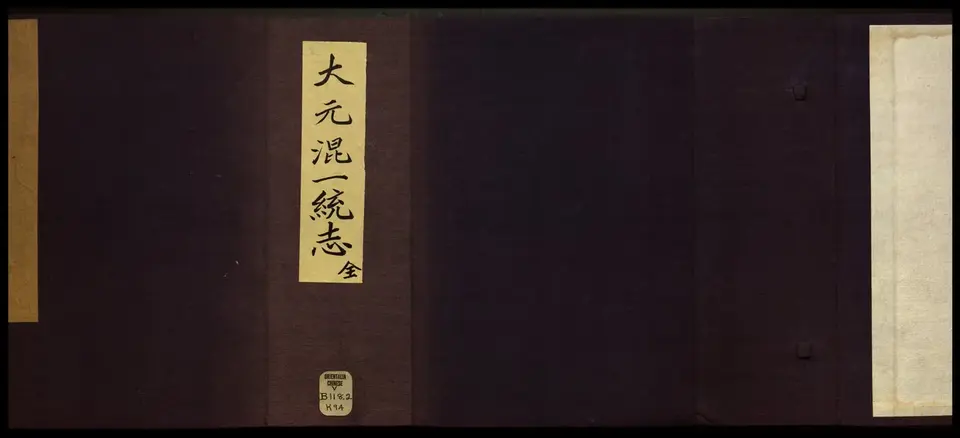
In 1689, Grand Secretary Xu Qianxue was commanded by the Kangxi Emperor to establish a private editorial bureau at Dongting Mountain on Lake Tai to compile the Comprehensive Gazetteer of the Great Qing (Da Qing Yitong Zhi). Recognizing Gu Zuyu's unmatched authority on empire-wide geography, Xu insisted that Gu join the enterprise. Seeking access to imperial archives to verify his own manuscripts, Gu accepted the post, collaborating closely with renowned evidential scholar Yan Ruoju and bibliophile Huang Yi. Gu drafted the pivotal treatises on passes, garrisons, and topographical history, providing the intellectual backbone for the imperial gazetteer.
In 1690, after thirty years of relentless intellectual labor, the hundred-and-thirty-volume Dushi Fangyu Jiyao was completed. Decades of unremitting toil had irreparably compromised Gu's health. In 1692, he passed away peacefully at his residence in Wuxi at the age of sixty-one. Though he died without wealth or high title, his steadfast integrity and monumental scholarship earned him an immortal place in Chinese intellectual history.
Comprising 130 volumes and exceeding 2.8 million Chinese characters, Dushi Fangyu Jiyao represents the towering zenith of traditional Chinese military and historical geography. The structural organization of the work is exceptionally coherent and comprehensive, divided into four core divisions and an appendix: the first division consists of the nine-volume Strategic Topography of Successive Dynasties, chronologically evaluating political administrative boundaries and military dynamics from high antiquity through the Ming dynasty; the second division forms the core of the work, spanning 114 volumes dedicated to the two capital districts and thirteen provinces of the Ming empire, meticulously detailing prefectures, counties, mountains, rivers, mountain gates, and defensive fortifications; the third division comprises the six-volume Rivers and Waterways, documenting the hydrographic networks of the realm; the fourth division is a single-volume treatise on celestial astrological divisions; and the work concludes with a four-volume appendix, General Survey of Atlases, providing integrated visual cartography.
The treatise adopts the administrative layout of the Ming dynasty as its primary coordinate system, indexing more than thirty thousand historical place-names. Gu Zuyu broke away from the arid registers of previous gazetteers that merely listed population and tax figures, synthesizing historical narrative with geographical space so that two millennia of dynastic warfare and topographical features became mutually illuminating.
The defining intellectual contribution of Dushi Fangyu Jiyao is its pervasive military strategic vision. Grieved by the catastrophic collapse of the Ming due to strategic incompetence, Gu elaborated the doctrine that "the essence of military command lies in understanding topographical barriers and discerning geographical advantages." He scrutinized the strategic advantages of imperial capitals, defensive defiles, and advance and retreat corridors across every major conflict in Chinese history.
Gu demonstrated the pivotal geopolitical roles played by strategic choke points: Hanzhong as the gateway to Sichuan, Xiangyang as the throat of the Middle Yangtze, Tongguan as the key to the Guanzhong basin, Xuzhou as the crossroads connecting north and south, and Hefei as the anchor of the Huai River defense line. He insisted that victorious commanders must master defensive barriers and exploit natural terrain; neglecting geographical advantages would inevitably lead to disaster even with massive armies. His penetrating analyses of iconic campaigns—including Guandu, Red Cliffs, the Fei River, and the siege of Xiangyang—stand as unmatched classics of military strategic analysis.
Gu Zuyu conducted rigorous evidential research, collating historical geographical treatises from the Han and Tang dynastic histories alongside landmark geographical works such as the Yuanhe Maps and Records of Prefectures and Counties, Universal Geography of the Taiping Era, Nine Regions Gazetteer of the Yuanfeng Era, and Record of Prominent Regions. He identified and corrected hundreds of deep-seated errors transmitted uncritically across centuries.
For instance, regarding the famed Kunming Pool excavated southwest of Han dynasty Chang'an, previous historians had repeated fanciful legends; Gu proved through rigorous textual analysis that Emperor Wu of Han had dug the lake to simulate the Dianchi and Erhai lakes of the southwestern Kunming tribes for naval training, tracing its hydrological evolution and structural remains across subsequent dynasties. Similarly, he clarified the precise battlefield topography and troop movement corridors of the Battle of Red Cliffs, establishing authentic historical boundaries through unyielding empirical proof.
Consistent with the practical statecraft ethos of the early Qing, Gu Zuyu's vision extended far beyond military campaigns to encompass physical and economic geography vital to popular welfare. The work systematically incorporates irrigation infrastructure, grain tribute waterways, salt and iron monopolies, agrarian military colonies, and horse administration.
In his six-volume hydrographic treatise Rivers and Waterways, he mapped the historical channel shifts of the Yellow, Yangtze, Huai, and Hai river systems, summarizing centuries of flood management and navigation maintenance. Fully aware that the Grand Canal constituted the logistical jugular vein of the empire, he cataloged lock gates, reservoirs, and dangerous shallows along its entire course. Gu declared that military strength and popular sustenance were inseparable, asserting that true statecraft required total familiarity with the economic arteries of the realm.
In his final years, Gu Zuyu served as the intellectual pillar of Xu Qianxue's imperial gazetteer bureau. Collaborating with evidential master Yan Ruoju, he contributed thirty years of accumulated field notes and collation drafts to the imperial project. The authoritative accounts of border garrisons, strategic defiles, and military history within the Comprehensive Gazetteer of the Great Qing were predominantly derived from Gu's personal drafts.
Following its print publication during the Jiaqing reign, Dushi Fangyu Jiyao exerted immense influence across the Qing empire. Wei Yuan's Illustrated Treatise on the Maritime Kingdoms (Haiguo Tuzhi) and Records of Imperial Military Exploits (Shengwu Ji) drew directly upon Gu's geographical frameworks. During the nineteenth century, statesman-generals Zeng Guofan and Zuo Zongtang kept the work on their camp desks, consulting it constantly when planning strategic campaigns. In modern scholarship, renowned historical geographer Tan Qixiang hailed Dushi Fangyu Jiyao as an insurmountable pinnacle of Chinese geographical science.
FIGURES ASSOCIATED WITH THIS DYNASTY