Birth in Wuxi
Born into an aristocratic Jiangnan lineage; showed early brilliance in literature, calligraphy, and painting.
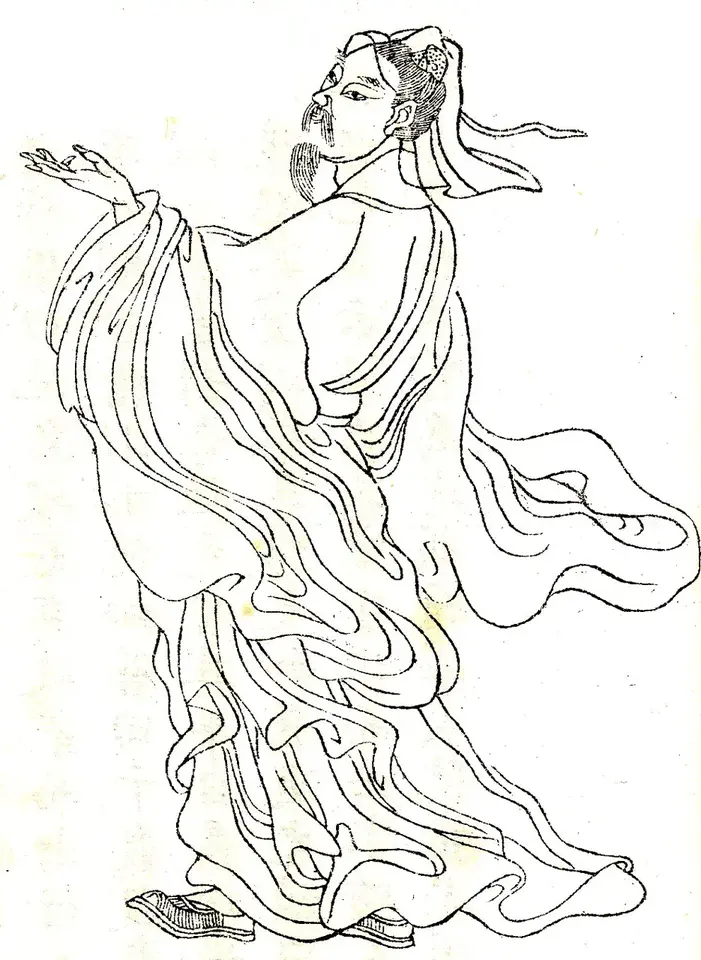
顾恺之
Gu Kaizhi (348–409), styled Changkang and nicknamed Hutou, was a native of Wuxi County, Jinling Commandery (modern Wuxi City, Jiangsu Province). He was an outstanding painter, art theorist, and poet of the Eastern Jin dynasty. Born into an established Jiangnan aristocratic clan, he served as army aide to Grand Marshal Huan Wen and later to Inspector of Jing Province Yin Zhongkan, before advancing to Regular Cavalier…
Gu Kaizhi (348–409), styled Changkang and nicknamed Hutou, was a native of Wuxi County, Jinling Commandery (modern Wuxi City, Jiangsu Province). He was an outstanding painter, art theorist, and poet of the Eastern Jin dynasty. Born into an established Jiangnan aristocratic clan, he served as army aide to Grand Marshal Huan Wen and later to Inspector of Jing Province Yin Zhongkan, before advancing to Regular Cavalier Attendant-in-ordinary during the Yixi era under Emperor An of Jin, authoring the ceremonial Memorial for the Military Standard during Liu Yu's northern expedition against Southern Yan. Along with Cao Buxing, Lu Tanwei, and Zhang Sengyou, he is celebrated as one of the "Four Masters of the Six Dynasties" and is venerated across Chinese art history as the founding father of both figure and landscape painting, earning the honorary title "Patriarch of Chinese Painting." Gu was celebrated for his broad erudition, excelling in verse, rhapsody, calligraphy, and painting, earning contemporary renown for possessing the "Three Perfections" (Supreme Wit, Supreme Painting, and Supreme Guilelessness), with Chancellor Xie An praising his artistry as "unrivaled since the birth of human mortals." In painting practice and aesthetic theory, Gu transformed the utilitarian didactic style of the Han and Wei eras, pioneering the conscious aesthetic doctrines of "depicting the spirit through form" (yi xing xie shen) and "attaining inspiration through creative contemplation" (qian xiang miao de), emphasizing that "the transmission of the spirit in portraiture resides precisely in the pupils of the eyes." When he completed the Vimalakirti mural at the Waguan Monastery in Jinling, his ceremonial dotting of the figure's eyes created a sensation that drew thousands of spectators and raised vast funds. Similarly, his portrait of Pei Kai with three fine hairs added to the cheek captured the subject's spiritual vitality, while his likeness of the one-eyed Yin Zhongkan minimized the subject's physical disability through skillful composition. In technique, Gu's brushwork was characterized by continuous, resilient, and circular lines, compared by ancient critics to "silkworms spinning silk in spring" or "drifting clouds and flowing water," establishing the classical "high-antiquity gossamer line" (gaogu yousi miao) and the "dense manner" (miti) of traditional line drawing. His written treatises, including On Painting, Encomiums on Eminent Paintings of the Wei and Jin Dynasties, and Record of Painting Mount Yuntai, represent China's earliest systematic treatises on painting theory. Surviving master copies of his compositions, such as the Admonitions of the Court Instructress, the Nymph of the Luo River, and the Wise and Benevolent Women, remain foundational masterpieces of classical Eastern art.
Born into an aristocratic Jiangnan lineage; showed early brilliance in literature, calligraphy, and painting.
Pledged one million cash for Waguan Monastery; painted the Vimalakirti mural and completed the eyes before a vast audience.
Appointed army aide to Grand Marshal Huan Wen, earning his respect and traveling along rivers and mountain landscapes.
Served as army aide to Inspector Yin Zhongkan, forming a close friendship and painting an acclaimed likeness of him.
Formulated foundational treatises on aesthetics, including On Painting and Record of Painting Mount Yuntai.
Appointed Regular Cavalier Attendant-in-ordinary under Emperor An; composed official prose for Liu Yu's northern expedition.
Passed away in the capital Jiankang at age 62, remembered by contemporaries for his creative genius.
Gu Kaizhi was born in 348 (the fourth year of the Yonghe era under Emperor Mu of Eastern Jin) into the prominent Gu lineage of Wuxi in Jinling Commandery. His father, Gu Yuezhi, served as Mounted Attendant-in-ordinary to the Governor of Yang Province and Left Assistant Director of the Department of State Affairs, earning a reputation for probity among Jiangnan scholars. Raised in a scholarly environment, Gu Kaizhi displayed intellectual precocity, mastering Confucian canonical texts, philosophical writings, poetic composition, calligraphy, and musical theory, while developing early skill in visual art.
In 364 (the second year of the Xingning era), the Waguan Monastery was erected in Jinling. The resident monks sought donations from imperial courtiers and the Jiangnan gentry. Leading dignitaries, including Chancellor Xie An and junior members of the Wang and Xie clans, contributed sums rarely exceeding several tens of thousands of cash. However, Gu Kaizhi, then an untested youth of sixteen or seventeen, stepped forward and inscribed a pledge of one million cash in the donation register. At that time, his father's household did not possess such resources, and the assembly dismissed his pledge as youthful bravado. When the monastery was completed, the monks approached him to collect the funds. Gu smiled calmly and replied: "Grant me private use of the northern wall of your great hall, and allow me to work behind closed doors for one month."
Gu sequestered himself within the hall, painting a monumental mural depicting the Buddhist layman Vimalakirti, leaving only the pupils of the eyes blank. On the day appointed for opening the doors, Gu announced: "Those who enter on the first day to witness the dotting of the eyes must donate one hundred thousand cash; on the second day, fifty thousand; thereafter, any voluntary offering will suffice." When Gu applied the ink dots to the pupils before the assembled crowd, the painted figure seemed to emanate spiritual vitality, appearing vividly lifelike. Citizens from across Jinling crowded the streets to witness the work, and within days, voluntary donations exceeded several million cash, establishing Gu's reputation throughout Jiangnan.
Reaching adulthood, Gu Kaizhi entered official service, initially joining the staff of Grand Marshal Huan Wen as an army aide. Huan Wen was an authoritarian military commander who treated subordinates with stern formality, yet he was disarmed by Gu's wit, candor, and painterly talent. Huan Wen held Gu in high regard, remarking to his guests: "Gu Changkang possesses an elevated, transcendent nature such as I have never witnessed before in my life!"
Accompanying Huan Wen's campaigns across central China, Gu traveled along the Yangtze and Han rivers and through the mountains of Jingxiang, absorbing the vast scale of natural landscapes that later informed his landscape compositions. Following Huan Wen's death, Gu served as army aide to Yin Zhongkan, Inspector of Jing Province. Yin was an avid patron of metaphysics and literature who treated Gu with deference, and the two spent hours discussing art and philosophy. When severe floods and droughts struck Jing Province, Gu accompanied Yin on tours of the countryside, observing rural hardship and terrain variations.
Among the Eastern Jin aristocracy, Gu's reputation in prose, poetry, and painting grew. Chancellor Xie An praised his artistic achievements, remarking that they were "unrivaled since the birth of human mortals." Contemporary literati celebrated him as embodying the "Three Perfections": Supreme Wit for his poetic brilliance, Supreme Painting for his artistic execution, and Supreme Guilelessness for his candid temperament that remained detached from worldly ambition.
Gu Kaizhi's portraiture broke with the mechanical reproduction of physical appearance, concentrating on revealing the subject's interior temperament and psychological depth.
The Jin statesman Pei Kai was admired for his handsome demeanor and noble bearing, but had three long, dark hairs growing from his cheek. Other portrait painters omitted these hairs as physical blemishes, resulting in portraits that lacked inner life. When commissioned to paint Pei Kai, Gu rendered the three hairs with fine lines, capturing their relationship to the facial muscles. Observers noted that the portrait conveyed an intense, focused gaze, radiating vitality that surpassed the living subject. When questioned, Gu explained: "Pei Kai's heroic spirit depends precisely upon these three hairs to project its vitality!"
Similarly, his patron Yin Zhongkan suffered from blindness in one eye and was sensitive regarding this physical impairment. When Yin asked for a portrait, he felt considerable apprehension. Gu arranged the composition using light and foreshortening to emphasize the steady gaze of Yin's healthy eye, while depicting the affected eye with feathery, diluted washes that suggested atmospheric shadow rather than deformity. The portrait presented a dignified, thoughtful thinker, and Yin was delighted with the result. Gu observed to friends: "In figure painting, whether limbs and bodies are handsome or crude bears little relation to artistic excellence; the transmission of the spirit in portraiture resides precisely in the pupils of the eyes!" This dictum became an aesthetic principle guiding Chinese figure painting across subsequent centuries.
In 405 (the first year of the Yixi era), following political upheavals, Emperor An of Jin was restored to the throne, and General Liu Yu assumed control of the central administration. In recognition of Gu's scholarly prestige, the court appointed him Regular Cavalier Attendant-in-ordinary, an imperial advisory post. During this period, when Liu Yu launched an expedition against the Southern Yan state ruled by Murong Chao, Gu was commissioned to compose the ceremonial Memorial for the Military Standard, celebrated for its grand syntax.
In his later years, beyond executing imperial decorative screens and palace murals, Gu synthesized his artistic practice into three treatises: On Painting, Encomiums on Eminent Paintings of the Wei and Jin Dynasties, and Record of Painting Mount Yuntai. In these works, he formulated an aesthetic framework based on "attaining inspiration through creative contemplation," "depicting the spirit through form," and "spiritual animation," evaluating over twenty canonical paintings from the Han and Wei eras with critical discernment. In Record of Painting Mount Yuntai, he outlined a systematic composition integrating Daoist landscape ideals with natural topography, discussing spatial depth, water movement, mist dispersal, and atmospheric balance, marking the emergence of landscape painting as an independent artistic discipline in China.
In 409 (the fifth year of the Yixi era), Gu Kaizhi passed away in Jiankang at sixty-two years of age. His lineage of fine line drawing and spiritual portraiture was carried forward through Lu Tanwei, Zhang Sengyou, Zhan Ziqian, Yan Liben, and Wu Daozi, enduring as a foundation of classical Chinese painting.
Gu Kaizhi's central contribution to aesthetics was liberating Chinese painting from a didactic instrument aimed at "promoting moral transformation and aiding human relations" into an autonomous art dedicated to expressing inner character and psychological truth. In his treatises, he established the core principles of "depicting the spirit through form" (yi xing xie shen) and "attaining inspiration through creative contemplation" (qian xiang miao de), asserting that visual art should not settle for mechanical verisimilitude, but must capture the inner nature, moral aura, and vitality of the subject.
He articulated this insight in his "pupil doctrine," arguing that the eyes are the windows to the soul. By calibrating the focus and expression of the gaze, the artist infuses the physical body with life. This formulation provided the conceptual foundation for Xie He's principle of "rhythmic vitality" (qiyun shendong) in the Six Principles of Painting, establishing the primacy of expressive spirit across traditional Chinese art.
In technical execution, Gu established the "gossamer line" (yousi miao), also known as the "spring silkworm spinning silk" method, which became the touchstone for classical Chinese fine-line brushwork (gongbi). Prior to Gu, painterly lines tended toward coarse or uneven strokes lacking sustained tension. Gu utilized firm, supple fine-hair brushes, executing continuous strokes of uniform thickness that bent and looped across the surface without interruption.
In Record of Famous Paintings through the Dynasties, Tang theorist Zhang Yanyuan praised his brushwork: "Gu Kaizhi's strokes are taut and continuous, circulating with effortless grace, moving with the speed of wind and lightning. Conception precedes the brush, and when the brush finishes, the conception remains, thereby preserving the complete spirit." His drapery folds suggest light silk floating in the breeze, forming the classical "dense manner" (miti) of line drawing. This technique is reflected in master copies of the Admonitions of the Court Instructress and the Nymph of the Luo River, remaining an enduring model for Chinese line drawing.
Gu Kaizhi was an early pioneer of independent landscape painting in China. Prior to the Six Dynasties, mountains and streams served merely as stylized stage backgrounds for figure narratives, characterized by awkward proportions where "figures were larger than mountains, and rivers could not float a boat." In his Record of Painting Mount Yuntai, Gu approached the natural landscape as an autonomous aesthetic object, designing a balanced composition of peaks, crags, rushing cascades, and wandering mists.
His text analyzed how to depict spatial layers, structural geology, fluid water currents, and atmospheric transitions, achieving a synthesis between Daoist spiritual contemplation and spatial organization that facilitated the evolution of Chinese landscape art. Furthermore, his treatises On Painting and Encomiums on Eminent Paintings of the Wei and Jin Dynasties represent China's earliest art criticism, analyzing the brushwork, coloration, composition, and spirit resonance of historical paintings, laying the intellectual foundation for Chinese art history.
FIGURES ASSOCIATED WITH THIS DYNASTY