Birth in Jiangnan
Born into a family of painters in the Jiangnan region.
顾闳中
Gu Hongzhong (顾闳中, c. 910–980) was a native of Jiangnan (modern Nanjing, Jiangsu). He was an illustrious court figure painter of the Southern Tang during the Five Dynasties and Ten Kingdoms period, serving as Painter-in-Attendance in the Hanlin Painting Academy. Endowed with exceptional talent in portraiture and narrative genre painting, he painted the imperial portrait of the Last Ruler Li Yu and stood as the leading master…
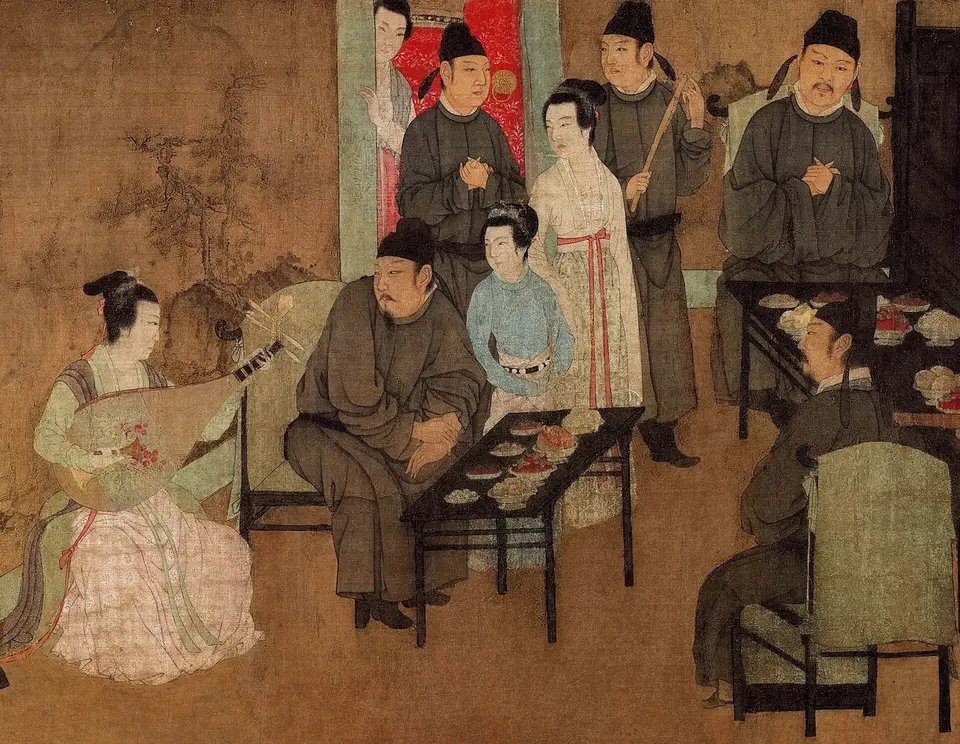
Gu Hongzhong (顾闳中, c. 910–980) was a native of Jiangnan (modern Nanjing, Jiangsu). He was an illustrious court figure painter of the Southern Tang during the Five Dynasties and Ten Kingdoms period, serving as Painter-in-Attendance in the Hanlin Painting Academy. Endowed with exceptional talent in portraiture and narrative genre painting, he painted the imperial portrait of the Last Ruler Li Yu and stood as the leading master of court figurative art. Gu Hongzhong's crowning artistic achievement was the creation of the monumental handscroll The Night Revels of Han Xizai (Han Xizai Yeyan Tu, preserved in the Palace Museum in Beijing). Dispatched secretly by Li Yu to observe the nightly carousals of Vice Minister Han Xizai, Gu Hongzhong relied upon his eidetic visual memory to recreate five continuous narrative scenes: listening to music, watching dance, resting, playing flutes, and bidding farewell. The scroll captures the profound internal melancholy of tenth-century intellectuals facing dynastic collapse.
Born into a family of painters in the Jiangnan region.
Appointed court painter under Emperor Yuanzong of Southern Tang (Li Jing).
Awarded the title of Painter-in-Attendance upon Li Yu's accession to the throne.
Dispatched by Li Yu to observe Han Xizai's nocturnal banquets and paint the revels.
Escorted to the Song capital Kaifeng following the fall of Jinling.
Passed away in Kaifeng at the age of approximately seventy-one.
Gu Hongzhong was born around 910 in Jiangnan, where the classical painting lineages of Gu Kaizhi, Lu Tanwei, and Zhang Sengyou had flourished for centuries. In his youth, he devoted himself to figurative draftsmanship, studying the court portraits of Tang masters Wu Daozi, Zhou Fang, and Zhang Xuan.
During the Baoda reign of Emperor Yuanzong (Li Jing), the Southern Tang state established the Hanlin Painting Academy, gathering celebrated masters from across China. Gu Hongzhong entered the academy as a specialist in portraits and religious wall paintings. His acute ability to capture human emotion and psychological depth earned him high favor in the Jinling palace, where he was tasked with painting official portraits of Li Yu before his accession.
Following Li Yu's accession, the Northern Song dynasty consolidated power in the north, creating an existential threat to Southern Tang. Li Yu grew suspicious of his senior ministers. Vice Minister of the Secretariat Han Xizai, a northerner of aristocratic background and towering intellect, was a candidate for chancellor.
Aware of Li Yu's paranoia and the hopeless prospects of the southern regime, Han Xizai resolved to disqualify himself from high office by staging extravagant, dissolute revels in his private residence. Conflicted over Han's true motives, Li Yu ordered Gu Hongzhong and Zhou Wenju to infiltrate Han's mansion secretly, commit the nocturnal carousals to memory, and paint an exact visual report.
Mingling among the guests, Gu Hongzhong watched the musicians, courtesans, and courtiers with extraordinary concentration. He memorized not only the architectural furnishings, musical instruments, and spatial layout, but also the nuanced expressions of Han Xizai, discerning the deep melancholy concealed beneath the bacchanalian festivities.
Returning to his studio, Gu Hongzhong worked continuously on a silk scroll exceeding three meters in length, producing The Night Revels of Han Xizai. In five flowing narrative episodes, he depicted Han Xizai listening to the pipa, striking the drum for dancing courtesans, resting behind curtains, enjoying a flute ensemble, and seeing off drunken guests. Viewing the scroll, Li Yu grasped Han Xizai's sorrowful refusal of power and abandoned the idea of making him chancellor, rewarding Gu Hongzhong with imperial treasure.
When Northern Song conquered Southern Tang in 975, Gu Hongzhong was relocated to Kaifeng. The Song imperial collection avidly acquired his figurative compositions, preserving not only The Night Revels of Han Xizai, but also Emperor Minghuang Striking the Wutong Tree and Snow Village. Gu Hongzhong passed away in Kaifeng around 980.
Preserved in the Palace Museum in Beijing, the silk handscroll measures 28.7 cm by 335.5 cm. The painting divides seamlessly into five interconnected acts through screens and couches: listening to pipa, drum accompaniment for dancer Wang Wushan, resting amidst red candles, listening to flute players, and departing at dawn. It stands as the peak of ancient Chinese narrative painting.
Gu Hongzhong revolutionized portraiture by depicting the tragic psychological dichotomy of his subject. While festive music fills the hall, Han Xizai maintains a heavy, distant gaze, reflecting the fatalistic alienation of a northern exile trapped in a doomed southern court.
His brushwork synthesizes the strength of the iron-wire line (tiexian miao) with the fluid softness of orchid-leaf lines (lanye miao), turning with angular firmness. His palette balances cinnabar red, malachite green, azurite blue, and ochre against subtle ink washes, creating an opulent yet refined aesthetic.
FIGURES ASSOCIATED WITH THIS DYNASTY