Birth in Penang
Born on a British-owned rubber plantation on Penang Island, Malaya, nurtured in a multicultural environment.
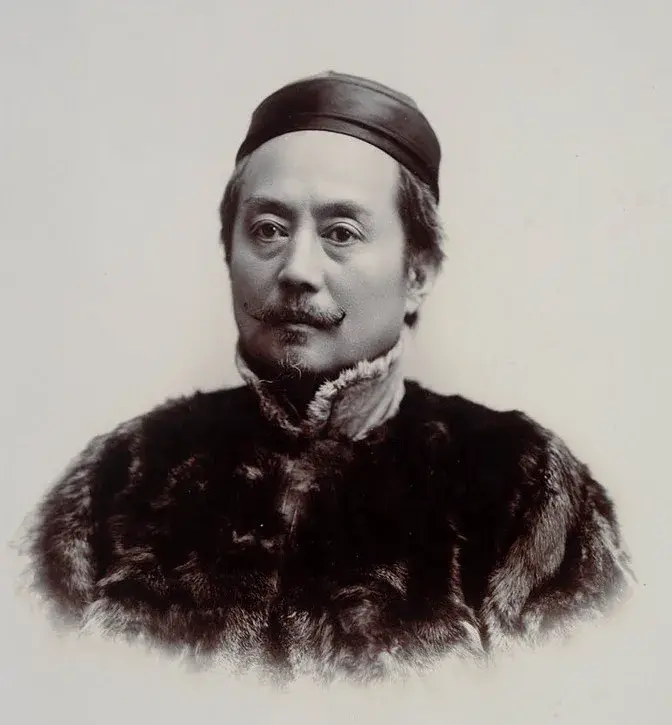
辜鸿铭
Gu Hongming (1857–1928), courtesy name Tangsheng and pseudonym Licheng, ancestral home in Tong'an County, Quanzhou Prefecture, Fujian Province, was born on Penang Island in British Malaya and became an internationally renowned scholar, translator, philosopher, and cultural giant during the late Qing and early Republican periods. Adopted in childhood by his Scottish patron, he pursued classical education in Europe, graduating…
Gu Hongming (1857–1928), courtesy name Tangsheng and pseudonym Licheng, ancestral home in Tong'an County, Quanzhou Prefecture, Fujian Province, was born on Penang Island in British Malaya and became an internationally renowned scholar, translator, philosopher, and cultural giant during the late Qing and early Republican periods. Adopted in childhood by his Scottish patron, he pursued classical education in Europe, graduating from the University of Edinburgh with a Master of Arts and completing advanced studies at Leipzig University in Germany. Fluent in English, German, French, Latin, and Ancient Greek, he mastered Western classical humanism and modern science. Returning to Southeast Asia in the early Guangxu reign, he experienced an intellectual awakening through discussions with Qing diplomat Ma Jianzhong, resigning his colonial post to dedicate his life to Chinese classical studies. Serving for two decades on the secretarial staff of Huguang Governor-General Zhang Zhidong, he helped establish Ziqiang Institute (the predecessor of Wuhan University), supervised negotiations for modern enterprises, and attained the rank of Senior Councilor in the Ministry of Foreign Affairs. During the early Republic, he accepted Cai Yuanpei's invitation to lecture on English literature and classical philosophy at Peking University. Amidst Western imperialist aggression and domestic uncritical Westernization, Gu translated The Analects, The Doctrine of the Mean, and The Great Learning, and authored The Spirit of the Chinese People, articulating Confucian humanism in elegant Victorian prose to international acclaim, becoming modern China's pioneer in cultural self-representation to the Western world.
Born on a British-owned rubber plantation on Penang Island, Malaya, nurtured in a multicultural environment.
Accompanied Scottish guardian Forbes Brown to Britain; charged by his father never to forget his Chinese ancestry.
Graduated with an MA from the University of Edinburgh; pursued philosophy and civil engineering at Leipzig University.
Concluded fourteen years of European study and entered colonial customs service in the Straits Settlements.
Held a three-day dialogue in Singapore with diplomat Ma Jianzhong, resolving to resign and master Chinese classics.
Joined Governor-General Zhang Zhidong's secretariat as Chief Foreign Secretary, serving for two decades.
Drafted the imperial memorial establishing Ziqiang Institute, the historic foundation of modern Wuhan University.
Published his English translation of The Analects in Shanghai, challenging Western missionary translations.
Appointed Director of the Huangpu River Conservancy; subsequently served as Senior Councilor in the Foreign Ministry.
Appointed Professor of English Literature at Peking University by Cai Yuanpei; published The Spirit of the Chinese People.
Died of acute pneumonia at his Beijing residence at age seventy after decades of international lecturing.
On July 18, 1857 (the twenty-seventh day of the fifth lunar month in the seventh year of the Xianfeng reign), Gu Hongming was born on Penang Island off the northwestern coast of the Malay Peninsula. His family originally hailed from Tong'an County, Quanzhou Prefecture, Fujian Province, having migrated to Southeast Asia for commerce. Gu's father, Gu Ziyun, managed a major rubber plantation owned by Scottish merchant Forbes Brown, while his mother was of Portuguese descent. This diverse upbringing endowed Gu from childhood with extraordinary linguistic facility and intercultural awareness.
Having no children of their own, the Browns developed deep affection for the precocious boy and formally adopted him. In 1867, when the Browns concluded their colonial enterprise and prepared to return to Scotland, Brown offered to take ten-year-old Gu with them to receive premier classical European schooling. Before departure, his father burned incense before the ancestral shrine and solemnly admonished him: "No matter where you travel in the world, whether surrounded by Britons, Germans, or Frenchmen, never forget that you are Chinese." This solemn parental charge became the lifelong guiding principle of Gu's cultural identity.
In Scotland, Brown supervised Gu's education with rigorous discipline. Gu attended elite boarding schools where he developed mastery of Latin, Ancient Greek, English, and German. Beyond studying Shakespeare and Milton, he engaged in intensive reading of Greek philosophy and formal logic, cultivating analytical precision and classical literary taste.
In 1870, at age fourteen, Gu was sent to Germany to study science and continental philosophy. In the early Guangxu period, on the strength of brilliant academic credentials, he gained admission to the University of Edinburgh. While there, he fell under the profound intellectual influence of historian and philosopher Thomas Carlyle, then Principal of the university, whose critique of utilitarian industrial capitalism spurred Gu to scrutinize the moral blind spots of modern Western commercial society.
In 1877, at age twenty, Gu completed his studies and received his Master of Arts degree from Edinburgh. Seeking further immersion in continental philosophy and applied science, he attended Leipzig University and the University of Paris, studying civil engineering and German idealism.
During his fourteen years across Europe, Gu displayed extraordinary linguistic genius, gaining fluency in English, German, French, Latin, Greek, and Italian. At a German gathering commemorating Otto von Bismarck, he delivered an extemporaneous speech in flawless, refined German on European geopolitical equilibrium, captivating the assembled scholars and establishing an exceptional command of Western civilizational heritage.
In 1880, having concluded fourteen years of study abroad, Gu returned to Penang. With his elite credentials and linguistic mastery, he was appointed to the British colonial customs service in the Straits Settlements, joining the privileged ranks of colonial administration. However, having lived entirely in Western environments, Gu realized with painful clarity that he was estranged from his ancestral culture, experiencing deep existential dislocation.
In 1881, prominent Qing Western Affairs diplomat Ma Jianzhong arrived in Singapore on a diplomatic and maritime mission. The two met by chance and engaged in continuous discussions spanning three days and nights. Ma eloquently expounded the five-thousand-year moral philosophy of Confucian civilization and laid bare the cultural imperialism underpinning Western colonial expansion.
The dialogue proved an intellectual revelation. Gu renounced his prestigious colonial appointment, discarded Western suits for traditional Chinese gowns, purchased the Complete Thirteen Classics with commentaries, and secluded himself in rigorous study. Approaching classical texts through the lens of Western philosophy, he mastered the Confucian corpus within several years, transforming from a Westernized scholar into a passionate advocate of traditional Chinese humanism.
In 1885, at twenty-eight, Gu arrived in mainland China. Recognizing his extraordinary talents, Huguang Governor-General Zhang Zhidong, a premier champion of the Self-Strengthening Movement, recruited Gu into his provincial secretariat as Chief Foreign Affairs Secretary. Zhang championed the doctrine "Chinese learning for fundamental principles, Western learning for practical application," establishing Hanyang Iron Works, modern textile mills, and modern military formations in Wuchang.
Throughout twenty years in Zhang's secretariat, Gu served as the viceroy's foremost foreign affairs counselor. He drafted and vetted thousands of diplomatic dispatches, foreign loan contracts, and railway concessions, producing English documents so immaculate and legally precise that foreign consuls and corporate agents found no cause for objection.
In 1893, Gu conceived and drafted Zhang's imperial memorial Establishing Ziqiang Institute, advocating a modern academy integrating Western sciences, languages, and traditional historiography, laying the foundation for modern Wuhan University. During the Boxer Uprising in 1900, Gu shuttled between foreign consulates in Hankou, negotiating the Southeastern Mutual Protection pact alongside Zhang Zhidong and Liu Kunyi, shielding central and southern China from foreign military invasion. In 1905, he was appointed Director of the Huangpu River Conservancy in Shanghai and subsequently elevated to Senior Councilor in the Foreign Ministry in Beijing.
Following the 1911 Revolution and the Qing abdication, Gu maintained a defiant cultural posture. Refusing to cut his queue, he continued walking Beijing's streets in traditional scholar's gowns and caps, symbolizing loyalty to ancestral ethical continuity, earning renown as "the Qing dynasty's last loyalist."
Recognizing Gu's unparalleled scholarly erudition, Peking University Chancellor Cai Yuanpei appointed him Professor of English Literature in 1917, lecturing on British literature, Greek philosophy, and Latin. His lectures, delivered in immaculate Oxford English and enriched by classical quotations, captivated students in packed lecture halls. Ascending the lectern, he famously remarked: "The queue on my head is visible, but the queue in your hearts is invisible; cutting the braid on your head is easy, but uprooting the slavish worship of foreign ways from your mind is difficult."
During the New Culture Movement, Gu stood in the vanguard opposing uncritical Westernization and radical iconoclasm promoted by Chen Duxiu and Hu Shi. In articles and public lectures, he argued that Western technological modernity lacked moral self-restraint, insisting that Confucian virtues of benevolence and filial piety were indispensable for human moral survival. Despite fierce intellectual debates, contemporaries like Cai Yuanpei, Chen Duxiu, and Hu Shi maintained profound respect for Gu's integrity and scholarship.
Around 1921, Gu resigned from Peking University amidst institutional shifts but remained an international intellectual celebrity. Following World War I, disillusioned Western and Asian thinkers sought alternative moral visions beyond Western industrialism.
Invited to Japan, Gu lectured at Tokyo Imperial University and Kyoto Imperial University, critiquing European imperialist militarism and advocating Confucian benevolent governance, generating intense debate across East Asia. International literary figures visiting China, including Somerset Maugham, Rabindranath Tagore, and Ryunosuke Akutagawa, traveled to Gu's modest Beijing alley residence to consult him on oriental philosophy.
Gu spent his final years in scholarly austerity. When northern warlord Zhang Zuolin took power in Beijing, he offered Gu an advisory post, but Gu remained politically detached. In the spring of 1928, Gu contracted acute pneumonia. He passed away on April 30, 1928, at his Beijing residence at age seventy.
Before the late nineteenth century, translation of Chinese classics into Western languages was monopolized by foreign missionaries. The translations of Scottish missionary James Legge were regarded as authoritative across the West. However, lacking intrinsic sympathy for Confucian spirituality, missionary translators often analyzed Chinese thought through rigid Christian theological frameworks, reducing living humanist ethics into wooden dogmas and distorting Western perceptions of Chinese civilization.
Gu recognized these fundamental defects, noting that while Legge's output was voluminous, it was mechanical and failed to grasp the living soul of Confucianism. Gu resolved to break this monopoly by translating core Confucian texts with authentic cultural subjectivity.
Beginning in 1898, Gu published English translations of The Analects (The Discourses and Sayings of Confucius), The Doctrine of the Mean (The Universal Order or Conduct of Life), and The Great Learning (The Higher Education). Utilizing an interpretive translation approach, he rendered classical Chinese into refined Victorian prose, annotating passages with cross-references to Goethe, Schiller, Carlyle, Matthew Arnold, and Shakespeare. Translating junzi as "real gentleman" and ren as "moral sense," his translations achieved international acclaim, dismantling Western condescension toward Chinese philosophy.
Gu's most influential international work was The Spirit of the Chinese People, published in Beijing in 1915 as World War I ravaged Europe. The unprecedented technological slaughter in Western trenches shattered the myth of Western scientific superiority and moral progress.
Diagnosing the spiritual crisis of modern industrial civilization, Gu presented Confucian humanism as a remedy for humanity. He proposed that the greatness of a civilization must be judged not by military power or material wealth, but by "what type of humanity, what kind of men and women it produces." He identified four essential attributes of the authentic Chinese character: depth, broadness, simplicity, and delicacy, which combined to form the quality of gentleness.
Gu argued that this gentleness was not weakness, but a state of spiritual maturity balancing adult philosophical wisdom with childlike innocence. Chinese society had endured for millennia because Confucian morality established social cohesion through internal ethical conscience rather than external police terror or theological fear. Following its publication, the book was translated into German, French, and Japanese, sparking widespread interest across Weimar Germany, where figures like Count Hermann von Keyserling and Hermann Hesse celebrated Gu alongside Tagore as an Eastern visionary.
While remembered as a cultural conservative, Gu was an essential architect of late Qing industrialization and modern higher education during his service under Zhang Zhidong.
In 1893, responding to the shortage of technical translators and diplomats, Gu assisted Zhang in drafting the imperial memorial Establishing Ziqiang Institute. He advocated breaking away from rote examination writing to establish a modern curriculum integrating foreign languages, commerce, natural sciences, and classical history. Approved by the imperial court, Ziqiang Institute opened in Wuchang, becoming one of China's earliest modern institutions of higher learning and the historic predecessor of Wuhan University.
In industrial diplomacy, Gu oversaw negotiations and foreign contracts for Hanyang Iron Works, Daye Iron Mine, and Pingxiang Colliery, securing foreign engineering expertise while defending Chinese mining rights. During the 1900 crisis, his diplomacy helped broker the Southeastern Mutual Protection pact, safeguarding the Yangtze provinces. Later, as Director of the Huangpu River Conservancy and Senior Councilor in the Foreign Ministry, he defended national sovereignty in treaty negotiations.
During the New Culture Movement, as radical intellectuals advocated discarding classical culture, writing in the vernacular, and importing Western systems wholesale, Gu mounted an unyielding intellectual defense of traditional culture.
Possessing a mastery of European literature, philosophy, and law deeper than most of his contemporaries, Gu analyzed Western modernity from a comparative vantage point. He cautioned that Western progress was rooted in mechanical materialism, social Darwinism, and imperialist exploitation. Discarding filial piety, righteousness, and ethical discipline would lead to moral collapse and cultural subjugation.
From his lecture podium at Peking University, using sharp wit and classical erudition, Gu challenged iconoclastic assumptions. His traditional attire served as a silent protest against uncritical imitation. While mocked by radicals as an anachronism, his critique of cultural colonization remains a prescient legacy of civilizational self-awareness.
Gu was also among the earliest scholars in modern China to translate Western romantic and narrative poetry into classical Chinese regulated verse, preceding the New Poetry movement by nearly two decades.
Recognizing the affinities between European metrical verse and traditional Chinese poetic rhythms, Gu translated William Cowper's narrative poem The Diverting History of John Gilpin into seven-character ancient-style verse, published in The North-China Herald, introducing Chinese readers to English satirical verse.
Furthermore, he translated Samuel Taylor Coleridge's masterwork The Rime of the Ancient Mariner into classical Chinese verse. Using the cadence of ancient songs, he rendered the poem's maritime mysticism, guilt, and reverence for nature into classical Chinese diction, demonstrating that authentic translation required deep spiritual resonance between civilizations.
FIGURES ASSOCIATED WITH THIS DYNASTY