Birth in Kunshan
Born on the twenty-fifth day of the second lunar month in Kunshan, Suzhou Prefecture, as the youngest son of Gu Xun.
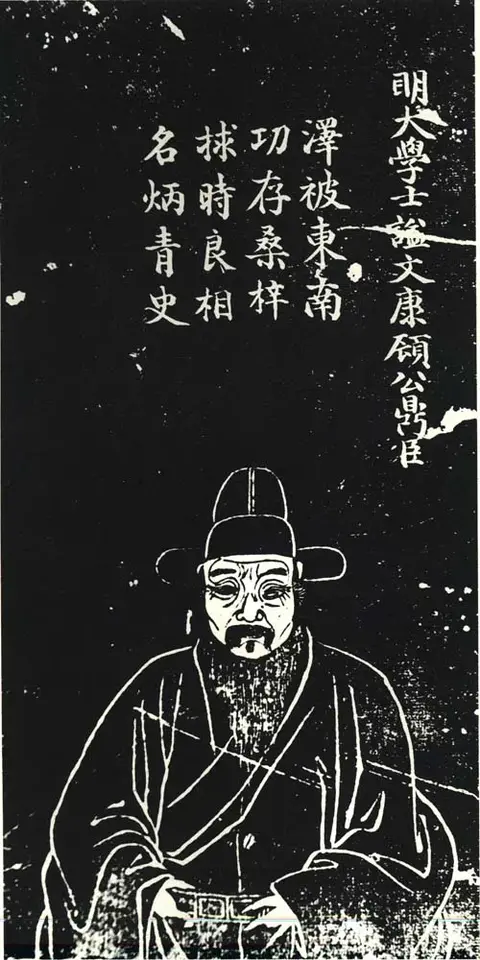
顾鼎臣
Gu Dingchen (1473–1540), styled Luzhi and art name Weizhai, later known as Jinzhai, was a preeminent statesman, imperial grand secretary, and classical scholar of the mid-Ming dynasty hailing from Kunshan, Suzhou Prefecture. In 1505, he attained the supreme distinction of first-rank principal graduate (Zhuangyuan) in the imperial palace examination. Despite suffering severe childhood hardship as the son of a concubine and…
Gu Dingchen (1473–1540), styled Luzhi and art name Weizhai, later known as Jinzhai, was a preeminent statesman, imperial grand secretary, and classical scholar of the mid-Ming dynasty hailing from Kunshan, Suzhou Prefecture. In 1505, he attained the supreme distinction of first-rank principal graduate (Zhuangyuan) in the imperial palace examination. Despite suffering severe childhood hardship as the son of a concubine and being cast out of his ancestral household, Gu persevered in secluded classical study, achieving exceptional erudition in the Confucian canons and dynastic administration. Inducted into the Hanlin Academy as Senior Compiler, he served across three successive reigns—Xiaozong, Wuzong, and Shizong (the Jiajing Emperor)—frequently presiding as Imperial Lecturer and Grand Supervisor of Instruction. Under Emperor Shizong, Gu enjoyed deep imperial confidence, rising through key offices to become Minister of Rites and Grand Supervisor of Instruction. In 1538, he was elevated to Grand Secretary of the Wuying Palace to participate in confidential state affairs, receiving the exalted ranks of Junior Guardian and Grand Tutor to the Crown Prince. Within the Grand Secretariat, he mediated administrative conflicts, advanced essential agrarian and border defense measures, and composed elegant Daoist green-paper prayers (Qingci) for the emperor's liturgical services. Over more than three decades of loyal bureaucratic service, Gu Dingchen was recognized for his prudent judgment, administrative integrity, and deep compassion for the populace. Facing endemic natural disasters and political strife, he repeatedly memorialized the throne to disburse emergency famine relief, exempt arrears in grain taxation, reform judicial procedures, and protect outspoken remonstrators from imperial retribution. He was also a prolific author of literary, historical, and ophthalmic medical treatises, including Weizhai Ji and Yiyan Fanglun. Following his death in office in 1540, he was posthumously granted the rank of Grand Guardian and bestowed the posthumous name Wenkang.
Born on the twenty-fifth day of the second lunar month in Kunshan, Suzhou Prefecture, as the youngest son of Gu Xun.
Expelled from the family estate due to the hostility of his father's principal wife; opened a village school and studied classics rigorously.
Passed the provincial examination in Yingtian Prefecture with honors, earning broad literary acclaim across Jiangnan.
Placed first in the palace examination as Zhuangyuan; was appointed Senior Compiler in the Hanlin Academy, soon returning home to observe mourning for his father.
Returned to the Hanlin Academy upon concluding mourning and participated in the compilation of the Xiaozong Shilu.
Promoted to Left Supervisor of the Left Spring Pavilion and Reader in the Hanlin Academy, instructing the heir apparent.
Appointed Imperial Lecturer upon the accession of the Jiajing Emperor, elucidating classical principles of governance.
Recommended by Grand Secretary Yang Yiqing and promoted to Chancellor of the Hanlin Academy.
Advanced to Grand Supervisor of Instruction, directing the ceremonial plowing rites alongside Emperor Shizong.
Promoted to Minister of Rites and Supervisor of Instruction, designing the architectural and ritual reforms for separate state sacrifices.
Appointed Grand Secretary of the Wuying Palace, participating in confidential state administration with the title Junior Guardian.
Passed away at his official residence in Beijing on the twenty-sixth day of the tenth lunar month at age sixty-eight; was posthumously titled Grand Guardian and named Wenkang.
Gu Dingchen was born on March 23, 1473, in Yushan, Kunshan County, Suzhou Prefecture. His father, Gu Xun, was already fifty-seven years old at his birth, while his mother, Lady Yang, was an attendant who had been elevated to secondary consort. During his youth, Gu suffered harsh treatment and contempt from his father's principal wife, Lady Wu. In 1490, at the age of seventeen, he was cast out of the main family mansion. Refusing to yield to despair, Gu took shelter in a local hamlet, where he established a village school to teach peasant children while devoting his nights to studying classical histories, legal codes, and statecraft literature.
In 1491, Lady Wu passed away, allowing Gu to return to the family home. In 1501, at the age of twenty-eight, he sat for the provincial civil service examination in Yingtian Prefecture and achieved licensing success. In 1505, Gu traveled to Beijing for the metropolitan examinations and advanced to the palace examination. In his policy treatise before Emperor Xiaozong in the Fengtian Palace, his profound analysis of agrarian welfare, military vigilance, and institutional ethics captivated the examiners and the sovereign. He was proclaimed Zhuangyuan, the principal graduate of the empire, and appointed Senior Compiler in the Hanlin Academy.
Shortly after his triumph, his elderly father passed away at nearly ninety years of age. Gu promptly returned to Kunshan to observe the three-year filial mourning period. Living in seclusion beside his father's grave, he devoted himself to historical collation and dutifully cared for his biological mother, demonstrating exemplary filial piety.
In 1508, having completed mourning rites, Gu returned to the capital and resumed his duties in the Hanlin Academy. He was commissioned as an editorial compiler for the Veritable Records of Emperor Xiaozong (Xiaozong Shilu). Working diligently through dynastic archives, his editorial precision was rewarded with imperial commendations from Emperor Wuzong upon the chronicle's completion in 1509, leading to his promotion to Hanlin Lecturer. However, his biological mother Lady Yang passed away shortly thereafter, compelling him to return home for a second three-year period of mourning.
In May 1516, Gu returned to court and was appointed Left Supervisor of the Left Spring Pavilion and Reader in the Hanlin Academy. During a turbulent era marked by eunuch dominance and volatile court politics under Emperor Wuzong, Gu maintained strict personal probity. Focusing exclusively on historiographical duties and imperial tutorials, he avoided sycophancy with court factions, securing an untarnished reputation among upright civil officials.
In 1521, Emperor Wuzong died without issue, and Emperor Shizong ascended the throne. Upon taking power, Shizong summoned seasoned Hanlin scholars to assist his daily administration. Gu was immediately appointed Imperial Lecturer in July 1521 to deliver expositions on statecraft. When censorial officials filed routine remonstrances regarding senior personnel, Gu proactively submitted his resignation, but Shizong issued warm imperial rescripts refusing his departure and deepening his trust in Gu.
During the early Jiajing reign, intense political strife surrounding the Great Rites Controversy convulsed the bureaucracy. Gu handled his duties with discreet composure, striving to preserve administrative stability. In 1523, he took temporary medical leave to convalesce in Kunshan, receiving an imperial decree urging his speedy recovery and return. In 1527, upon his return to Beijing, Senior Grand Secretary Yang Yiqing strongly recommended Gu as an indispensable pillar of state. In October 1528, Shizong promoted Gu to Chancellor of the Hanlin Academy.
In 1529, observing moral laxity among imperial academy students, Shizong composed the Five Admonitions, including the Jingyi Ting Zhen (Admonition for the Hall of Reverent Unity), ordering stone tablets erected in academies throughout the empire. Gu served as chief commentator, compiling the authoritative Jingyi Ting Zhen Zhu, which was adopted by imperial decree as required canonical reading for all civil students. When supervising censors Liu Shiyang and Li Ren petitioned for Gu's dismissal, alleging flattery, an enraged emperor ordered their arrest in imperial prisons; Gu intervened magnanimously, petitioning Shizong to spare the remonstrators, thereby earning widespread respect for his ministerial breadth.
In 1530, Gu was promoted to Grand Supervisor of Instruction. He oversaw imperial education and assisted Shizong in the solemn imperial plowing ceremonies, performing the ritual furrowing rites. Over the following years, Gu played an essential consultative role in drafting imperial protocols for restructuring state sacrifices.
In February 1534, Gu was elevated to Minister of Rites while continuing to manage the Supervisorate of Instruction. As the primary arbiter of state ritual, Gu directed the construction of the Temple of Earth, Temple of Sun, and Temple of Moon in Beijing, implementing Shizong's vision of separate state sacrifices for Heaven and Earth with meticulous classical accuracy. In 1537, when Shizong undertook an imperial tour to his ancestral fief of Chengtian in Huguang, Gu and Grand Secretary Xia Yan were entrusted with guarding the capital. During this delicate mission, Gu coordinated capital garrisons, maintained civil order during severe summer storms, and secured grain shipments to ensure absolute tranquility.
During policy discussions in the Fengtian and Wenhua Palaces, Gu repeatedly submitted confidential memorials on frontier defense, advocating strategic garrisons and economic resilience against northern nomadic incursions and southern pirate raids, earning approval from both the Ministry of War and Ministry of Revenue. In August 1538, Shizong appointed Gu Grand Secretary of the Wuying Palace, inducting him into the Grand Secretariat alongside Senior Grand Secretary Xia Yan, with the concurrent titles of Junior Guardian and Grand Tutor to the Crown Prince.
As Shizong became increasingly absorbed in Daoist liturgical ceremonies, he required grand secretaries to draft sacrificial prayers on fine green paper (Qingci). Possessing exceptional mastery over parallel prose, Gu produced compositions of majestic cadence and devotional elegance that captivated the emperor, establishing a lasting pattern of Daoist literary patronage in the mid-Ming cabinet. Concurrently, when torrential rains devastated northern and southern provinces in the autumn of 1538, Gu drafted urgent petitions urging grain relief and tax remissions, saving millions of destitute subjects.
During his final years in the Grand Secretariat, Gu worked alongside the domineering and abrasive Xia Yan, as well as colleague Zhai Luan. Rather than engaging in factional intrigue, Gu consistently acted as a steadying, conciliatory force, mediating disputes between the emperor and high ministers and softening aggressive policy implementations.
In the autumn of 1540, following imperial personnel evaluations, Gu followed precedent by submitting his resignation, which was warmly declined by Shizong. Exhausted by decades of strenuous intellectual and administrative burdens, Gu fell gravely ill. On November 24, 1540, he passed away in his official residence in Beijing at the age of sixty-eight.
Deeply grieved, Emperor Shizong cancelled court audiences for a day, ordering state funerals under the highest ministerial protocols. The throne posthumously elevated Gu to Grand Guardian, bestowed the honorable posthumous name Wenkang, and authorized the construction of the Chonggong Ancestral Shrine in Kunshan to commemorate his illustrious service.
Gu Dingchen's emergence as the Zhuangyuan of 1505 marked him as one of the towering intellectual figures of the Hongzhi era, a period renowned for its classical scholarship and literary excellence. In the palace examination, his policy dissertation addressed systemic civil and military deficiencies with eloquence and practical acumen, winning unanimous acclaim from chief examiners Li Dongyang and Jiao Fang.
This triumph cemented Gu's stature as an intellectual leader in the Hanlin Academy. He directed the compilation of imperial annals, including the Xiaozong Shilu, and authored monumental stone inscriptions and ritual commentaries. His collected works, Weizhai Ji and Wenkang Gong Ji, remain quintessential models of elegant mid-Ming bureaucratic and humanist prose.
The Jiajing reign witnessed the most radical ritual reconfigurations of the Ming dynasty. In Emperor Shizong's campaign to separate the cosmological sacrifices to Heaven and Earth, Gu Dingchen served as the chief institutional architect and administrative executor in his role as Minister of Rites.
Marshaling classical precedents from the Rites of Zhou and Book of Han, Gu provided the scholarly justification for establishing distinct circular and square altars for Heaven and Earth, replacing the early-Ming practice of combined worship. He supervised the spatial design and physical construction of Beijing's Temple of Earth, Temple of Sun, and Temple of Moon, establishing the quadripartite suburban sacrificial layout that endured across the Ming and Qing dynasties for four centuries.
Gu's induction into the Grand Secretariat in 1538 occurred at a pivotal historical moment when cabinet power expanded rapidly amidst intensifying factional rivalries. Surrounded by the fiery, authoritarian personality of Senior Grand Secretary Xia Yan, Gu functioned as a patient, stabilizing counselor who mitigated friction and shielded vulnerable officials.
Within the cabinet, Gu directed state attention toward sound fiscal management and frontier preparedness. He ordered thorough audits of provincial land registers to curtail illegal encroachments by imperial princes, while ensuring timely supply convoys and defensive restorations along northern frontier passes, maintaining vital institutional stability throughout a volatile reign.
Throughout his official career, Gu remained dedicated to the welfare of the common populace. When devastating floods and severe droughts afflicted the northern and southern metropolitan regions in 1537 and 1538, causing widespread destruction and famine, Gu personally urged Emperor Shizong to manifest imperial benevolence. His memorials secured imperial decrees releasing grain reserves and remitting hundreds of thousands of bushels in tax arrears.
In judicial matters, Gu exemplified ministerial magnanimity. When censors Liu Shiyang and Li Ren were imprisoned for bitterly attacking him, Gu intervened directly with the throne to plead for their lives, warning that executing or severely punishing surveillance officials would silence vital imperial criticism. His defense saved the remonstrators, winning praise from contemporaries across the bureaucratic spectrum.
In Ming political history, Gu Dingchen was the pioneering figure who introduced the composition of Daoist green-paper prayers (Qingci) as an elite function of the Grand Secretariat. Responding to Emperor Shizong's deep devotion to Daoist spiritual retreats, Gu deployed his mastery of rhythmic parallel prose to compose prayers characterized by celestial imagery, musical cadence, and philosophical subtlety.
Gu's success in satisfying Shizong's liturgical requirements transformed Qingci composition into an influential qualification for high ministerial advancement, setting a precedent that was later pursued with consummate political acumen by subsequent grand secretaries including Xia Yan and Yan Song.
Beyond statecraft and literature, Gu made significant scholarly contributions to traditional Chinese medicine, particularly in the diagnostic and therapeutic treatment of ophthalmic disorders. Recognizing that visual afflictions stemmed from internal visceral disharmonies and vascular stagnation rather than mere external irritation, he advocated comprehensive systemic therapies.
Drawing upon decades of collected clinical formulas and personal observations, he authored Yiyan Fanglun (Treatise on Eye Prescriptions) and Jingyan Fang (Tested Prescriptions). These texts systematically analyzed the etiology of ocular diseases and provided detailed herbal decoction strategies, surviving as valued clinical contributions to imperial Chinese medical literature.
Following Gu Dingchen's passing, the gentry and commoners of Kunshan successfully petitioned the throne to establish an official memorial shrine. In 1559, Emperor Shizong granted the imperial plaque "Chonggong" (Honoring Merit) for the Gu Wenkang Gong Chonggong Shrine constructed at the foot of Mount Ma'an in Kunshan. The complex enshrined Gu's painted likeness and featured a grand stele detailing his statecraft contributions.
Gu's moral and scholarly ethos inspired successive generations of his lineage. His eldest son Gu Lufang earned the Juren degree and served as Secretary in the Ministry of Justice, known for his judicial leniency; younger sons Gu Luxiang, Gu Luzhen, and Gu Luji all attained administrative positions; and his nephew Gu Qian achieved the Jinshi degree and served as a principled Investigating Censor in Shanxi. The family's lineage code, preserved in the Gu Shi Jiafan, deeply influenced Jiangnan clan education for over a century.
In addition to classical Hanlin prose, Gu Dingchen was an accomplished composer of vernacular Sanqu lyric suites and northern-southern dramatic melodies. He studied the modal structures and phonetic systems of dramatic music, composing lyrics noted for natural diction, evocative imagery, and lyrical warmth.
His representative compositions were included in the celebrated collection Nanbei Gong Ciji. Avoiding obscure classical illusions, his vernacular poetry captured both the romantic elegance of Jiangnan water towns and the melancholy aspirations of Confucian intellectuals, providing vital momentum for the artistic transition from early literati verse toward the emergence of the Kunqu opera tradition.
FIGURES ASSOCIATED WITH THIS DYNASTY