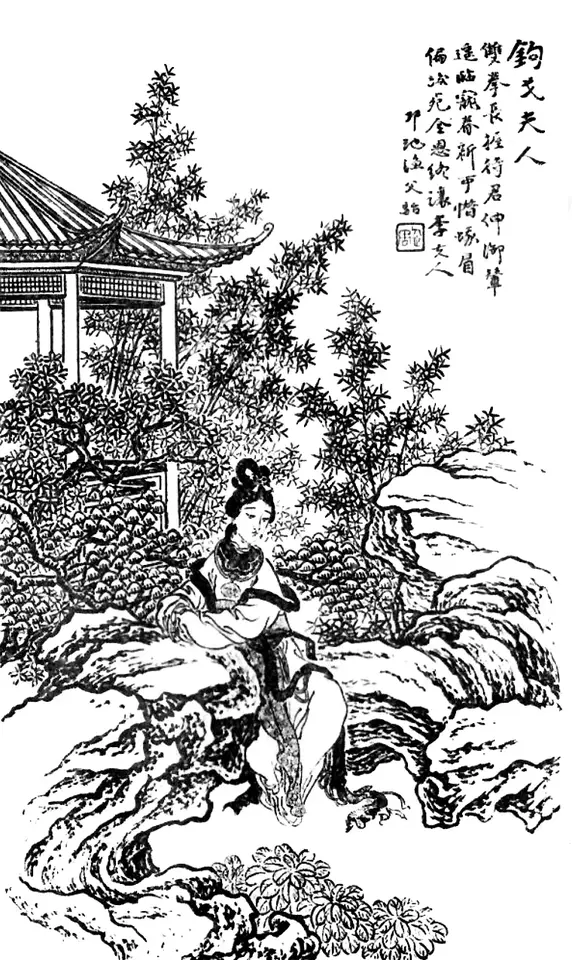
Biography
Prophecy in Hejian and Entering the Palace with Unfurled Fists
Consort Zhao was born into a commoner household in Wuyuan County, Hejian Commandery (modern southeastern Suning County, Hebei Province). In her early years, her father became entangled in a legal infraction, was punished with punitive castration, and served as a junior palace eunuch (Zhonghuangmen) in the capital city of Chang'an, eventually dying and being interred outside the western Yongmen Gate. Consort Zhao remained in her rural hometown. Possessing remarkable beauty and an elegant demeanor, she suffered from a congenital condition where both of her hands were clenched tightly into fists, unable to extend her fingers.
In his declining years, Emperor Wu became deeply preoccupied with immortality seekers, astral omens, and Daoist rituals, regularly embarking on extensive imperial circuits. During the Tianhan era, while touring the maritime regions and crossing through Hejian Commandery, local diviners and astrologers reported that an extraordinary vapor of vibrant purple and blue rose straight toward the sky, signifying the presence of a transcendent maiden. Aging yet ever eager for divine anomalies, Emperor Wu ordered his retinue to conduct an immediate search throughout the commandery.
Officials located the youthful Zhao maiden and escorted her before the imperial carriage. Emperor Wu summoned her to approach. Struck by her rare beauty, he noticed her tightly clenched hands. Reaching forward, the emperor gently stroked and parted her hands. Her fingers opened effortlessly, unfolding into flat palms. Deeply amazed by what he interpreted as divine favor, Emperor Wu ordered her admitted into the imperial carriage and escorted back to the capital palace. Because of this miraculous beginning, court attendants referred to her as the Fist Lady.
Promotion to Handsome Lady and the Gate of Yao's Mother
Upon entering the imperial court, the Zhao maiden captivated the elderly emperor through her gentle temperament and dignified poise, rapidly becoming his most cherished concubine. Emperor Wu soon elevated her to the rank of Handsome Lady (Jieyu). In the hierarchical order of the Western Han imperial harem, this rank stood second only to the empress, enjoying official allowances and ceremonial status comparable to that of the imperial chancellor. Furthermore, Emperor Wu allocated her the opulent Gouyi Pavilion within the Ganquan Palace complex, which led contemporaries and court officials to call her Lady Gouyi.
In 94 BC, Consort Zhao gave birth to an imperial prince at Gouyi Pavilion, who was named Liu Fuling. According to palace records and court tradition, her pregnancy endured for fourteen full months prior to labor. Delighted by the birth of an infant son in his twilight years, Emperor Wu remarked to his close courtiers that ancient chronicles recorded that Qingdu, the mother of the legendary sage king Yao, had similarly carried Yao for fourteen months. Viewing this correspondence as an auspicious portent, Emperor Wu issued an imperial decree renaming the southern gate of Gouyi Pavilion as the Gate of Yao's Mother.
However, Empress Wei's son, Liu Ju, had already served as the legitimate crown prince for over three decades. Emperor Wu's decision to designate a concubine's residence as the Gate of Yao's Mother sent destabilizing political shockwaves through court circles, stoking dangerous succession rivalries and planting the seeds of factional discord.
The Witchcraft Upheaval and the Succession Crisis
In 91 BC, the devastating Witchcraft Catastrophe erupted throughout Chang'an. Exploiting Emperor Wu's paranoia and deteriorating health, corrupt officials such as Jiang Chong and Su Wen fabricated allegations of sorcery against Empress Wei and Crown Prince Liu Ju. Driven into desperation, the crown prince raised troops to execute Jiang Chong, but was ultimately defeated by imperial forces, fled to Huxian, and committed suicide; Empress Wei also took her own life. Though Emperor Wu eventually recognized the tragic falsehood of the charges, exterminated Jiang Chong's clan, and constructed the Palace of Paternal Longing, the empire's supreme succession was left catastrophically vacant.
Among Emperor Wu's surviving adult sons, Prince Liu Dan of Yan hastily dispatched an envoy requesting permission to lead his retinue into the capital to guard the palaces, overtly maneuvering for the heirship. Enraged by this unfilial ambition, Emperor Wu executed the envoy and stripped Yan of three counties. Prince Liu Xu of Guangling was physically imposing and reckless, indulging in hunting and brawling without regard for Confucian propriety, disqualifying himself from imperial consideration. Prince Liu Bo of Changyi passed away prematurely following the exposure of an illicit succession plot orchestrated by his uncle Li Guangli and Chancellor Liu Qumao.
Under these circumstances, only the youngest son, Liu Fuling, met Emperor Wu's rigorous standards. By 89 BC, the young prince, then around five or six years old, exhibited remarkable physical vigor, keen intellect, and regal composure that reminded the aging emperor of his own youth. Convinced that Liu Fuling was the only child capable of preserving the Han dynastic legacy, Emperor Wu secretly resolved to make him the imperial heir.
Young Ruler and Vigorous Mother: Forced Death at Ganquan Palace
Although his choice was settled, Emperor Wu was haunted by historical precedent and political anxiety. Having lived through the regency of Grand Empress Dowager Dou, the machinations of maternal relatives like Tian Fen, and the harrowing historical lessons of Empress Dowager Lu's usurpation following Emperor Gaozu's death, Emperor Wu understood that an underage sovereign coupled with a young, vigorous mother invariably produced maternal-clan despotism. Liu Fuling was still a child incapable of personal rule, while Consort Zhao was barely in her twenties.
Emperor Wu recognized that if he passed away leaving an infant emperor, Consort Zhao would dominate the inner court as empress dowager, inevitably elevating her male kin and threatening the Liu imperial lineage. Guided by cold dynastic pragmatism, Emperor Wu concluded that to establish the son, he had to eliminate the mother.
In 88 or 87 BC, while residing at Ganquan Palace with Consort Zhao in attendance, Emperor Wu deliberately reprimanded her on a trivial pretext. Terrified, Consort Zhao removed her hairpins and earrings, prostrating herself before the steps to plead for mercy. Emperor Wu ordered imperial guards to drag her into confinement. Trembling, she repeatedly looked back at him, but the emperor shouted harshly, telling her to move quickly because she would not be permitted to live. She was escorted to the inner detention quarters at Yunyang Palace and died shortly thereafter in prison, in her early twenties.
Under cover of darkness, palace attendants hastily buried her in the plains of Yunyang south of Ganquan Palace. Baffled by this ruthless execution of the prospective heir's mother, close attendants whispered among themselves. Informed of their bewilderment, Emperor Wu summoned his officials and declared that historical dynasties fell into turmoil whenever an infant ruler was paired with a vigorous young mother, as an isolated imperial dowager grew haughty and unchecked while her relatives monopolized state authority, citing Empress Lu's tyranny as an unanswerable lesson.
Enthronement of Emperor Zhao and Posthumous Honors
In the spring of 87 BC, Emperor Wu formally designated eight-year-old Liu Fuling as crown prince on his deathbed. He appointed Commandant of Equages Huo Guang as Grand Marshal and General-in-Chief, entrusting him alongside Jin Midi, Shangguan Jie, and Sang Hongyang to form a collective regency. Days later, Emperor Wu passed away at Wuzuo Palace, and Liu Fuling ascended the throne as Emperor Zhao.
Remembering his mother's tragic fate and maternal care, Emperor Zhao posthumously elevated Consort Zhao to Empress Dowager in the summer of 86 BC. He mobilized twenty thousand troops from the capital commanderies to reconstruct her burial site into the Yunling Mausoleum at Yunyang, complete with ancestral temples and residential shrines. A dedicated funerary town of three thousand households was established to maintain the mausoleum under the supervision of official directors.
Concurrently, Emperor Zhao conferred honors upon his maternal relatives. Since Consort Zhao's father was long deceased, he was posthumously enfeoffed as Marquess of Shuncheng. Consort Zhao's paternal aunt, Zhao Junxu, was awarded two million cash, alongside imperial grants of servants, fertile estates, and capital mansions. Her surviving male kin received graded honors based on kinship proximity. However, because her father was dead and no powerful male relatives occupied high military or administrative office, the Zhao family never evolved into an overbearing political faction, fulfilling Emperor Wu's original strategic objective.
Evolution of the Mausoleum and Sacrificial Controversies
During the mid-to-late Western Han, the Yunling Mausoleum experienced significant ritual and political controversy. Throughout the reigns of Emperors Zhao, Xuan, and Yuan, the site retained full imperial status, featuring grand sacrificial banquets and horse-drawn ceremonial processions, commonly referred to by locals as the Maiden's Tomb.
In 44 BC, during Emperor Yuan's reign, reform-minded Confucian scholars gained control of court ritual debates. Prime Minister Wei Xuancheng and his associates submitted memorials citing the Rites of Zhou and the Book of Songs, arguing that concubine mothers who had never been formal empresses should not receive supreme ancestral sacrifices alongside dynastic emperors. They petitioned to abolish state sacrifices at Empress Dowager Bo's Nanling and Empress Dowager Zhao's Yunling, a proposal Emperor Yuan initially approved. However, when Emperor Yuan fell persistently ill several years later, court astrologers attributed his affliction to ancestral displeasure over cancelled rites, prompting the emperor to restore all sacrifices at Yunling.
Early in Emperor Cheng's reign, Chancellor Kuang Heng renewed petitions to permanently abolish sacrifices at non-orthodox concubine shrines, securing imperial approval. During the reign of Emperor Ping, Wang Mang abolished the imperial title of Yunling altogether, downgrading the administrative district to Yunling County. The fluctuating sacrificial status of Consort Zhao's shrine reflected the evolving conflict between imperial prerogative, ritual orthodoxy, and Confucian scholarship in the late Western Han.
Major Achievements
The Tragic Policy of Eliminating the Mother to Crown the Son
Emperor Wu's execution of Consort Zhao represents one of the most starkly calculated political decisions in imperial Chinese history. Traditional Confucian ethics and ancestral rites placed maternal filial piety and the authority of the mother at the apex of moral obligations, and no prior legal precedent existed for executing an innocent mother to safeguard dynastic stability. Having witnessed the regency of Empress Dowager Dou, the corruption of Tian Fen, and the historic violence of the Lu clan, Emperor Wu recognized the institutional flaw of hereditary autocracy: an infant ruler lacked political independence, while a vigorous mother residing in the inner court naturally relied on her natal lineage, creating an unchecked maternal-clan monopoly.
By eliminating Consort Zhao, Emperor Wu severed the organizational root of future maternal-clan despotism. This ruthless political realism facilitated the smooth succession of the eight-year-old Emperor Zhao under Huo Guang's regency, shielding the Han Dynasty from civil fragmentation and creating an enduring paradigm of succession security.
Institutionalization of the Succession Policy in Northern Wei
While Emperor Wu's action was an extraordinary ad hoc measure that never became a codified Western Han statute, it was subsequently transformed into formal constitutional law by the Tuoba Xianbei rulers of the Northern Wei Dynasty. Emperor Daowu (Tuoba Gui) sought to eradicate maternal tribal influences and prevent consort clans from subverting the imperial throne. He institutionalized Emperor Wu's precedent into a binding ancestral law, known as executing the mother when the son is elevated.
For more than a century, Northern Wei enforced this practice without exception: whenever an imperial prince was proclaimed crown prince, his biological mother was immediately forced to commit suicide regardless of her standing or imperial favor. While this brutal mechanism curbed maternal-clan usurpation, it wrought immense psychological trauma within the imperial household, enduring until its repeal under Empress Dowager Ling. As historian Wei Shou recorded in the Book of Wei, Han Wu exercised emergency discretion, but the Wei dynasty turned it into constant statutory rule.
Political Ramifications of the Gate of Yao's Mother
Emperor Wu's decision to name Consort Zhao's residence the Gate of Yao's Mother following Prince Fuling's birth ignited dangerous political consequences. Sima Guang observed in Zizhi Tongjian that while the empress and crown prince were alive and well, naming a consort's portal after Yao's mother lacked constitutional propriety, signaling to ambitious courtiers that the emperor favored his youngest son and providing unscrupulous conspirators with an incentive to undermine Crown Prince Liu Ju.
By publicly associating Consort Zhao with the mother of Emperor Yao, Emperor Wu prematurely disrupted the political equilibrium between the inner court and the bureaucratic administration. Opportunists like Jiang Chong recognized the emperor's growing estrangement from Empress Wei and the crown prince, emboldening them to fabricate witchcraft accusations that resulted in Prince Liu Ju's death. Thus, the Gate of Yao's Mother became the covert epicenter of the political tempest that engulfed the capital.
Historiographical Divergences on Consort Zhao's Demise
Ancient historical accounts present sharply divergent narratives regarding Consort Zhao's death, reflecting different historiographical agendas. Ban Gu's biography in the Book of Han exercised cautious restraint, recording merely that Consort Zhao accompanied the emperor to Ganquan, incurred his displeasure for an infraction, and died of sorrow, being quietly interred at Yunyang. Historians recognize this account as an instance of concealing flaws for the honorable, crafted to protect Emperor Wu's reputation as a benevolent monarch.
In contrast, Chu Shaosun's continuation of Sima Qian's Records of the Grand Historian preserved the vivid scene of Consort Zhao weeping on the palace stairs, Emperor Wu's chilling command that she must not live, and the subsequent imperial assembly where the emperor justified his policy. Chu Shaosun's candid narrative exposed the unvarnished reality of Han dynastic politics, an account later adopted by Sima Guang in Zizhi Tongjian. The contrast between these two classical accounts highlights the enduring tension between courtly whitewashing and authentic historical documentation.
Restructuring Central Authority and the Rise of Regent Ministers
Consort Zhao's execution eliminated the possibility of an overmighty maternal regency, compelling Emperor Wu to formulate an entirely new governance model for the underage Emperor Zhao. Rather than consigning administrative authority to maternal relatives, Emperor Wu commissioned palace painters to produce an illustration of the Duke of Zhou Assisting King Cheng, presenting it to Huo Guang.
This act established a ministerial regency led by General-in-Chief Huo Guang, supported by senior statesmen Jin Midi, Shangguan Jie, and Sang Hongyang. This institutional transformation enabled the Western Han bureaucracy to function smoothly under the oversight of civil ministers and military commanders, avoiding consort-clan usurpation and laying the institutional foundations for the peace and prosperity of the Zhao-Xuan Restoration.
Archaeological Excavation of Yunling Mausoleum and Separate Burial Rites
The Yunling Mausoleum, situated in modern Da'geda Village, Tiewang Town, Chunhua County, Shaanxi Province, represents a crucial physical monument of Western Han imperial funerary archaeology. Extensive surveys and excavations conducted by Shaanxi archaeological teams have revealed the complete architectural layout of this two-thousand-year-old imperial park.
The archaeological evidence confirms that Yunling was laid out in a roughly square plan enclosed by rammed-earth walls with four symmetrical gate towers. The central burial mound takes the shape of a truncated pyramid (fudou), measuring approximately one hundred and fifty meters along its base, fifty meters along its summit, and surviving to a height of over thirty meters. South of the mound, archaeologists discovered the rammed-earth foundations of triple-tower gate structures (sanchuque) and extensive ceremonial halls, recovering massive quantities of Han dynasty cord-pattern roof tiles, hollow bricks, ceramic drainage pipes, and bronze fittings. Yunling provides conclusive material evidence of the separate burial system for Western Han imperial consorts interred outside the emperor's necropolis.
Folktales, Immortality Legends, and Literary Memory
Because of the miraculous unfurling of her clenched fists upon entering the palace and her tragic demise, Consort Zhao's persona was rapidly romanticized by popular folklore and medieval anomaly literature (zhiguai). The Eastern Han Liexian Zhuan recorded that a jade hook was discovered in her hands, that sweet fragrance lingered for miles after her death, and that when her tomb was opened during Emperor Zhao's reign, only a pair of silk slippers remained, indicating her ascension as a Daoist immortal. The Hanwu Gushi similarly invented the legend of divine blue birds circling the Tongling Platform at Ganquan Palace.
In classical Chinese literature, Consort Zhao endured as a universal symbol of fragile beauty crushed by statecraft. From Tang poet Li Shangyin to Qing dynasty masters such as Wang Shizhen, Yuan Mei, and Qian Qianyi, poets repeatedly meditated upon her fate. Their verses reflected on the irony of an imperial favorite celebrated as Yao's mother only to be executed on the altar of dynastic preservation, leaving an indelible imprint on Chinese cultural memory.