Birth in Kunshan
Born in winter in the lunar year of Jiwei at Duchiao Town, Kunshan County, Suzhou Prefecture.
龚贤
Gong Xian (龚贤, 1619–1689), also known as Qixian, with courtesy names Banqian and Banmu and pseudonyms Yeyi, Chai Zhangren, and Zhongshan Yelaoren, was a native of Kunshan, Jiangsu, who later relocated to Jiangning (present-day Nanjing). He was an outstanding landscape master, renowned poet, calligrapher of the late Ming and early Qing dynasties, and the acknowledged leader of the celebrated "Eight Masters of Jinling." In his…
Gong Xian (龚贤, 1619–1689), also known as Qixian, with courtesy names Banqian and Banmu and pseudonyms Yeyi, Chai Zhangren, and Zhongshan Yelaoren, was a native of Kunshan, Jiangsu, who later relocated to Jiangning (present-day Nanjing). He was an outstanding landscape master, renowned poet, calligrapher of the late Ming and early Qing dynasties, and the acknowledged leader of the celebrated "Eight Masters of Jinling." In his youth, Gong sought painting instruction from the late Ming master Dong Qichang and actively participated in the Restoration Society (Fushe) reformist campaigns against corrupt court eunuchs, forging close ties with patriotic figures such as Gu Yanwu, Wu Yingji, and Fang Yizhi. Amid the catastrophic Ming-Qing transition, his homeland fell and his family fractured, forcing him into a harrowing decade-long wandering exile across Yangzhou, Hai'an in Taizhou, and several northern provinces. Following the Qing conquest, Gong Xian lived in steadfast reclusion among commoners, settling in his twilight years at the foot of Mount Qingliang in Nanjing. There, he built a modest half-acre garden and the "Sweeping Leaves Tower" (Saoye Lou), supporting himself through painting sales, private apprenticeships, and poetic composition while embracing unvarnished poverty. In the realm of art, he stood unparalleled across generations, inventing the famous "accumulated ink method" (jimo fa) in Chinese landscape painting. His monumental works exhibited brooding, moisture-drenched brushwork, sublime density, and towering structural tension, giving rise to the profound, dark idiom of "Black Gong" and the ethereal clarity of "White Gong." These innovations definitively checked the superficial, fragile mannerisms prevailing among contemporary literati painters. Concurrently, he authored seminal theoretical and literary works such as Huajue (Secrets of Painting) and Caoxiangtang Ji (Collection of the Fragrant Grass Hall), whose solemn verses mourned the fallen dynastic realm and established him as a revered exemplar of loyalist art and patriotic poetry.
Born in winter in the lunar year of Jiwei at Duchiao Town, Kunshan County, Suzhou Prefecture.
Moved with his grandfather and father to Shangyuan County, Jiangning Prefecture, settling in Nanjing.
Began learning painting under late Ming master Dong Qichang, claiming mastery in painting by age thirteen.
Befriended Gu Mengyou, Fang Wen, and Yang Ribu, joining the Manifesto for Preventing Chaos in the Secondary Capital.
Ming fell; the Hongguang court was established in Nanjing, where factional rivals persecuted Fushe members.
Qing forces captured Nanjing; his first wife died, and Gong fled in despair to Yangzhou amidst widespread massacres.
Invited by close friend Xu Yi to teach at Liuzhuang in Hai'an Town, Taizhou, where he tutored for five years.
Departed Hai'an and returned to Yangzhou, subsequently wandering through Shandong, Hebei, Beijing, and Zhejiang.
Remarried while enduring poverty in Yangzhou, penning verses on securing a humble hearth in midlife.
Returned to Nanjing, purchasing land at the foot of Mount Qingliang to construct the Half-Acre Garden.
Erected the Sweeping Leaves Tower thatched studio, mentoring painting disciples and drafting Huajue.
Painted his renowned twenty-four-leaf landscape album, entering the absolute zenith of his creative powers.
Forged deep bonds with literary figures Zhou Lianggong and Kong Shangren, who revered Gong's artistic integrity.
Harassed and humiliated by local bullies demanding paintings, he fell ill and passed away in the eighth lunar month.
Gong Xian was born in the winter of 1619 (the forty-seventh year of the Wanli reign in the Ming dynasty) into a literati household in Duchiao Town, Kunshan County, Suzhou Prefecture, Jiangsu. Regarding Gong Xian's exact birth year, modern art historians once debated various hypotheses; however, rigorous chronological collation by scholar Wang Shiqing and Gong Xian's own inscription on the monumental twenty-four-leaf album painted in 1676—stating "I am approaching sixty years of age, fearing that my physical stamina will soon wane"—conclusively confirmed 1619 as his birth year. Originally named Qixian, with courtesy names Banqian and Banmu, he possessed a quiet, resolute, and contemplative demeanor from early childhood, exhibiting innate artistic gifts.
In 1629, literati leader Zhang Pu and fellow scholars consolidated southern literary societies at the famous Yinshan gathering in Wujiang, inaugurating the Restoration Society (Fushe). That same year, the eleven-year-old Gong Xian accompanied his grandfather and father, Gong Yuanmei, on their relocation to Shangyuan County in Jiangning Prefecture (modern Nanjing). Shortly thereafter, his father remarried Lady Wang as his secondary spouse. Subsequently, Gong Xian's grandfather and father were appointed to administrative posts in Sichuan. Amid the escalating chaos of late Ming peasant rebellions and rugged mountain distances, all communication with his father and grandfather was permanently severed. Left behind with his stepmother, Lady Wang, Gong Xian lived a frugal, quiet existence in Jinling, devoting himself to books and painting.
In the winter of 1631, Dong Qichang, the supreme arbiter of late Ming calligraphy and painting, traveled north to resume his duties as Minister of Rites and stopped in Jinling. Through personal introductions, the thirteen-year-old Gong Xian was granted direct access to observe Dong Qichang's brushwork and absorb the fundamental tenets of landscape painting. Gong Xian later noted in an inscription, "By age thirteen, I was already able to paint." Under Dong's guidance, Gong thoroughly analyzed the compositional logic of Five Dynasties, Song, and Yuan masters, while simultaneously studying under Nanjing and Songjiang painters including Yun Xiang, Zou Zhilin, Li Liufang, and Li Yongchang, thereby establishing a solid Classical foundation.
As he matured, Gong Xian expanded his artistic reputation while absorbing the moral righteousness of late Ming southern intellectuals. During the Chongzhen reign, he forged close companionships with Nanjing literati such as Gu Mengyou, Fang Wen, Yang Ribu, Shi Ruoweng, Xue Qianren, and Ji Yingzhong, enthusiastically joining the Restoration Society. When disgraced former eunuch partisan Ruan Dacheng lived in Nanjing plotting a political resurgence alongside demoted governor Ma Shiying, Restoration Society leaders Huang Zongxi and Wu Yingji published the Manifesto for Preventing Chaos in the Secondary Capital. Gong Xian indignantly signed his name to this historic petition. During this formative period, the twenty-year-old Gong was profoundly moved upon inspecting Mi Fu's masterpiece Cloud Gate Mountain, an experience that inspired his lifelong ambition to transcend conventional painterly formulas.
In the spring of 1644, peasant forces under Li Zicheng seized Beijing, and the Chongzhen Emperor committed suicide. In Nanjing, the Prince of Fu, Zhu Yousong, was enthroned under the patronage of Ma Shiying and Ruan Dacheng, initiating the short-lived Hongguang regime. The court was engulfed in factional vendettas, with Ma and Ruan violently persecuting literati who had signed the anti-Ruan manifesto. As a prominent Fushe signatory, Gong Xian faced imminent peril. The crisis peaked in May 1645 when Qing armies led by Prince Dodo crossed the Yangtze and captured Nanjing, executing Southern Ming leaders and perpetrating massacres across Yangzhou, Jiading, Jiangyin, and Kunshan.
Homeland ruined and dynastic order shattered, Gong Xian suffered the death of his first wife, while his household was scattered. Committed to his loyalist convictions, he fled Nanjing to escape Qing authorities. Wandering as a destitute refugee in Yangzhou, he found shelter in dilapidated temples amidst desolate ruins. For more than ten years, Gong endured a rootless, precarious existence across the war-torn landscape.
In 1642, the twenty-four-year-old Gong Xian undertook an extensive northern journey. At that time, internal conflicts and Manchu incursions threatened northern China. Filled with a desire to examine strategic frontier geography and expand his artistic horizons, Gong left Nanjing and journeyed across Shandong, passing through Yanzhou, Linqing, Haizhou, and Fengpei. During this expedition, Gong climbed to the summit of Mount Tai, taking in the rugged massifs of Shandong and gazing upon the surging expanse of the Yellow River.
This encounter with northern mountains exerted a transformative visual and aesthetic impact on the young artist. While southern landscapes were gentle and verdant, northern ranges presented jagged granite precipices, immense geological mass, and awe-inspiring verticality. Observing dawn over the sea of clouds from the peak of Mount Tai, Gong experienced the raw majesty of nature. He merged the structural bone and gravitas of northern mountains with the atmospheric mist and moisture of southern hills. This journey enriched his poetry with heroic sorrow and moved his painting style away from Dong Qichang's delicate linear models toward the dense, imposing massifs that characterized his mature masterworks.
In autumn 1648, impoverished and desperate, Gong accepted an invitation from his old friend Xu Yi, an affluent loyalist gentleman in Hai'an Town, Taizhou. Xu invited Gong to settle at his estate, Liuzhuang, to tutor his son Xu Neng in Classical literature and painting. During his five years at Liuzhuang, Gong enjoyed warm hospitality and financial security. He guided Xu Neng through the Classics, methodically refined his own landscape brushwork, and produced numerous handscrolls and albums. Yet the coastal winds and barren salt flats of Hai'an only deepened his grief over dynastic ruin and prolonged exile. In the winter of 1652, he bid farewell to the Xu family, composing moving parting poems such as Parting from Disciple Xu Neng, Farewell to My Confidant Lu Chao, Leaving Hai'an Town, and Reminiscence at Swallow Rock, capturing the quiet dignity of a displaced loyalist intellectual.
Returning to Yangzhou in 1654, Gong undertook further journeys through Shandong, Beijing, and Zhejiang. In 1657, he remarried while living in modest circumstances in Yangzhou, composing the poignant poem A Wanderer Secures a Home in Middle Age, reflecting the trials of maintaining domestic life amidst societal collapse.
During the early Kangxi reign, as southern resistance subsided, the forty-five-year-old Gong Xian returned to his beloved Nanjing, concluding twenty years of exile. Yet the city had been transformed into an administrative provincial hub and garrison for Qing Banner armies, with many former companions either deceased or living in compromised submission. Gong refused to seek office or submit to the new regime. Pooling his modest savings, he purchased several acres of neglected land at the foot of Mount Qingliang on the western edge of the city. There he erected a simple thatched cottage, developed a half-acre vegetable garden, and named his study "Sweeping Leaves Tower" (Saoye Lou), inspired by the autumn ritual of sweeping fallen foliage to boil tea.
In this sanctuary, Gong spent more than two decades in monastic simplicity, adopting titles such as "Chai Zhangren" (Old Firewood Master), "Banqian" (Half-Thousand), and "Yeyi" (Forgotten Hermit). Completely renouncing officialdom, he earned a living by teaching painting and selling landscapes. In this modest tower, he pursued profound artistic breakthroughs, pouring his life experiences and loyalist grief into his brushwork. Literati and aspiring artists traveled from across the realm to study under him. Gong taught without pretension, compiling Huajue (Secrets of Painting) to guide his students, transforming the Sweeping Leaves Tower into a revered sanctuary of loyalist culture and landscape innovation.
By the middle of the Kangxi reign, Gong Xian's artistic renown extended across the empire; however, his unbending moral integrity eventually provoked tragedy. Throughout his life, Gong had refused to compromise his principles, consistently shunning sycophantic officials and overbearing gentry. In 1689, an influential local dignitary in Nanjing—recorded variously as an arrogant retainer of the Governor-General or a Banner grandee—attempted to coerce the aging painter into producing landscape works for his private display.
Gong Xian despised the man's tyrannical conduct and adamantly refused the commission. Infuriated by this defiance, the grandee dispatched thugs to harass and insult the elderly painter at his home. Already frail and battling chronic ailments, Gong was deeply shaken by this public humiliation. He took to his bed in acute distress and passed away in his thatched studio in the eighth lunar month of 1689, at the age of seventy-one. At his death, his home was stripped bare, leaving his family unable to afford funeral rites. Fortunately, the celebrated playwright and scholar Kong Shangren, author of The Peach Blossom Fan, was stationed in Nanjing supervising river conservancy. Revering Gong Xian's art and character, Kong rushed to the Sweeping Leaves Tower, financed the burial rites, took responsibility for supporting Gong's orphaned young son, and transcribed the master's scattered poetry and paintings. Thanks to Kong's devotion, Gong Xian's artistic and literary legacy was preserved for posterity.
Gong Xian occupies an illustrious position in the annals of Chinese landscape painting. Following the dynastic cataclysm of the Ming-Qing transition, southern painting fractured into two principal currents: the Orthodox school led by the "Four Wangs, Wu, and Yun," and the individualist loyalist currents exemplified by the "Four Monk Painters" and the "Eight Masters of Jinling." Alongside contemporaries Fan Qi, Gao Cen, Zou Zhe, Wu Hong, Ye Xin, Hu Zao, and Xie Sun, Gong Xian formed the celebrated Eight Masters of Jinling. Among this circle, Gong stood head and shoulders above his peers in conceptual vision, technical innovation, brushwork power, and theoretical synthesis, universally acknowledged as the undisputed leader of the group.
Unlike Orthodox painters who confined themselves to imitating Huang Gongwang and Ni Zan through dry, sparse brushwork, Gong Xian rooted his vision in the living topography of the Jiangnan landscape. Spending decades observing Mount Qingliang, Mount Qixia, and the Yangtze gorges around Swallow Rock, he captured the atmospheric moisture, shifting tempests, and geological mass of southern China. His compositions featured densely layered peaks, deep chasms, dark ancient groves, and mist-veiled hamlets, breaking free from fragile mannerisms to introduce a rugged, imposing realism that marked an important milestone in early modern Chinese art.
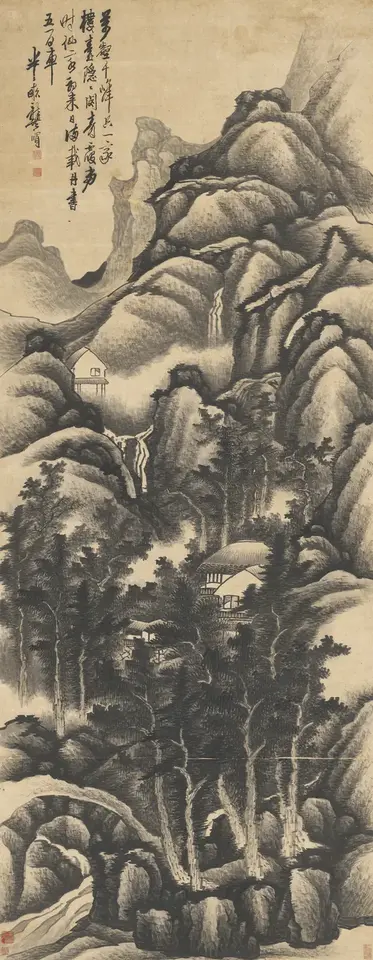
Gong Xian's most celebrated technical breakthrough was his development of the "accumulated ink method" (jimo fa). Prior to Gong Xian, landscape painters primarily relied on linear contouring and textural rubbing (cun), rarely applying ink washes more than two or three times for fear of muddying the paper surface. Through decades of experimentation with Chinese ink and Xuan paper, Gong developed a revolutionary layering technique that built forms through successive applications of ink.
In executing a painting, Gong first brushed linear outlines and mountain contours with pale ink. Once dry, he returned with progressively darker ink, repeatedly stippling, rubbing, and washing the forms across seven, eight, or even dozens of layers. Each application responded precisely to the spatial density and tonal balance of previous strokes, combining wet and dry brushwork so that the deepest blacks remained luminous and transparent. Modern master Huang Binhong celebrated Gong Xian as "the foremost master of ink method in the Qing dynasty." Historically, Gong's oeuvre is divided into two distinct stylistic modes: "Black Gong" and "White Gong." The "Black Gong" mode, characterized by dense, shadowy, and monumental massifs, represents the zenith of his accumulated ink technique; the "White Gong" mode, marked by clean linear delineation, restrained rubbing, and expansive white space, captures an ethereal, transcendent hermit aesthetic. Together, these two complementary systems formed a majestic visual vocabulary.
Gong Xian was not only a gifted painter, but also an astute aesthetician and educator. Teaching disciples for over twenty years at the Sweeping Leaves Tower, he recognized that traditional painting manuals were either too cryptic or excessively mechanical. To provide systematic instruction, he distilled his lifelong insights on composition, brush handling, and ink application into lucid pedagogical manuals, including Huajue (Secrets of Painting), Gong Banqian Ketu Huagao (Instructional Sketches of Gong Banqian), Chai Zhang Huashuo (Treatise on Painting by the Firewood Master), and numerous colophons.
In Huajue, Gong articulated timeless aesthetic principles, emphasizing that students must "first seek stability, and only then seek marvel," warning against pursuing superficial eccentricity without grounding in disciplined fundamentals. He formulated methodical rules for tree placement, rock anatomy, cloud dynamics, and plateau layering, stating that "rocks take solidity as their essence, while trees take erect strength as their bone." In ink work, he summarized the ideal balance as "holding the moisture of spring rain within the brush, while retaining the stark sharpness of autumn wind." Marked by clarity and structural logic, his treatises provided the most comprehensive and practical instructional curriculum in pre-modern Chinese art. These texts deeply influenced Qing painters and later served as a foundational theoretical pillar for modern artists such as Li Keran.
During his lifetime, Gong Xian was celebrated as both an extraordinary painter and an accomplished poet. He composed thousands of poems over his lifetime, selecting his finest verses for the anthology Caoxiangtang Ji (Collection of the Fragrant Grass Hall). Amidst the turbulence of dynastic change, Gong maintained his integrity, channeling his grief, exile, and empathy for common suffering into metrically disciplined verse.
His poetry inherited the solemn, historically grounded tradition of the Tang master Du Fu. Contemporaries such as Fang Wen and Wang Shizhen praised his poetic voice, with Wang remarking in Yuyang Shihua that his verses were "lofty, profound, stable, and entirely his own." In famous works such as The Skiff, Departing Swallow Rock Under Evening Light, and Drinking at the Xu Family Garden, Gong described the ruin of Jiangnan and the anguish of displaced families in stark, mournful language. In one poem, he wrote: "In short garments I abandoned the capital, in white hairs I wander like a drifting tumbleweed; I read not the biography of Jing Ke, ashamed to pose as a sword-wielding hero." These verses, paired with his dark landscapes, created an intimate, enduring chronicle of loyalist sorrow.
Gong Xian's pedagogical work at the Sweeping Leaves Tower dismantled the conventional reliance on vague intuition, transforming landscape painting into structured, progressive modules. He organized his curriculum into detailed units covering tree anatomy, rock forms, water, clouds, architecture, and watercraft.
In rendering trees, Gong demonstrated the principle of "branching out in four directions," categorizing dozens of foliage stippling techniques—such as willow leaves, double-outline leaves, pine needles, and pepper dots—according to seasonal and botanical varieties. In depicting rocks, he systematically illustrated the construction of tiered flat ledges, aggregated boulders, and massive layered blocks, revealing how mountain geology builds from base to summit. Compositionally, he taught that "rocks require alternating large and small masses, while trees demand coherent groupings and openings." In handling water and mist, he held that "unpainted white paper is water, and unpainted white paper is cloud; void and solid give birth to each other, maintaining continuous vital breath." This instructional rigor nurtured generations of Qing artists and laid the groundwork for modern Chinese studio curricula.
The duality of "White Gong" and "Black Gong" reflects a coherent intellectual and visual progression, illustrating Gong Xian's lifelong journey from expansive clarity to monumental density.
The "White Gong" manner flourished primarily during his middle-aged exile in Hai'an and Yangzhou. Influenced by Dong Qichang, Huang Gongwang, and Ni Zan, these works emphasized clean, centered brushwork with sparse textural rubbing and vast areas of blank paper. This style evoked the transcendent reclusion and moral purity of a loyalist scholar detached from mundane decay. In contrast, the "Black Gong" manner matured after his return to Nanjing. Drawing upon the structural mass of northern Song masters Dong Yuan, Juran, Fan Kuan, and Mi Fu, Gong abandoned delicate linear austerity. Utilizing his signature accumulated ink method, he built deep, moisture-saturated mountain ranges resembling dark iron bastions. "Black Gong" captured an epic solemnity that harmonized personal grief over dynastic collapse with the eternal grandeur of the natural cosmos, marking an unprecedented artistic peak.
Gong Xian's renown as a painter has often overshadowed his accomplishments in calligraphy. In reality, he was a distinctive calligrapher who merged the fluid grace of Mi Fu and Dong Qichang with the archaic weight of Han-Wei steles, developing an angular, weathered script.
His surviving calligraphic works appear predominantly in his poetic inscriptions on monumental hanging scrolls and handscrolls. Writing on raw or semi-sized paper, he favored centered, deliberate strokes that integrated the rounded resistance of seal script, free from superficial slickness. His character structures leaned slightly, balancing tension and equilibrium, with short horizontal strokes resembling severed iron and elongated vertical strokes resembling gnarled vines. Gong placed great emphasis on harmonizing poetry, calligraphy, and painting. Amidst dense mountain ranges and layered ink washes, he consistently reserved a corner of blank paper to inscribe long personal verses in running script. The calligraphic rhythm interacted seamlessly with the painted atmosphere, prompting critic Zhou Lianggong to remark that his "calligraphy and painting mutually stimulate each other, uniting spirit and intellect."
During his reclusion at the Sweeping Leaves Tower, Gong Xian avoided Qing officialdom while cultivating deep friendships with loyalist scholars and open-minded intellectuals across Jiangnan. His simple study served as an important gathering place for loyalist culture in early Qing Nanjing.
His lifelong circle included fellow Restoration Society figures such as Fang Wen, Gu Mengyou, Ji Yingzhong, Du Jun, and Cheng Zhengkui, alongside sympathetic patrons such as Zhou Lianggong and Wang Shizhen. In autumn and spring, these scholars climbed Mount Qingliang to gather at the Sweeping Leaves Tower, boiling tea over fires of fallen leaves, examining antique rubbings, and composing verse, with Gong frequently painting landscapes to commemorate their meetings. In particular, his friendship with playwright Kong Shangren blossomed into a profound bond. Kong provided material support during Gong's final years, financed his burial, cared for his young son, and edited his collected works, creating a moving testament to literary devotion during a tumultuous era.
Gong Xian produced numerous landscape masterpieces, many of which are now preserved as national treasures in major cultural institutions. Key works include A Thousand Peaks and Myriad Ravines and Twenty-Four Views of Mount She in the Palace Museum, Landscape for Armchair Traveling in the Nanjing Museum, alongside Streams and Mountains Without End, Summer Mountains After Rain, and Mount Qingliang Ringed in Green.
In these works, Gong distilled and restructured his observations of Mount Zhong, Mount Qixia, Mount Qingliang, and the Yangtze River. His paintings feature precipitous peaks, surging ravines, ancient pines, and secluded thatched pavilions emerging from cloud-filled forests, where profound ink density radiates inner light, embodying both the vital force of nature and the quiet dignity of his native soil. Gong's innovations exerted a transformative influence on twentieth-century Chinese painting. Modern master Huang Binhong drew directly from Gong's accumulated ink technique to forge his own dense, layered style, while Li Keran built upon Gong's rich tonal depth to pioneer the celebrated "Li School Landscape." As an enduring pioneer of ink method reform, Gong Xian's artistic vision continues to resonate across the centuries.
FIGURES ASSOCIATED WITH THIS DYNASTY