Birth in Huaiyin
Born into an established family in Huaiyin, mastering the Confucian classics, calligraphy, painting, and board games in his youth.
龚开
Gong Kai (龚开, 1222–1307), courtesy name Shengyu, art names Cuiyan, Guichengsou, and Yansou, celebrated by peers as Master Gong, was a native of Huaiyin. He was an acclaimed literatus painter, patriotic poet, and towering loyalist figure during the Song-Yuan dynastic transition. In his early years, Gong joined the military secretariats of Southern Song commanders Zhao Kui and Li Tingzhi, serving alongside Grand Councilor…
Gong Kai (龚开, 1222–1307), courtesy name Shengyu, art names Cuiyan, Guichengsou, and Yansou, celebrated by peers as Master Gong, was a native of Huaiyin. He was an acclaimed literatus painter, patriotic poet, and towering loyalist figure during the Song-Yuan dynastic transition. In his early years, Gong joined the military secretariats of Southern Song commanders Zhao Kui and Li Tingzhi, serving alongside Grand Councilor Lu Xiufu in Guangling and forming an intimate, lifelong bond of brotherhood. During the Jingding reign of Emperor Lizong, he served as Director of Fiscal Transportation in the Huai River Defense Commission, managing salt and iron monopolies and military logistics. During the Mongol invasion, he actively participated in loyalist resistance across Zhejiang and Fujian. Following the cataclysmic fall of the Song dynasty at the Battle of Yashan, Gong refused all Yuan imperial appointments, living as a destitute loyalist recluse across Suzhou and Hangzhou and sustaining his family by selling paintings. In art, he revolutionized horse and figure painting, pioneering an expressive dry-brush technique depicted in his immortal masterpiece Painting of a Thin Horse (Jun'gu Tu, also known as Shouma Tu), which utilized a starving fifteen-ribbed steed to symbolize the unbending moral integrity of surviving Song scholars. His celebrated scroll Zhongshan Excursion portrayed Zhong Kui through satirical monochrome ink. In literature, his Eulogies for the Thirty-Six of Song Jiang established the canonical names and nicknames of the Liangshan heroes, serving as the foundational narrative source for the classic novel Water Margin (Shuihu Zhuan). He passed away in 1307 at the age of eighty-six, leaving behind Guichengsou Ji and Gu Qijing.
Born into an established family in Huaiyin, mastering the Confucian classics, calligraphy, painting, and board games in his youth.
Recruited into the military secretariat of Grand Marshal Zhao Kui, advising on defense fortifications along the Huai River.
Entered the Guangling defense headquarters of Li Tingzhi, drafting military proclamations alongside lifelong friend Lu Xiufu.
Appointed Director of Fiscal Transportation in the Huai River Defense Commission, supervising taxation and ordnance production.
Crossed the Yangtze southward following the breach of regional defense lines, actively coordinating resistance militias in Zhejiang and Fujian.
Mourned the fall of Song and Lu Xiufu's leap into the sea at Yashan, composing eulogies and resolving never to serve under the Mongol regime.
Lived in poverty across Suzhou and Hangzhou as a loyalist recluse, adopting the title Guichengsou and selling paintings for livelihood.
Authored Eulogies for the Thirty-Six of Song Jiang, alongside historical biographies celebrating the martyrdom of Lu Xiufu and Wen Tianxiang.
Passed away at his residence in Suzhou at the age of eighty-six; disciples and peers compiled his surviving literary works into Guichengsou Ji.
Gong Kai was born in 1222 in Guishan, Huaiyin. His ancestral clan had resided along the Grand Canal for generations, maintaining an illustrious tradition of classical learning. Standing eight feet tall with a commanding physical presence, young Gong mastered canonical philosophy, poetry, calligraphy, monochrome painting, and mathematical astronomy.
During the Chunyou and Baoyou eras of Emperor Lizong, Mongol cavalry launched continuous assaults against the Huai River defense perimeters. Acclaimed commanders Zhao Kui and Li Tingzhi directed regional defense, recruiting exceptional scholars into their secretariats. Recognized for his strategic vision and elegant prose, Gong entered Li Tingzhi's headquarters in Guangling. In this military bureau, Gong shared quarters with Lu Xiufu, who would later become Left Grand Councilor of the Southern Song. The two scholars bonded deeply over statecraft and military strategy, forging an inviolable friendship.
During the Jingding reign, Gong was appointed Director of Fiscal Transportation in the Huai River Defense Commission. He supervised the transport of state salt and iron revenues, cracked down on corruption, and organized armaments production, ensuring a steady stream of provisions for the northern frontier.
In 1275, Mongol forces crossed the Yangtze River, shattering the central Song defense networks. Gong traveled tirelessly along the coastal routes of Zhejiang and Fujian, coordinating local resistance militias and aiding loyalist commanders.
In the spring of 1279, the Southern Song collapsed utterly at the Battle of Yashan, where Chancellor Lu Xiufu leaped into the stormy waves carrying the eight-year-old child emperor Zhao Bing. When the catastrophic news reached Jiangnan, Gong faced south and wept blood, composing an epic elegy mourning Lu's sacrifice. Adopting the literary names Guichengsou (Elder of the Turtle City) and Yansou, Gong severed all ties with worldly politics, living in reclusion across Suzhou and Hangzhou.
Under Yuan dominion, former Song intellectuals faced severe political disenfranchisement. Gong lived in profound material destitution, yet he refused to flatter foreign overlords, relying solely on selling paintings to buy coarse grain for his family. When painting in his humble studio, his eldest son Gong Jun knelt beside his couch, holding paper while his father splashed ink. Yuan grand master Zhao Mengfu visited Gong during his travels in Jiangnan, praising his noble bearing as possessing the transcendent purity of an ancient immortal.
In his eighties, residing in Suzhou, Gong maintained razor-sharp vision and astonishing creative vitality. In an impoverished cottage, he worked tirelessly to record the heroic martyrdoms of the fallen dynasty, composing the authoritative Biography of Lu Junshi and Biography of Prime Minister Wen, preserving irreplaceable eyewitness records of the late Song resistance.
Concurrently, drawing from regional folk traditions circulating along the Huai River, he compiled Eulogies for the Thirty-Six of Song Jiang, creating the definitive poetic framework for the thirty-six peasant rebels of the Liangshan marshes.
In 1307, at the age of eighty-six, Gong fell ill at his Suzhou hermitage. Facing death, he examined his surviving manuscripts with serene detachment, declaring to his disciples: "I was born a subject of the Great Song, and in death I return to the earth of the Song realm; my soul is tranquil, with nothing to regret before heaven and earth!" He died peacefully shortly thereafter. His disciples compiled his verses and colophons into the enduring anthology Guichengsou Ji.
Gong Kai's foremost achievement in Chinese art history was overturning the ancient aesthetic tradition of depicting imperial steeds as plump, sleek, and majestic, a style established by Tang masters Cao Ba and Han Gan. Instead, Gong pioneered the technique of using coarse ink-wash brushstrokes to depict gaunt, emaciated horses. His immortal surviving masterpiece, Painting of a Thin Horse (Jun'gu Tu or Shouma Tu), is preserved in the Osaka City Museum of Fine Arts.
In this iconic painting, Gong utilized dry ink and jagged contours to outline a starving, aged courser standing alone in an empty landscape, its spine jutting upward like a mountain ridge and its fifteen ribs clearly visible. He inscribed his celebrated poem: "Frost chills the autumn grass in the setting sun; its bones stand like mountains, its mane and tail bald. As Sima Xiangru fell ill with bones piled high, so antiquity judged horses alongside human talent." Through the emaciated yet unconquered steed, he constructed an immortal political metaphor for Song loyalist scholars who chose destitution and starvation over collaboration with foreign conquerors.
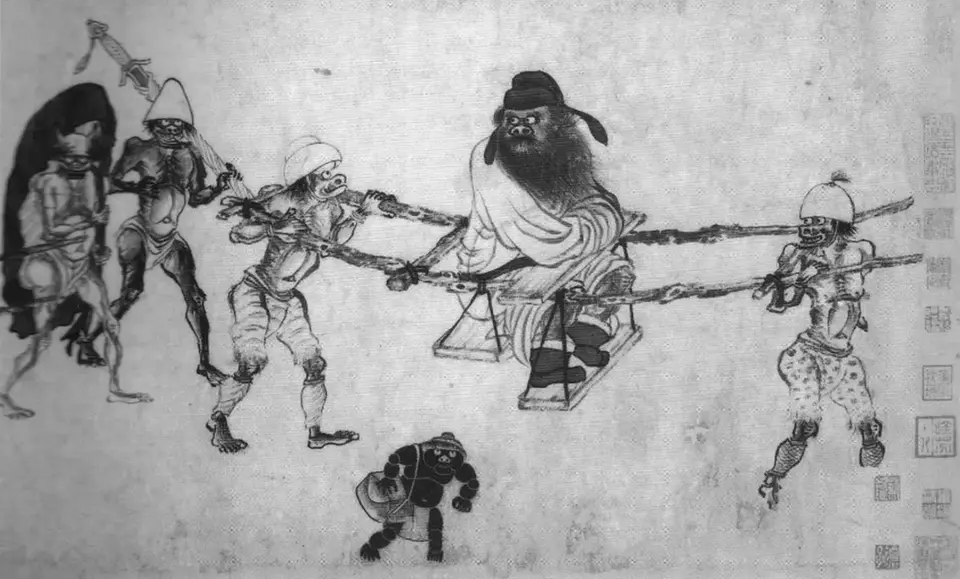
In figure painting, Gong achieved worldwide renown for his depiction of Zhong Kui and supernatural demons. His surviving handscroll, Zhongshan Excursion (Zhongshan Chuyou Tu), now housed in the Freer Gallery of Art in Washington, D.C., depicts Zhong Kui and his sister traveling in state accompanied by grotesque spirit attendants.
Gong invented the specialized technique of applying dense layers of splashed ink to portray bizarre, misshapen demons carrying palanquins and trunks. In his colophon, he utilized the spirit world to satirize the corrupt ministers who caused the fall of the Southern Song and the grotesque social inversions under Mongol military tyranny, creating one of the most powerful social satires in classical Asian art.
In literary history, Gong achieved monumental distinction by authoring Eulogies for the Thirty-Six of Song Jiang (Song Jiang Sanshiliu Ren Zan Bing Xu). During the formative era of Chinese vernacular fiction, Gong was the first classical scholar to gather, codify, and poeticize the oral legends of the Liangshan rebels.
In his preface and poems, he assigned canonical names, distinct weapon specialties, and iconic epithets to all thirty-six heroes, designating Song Jiang as the Timely Rain, Wu Yong as the Resourceful Star, Lu Junyi as the Jade Qilin, and Li Kui as the Black Whirlwind. This crucial text provided the definitive character roster and moral archetype that directly inspired Shi Nai'an in crafting the great classical novel Water Margin (Shuihu Zhuan).
Gong undertook the sacred cultural mission of preserving the historical memory of the Southern Song dynasty. With tragic eloquence, he authored the Biography of Lu Junshi, the Biography of Prime Minister Wen, and the preface to Lu's funeral elegies.
Having served alongside Lu Xiufu in the Huai defense headquarters for over a decade, Gong provided meticulous eyewitness accounts of Lu's political deliberations, military defenses, and his final heroic leap into the sea at Yashan. His austere, moving prose supplied essential historical records omitted by the official dynastic histories, establishing the definitive chronicle of the final Song resistance.
FIGURES ASSOCIATED WITH THIS DYNASTY