Birth in Hefei
Born into a prominent aristocratic family in Hefei County, Luzhou Prefecture, Southern Zhili.
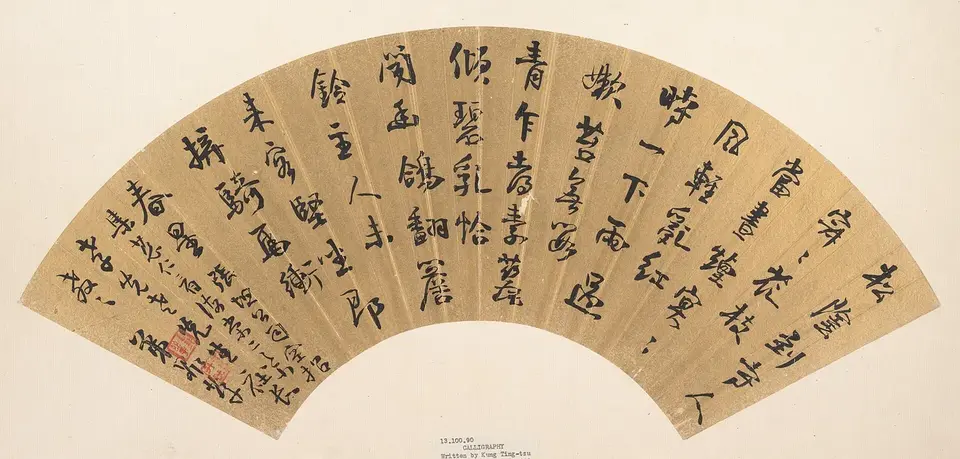
龚鼎孳
Gong Dingzi (龚鼎孳, 1615–1673), courtesy name Xiaosheng and pseudonym Ding'an, was a native of Hefei County, Luzhou Prefecture, Southern Zhili. He was an outstanding man of letters, poet, and high-ranking statesman of the late Ming and early Qing dynasties, celebrated in literary history alongside Qian Qianyi and Wu Weiye as one of the renowned "Three Great Masters of Jiangzuo." Originating from a distinguished aristocratic…
Gong Dingzi (龚鼎孳, 1615–1673), courtesy name Xiaosheng and pseudonym Ding'an, was a native of Hefei County, Luzhou Prefecture, Southern Zhili. He was an outstanding man of letters, poet, and high-ranking statesman of the late Ming and early Qing dynasties, celebrated in literary history alongside Qian Qianyi and Wu Weiye as one of the renowned "Three Great Masters of Jiangzuo." Originating from a distinguished aristocratic lineage in Hefei, Gong earned his metropolitan degree of Jinshi in 1634 at age twenty. Initially appointed Magistrate of Qishui County, he achieved notable merit in repelling bandit forces before being promoted to Supervising Censor of the Office of Scrutiny for War. At the imperial capital, he gained national renown for his courageous memorials impeaching Grand Secretary Chen Yan, persevering through harsh imprisonment in the Imperial Silk Bodyguard prison without compromising his convictions. During the cataclysm of 1644, when the Dashun insurgent forces under Li Zicheng seized Beijing, Gong was appointed Directing Inspector; following the Qing entry into the capital, he submitted to the new dynasty and was appointed Supervising Censor of the Office of Scrutiny for Personnel. Over subsequent decades, he ascended to Left Censor-in-Chief, Minister of Justice, Minister of War, and Minister of Rites. Although his service under three regimes subjected him to moral censure from later historians—eventually leading Emperor Qianlong to place him in the Biographies of Twice-Serving Officials—Gong consistently submitted outspoken memorials on behalf of the populace. Furthermore, leveraging his judicial authority as Minister of Justice and Censor-in-Chief, he repeatedly intervened to dismiss literary inquisitions, privately exhausting his personal wealth to rescue and harbor southern anti-Qing literati and Ming loyalists, earning universal reverence as a righteous benefactor. In literature, he presided over the Beijing literary scene for nearly three decades, authoring Ding'an Shiji and Ding'an Ci, synthesizing classical elegance with profound sorrow to pioneer the early Qing literary renaissance.
Born into a prominent aristocratic family in Hefei County, Luzhou Prefecture, Southern Zhili.
Passed the palace examination at age twenty and was assigned as Magistrate of Qishui County.
Elevated to Supervising Censor of the Office of Scrutiny for War, outspokenly impeaching Chen Yan.
Incarcerated in the Imperial Silk Bodyguard prison after displeasing the Chongzhen Emperor.
Took the famed Qinhuai courtesan and poet Gu Mei (Gu Hengbo) as secondary spouse at Shanjie Tower.
Dashun forces seized Beijing; Gong served briefly under Dashun before submitting to the Qing dynasty.
Urged the Shunzhi Emperor to halt retrospective taxation and suspend coercive queue-order enforcement in the south.
Elevated to Junior Lord of the Court of Imperial Sacrifices, celebrated among the Three Great Masters of Jiangzuo.
Appointed Left Censor-in-Chief of the Censorate, enforcing bureaucratic discipline despite factional friction.
Promoted to Minister of Justice, using judicial review to exonerate scholars caught in literary inquisitions.
Reassigned as Minister of War, reforming military transport, curbing Banner abuses, and assisting boatmen.
Transferred to Minister of Rites, directing national educational rites and advancing southern literati.
Passed away from illness at his official Beijing residence at age fifty-nine, posthumously titled Wenmin.
Gong Dingzi was born in 1615 in Hefei County, Luzhou Prefecture, Southern Zhili, into an illustrious family of imperial gentry. The Gong clan of Hefei was celebrated for its generational devotion to Confucian learning, with numerous kin serving in civil administration. Possessing exceptional intellect from early childhood, Gong memorized canonical texts effortlessly; by age ten, he commanded the commentaries of the Nine Classics and composed essays with astonishing speed, earning acclaim as a child prodigy. In 1634, at the age of twenty, Gong passed the metropolitan and palace examinations, obtaining the third-class Jinshi degree and winning widespread renown in southern literary circles.
Upon obtaining his degree, Gong was selected as Magistrate of Qishui County in Huangzhou Prefecture, Huguang (modern Xishui, Hubei). At that time, peasant rebellions led by Zhang Xianzhong and other leaders swept across the middle Yangtze basin, placing Qishui in frequent danger. Confronted with military chaos, the young magistrate demonstrated exceptional governance and tactical competence. Upon assuming office, he repaired ramparts, reinforced watchtowers, recruited capable local militias, and established beacon towers. Simultaneously, he lowered tax burdens and curtailed administrative extortions, securing the affection of local residents. Under his leadership, Qishui successfully withstood enemy sieges. For his administrative acumen and military achievements, Gong was commended by the regional governor and imperial court as an exemplary local magistrate.
In 1641, Gong was summoned to the imperial capital and promoted to Supervising Censor of the Office of Scrutiny for War. At that juncture, the Ming empire faced external invasions by Manchu forces in the north and internal peasant uprisings across central China. The Chongzhen Emperor grew suspicious and volatile, while Grand Secretaries Chen Yan and Xue Guoguan engaged in factional intrigue and concealed military setbacks. Serving as a remonstrance official, Gong courageously submitted outspoken memorials exposing court corruption. He indicted Minister of War Yang Sichang for strategic incompetence and attacked Senior Grand Secretary Chen Yan for bribery, deceit, and factional patronage, creating immense reverberations at court.
In 1642, Gong submitted an unsparing memorial detailing the destructive impact of extortionate military levies and the collapse of northern border garrisons, urging the emperor to dismiss flatterers and grant relief to the populace. Enraged by this criticism, the Chongzhen Emperor ordered Gong stripped of rank and arrested by the Imperial Silk Bodyguard. Interrogated and tortured in the prison, Gong refused to yield, recant, or implicate colleagues. Supported by petitions from southern Fushe scholars and conscientious court officials, the emperor eventually succumbed to public pressure and released him.
In 1643, while residing in Jinling, Gong married the renowned Qinhuai poet and artist Gu Mei (Gu Hengbo) as his secondary spouse. Endowed with extraordinary literary and musical talents, Gu shared his intellectual life. At their Beijing residence, Gong erected the Shanjie Tower (Tower of Good Understanding), where the couple composed poetry, creating an artistic partnership amidst national turmoil.
In March 1644, peasant armies under Li Zicheng breached Beijing, and the Chongzhen Emperor committed suicide on Coal Hill. Confronted with the fall of the capital, Gong attempted suicide by jumping into a well, but survived because the well was dry, and was subsequently captured by Dashun troops. Recognizing Gong's prestige among the literati, Li Zicheng compelled him to accept appointment as Directing Inspector overseeing northern Beijing. Two months later, Qing armies swept past the Shanhai Pass, defeated Li Zicheng, and occupied the capital.
Confronting the new dynasty, Gong submitted to the Qing and was appointed Supervising Censor of the Office of Scrutiny for Personnel. His service under the Ming, the Dashun regime, and the Qing dynasty became his greatest moral vulnerability, eliciting severe condemnation from contemporary loyalists and later historians. However, after entering Qing service, Gong avoided sycophancy, using his position to intercede on behalf of the populace. In 1645, when the Qing court imposed the queue-cutting order and attempted to collect Ming tax arrears in Jiangnan, Gong submitted memorials pleading for the cancellation of back taxes, the suspension of the queue decree, and amnesties for surrendered officials' kin. Although the Shunzhi Emperor viewed his memorials with suspicion, he adopted many of his proposals, sparing countless civilians from punitive violence.
During the Shunzhi reign, although Gong was favored by the Shunzhi Emperor for his administrative competence and literary brilliance, his unconventional manner and background as a surrendered official invited hostility in a polarized court. In 1646, censors impeached Gong for forming cliques and acting arbitrarily; however, the Shunzhi Emperor pardoned him. In 1650 and 1652, Gong submitted memorials denouncing Manchu Banner land appropriations and defending persecuted southern landowners, prompting retributive attacks from conservative Banner nobles that led the Ministry of Personnel to demote him by three to five ranks.
Confronted with factional hostility, Gong maintained equanimity. During periods of demotion, he fulfilled his administrative duties conscientiously while composing poetry during his leisure hours. Recognizing that Gong possessed deep institutional knowledge and genuine concern for societal peace, the Shunzhi Emperor repeatedly reinstated him following factional storms, enlisting his expertise in codifying early Qing legal and institutional statutes. These trials reinforced Gong's commitment to mitigating judicial cruelty and shielding southern intellectuals.
Following the Shunzhi period, Gong's erudition and administrative competence propelled him to high office. In 1653, he was appointed Junior Lord of the Court of Imperial Sacrifices and subsequently Left Vice Commissioner of the Office of Transmission. In 1660, the Shunzhi Emperor appointed him Left Censor-in-Chief of the Censorate, placing him at the helm of imperial surveillance.
During the early Kangxi reign, as Regent Oboi consolidated power, political purges targeted southern scholars. In 1664, Gong was promoted to Minister of Justice. In this capacity, he demonstrated the moral courage that earned him lasting admiration. During an era marked by the Zhuang Tinglong Ming History inquisition, the Jiangnan Lamenting Temple Case, and coastal treason trials, thousands of scholars faced execution or exile. Gong utilized his authority to review death penalties, deftly reinterpreting evidence to reduce capital charges and mitigate collective punishments. He used his personal salary to bribe guards and secure the escape of anti-Qing fighter Yan Ermei, while providing essential legal protection for philosopher Gu Yanwu. Literati across China revered him as a "righteous benefactor of the realm."
Despite holding high imperial office, Gong maintained humble and conciliatory attitudes toward his ancestral home. The popular folk tradition of the "Gongwan Lane" in Hefei illustrates his disdain for abusing power. The Gong clan owned an expansive mansion adjacent to the estate of another influential family, the Wan clan. One year, both families undertook simultaneous estate expansions, sparking a boundary dispute over dividing walls that led to litigation in the county magistrate's court, where the local magistrate hesitated to rule against the minister's kin.
Relying on Gong's high status, the Gong clan sent a courier to Beijing requesting his intervention. Reading the letter, Gong smiled, declined to intervene, and inscribed a famous verse on the margin: "Sending a letter a thousand leagues for a wall, what harm is there in yielding three feet? The Great Wall still stands today, yet where is the First Emperor of Qin?" Ashamed upon reading the verse, the Gong family demolished their wall and retreated three feet; touched by this magnanimity, the Wan family also receded three feet. This mutual compromise created a six-foot-wide public thoroughfare that eased city traffic, commemorated by Hefei residents across generations as "Gongwan Lane."
In 1666, Gong was transferred to Minister of War, where he curbed administrative abuses, stabilized Grand Canal grain transport, and shielded canal boatmen from excessive levies. In 1669, following Emperor Kangxi's assumption of direct personal rule and the elimination of Oboi, Gong was appointed Minister of Rites, overseeing the state examinations, ritual codes, and imperial education.
At the Ministry of Rites, Gong championed Classical Confucian principles, securing the revival of the triennial provincial and metropolitan examinations in the south and resisting efforts by Banner conservatives to abolish the civil service system. He ensured that examination grading was based strictly on textual mastery and literary refinement, enabling impoverished scholars from the south to enter government service. However, decades of administrative labor and private remorse over serving three dynasties undermined his constitution. In September 1673, Gong passed away at his Beijing residence at age fifty-nine, with disciples privately conferring upon him the posthumous title of "Wenmin."
In 1776, during the compilation of the Siku Quanshu, the Qianlong Emperor sought to reinforce orthodox Confucian loyalism by compiling the Biographies of Twice-Serving Officials (Erchen Zhuan), assigning Gong Dingzi and Qian Qianyi to the second division as compromised officials. Nevertheless, official censure failed to diminish his stature as a literary titan or obscure his historic contributions in sheltering imperiled intellectuals.
Gong Dingzi holds a distinguished position in Chinese literary history. Amid the upheavals of the Ming-Qing transition, he achieved parity alongside Qian Qianyi and Wu Weiye, forming the renowned "Three Great Masters of Jiangzuo." Among this triumvirate, Qian was acclaimed for his encyclopedic erudition and Wu for his narrative ballads, while Gong stood out for his dynamic imagination, lyrical elegance, and emotional range.
Residing in Beijing for nearly thirty years as an imperial dignitary, Gong made his residence at Shanjie Tower the intellectual hub of northern China. Generous and accessible, he welcomed aspiring writers from across the realm. Prominent figures including Wang Shizhen, Shi Runzhang, Song Wan, Zha Shenxing, and Liang Qingbiao received vital patronage and early encouragement under his roof. Gong advocated returning to the robust poetic traditions of the Han, Wei, Tang, and Song dynasties, rejecting both the mechanical archaism of the Ming Seven Masters and the fragile trivialities of late Ming schools. Through thirty years of cultural leadership, he guided the recovery of early Qing literature toward lasting revitalization.
Gong produced an extensive poetic corpus, later compiled into Ding'an Shiji (Collected Poems of Ding'an). His poetry reflected his early examination triumphs, his frontier campaigns against rebels, his harrowing imprisonment, the trauma of dynastic collapse, and the isolation of high office.
Artistically, Gong mastered multiple poetic forms, excelling in pentasyllabic ancient verse and heptasyllabic narrative songs (gehang). His ancient-style verse captured the rugged spirit of the Han-Wei era and Tao Yuanming's natural tranquility; his narrative ballads synthesized the historical gravity of Du Fu, the evocative imagery of Li Shangyin, and the narrative flow of Wu Weiye. In masterworks such as Willow of the White Gate, Spring in the Imperial Park, Lament for Chu, and Departing Beyond the Frontier, he intertwined grief for the fallen Ming with sorrow over civilian suffering and personal remorse over dynastic compromise. Scholar Wang Shizhen praised his poetic vigor as "vast and inexhaustible, like ten thousand bushels of water bursting from a spring," while modern scholar Qian Zhonglian celebrated his verses as "towering, incisive, solemn, and magnificent—the crowning achievement of an age."
In addition to his poetry, Gong was a foundational innovator in the history of Qing ci poetry. Following the mid-Ming period, the ci genre had fallen into sharp decline. Although poets such as Chen Weisong, Zhu Yizun, and Nalan Xingde spearheaded its resurgence in the high Qing, Gong Dingzi's Ding'an Ci represented the earliest catalyst of that revival.
Gong's ci verse drew inspiration from Southern Tang rulers Li Jing and Li Yu, alongside Northern Song masters Yan Shu, Ouyang Xiu, and Qin Guan, displaying particular mastery in shorter lyrical forms. His poetic style was subtle and melancholic, employing delicate phrasing to convey veiled grief over dynastic collapse and personal regrets over his political choices. He expressed deep remorse for having compromised his principles, using harmonious metrics and unfeigned emotional sincerity to establish an introspective, multi-layered voice that profoundly influenced the subsequent Changzhou Ci School and late Qing poets.
Reaching high office as Minister of Justice and Left Censor-in-Chief, Gong differed sharply from self-serving courtiers. He maintained an enduring affinity for Han cultural traditions and deep compassion for former Ming subjects. During the violent pacification campaigns of the early Qing, Gong turned his judicial offices into a protective sanctuary for southern intellectuals.
Amidst ruthless literary inquisitions, Gong intervened to save numerous lives. When anti-Qing fighter Yan Ermei faced execution in prison, Gong expended immense resources to engineer his escape; when philosopher Gu Yanwu was implicated in a dangerous political indictment, Gong resolved the case through court influence, shielding Gu from imprisonment. After loyalist martyr Zhang Huangyan was executed, Gong provided secret shelter for his surviving followers and financed their proper burial. When destitute southern scholars arrived in the capital, Gong hosted them at Shanjie Tower, providing monthly stipends and travel allowances so they could return home to pursue scholarship. Early Qing thinker Wei Xi praised him: "Lord Gong of Hefei, while occupying the highest ministerial posts, maintained a heart of boundless righteousness; sixteen or seventeen out of every twenty surviving loyalists across the realm owe their lives to his protection. That the realm calls him a righteous benefactor is no empty praise!"
In 1666, Gong was appointed Minister of War, overseeing military rosters and command logistics. At that time, three regional feudatories expanded their power while Banner garrisons abused their authority, often seizing farmland and extorting merchant shipments. Gong addressed these abuses by reasserting strict military regulations, forbidding troops from mistreating commoners, and punishing commanders who permitted extortion.
In transportation logistics, Gong championed relief for Grand Canal trackers and boatmen who suffered severe administrative exploitation. Corrupt tax checkpoints along the canal routinely extorted fees, causing boatmen to flee and threatening to paralyze grain transport. Gong petitioned Emperor Kangxi to abolish extortionate transit surcharges, ban Banner overseers from flogging laborers, and mandate grain stipends from imperial reserves for canal workers. These measures secured the capital's grain supply and relieved the hardships of countless southern boatmen.
Assuming the post of Minister of Rites in 1669, Gong took charge of state ceremonies, schools, and the civil service examinations. During the early Qing period, conservative Banner aristocrats advocated abandoning the examination system in favor of hereditary military preferences, threatening to close avenues of advancement for southern Han literati.
Gong argued vigorously that Confucian ethics were essential to imperial stability and that the examination system was indispensable for winning over the hearts of southern scholars. He stabilized the triennial examination schedules and resisted aristocratic interference in grading. In evaluating essays, he penalized influence-peddling and rewarded Classical erudition, allowing many impoverished scholars from the south to enter public service. By lending his prestige to the examination system, Gong fostered cultural integration between the court and the Han intelligentsia, stabilizing early Qing governance.
Gong's major literary achievement lay in dismantling the rigid archaism popularized by the Ming dynasty Seven Masters. Since the mid-Ming, the literary scene had been dominated by the dogmatic rule that "prose must emulate the Qin and Han, while poetry must copy the High Tang," which reduced writing to mechanical mimicry divorced from personal sentiment.
Collaborating with Qian Qianyi and Wu Weiye, Gong promoted the doctrine that "poetry originates from genuine emotion, roots itself in native sensibility, and is enriched by erudition." Gong's innovative heptasyllabic narrative ballads broke down artificial barriers between High Tang and Late Tang styles, combining Du Fu's gravitas with the dense melancholy of Li He and Li Shangyin. His narrative songs possessed grand structures, varied pacing, dynamic temporal shifts, and intricate musical resonance. In masterworks like Willow of the White Gate and Lament for Chu, he synthesized his remorse over dynastic compromise with the historic tragedy of dynastic fall, setting an enduring artistic benchmark for three centuries of Qing poetry.
Despite spending decades in the imperial capital, Gong remained deeply committed to the cultural development of his native Anhui. During the Shunzhi and Kangxi reigns, his younger brother Gong Dingsi retired from his post as Magistrate of Xianju in Zhejiang and returned to Hefei. With Gong's encouragement and financial assistance, Gong Dingsi channeled the Fei River to build landscaped estates in southwestern Hefei, constructing the famed Daoxiang and Shuiming pavilions.
Visiting his hometown during leaves of absence, Gong joined Gu Hengbo in climbing the pavilions to gaze upon the mist-covered streams, hosting literary salons for regional scholars and composing evocative verses celebrating the scenic beauty of Hefei. Overlooking water and verdant paddies, Daoxiang Pavilion became an iconic cultural retreat where traveling dignitaries gathered to view the landscape. This architectural and literary patronage enriched Hefei's cultural identity, ensuring that Daoxiang Pavilion remains an enduring historic landmark in the city.
The romantic and intellectual partnership between Gong Dingzi and his secondary spouse Gu Hengbo (Gu Mei) remains a celebrated chapter in late imperial literati history. Ranked among the famous "Eight Beauties of Qinhuai," Gu was renowned for her beauty, poetic mastery, and painting, earning the title "Mistress of Meilou." Married to Gong since the end of the Chongzhen period, she remained his companion for thirty years.
In Beijing, Gong constructed the Shanjie Tower (Tower of Good Understanding) as their residence. Beyond serving as a private artistic haven where the couple painted and exchanged verse, Shanjie Tower became a prominent cultural salon for the early Qing literati. Recognizing Gong's philanthropic mission, Gu actively supported his efforts to shelter imperiled scholars, frequently donating her private jewelry to fund their rescue. Gong inscribed numerous affectionate poems to her, affectionately calling her his "wise and capable partner." When Gu passed away, Gong was devastated, composing heartfelt laments that reflected his deep personal devotion. Their union illuminated the private lives of early Qing literati, introducing a touch of personal grace to a tumultuous historical era.
FIGURES ASSOCIATED WITH THIS DYNASTY