耿继茂
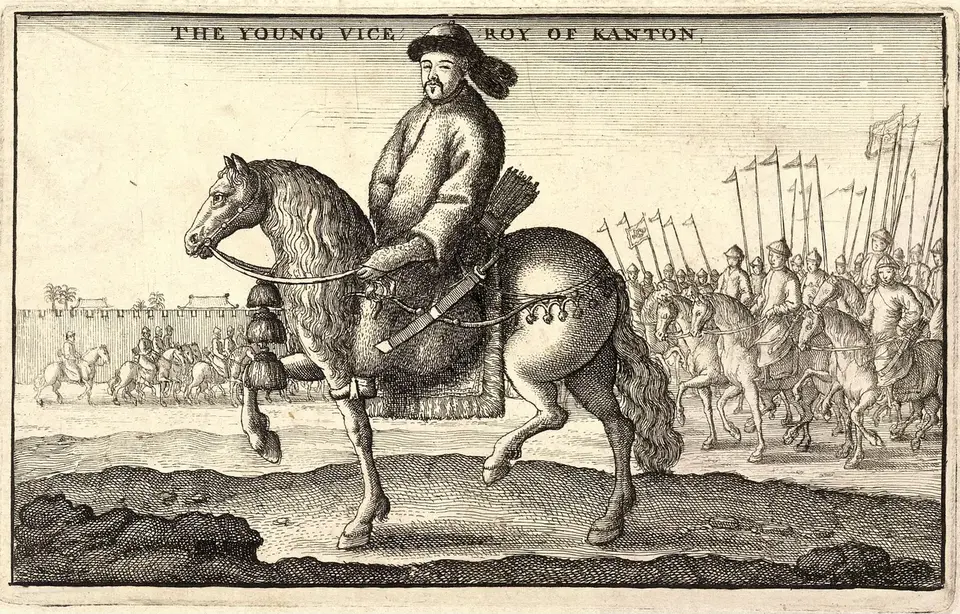
Historical portrait of Geng Jimao
Image creditsWenceslaus Hollar · Public domainImage source

Historical figure

Geng Jimao (耿继茂)

耿继茂

Geng Jimao (耿继茂, ?–1671) was a native of Gaizhou in Liaodong, enrolled in the Han Plain Yellow Banner. He was the second Prince Jingnan, one of the Early Qing Three Feudatories, the son of founding prince Geng Zhongming, and the father of Geng Jingzhong. In 1649, after his father committed suicide in Ji'an out of fear of prosecution for harboring runaway banner slaves, Geng Jimao took command of the army and was confirmed as…

Qing Dynasty

PROFILE

Geng Jimao (耿继茂, ?–1671) was a native of Gaizhou in Liaodong, enrolled in the Han Plain Yellow Banner. He was the second Prince Jingnan, one of the Early Qing Three Feudatories, the son of founding prince Geng Zhongming, and the father of Geng Jingzhong. In 1649, after his father committed suicide in Ji'an out of fear of prosecution for harboring runaway banner slaves, Geng Jimao took command of the army and was confirmed as Prince Jingnan by the court. Collaborating with Prince Pingnan Shang Kexi, he besieged and captured Guangzhou after ten months of combat, eradicating Southern Ming resistance across Guangdong. In 1651, he led troops into Guangxi to combat the forces of Li Dingguo. In 1660, to counter the maritime strength of Zheng Chenggong along the southeastern coast, the Qing court ordered Geng Jimao to transfer his feudal army to Fujian and garrison Fuzhou. Operating closely with regional banner commanders and Governor-General Li Shuaitai, Geng engaged in protracted naval warfare against Zheng Chenggong and Zheng Jing around Xiamen and Kinmen. In 1663, Geng participated in the amphibious assault that conquered Kinmen and Xiamen, crippling Zheng Jing fleet and forcing the Zheng regime to retreat to Taiwan. During his tenure in Fujian, Geng monopolized civil and military authority, amassing commercial profits and private armies like an autonomous warlord. He died in Fuzhou in 1671 and was granted the posthumous title Zhongmin. His son Geng Jingzhong subsequently inherited the princedom and was executed after joining the Revolt of the Three Feudatories.

Posthumous Name
Zhongmin
Native Place
Gaizhou, Liaodong (Modern Gaizhou, Liaoning)
Dynasty
Qing Dynasty
Death Date
1671 (Tenth Year of Kangxi)
Highest Identity
Prince Jingnan
Accurate Identity Positioning
Second Prince Jingnan of the Early Qing Three Feudatories, Plain Yellow Banner Commander, Leader of Southern Campaigns and Military Garrison in Fujian

LIFE TIMELINE

Relationship graph

BIOGRAPHY

Chronology

  • 1649 (Sixth Year of the Shunzhi Reign) | Succession to Princedom | Assumed command of the army following Geng Zhongming death, confirmed as Prince Jingnan by imperial decree.
  • 1650 (Seventh Year of the Shunzhi Reign) | Fall of Guangzhou | Cooperated with Shang Kexi to capture Guangzhou after a protracted siege, subduing Southern Ming forces.
  • 1651 (Eighth Year of the Shunzhi Reign) | Campaign in Guangxi | Marched into Guangxi to confront Xi Army remnants and Southern Ming loyalists under Li Dingguo.
  • 1660 (Seventeenth Year of the Shunzhi Reign) | Transfer to Fujian | Ordered by the imperial court to relocate his feudal command to Fuzhou to counter coastal incursions by Zheng Chenggong.
  • 1663 (Second Year of the Kangxi Reign) | Victory at Kinmen and Xiamen | Coordinated with Governor-General Li Shuaitai to seize Kinmen and Xiamen, forcing Zheng Jing to retreat to Taiwan.
  • 1671 (Tenth Year of the Kangxi Reign) | Death in Fuzhou | Passed away at his residence in Fuzhou; awarded the posthumous name Zhongmin, succeeded by his son Geng Jingzhong.

Life and Career

Succession and the Conquest of the South

Geng Jimao belonged to a prominent military lineage in Liaodong. His father, Geng Zhongming, had originally served Ming artillery commander Sun Yuanhua before surrendering to the Later Jin alongside Kong Youde during the Wuqiao Mutiny. Honored as Prince Huaishun by Hong Taiji and renamed Prince Jingnan in the early Shunzhi era, Geng Zhongming commanded an imperial expedition to the south in 1649. However, when his subordinates were discovered harboring fugitive Eight Banner serfs, Geng Zhongming took his own life at Ji'an in Jiangxi to escape capital indictment.

Geng Jimao demonstrated composure during the crisis, maintaining order among the troops and petitioning the court with assurances of loyalty. The Shunzhi Emperor approved his succession as Prince Jingnan, directing him to continue the southern expedition. Joining forces with Prince Pingnan Shang Kexi, Geng invested Guangzhou, which was defended by resolute Southern Ming loyalists. Utilizing heavy red-coat artillery to bombard the citadel day and night, the allied princes maintained a ten-month siege. In the winter of 1650, they breached the northern battlements and took the provincial capital. In 1651, Geng led his forces into Guangxi, supporting Prince Dingnan Kong Youde against Li Dingguo in protracted campaigns across Xunzhou and Guilin.

Garrisoning Fujian and the Expulsion of Zheng Naval Forces

In 1660, maritime loyalist Zheng Chenggong mounted a massive amphibious offensive up the Yangtze River, besieging Nanjing and terrifying the court. Recognizing that existing Green Standard garrisons were inadequate, the Qing court ordered Geng Jimao to relocate his entire banner detachment to Fujian, establishing his princely headquarters at Fuzhou with supreme authority over regional military operations.

Upon reaching Fujian, Geng enforced the severe coastal clearance decrees, forcibly evacuating coastal settlements inland to sever Zheng commercial and logistical networks. Following Zheng Chenggong death on Taiwan in 1662, his heir Zheng Jing retained strong naval bases on Kinmen and Xiamen, launching frequent raids against Tong'an and Haicheng. In the autumn of 1663, Geng coordinated with Governor-General Li Shuaitai and allied Dutch East India Company warships to launch a decisive joint amphibious assault. Geng led his divisions across the Xiamen straits, routing Zheng Jing fleet at Wushashan and taking Kinmen and Xiamen. Suffering devastating vessel losses, Zheng Jing evacuated his remaining detachments to Taiwan. The fall of these islands pacified the Fujian coast, earning Geng imperial commendations from the young Kangxi Emperor.

Princely Autonomy and Aftermath

Following the capture of Kinmen and Xiamen, Geng Jimao power in Fujian reached its zenith. Exploiting princely prerogatives, he constructed an opulent palace in Fuzhou and erected customs tollhouses across Fuzhou, Quanzhou, and Zhangzhou, monopolizing profitable coastal maritime trade and salt production. He expropriated thousands of acres of fertile farmland, levied unauthorized surcharges upon regional magistrates, and expanded his private elite bodyguard regiments, forming an autonomous fiefdom in alliance with Shang Kexi in Guangdong and Wu Sangui in Yunnan.

Although governing Fujian with autocracy, Geng carefully maintained formal subservience toward Beijing, avoiding open defiance of imperial edicts. In June 1671, Geng Jimao passed away in his Fuzhou palace from chronic illness. The Qing court financed his funeral and granted the posthumous title Zhongmin. His eldest son, Geng Jingzhong, inherited the princedom. Lacking his father strategic patience, Geng Jingzhong joined Wu Sangui rebellion in 1673, ultimately bringing total annihilation upon the Geng feudatory following the suppression of the revolt.
Interpersonal Connections

  • Father: Geng Zhongming (First Prince Jingnan who committed suicide in 1649)
  • Eldest Son and Successor: Geng Jingzhong (Third Prince Jingnan, joined the Revolt of the Three Feudatories and executed)
  • Southern Campaign Comrade: Shang Kexi (Prince Pingnan who jointly captured Guangzhou with Geng)
  • Principal Adversary: Zheng Jing (Successor to Zheng Chenggong, defeated at Kinmen and Xiamen by Geng forces)

Historical Evaluations

  • The Draft History of Qing (Qing Shi Gao), Biography of Geng Zhongming, recorded: "Geng Jimao inherited the princedom, pacified Guangdong alongside Shang Kexi, relocated to garrison Fujian, and broke Zheng Jing at Kinmen and Xiamen, clearing the coastline. He maintained strict military discipline but extracted heavy levies; commanding troops in Fujian to entrench himself, he resembled an independent kingdom."
  • Wei Yuan in Sheng Wu Ji evaluated: "Among the Three Feudatories, the Geng lineage spent two generations pacifying Lingnan and subduing Fujian, with the recovery of Kinmen and Xiamen standing as their crowning achievement. Jimao was brave and skilled in warfare; it was lamentable that his successor Jingzhong acted with reckless delusion, bringing extinction upon his house."

Related Entries

  • Geng Zhongming
  • Shang Kexi
  • Geng Jingzhong

FIGURES ASSOCIATED WITH THIS DYNASTY

Bibliography

  • Zhao Erxun et al., Draft History of Qing (Qing Shi Gao), Volume 474, Biographies 261: Biography of Geng Zhongming and Geng Jimao.
  • Wei Yuan, Sheng Wu Ji (Military History of the Sacred Dynasty), Volume 2: Early Chronicle of Kangxi Pacification of the Three Feudatories.
  • Jiang Liangqi, Donghua Lu (Records from the Donghua Gate), Shunzhi and Kangxi Reigns.