Auspicious Birth into Eminent Gentry
Born in Jurong, Danyang; grandson of Grand Administrator Ge Ju, son of Minister Ge Yan.
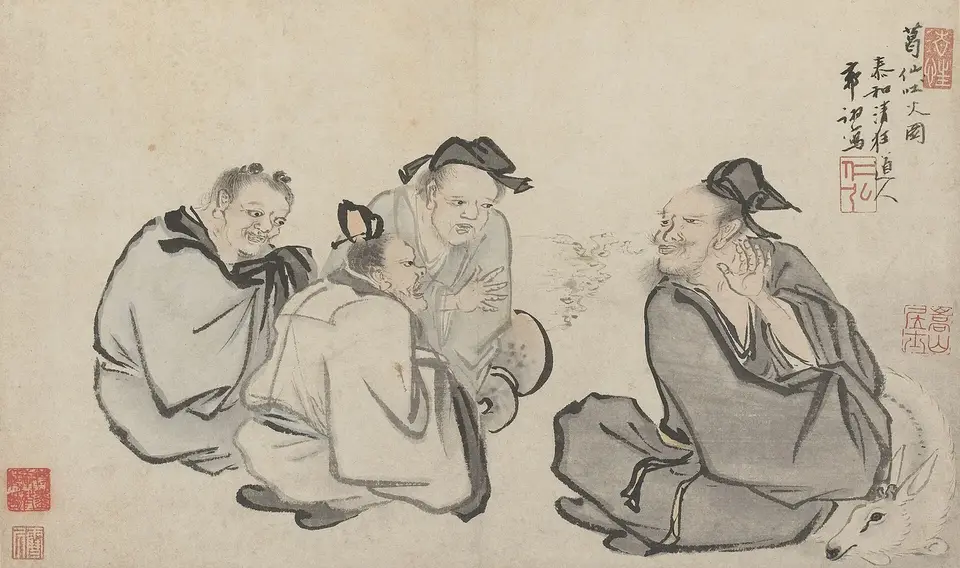
葛玄
Ge Xuan (葛玄, 164–244), courtesy name Xiaoxian, known honorifically as Immortality Venerable Ge (Ge Xianweng) and the Grand Transcendent of the Supreme Ultimate (Taiji Xianweng), was a native of Jurong in Danyang Commandery (present-day Jurong, Jiangsu). He was the grand-uncle of the seminal Jin-dynasty Daoist master Ge Hong, and an illustrious Daoist philosopher, physician, master of operative alchemy (waidan), and talismans…
Ge Xuan (葛玄, 164–244), courtesy name Xiaoxian, known honorifically as Immortality Venerable Ge (Ge Xianweng) and the Grand Transcendent of the Supreme Ultimate (Taiji Xianweng), was a native of Jurong in Danyang Commandery (present-day Jurong, Jiangsu). He was the grand-uncle of the seminal Jin-dynasty Daoist master Ge Hong, and an illustrious Daoist philosopher, physician, master of operative alchemy (waidan), and talismans during the Three Kingdoms era in Eastern Wu. Reorganized in institutional Daoism alongside Zhang Daoling, Xu Xun, and Sa Shoujian as one of the Four Heavenly Preceptors (Si Da Tianshi), Ge Xuan was the founding patriarch of the Lingbao School (Gezao Sect) and the ancestral patriarch of the Southern Ge tradition. Born into an eminent Jiangnan aristocratic gentry lineage whose grandfather Ge Ju served as Grand Administrator of Anping and father Ge Yan reached the position of Grand Minister of the Imperial Secretariat in Eastern Wu, Ge Xuan mastered the Confucian Five Classics and Lao-Zhuang metaphysics in his youth. Following the premature demise of his parents when he was in his teens, he renounced bureaucratic ambitions to seek transcendent longevity in sacred mountains. Retiring into the Tiantai and Kuacang ranges, Ge Xuan became the primary disciple of the famed Han master thaumaturge Zuo Ci. From Zuo Ci, he received foundational esoteric scriptures, including the Scripture of the Golden Elixir of Ninefold Cyclical Transformation, the Scripture on the Divine Elixir of Great Clarity, and the Text of the Three Sovereigns, systematically mastering laboratory alchemy, respiratory gymnastics (daoyin), and talismanic exorcism. Sun Quan, Emperor Da of Eastern Wu, deeply revered his transcendent arts, summoning him to court in Jianye, constructing a dedicated residence (the Special Pavilion) for him, and repeatedly offering high ministerial offices, all of which Ge Xuan serenely declined. During his time in Wu, he demonstrated supernatural wonders, curing widespread pestilence and commanding spirits. He subsequently established an alchemical retreat and liturgical sanctuary on Mount Gezao (in present-day Zhangshu, Jiangxi), which became the supreme ancestral seat of the Lingbao tradition. Ge Xuan played an indispensable role in the structural evolution of Daoist theology. He integrated operative alchemy with Confucian filial ethics and Mahayana Buddhist universal salvation, forming the core textual stream of the Lingbao scriptures, later institutionalized by his descendant Ge Chaofu during the Eastern Jin dynasty. Ge Xuan transmitted his alchemical arcana to his foremost disciple Zheng Yin, who subsequently passed them to Ge Hong, preserving the intellectual core that culminated in the masterwork Baopuzi. In 244 (Chi'wu 7), foreknowing his earthly conclusion, Ge Xuan underwent peaceful corpse-deliverance (shijie) at the age of eighty-one, leaving behind only empty robes. In the Song dynasty, he was officially honored by Emperor Huizong as the Perfected Chongying and elevated by Emperor Lizong as the Grand Transcendent of the Supreme Ultimate.
Born in Jurong, Danyang; grandson of Grand Administrator Ge Ju, son of Minister Ge Yan.
Lost his parents in his teens; mastered the Five Classics, Laozi, and Zhuangzi, renouncing worldly office.
Entered Mount Tiantai and Mount Kuacang; studied under Zuo Ci, receiving the Ninefold Golden Elixir scriptures.
Traveled to Mount Gezao in Jiangxi, constructing alchemical furnaces, dispensing healing talismans, and healing pestilence.
Welcomed to Jianye by Sun Quan; lodged in the Special Pavilion, refusing government posts while performing miraculous cures.
Transmitted the alchemical texts and Lingbao liturgies to his chief disciple Zheng Yin on Mount Tiantai.
Bathed and sat peacefully into transcendence at age eighty-one, leaving only empty garments on his couch.
Bestowed the imperial title of Perfected Chongying by the Northern Song court, revered across Lingbao altars.
Ge Xuan was born in the seventh year of the Yanxi era of Emperor Huan of Eastern Han (164) in Jurong County, Danyang Commandery (present-day Jurong, Jiangsu). The Jurong Ge clan was one of the most prominent noble families in the southern Jiangnan region during the Han, Wei, and Jin periods. Ge Xuan's seventh-generation ancestor, Ge Ai, had been enfeoffed as Marquis of Tong in Xiapi for meritorious military service during the Western Han dynasty. His grandfather, Ge Ju, served as Grand Administrator of Anping and Gentleman of the Yellow Gates; his grand-uncle, Ge Mi, served as Grand Administrator of the Fifth Commandery of Yuzhang; and his father, Ge Yan (courtesy name Deru), was a versatile statesman who served Eastern Wu as Commandery Head Clerk, Magistrate of Shanyin, Cavalier Regular Attendant, and Grand Minister of the Imperial Secretariat (Da Shangshu).
Nurtured in this cultured aristocratic environment, Ge Xuan exhibited remarkable intellectual precocity from early childhood. Before reaching twenty, he had read widely across the Confucian Five Classics, the diverse philosophical treatises of the Hundred Schools, and the dynastic histories of Sima Qian and Ban Gu. In particular, he felt a profound philosophical resonance with the serene principles of natural non-action expounded in Laozi's Daodejing and Zhuangzi's Nanhua Zhenjing. When Ge Xuan was in his teens, his parents passed away in close succession. This profound bereavement impressed upon him the fragility of mortal life and the futility of worldly status. Confronted with the conventional bureaucratic careers pursued by contemporary aristocratic sons, Ge Xuan made the resolute choice to abandon the political arena, dedicating his life to discovering the cosmic principles of heaven and earth and cultivating transcendent longevity.
During the Zhongping era of Emperor Ling, Ge Xuan packed his belongings, bid farewell to his ancestral estate, and retreated alone into the secluded valleys of Mount Tiantai, Mount Chicheng, and Mount Kuacang in Kuaiji Commandery. Living in a thatched hut amid pine forests, cascading waterfalls, and mountain mists, he gathered wild medicinal herbs like poria (fuling) and Solomon's seal (huangjing), practicing the Daoist arts of grain avoidance (bigu), respiratory circulation, and salivary ingestion, attaining an exceptionally purified physical and mental state.
During his mountain retreat, Ge Xuan encountered the decisive mentorship of his spiritual career: he was accepted as a disciple by Zuo Ci, the foremost thaumaturge of the late Eastern Han. Zuo Ci (courtesy name Yuanfang), a native of Lujiang, was an alchemical master renowned across northern and central China for his command of the Five Classics, astrological divination, and the arts of the Ninefold Golden Elixir. Recognizing Ge Xuan's integrity, steadfast resolve, and synthetic intellectual grasp, Zuo Ci accepted him as his principal lineage disciple.
Zuo Ci transmitted the supreme textual treasures of early alchemical Daoism to Ge Xuan: the three volumes of the Scripture on the Divine Elixir of Great Clarity, the single volume of the Scripture of the Golden Elixir of Ninefold Cyclical Transformation, and the ancient esoteric Text of the Three Sovereigns. In addition to texts, Zuo Ci personally instructed him in the intricate furnace temperatures required for sublimating mercury and lead, techniques for spiritual flight, and esoteric talismanic invocations to command spirits. Diligently practicing these teachings, Ge Xuan mastered the inner secrets of operatory laboratory alchemy, combining physical preservation with spiritual transcendence to lay the foundation of the Daoist danding (elixir tripod) tradition.
During the Jian'an era, as warlords fought for control of China, Ge Xuan sought sacred geography endowed with geomantic purity to smelt the ninefold divine elixir, traveling to Mount Gezao in Jiangxi (present-day Zhangshu, Jiangxi).
Mount Gezao was renowned as an auspicious grotto-heaven. Perceiving that its topography mirrored the cosmic diagrams of Yin-Yang and the Eight Trigrams, Ge Xuan built a thatched hut and erected an open-air stone altar near the Woyun Hermitage on the eastern peak. He carved wells out of solid rock to tap sweet springs and established an alchemical laboratory. Gathering rare minerals and medicinal herbs, he refined cinnabar and gold over complex cycles of heat, producing celebrated golden elixirs. The historic Alchemical Altar of the Immortal and the Herb-Washing Pool constructed by Ge Xuan remain preserved on Mount Gezao to this day.
While residing at Mount Gezao, Ge Xuan practiced compassionate philanthropy. The southern climate was humid, and devastating epidemics frequently swept through peasant villages. Ge Xuan prepared herbal mixtures, compounded medicinal pills, and inscribed talismanic symbols into mountain springs, providing free medical relief to impoverished commoners. Those suffering from chronic diseases or contagions recovered swiftly upon drinking his blessed water and taking his remedies. Peasants and gentry throughout Jiangxi and Huainan revered him as a living transcendent, addressing him honorifically as Immortality Venerable Ge (Ge Xianweng).
Crucially, it was on Mount Gezao that Ge Xuan founded the liturgical heritage of the Lingbao School. According to Daoist tradition, the Grand Transcendent of the Supreme Ultimate and celestial deities descended upon his altar to confer the True Writs of the Supreme Lingbao. Synthesizing classical Daoist philosophy, alchemical preservation, and universal salvation, Ge Xuan founded the Lingbao liturgical system centered upon community fasts, purification ceremonies, and the salvation of all souls. Mount Gezao subsequently became one of the Three Mountain Talismanic Sanctuaries of Daoism, universally honoring Ge Xuan as its foundational patriarch.
In 222 (Huangwu 1), Sun Quan proclaimed himself King of Wu and established his capital at Jianye (present-day Nanjing). Open-minded and inquisitive, Sun Quan held profound reverence for longevity arts and cosmic masters. Long hearing of Ge Xuan's towering reputation, Sun Quan dispatched envoys with gifts to invite him to court.
Hoping to promote regional peace, Ge Xuan arrived in Jianye. Sun Quan received him with the veneration accorded to a national preceptor, constructing a grand garden hermitage within the capital named the Special Pavilion (Biege) exclusively for his residence. Sun Quan visited the pavilion regularly to consult Ge Xuan on statecraft and self-cultivation. Impressed by his breadth of knowledge, Sun Quan repeatedly offered to appoint him as an Imperial Chancellor or Minister. Maintaining the independent integrity of a transcendent hermit, Ge Xuan consistently declined, stating that a man of the mountains was unsuited for the machinery of government.
While in Jianye, Ge Xuan exhibited numerous extraordinary thaumaturgical feats. Pei Songzhi's commentary on the Records of the Three Kingdoms (quoting Ge Hong's Shenxian Zhuan) details several episodes: once, when Sun Quan hosted a waterside banquet during a scorching summer drought, the emperor lamented the lack of fresh fish from distant rivers. Ge Xuan stepped forward, sketched waves and fish with ink inside a wooden basin, and instantly fresh spring water bubbled up, yielding several large, leaping carp that were cooked and served to the amazed guests. In the depths of freezing winter, when plants were withered, Sun Quan expressed a desire for fresh lotus flowers; Ge Xuan filled a bowl with earth, sprinkled it with water from his mouth, and within moments, green lotus pads shot up, bearing two vibrant pink blossoms blooming in the frost.
Furthermore, Ge Xuan excelled at hydrokinetic arts. When sailing with Sun Quan on the turbulent waters of the Yangtze River, a violent storm erupted, terrifying the crew. Ge Xuan stepped off the deck and walked calmly across the towering waves; the surging waters never wet his shoes as he strolled across the surface as if on level ground. Deeply moved, Sun Quan ordered Daoist temples built across Jiangnan mountains in his honor, and high ministers such as Bu Zhi and Gu Yong held him in supreme veneration.
In his later years, aware that his mortal mission was nearing completion, Ge Xuan focused on ensuring the unbroken transmission of the alchemical scriptures and Lingbao liturgies.
On Mount Tiantai and Mount Gezao, Ge Xuan evaluated his disciples and selected Zheng Yin (courtesy name Siyuan) as his principal successor. Zheng Yin was a distinguished scholar proficient in the Confucian Nine Classics, mathematics, and musical tuning. Ge Xuan presented the Scripture of the Golden Elixir of Ninefold Cyclical Transformation, the Scripture of the Divine Elixir of Great Clarity, the Text of the Three Sovereigns, and Lingbao liturgical records to Zheng Yin, charging him: "These scriptures contain the secrets of creation and must never be transmitted lightly. Guard them faithfully; in the future, a great genius will arise from my own Ge lineage, and you must transmit them to him on my behalf!"
Zheng Yin faithfully preserved the teachings, eventually transmitting them on Mount Luofu to Ge Xuan's grand-nephew, the celebrated Eastern Jin philosopher and physician Ge Hong. Relying upon Ge Xuan's ancestral texts, Ge Hong authored the seminal Baopuzi, advancing Chinese laboratory chemistry and medicine to world-renowned heights and cementing the Ge Lineage Tradition (Ge Shi Dao) within Chinese religious history.
In 244 (Chi'wu 7 of Sun Quan), Ge Xuan prepared for his departure. That winter, he assembled his disciples at his stone hermitage on Mount Tiantai, announcing that he was summoned by the celestial court. Before his disciples, eighty-one-year-old Ge Xuan bathed, donned fresh robes and cap, and sat peacefully on his couch, closing his eyes into quietude.
His disciples mourned him for three days and nights. On the fourth morning, when they prepared to shroud his body, they lifted the silk coverlet to find the bed completely empty: only his robes, cap, and shoes lay neatly arranged on the mattress, his physical form having vanished. He had attained the classic state of corpse-deliverance (shijie).
Following his ascension, successive imperial dynasties bestowed exalted honors upon him. In 1104 (Chongning 3), Emperor Huizong of Northern Song canonized him as the Perfected Chongying. In 1235, Emperor Lizong of Southern Song added the title of True Lord Chongying Fuyou, and in 1269 elevated him as the Grand Transcendent of the Supreme Ultimate (Taiji Xianweng), establishing his permanent place as one of the Four Heavenly Preceptors of Daoism.
Born into the aristocratic Jurong Ge clan, mastered the Five Classics and Daoist thought in youth before renouncing bureaucratic office following the loss of his parents.
Cultivated longevity in sacred Tiantai and Kuacang mountains, practicing bigu and respiratory gymnastics to transcend mundane attachments.
Apprenticed under master thaumaturge Zuo Ci, receiving the foundational Ninefold Golden Elixir and Great Clarity scriptures.
Mastered the laboratory sublimation of cinnabar and mercury, establishing foundational protocols for Chinese external alchemy.
Established an alchemical laboratory and herb-washing springs on Mount Gezao, dispensing medicine and talismans to relieve regional epidemics.
Received the sacred Lingbao scriptures, creating the Lingbao liturgical tradition centered on community purification and universal salvation.
Revered by Sun Quan, who built the Special Pavilion for his residence in Jianye; refused high ministerial appointments to maintain hermit integrity.
Demonstrated supernatural wonders, including painting water to produce live fish, blooming winter lotuses, and walking atop Yangtze storms.
Transmitted his alchemical and Lingbao texts to Zheng Yin, laying the direct foundation for his grand-nephew Ge Hong's masterwork Baopuzi.
Underwent peaceful corpse-deliverance in 244 at age eighty-one, honored by the Song dynasty as Grand Transcendent of the Supreme Ultimate.
FIGURES ASSOCIATED WITH THIS DYNASTY