Birth
Born in Guizhou into the renowned northern martial clan of Gao Siji.
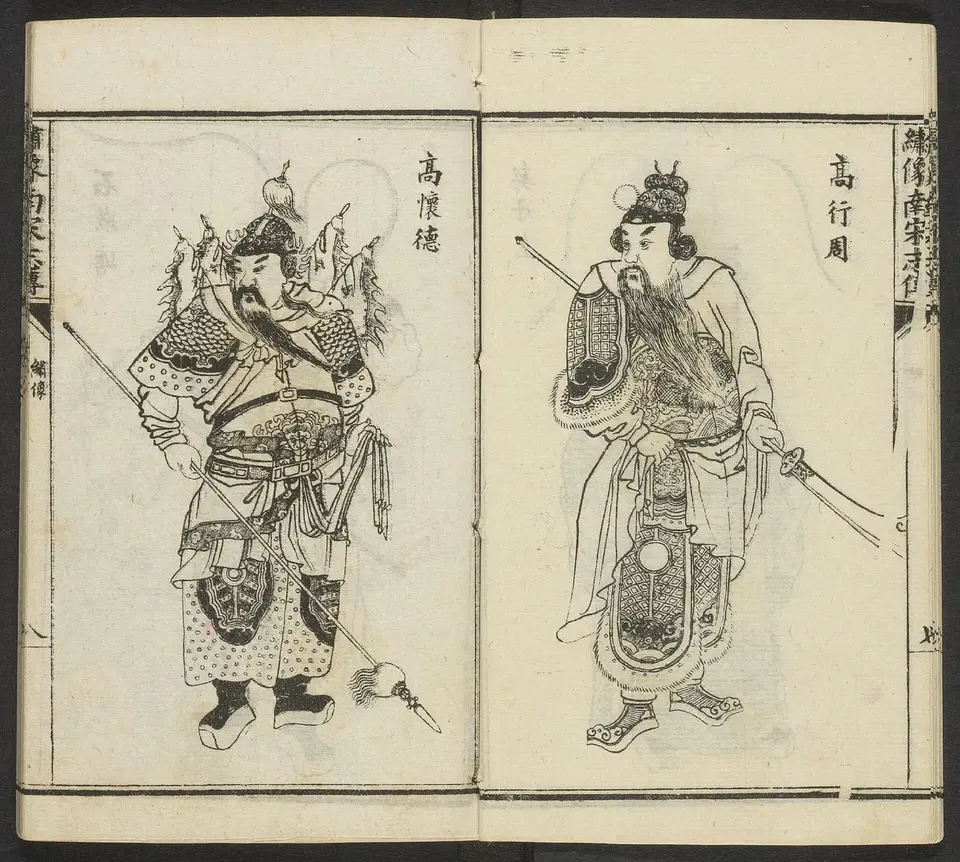
高行周
Gao Xingzhou (高行周, 885–952), style name Shangzhi, was one of the most prominent military commanders and regional princes of the Five Dynasties period, serving with distinction across four successive regimes (Later Tang, Later Jin, Later Han, and Later Zhou). Hailing from Guizhou (modern Huailai, Hebei), he was the son of Gao Siji, the famed "White Horse General" of the late Tang. Renowned for his imposing stature, tactical…
Gao Xingzhou (高行周, 885–952), style name Shangzhi, was one of the most prominent military commanders and regional princes of the Five Dynasties period, serving with distinction across four successive regimes (Later Tang, Later Jin, Later Han, and Later Zhou). Hailing from Guizhou (modern Huailai, Hebei), he was the son of Gao Siji, the famed "White Horse General" of the late Tang. Renowned for his imposing stature, tactical composure, and mastery of cavalry warfare, Gao Xingzhou initially served in Youzhou before joining Prince of Jin Li Keyong and future emperor Li Siyuan, playing a critical role in the destruction of the Later Liang dynasty. Over a four-decade career, Gao Xingzhou commanded more than ten premier regional circuits, including Fuzhou, Yingzhou, Yanzhou, Luzhou, Luoyang, Yedu, and Yunzhou. He was repeatedly entrusted with suppressing major regional insurrections, successfully pacifying the rebellions of Wang Du in Dingzhou, Fan Yanguang in Weibo, and An Congjin in Xiangyang. At the Battle of Qicheng in 944, he led imperial forces in withstanding the full-scale invasion of Emperor Taizong of Liao. Under the Later Zhou dynasty, Emperor Guo Wei honored him as Grand Preceptor and Director of the Secretariat, creating him Prince of Qi and granting him the supreme court privileges of sword-bearing and unannounced audience. He passed away in 952 and was posthumously honored as Prince of Qin with the posthumous name Wuyi. His son Gao Huaide became a founding hero of the Northern Song dynasty.
Born in Guizhou into the renowned northern martial clan of Gao Siji.
Entered the garrison retinue of Liu Rengong following his father's death.
Submitted to the Jin army alongside his cousin Gao Xinggui; joined Li Siyuan's elite guard.
Charged through Liang lines to rescue Yuan Xingqin; refused covert overtures from Li Cunxu.
Smashed an ambush at Doumen to rescue Li Siyuan from encirclement by Liang troops.
Spearheaded an amphibious night crossing of the Yellow River during torrential rains to take Yunzhou.
Defeated Khitan general Tuonuo and crushed Wang Du's insurrection in Dingzhou.
Confirmed as Military Governor of Zhaoyi Circuit with chancellorship rank under Shi Jingtang.
Besieged Yedu and forced the surrender of rebel governor Fan Yanguang; appointed Regent of Luoyang.
Crushed the rebellion of An Congjin at Huyang and captured Xiangyang after a ten-month siege.
Commanded guard cavalry at Qicheng to repel massive Liao invasions, saving the imperial camp.
Invested as Director of the Secretariat and Military Governor of Tianxiong Circuit, created Prince of Qi.
Bestowed supreme court honors by Later Zhou founder Guo Wei, appointed Military Governor of Tianping Circuit.
Passed away in office at Yunzhou at age 68; posthumously honored as Prince of Qin, posthumous name Wuyi.
Gao Xingzhou was born into a celebrated martial family in the northern borderlands of Guizhou. His father, Gao Siji, was widely feared across Youzhou and Hebei for his lethal prowess with the heavy spear. In 895, following his father's execution due to friction with Li Keyong's commanders, Gao Xingzhou was retained as a hostage-officer in Youzhou by regional governor Liu Rengong.
When Liu Rengong's despotic son Liu Shouguang proclaimed himself emperor in 911, the Jin state dispatched Zhou Dewei to besiege Youzhou. In 913, Gao Xingzhou's cousin Gao Xinggui surrendered Wuzhou to the Jin. When besieged by rebel general Yuan Xingqin, Gao Xingzhou made a daring solo breakout to request relief from the Jin lines. Li Siyuan crushed the besiegers, and Gao Xingzhou was placed in Li Siyuan's personal bodyguard, sharing guard command with future emperor Li Congke.
During the prolonged war against Later Liang, Gao Xingzhou repeatedly demonstrated exceptional combat audacity. In 915, during skirmishes around Shenxian, former Yan general Yuan Xingqin was enveloped by several rings of Liang shock cavalry. Gao Xingzhou spurred his horse into the melee, cutting down enemy captains and bringing Yuan Xingqin out safely. Observing his heroism, Prince Li Cunxu attempted to lure Gao Xingzhou into his own retinue with promises of rapid promotion, but Gao Xingzhou resolutely refused out of deep loyalty to Li Siyuan.
In 919, when Li Siyuan's force was ambushed by superior Liang numbers at Doumen along the Yellow River, Gao Xingzhou led several hundred heavy cavalry into the enemy's exposed flank, rescuing his commander from imminent capture. In the autumn of 923, Li Siyuan launched a surprise strike on Yunzhou. Despite torrential rains that demoralized the ranks, Gao Xingzhou declared that foul weather provided perfect cover for surprise. He led the vanguard across the raging Yellow River at midnight, scaled the walls, and seized the fortress. Following the capture of Kaifeng and the fall of Later Liang, he was promoted to Prefect of Duanzhou.
Following Li Siyuan's coronation as Emperor Mingzong of Later Tang in 926, Gao Xingzhou governed several crucial circuits. In 928, Wang Du, governor of Dingzhou, rebelled with Khitan support. Serving under Wang Yanqiu, Gao Xingzhou led the cavalry at the Battle of Jiashan, outflanking the enemy and capturing Khitan general Tuonuo, subsequently executing Wang Du.
Under the Later Jin dynasty, Gao Xingzhou proved equally indispensable. In 937, Fan Yanguang rebelled in Yedu with Weibo's crack troops. Gao Xingzhou encircled the city with extensive entrenchments, repelling all sorties and forcing Fan Yanguang's surrender after a year-long siege. In 941, when An Congjin rose in revolt in Xiangyang, Gao Xingzhou marched south with extraordinary speed, ambushing the rebels at Huyang and capturing thirty fortified stockades before starving Xiangyang into surrender, restoring imperial authority across the middle Yangtze.
In 944, Emperor Taizong of Liao led an overwhelming nomadic invasion into Hebei, threatening the imperial headquarters at Chanzhou. Gao Xingzhou was appointed Battle Array Commander of Cavalry, holding the vital fortress of Qicheng alongside veteran general Fu Yanqing. Deploying heavy crossbows in alternating volleys supported by cavalry counter-charges, they inflicted devastating losses on the Khitan horsemen, forcing their full retreat. When Later Jin collapsed in 946 due to Du Chongwei's treason, Gao Xingzhou kept his garrison closed and defied the invaders, who dared not approach his territory.
Both the Later Han and Later Zhou regimes lavished immense honors upon Gao Xingzhou. Later Han founder Liu Zhiyuan created him Prince of Qi and assigned him to govern Yedu. Upon founding the Later Zhou in 951, Emperor Guo Wei granted him the rank of Grand Preceptor, concurrent Director of the Secretariat, and Military Governor of Tianping Circuit, bestowing upon him the imperial prerogatives of carrying a sword into the palace and entering without announcing his name. Gao Xingzhou conducted his final governorship with humility and benevolence, protecting the local peasantry until his peaceful death in 952 at age sixty-eight. Guo Wei suspended court for three days and posthumously created him Prince of Qin with the noble posthumous title Wuyi.
Gao Xingzhou was the preeminent troubleshooter of the Five Dynasties era, having successfully directed the suppression of major warlord rebellions in Dingzhou, Weibo, and Xiangyang. His mastery of prolonged circumvallation and battlefield shock tactics preserved central dynastic authority across decades of political volatility.
During the Liao-Jin wars, his valiant stand at Qicheng demonstrated that disciplined Central Plains combined-arms tactics could decisively defeat steppe cavalry armies. His reputation for defensive firmness shielded his domains from nomadic ravages.
FIGURES ASSOCIATED WITH THIS DYNASTY