Defeating the Daxi
Pursued Daxi rebel tribesmen alongside Fumeng Lingcha, crushing them with three thousand cavalry.
高仙芝
Gao Xianzhi (高仙芝, ?–756), of Goguryeo descent with ancestral roots in Goguryeo who later settled in Anhua, Jingzhao, was an eminent military general and Military Commissioner of Anxi during the Tianbao era under Emperor Xuanzong of the Tang dynasty. Born into a hereditary military lineage, he accompanied his father into Tang service during his youth. Acclaimed along the western frontier for his horsemanship, archery, and…
Gao Xianzhi (高仙芝, ?–756), of Goguryeo descent with ancestral roots in Goguryeo who later settled in Anhua, Jingzhao, was an eminent military general and Military Commissioner of Anxi during the Tianbao era under Emperor Xuanzong of the Tang dynasty. Born into a hereditary military lineage, he accompanied his father into Tang service during his youth. Acclaimed along the western frontier for his horsemanship, archery, and decisive tactical brilliance, he served successively as Vice Protector-General of Anxi and Military Commissioner of the Four Garrisons of Anxi, venerated among Central Asian kingdoms as a master of mountain warfare. During the Tianbao reign, the Tibetan Empire (Tubo) allied with the Kingdom of Lesser Bolor to sever the tribute routes connecting more than twenty Western Regions kingdoms with the Tang court. In 747, Gao Xianzhi commanded an elite expeditionary force of ten thousand Tang cavalry on a long-distance expedition across the Pamir Plateau. Scaling glaciated peaks, crossing alpine precipices, and capturing the citadels of Lianyun and Anuyue, he captured the King of Lesser Bolor and his Tibetan queen, re-establishing Tang suzerainty south of the Congling mountains. In 751, Gao led Tang forces deep into Central Asia against the Abbasid Caliphate, fighting a massive battle at Talas (modern Taraz, Kazakhstan) before suffering defeat when Qarluq auxiliary forces betrayed his flank. In 755, following the outbreak of the An Lushan Rebellion, Gao was appointed Vice Marshal, conducting a strategic retreat to Tongguan to fortify the mountain pass and check rebel advances into the capital. However, supervising eunuch Bian Lingcheng, harbored personal malice after failed bribery attempts, falsely accused Gao of insubordination and misappropriation of rations. The panicked Emperor Xuanzong ordered Gao Xianzhi's execution at Tongguan, causing widespread grief among his troops. Gao's wrongful death precipitated the collapse of the Tongguan defenses and the fall of Chang'an, marking a tragic turning point in the decline of the High Tang.
Pursued Daxi rebel tribesmen alongside Fumeng Lingcha, crushing them with three thousand cavalry.
Commanded ten thousand cavalry across the glaciated Pamirs to capture Lianyun and take the king captive.
Promoted to Military Commissioner of the Four Garrisons of Anxi and ennobled as Duke of Miyun.
Marched deep into the Pamirs to conquer the Kingdom of Qieshi, capturing its king and securing Central Asia.
Advanced two thousand li into Central Asia against the Abbasid Caliphate; defeated after Qarluq mercenaries betrayed his rear.
Appointed Vice Marshal following the outbreak of the An Lushan Rebellion, enlisting recruits to defend the east.
Retreated to Tongguan alongside Feng Changqing, establishing defensive fortifications that halted the rebels.
Executed at Tongguan following false accusations by eunuch Bian Lingcheng, eliciting lamentations across the army.
Gao Xianzhi originated from an aristocratic military lineage of Goguryeo. Following the joint conquest of Goguryeo by the Tang and Silla in 668, his clan was relocated to the interior, registering in Anhua, Jingzhao. His father, Gao Sheji, gained renown for physical valor in the Tang army, serving in the Four Garrisons of Anxi and rising to General of the Right Militant Guard and regional garrison commander. Possessing an imposing stature, handsome features, and martial skill, Gao Xianzhi mastered horsemanship, archery, and military treatises from his youth. Entering military service in the Anxi Protectorate during his twenties, he was awarded the post of Mobile General through his father's meritorious standing.
Serving in the Anxi forces, Gao Xianzhi displayed tactical prudence, earning the confidence of Vice Protector-Generals Tian Renwan and Gai Jiayun. In the late Kaiyuan era, Fumeng Lingcha assumed command as Military Commissioner of the Four Garrisons of Anxi, recognizing Gao's talents and promoting him to Vice Protector-General and Expeditionary Army Commissioner. In 741, when the Western Turkic Daxi tribe rebelled and migrated westward, Fumeng Lingcha dispatched Gao Xianzhi at the head of three thousand light cavalry in pursuit. Braving winter blizzards, Gao covered over a thousand li to launch a surprise dawn raid west of the Suyab River, annihilating the rebel force and capturing its chieftain. This expedition established his reputation across Central Asia for rapid mobility and alpine warfare.
During the early Tianbao period, the Tibetan Empire expanded northward from the Qinghai-Tibetan Plateau, threatening Tang communications along the southern rim of the Tarim Basin. Seeking to sever ties between the Tang Four Garrisons and Central Asian kingdoms south of the Pamirs, the Tibetan court married a royal princess to the King of Lesser Bolor (situated in modern Gilgit, Kashmir), drawing the kingdom into the Tibetan orbit. Occupying strategic passes through the Pamir Plateau, Lesser Bolor's defection caused more than twenty neighboring states to suspend tribute missions to Chang'an, isolating Tang positions. Multiple imperial offensives failed due to the rugged terrain.
In 747, Emperor Xuanzong appointed Gao Xianzhi as Expeditionary Military Commissioner, accompanied by palace eunuch Bian Lingcheng as imperial supervisor, mobilizing ten thousand elite cavalry and infantry from Anxi. Departing from Qiuci (modern Kuqa), the expedition marched westward past Shule (Kashgar), crossing the Pamir Plateau at altitudes exceeding four thousand meters amidst blizzards and crevasses.
Gao launched a coordinated three-pronged assault on the Tibetan fortress of Lianyun (modern Sarhad, northeastern Afghanistan), perched upon sheer river cliffs and garrisoned by nearly ten thousand Tibetan troops. Wading across the swollen Shaluo River, Gao personally led elite shock troops up the cliffs, killing five thousand defenders and capturing the citadel. Advancing further, the army confronted Mount Tanjula at an elevation of 4,600 meters, where soldiers hesitated before ice-covered chasms. Gao dispatched advance scouts disguised as local envoys from Anuyue to proclaim an imperial victory, restoring morale. Wrapping themselves in felt blankets, Tang troops slid down the glaciers, appearing before Anuyue. Terrified by their unexpected arrival, the garrison surrendered. Gao captured the royal capital of Lesser Bolor, seized the king and his Tibetan consort, and severed the rattan suspension bridge across the Ruoshui River, preventing Tibetan reinforcements from intervening. This campaign broke the Tibetan encirclement, restoring Tang suzerainty over twenty kingdoms, for which Gao was promoted to Military Commissioner of the Four Garrisons of Anxi and ennobled as Duke of Miyun Commandery.
In 750, the mountain kingdom of Qieshi (modern Chitral, northwestern Pakistan) allied with the Tibetans, closing the trade routes of Tokharistan. Gao Xianzhi once again marched his veteran infantry and cavalry across the Pamir ranges, storming the capital and capturing King Bote-mei, consolidating Tang hegemony over Central Asia.
However, repeated triumphs bred arrogance. In late 750, Gao accused the King of Chach (modern Tashkent, Uzbekistan) of failing in tributary etiquette and communicating with Turkic tribes. When the king sued for peace, Gao agreed to an armistice, but subsequently launched a surprise attack on the defenseless city, slaughtering inhabitants, capturing the royal household, and seizing vast quantities of gold and jewels for personal enrichment. The surviving prince fled to the Abbasid Caliphate, appealing to Governor Abu Muslim of Khurasan for military assistance. Abu Muslim mobilized Arab and Central Asian forces to challenge Tang power.
In July 751, seeking to preempt the invasion, Gao Xianzhi led thirty thousand Tang troops alongside Fergana and Qarluq auxiliary forces two thousand li into Central Asia, engaging the Abbasid army on the Talas River (modern Taraz, Kazakhstan). The armies fought fiercely for five days. At the height of the engagement, the Qarluq mercenary cavalry mutinied, attacking the Tang rear while Arab heavy cavalry struck the front lines. Surrounded and disorganized, the Tang ranks collapsed. Supported by commanders Li Siye and Duan Xiushi, who cut an escape corridor through the melee, Gao retreated with several thousand survivors to Anxi. While the defeat checked Tang expansion into Transoxiana, the heavy casualties sustained by Abbasid forces prevented them from advancing east of the Pamirs, leaving Tang border defenses intact.
Recognizing Gao's distinguished record, Emperor Xuanzong refrained from demoting him, summoning him to the capital as General of the Right Feather Forest Army and subsequently appointing him Military Commissioner of Hexi. In November 755, An Lushan launched his rebellion in Fanyang, sweeping through the Central Plains with 150,000 veteran troops.
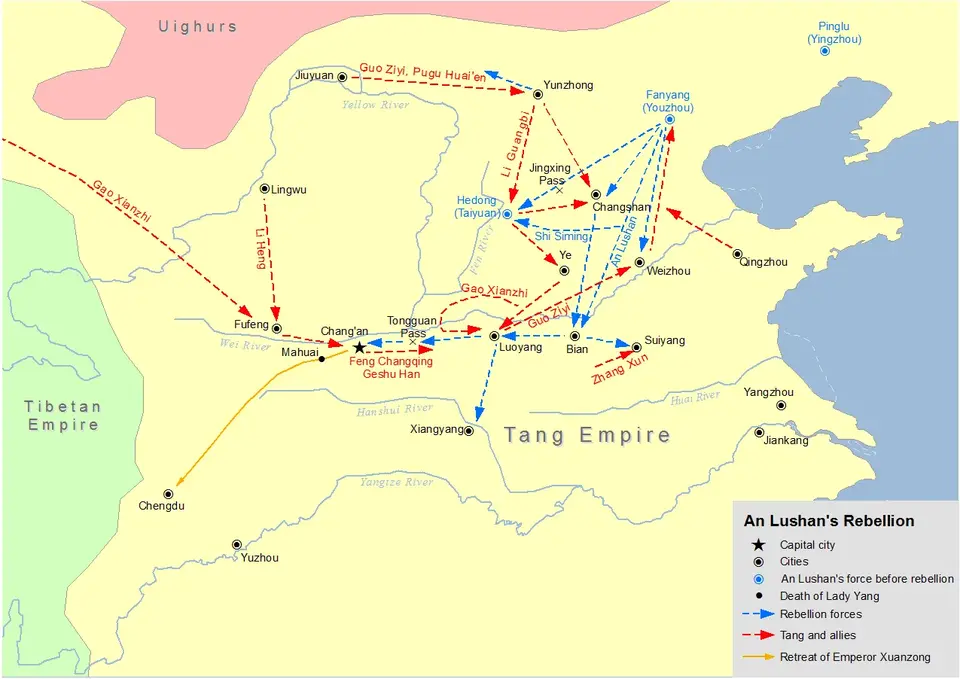
With imperial reserves depleted by peace, the emperor appointed Gao Xianzhi as Vice Marshal to assist Prince Li Wan, hastily recruiting dozens of thousands of urban conscripts in Chang'an. Following General Feng Changqing's defeat at Luoyang and the fall of the eastern capital, Feng retreated to Shanzhou to join Gao's forces. Recognizing that raw recruits could not withstand elite rebel cavalry in open plains, Gao adopted Feng's counsel, abandoning the indefensible position at Shanzhou to establish a defensive perimeter at the fortified pass of Tongguan.
At Tongguan, Gao utilized the terrain along the Yellow River and Qinling mountains to build earthen ramparts, dig deep ditches, and restore troop discipline. When rebel commander Cui Qianyou launched repeated assaults, Gao directed concentrated archery volleys from the ramparts, repelling enemy charges and halting the rebel advance for months, stabilizing the approaches to Chang'an.
However, Gao's refusal to accommodate eunuch supervisor Bian Lingcheng's demands for military bribes provoked bitter hostility. Bian slipped back to Chang'an, falsely telling Emperor Xuanzong that Feng Changqing had undermined morale while Gao Xianzhi had embezzled rations and surrendered strategic territory. Panicked by the crisis, the emperor accepted these slanders, dispatching Bian to Tongguan with orders to execute both commanders.
In January 756, Bian read the imperial decree in the Tongguan camp. Facing his troops, Gao declared: "If I retreated before the enemy, death is my due; but if I embezzled rations or betrayed my men, Heaven bear witness that I die wrongfully!" Tens of thousands of soldiers wept aloud, protesting his innocence. Ignoring their pleas, Bian had Gao Xianzhi decapitated. Gao's execution shattered morale at Tongguan. His successor, the ailing general Geshu Han, was subsequently compelled by court orders to abandon the fortifications, leading to the destruction of the imperial army, the fall of Tongguan and Chang'an, and Emperor Xuanzong's flight to Sichuan.
Gao Xianzhi's campaign across the Pamir Plateau remains a celebrated feat in ancient mountain warfare. Lesser Bolor was situated in a rugged pocket of the Karakoram and Hindu Kush ranges, surrounded by glaciated peaks exceeding four thousand meters, regarded as impassable for large armies.
Leading ten thousand infantry and cavalry, Gao executed a synchronized advance through high-altitude passes. Overcoming frostbite, altitude sickness, and treacherous precipices, he captured Lianyun Fort and traversed Mount Tanjula, taking the Tibetan-allied capital by surprise. Military historians have compared this operation to Hannibal's and Napoleon's crossings of the Alps, noting that it neutralized Tibetan influence south of the Congling range and secured Tang prestige across the Tarim Basin.
As Protector-General of Anxi and Military Commissioner of the Four Garrisons, Gao Xianzhi played a central role in maintaining the security of oasis city-states and safeguarding trans-Eurasian trade routes.
Following his victories in Lesser Bolor and Qieshi, Gao established beacon stations, fortified outposts, and agricultural colonies across the Pamir corridors and the Tarim Basin. He protected merchant caravans traveling between Chang'an, Samarkand, Baghdad, and Constantinople, ensuring that thirty-six oasis states retained tributary ties with the Tang. For over a decade, his garrisons facilitated the transmission of Chinese silk, paper, coinage, and laws westward, supporting the commercial prosperity of the overland Silk Road.
The Battle of Talas in 751 was the sole major military engagement between the Tang dynasty and the Abbasid Caliphate, resulting in significant historical reverberations for Eurasian cultural exchange.
Marching two thousand li into Central Asia, Gao engaged Abbasid forces for five days, demonstrating the defensive discipline of Tang crossbow formations. Although the defection of mercenary auxiliaries led to tactical defeat, the heavy losses suffered by Abbasid forces dissuaded them from further eastward expansion, maintaining geopolitical equilibrium between Central Asia and the Chinese borderlands. Furthermore, Tang prisoners captured at Talas included specialized artisans who introduced Chinese papermaking technology to Samarkand and Baghdad, whence it spread across the Islamic world and into Europe, accelerating literacy and the transmission of knowledge in the pre-modern era.
During the opening stages of the An Lushan Rebellion, Gao Xianzhi demonstrated strategic foresight. Following the collapse of imperial defenses in the east, he resisted pressures for an immediate counter-offensive, choosing to establish fortified positions at Tongguan.
His defensive strategy utilized the mountain narrows to halt rebel cavalry, securing the capital and providing time for regional loyalist armies to mobilize. However, his integrity antagonized the supervising eunuch Bian Lingcheng, leading to his execution on fabricated charges. His death demoralized the frontier garrisons and led directly to the disastrous sortie under Geshu Han, the loss of Tongguan, and the sack of Chang'an, remembered as a tragic consequence of court intrigue during the Tang dynasty's descent from its golden age.
FIGURES ASSOCIATED WITH THIS DYNASTY