Birth in Dongping
Born into a scholarly family in Xucheng, Dongping, studying classical history and northern music.
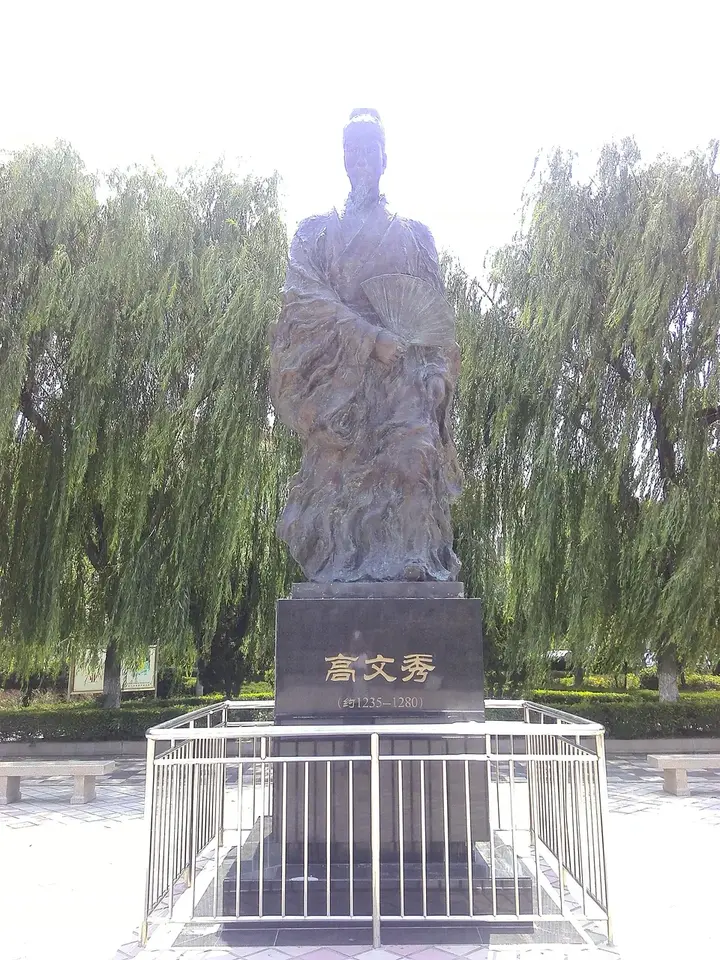
高文秀
Gao Wenxiu (高文秀) was a celebrated playwright and dramatic titan of the early Yuan Dynasty, hailing from Xucheng in Dongping Route (modern Shandong Province). During the Jin-Yuan transition, Dongping flourished as an enlightened center of Chinese classical education and popular theatre under the patronage of the Yan family. Gao studied at the Dongping Prefectural Academy, acquiring a deep familiarity with both classical…
Gao Wenxiu (高文秀) was a celebrated playwright and dramatic titan of the early Yuan Dynasty, hailing from Xucheng in Dongping Route (modern Shandong Province). During the Jin-Yuan transition, Dongping flourished as an enlightened center of Chinese classical education and popular theatre under the patronage of the Yan family. Gao studied at the Dongping Prefectural Academy, acquiring a deep familiarity with both classical history and urban performance arts. Moving between Dongping and the capital Dadu, he devoted his career to theatrical composition. Renowned for his extraordinary creative agility, prolific output, and colloquial vitality, his dramatic style mirrored that of founding master Guan Hanqing, earning him the prestigious contemporary title "Little Hanqing" (Xiao Hanqing). Gao was an exceptionally prolific writer; Zhong Sicheng's Register of Ghosts (Lu Gui Bu) recorded thirty-four zaju plays by his hand, a total surpassed in the Yuan Dynasty only by Guan Hanqing. Tragically, Gao died young at around forty years of age. In Chinese dramatic history, Gao was the foremost creator of "Water Margin plays" (Shuihu xi), especially his celebrated cycle of eight plays focusing on the heroic outlaw "Black Whirlwind" Li Kui. His extant masterpiece Black Whirlwind's Double Triumphs (Heixuanfeng Shuang Xian Gong), alongside Kang Jinzhi's Li Kui Carries Thorns, stands as the crowning achievement of early Water Margin theatre. In Taihe Zhengyin Pu, Prince Zhu Quan praised his poetic lyrics as resembling "peonies in a golden vase," celebrating him as a premier exemplar of the naturalistic school of northern zaju.
Born into a scholarly family in Xucheng, Dongping, studying classical history and northern music.
Enrolled in the Dongping Prefectural Academy, immersing himself in regional theatrical arts.
Traveled between Dongping and Dadu, composing plays on outlaw chivalry and historical events.
Authored over thirty variety plays; Dadu audiences and peers universally hailed him as "Little Hanqing."
Composed Black Whirlwind's Double Triumphs and Meeting at Mianchi, achieving lasting stage popularity.
Passed away in his native region at around age forty, deeply mourned by scholars and actors alike.
Recorded by Zhong Sicheng in the Register of Ghosts among venerable early masters.
Gao Wenxiu was born in early Yuan Xucheng, Dongping. During the chaotic dynastic transition, Dongping was governed by regional warlords Yan Shi and his son, who prioritized Confucian education and granted asylum to displaced scholars. This stable cultural environment made Dongping one of the most vibrant literary and theatrical capitals in northern China.
Gao entered the Dongping Prefectural Academy as a licensed scholar. Blessed with extraordinary wit, he mastered the classics while developing a passion for Jin farces, northern balladry, and folklore. Recognizing that northern zaju drama was entering its golden age, Gao chose to channel his full talents into playwriting. He spent years in urban theater districts, associating with actors and storytellers, gaining an acute understanding of stagecraft, dialogue rhythm, and the emotional pulse of ordinary citizens.
Following his early success, Gao moved to the imperial capital Dadu, the vibrant heart of Yuan theatre where masters like Guan Hanqing, Bai Pu, and Ma Zhiyuan congregated. Gao's inspiration flowed effortlessly, producing plays with astonishing speed and quality that captivated theatergoers across the capital.
Gao's plays featured tightly woven plots, sparkling colloquial dialogue, and lively northern idioms, free from scholarly pretension and full of grassroots vitality. His style bore an uncanny resemblance to Guan Hanqing's works, showcasing sharp characterization and bold humor. Acknowledging his towering genius, capital critics and fellow dramatists affectionately dubbed him "Little Hanqing" (implying that his theatrical brilliance rivaled that of Guan Hanqing himself), securing his place in the front ranks of early Yuan dramatists.
Gao's creative energy was boundless; in roughly two decades, he composed over thirty variety plays. The Register of Ghosts documented thirty-four distinct plays, a prolific volume second only to Guan Hanqing. His works played to packed houses in northern cities and spread along trade routes into southern commercial hubs.
Yet his brilliant career was cut short by sudden illness. Gao passed away in the late Zhiyuan era at around age forty. When dramatic theorist Zhong Sicheng compiled the Register of Ghosts, he placed Gao among the venerable early masters, expressing profound lamentation for his premature death.
Gao Wenxiu's most celebrated contribution to Chinese literature was his pioneering leadership in Water Margin theatre. Among the heroic outlaws of Mount Liang, Gao was particularly fond of depicting the reckless, fiercely loyal, and comedic "Black Whirlwind" Li Kui.
He composed eight plays centered on Li Kui, creating a specialized dramatic sub-genre. His masterpiece Black Whirlwind's Double Triumphs (Heixuanfeng Shuang Xian Gong) has survived intact. In the play, Li Kui disguises himself as an innocent rustic farmer, outsmarting corrupt officials and defeating oppressive bullies during an imperial pilgrimage. Blending heroic defiance with slapstick humor, the play formed the definitive stage prototype of Li Kui, directly inspiring Shi Nai'an's later classic novel The Water Margin.
In addition to outlaw drama, Gao excelled in adapting Warring States and Han dynasty historical legends to celebrate chivalric heroism. His extant complete historical plays include Meeting at Mianchi (Mianchi Hui) and Xu Jia Berates Fan Ju (Cui Fan Ju).
In Meeting at Mianchi, drawing upon Sima Qian's Records of the Grand Historian, he vividly dramatized the courage and diplomatic genius of Lin Xiangru during his tense confrontation with the King of Qin. In Cui Fan Ju, he traced Fan Ju's journey from betrayal and humiliation to triumphant vindication. Ming critic Meng Chengshun praised the play, writing that "its poignant emotions and fierce dignity spring straight from the heart of a true man."
In dramatic poetics, Gao Wenxiu was a foremost master of the "naturalistic school" (bense pai) of northern variety opera. In Taihe Zhengyin Pu, Prince Zhu Quan acclaimed his lyrics as resembling "peonies in a golden vase."
This poetic praise highlighted Gao's ability to balance rich emotional grandeur with unadorned vernacular naturalness. Gao expertly utilized northern street idioms, parallel phrasing, and dynamic musical rhythms, enabling audiences to experience authentic urban human vitality, thereby permanently enriching the expressive vocabulary of Chinese opera.
FIGURES ASSOCIATED WITH THIS DYNASTY