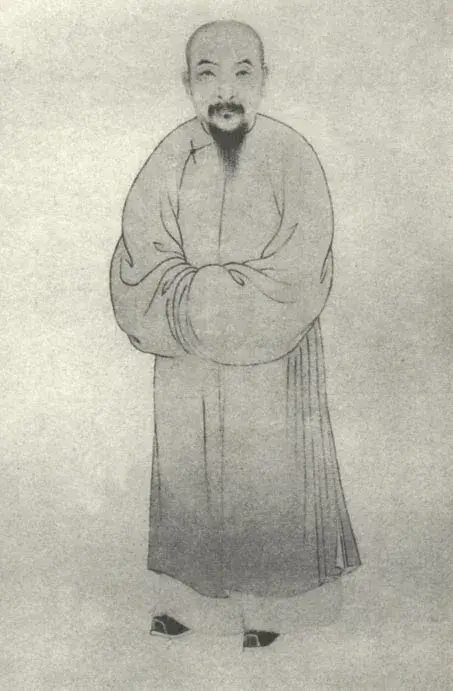
Biography
Impoverished Youth and Scrivenery at Zhantan Temple
Gao Shiqi was born in 1645 at Shirenshan, Yuyao County, Shaoxing Prefecture, Zhejiang Province (modern Cixi, Ningbo). While his remote ancestors were distinguished scholars in eastern Zhejiang, his household suffered acute destitution by his father's generation. Endowed with extraordinary memory and artistic sensitivity, Gao excelled in classical calligraphy, mastering Jin and Tang models with architectural balance and rhythmic grace.
During the early Kangxi reign, seeking escape from crushing poverty, young Gao traveled north to Beijing. Arriving penniless and without patrons, he resided in the western corridor of Zhantan Temple outside Xuanwumen, setting up an open-air desk to sell calligraphy and copy legal petitions for travelers. Despite his hardship, Gao studied canonical histories day and night, gradually attracting the attention of metropolitan grandees through his refined bearing and exquisite script.
Grand Secretary Songgotu noticed Gao's elegant manuscript submissions, recognizing his statecraft intellect. Songgotu hired Gao as his private secretariat advisor. In this grand residence, Gao gained access to rare four-branch classics, deepening his philological mastery and acquiring firsthand understanding of Qing court politics, creating the foundation for his spectacular career advancement.
Imperial Examinations and Inauguration of the South Study
In 1671, seeking to reform inner-court documentation, the Kangxi Emperor commanded the Hanlin Academy to administer open examinations to recruit skilled scriveners and essayists. Gao took the examinations, composing fluent policy treatises in superb calligraphy. Personally reviewing the examinations, Emperor Kangxi was delighted, issuing an unprecedented decree appointing the commoner scholar as Clerk in the Supervisorate of Imperial Instruction, followed by promotion to Secretary in the Grand Secretariat.
Serving in the imperial presence, Gao displayed exceptional diligence. Whenever Emperor Kangxi inquired into historical precedents, Gao cited volume and chapter instantly; whenever confidential rescripts were required, Gao drafted them within moments, aligning perfectly with imperial intentions. In November 1677, Emperor Kangxi established the South Study as his confidential advisory organ, choosing Gao Shiqi and Zhang Ying as its inaugural attendants to discuss classical exegesis and draft strategic edicts.
During his decade in the South Study, Gao exercised immense confidential influence. As urgent dispatches arrived during the suppression of the Three Feudatories Rebellion, Gao drafted strategic counter-offensive orders late into the night. Later, during the recovery of Taiwan and the Yaksa campaigns against Tsarist Russian encroachment, Gao participated in confidential inner-court councils, earning Emperor Kangxi's absolute trust.
Imperial Entourage and Apex of Court Favor
During the mid-Kangxi reign, with the empire pacified, Emperor Kangxi embarked on extensive inspection tours across the realm. Gao, possessing sparkling poetic talent and encyclopedic knowledge, became an indispensable member of the imperial entourage during steppe hunts and regional inspections.
In 1682, when Emperor Kangxi traveled to Shengjing to perform ancestral rites, Gao accompanied the monarch beyond the Great Wall. Recording terrain, steppe hunts, and tribal diplomacy, he produced the classic travelogue Eastern Tour Diary. In 1684 and 1689, Gao accompanied Emperor Kangxi on southern inspection tours through Jiangnan. The emperor visited Gao's private villa in Pinghu, inscribing a hall plaque reading 'Songxue Studio' and bestowing antique inkstones and royal banquets upon his favorite courtier.
During this period, Gao advanced to Reader-in-Waiting of the Hanlin Academy, Junior Supervisor of Instruction, and Vice Minister of Rites. However, his proximity to the throne gave him tremendous informal leverage over bureaucratic appointments. Provincial governors and metropolitan ministers courted his patronage, creating extensive factional networks that inevitably attracted political retribution from rivals.
Impeachment by Guo Xiu and Connoisseurship in Retirement
In 1689, fierce factional conflict erupted between northern and southern bureaucratic cliques headed by Mingzhu and Xu Qianxue. Gao, connected to various factions and wielding inner-court influence, became a prime target for reformist censors.
In the winter of that year, Censor Guo Xiu submitted his famous impeachment memorial, accusing Grand Secretary Jin Fu while fiercely denouncing Gao Shiqi and Wang Hongxu for abusing imperial trust, amassing illicit fortunes, and building private cliques. To restore institutional equilibrium and quell public debate, Emperor Kangxi permitted Gao to resign and retire to his native home.
Gao embraced retirement with philosophical composure. Returning to Pinghu, Zhejiang, he constructed Jiangcun Cottage, adopting the art name Jiangcun Laoren. During years of pastoral leisure, he dedicated himself to editing classical histories and appraising ancient calligraphy and paintings. In the summer of 1693, he collated and evaluated over two hundred masterpieces in his possession, authoring his monumental connoisseurship catalog Jiangcun Xiaoxia Lu, establishing an enduring milestone in Chinese art history.
Imperial Recall and Posthumous Honors
Emperor Kangxi deeply missed Gao's erudition and intimate companionship. In the spring of 1694, the emperor issued an imperial decree: 'Command Gao Shiqi to return to the capital to resume duties in the South Study with his former titles.'
Returning to court, Gao conducted himself with circumspect humility, turning away political supplicants to focus entirely on accompanying Emperor Kangxi in reviewing historical treatises. The emperor treated him with warmth, granting him a residence within the Forbidden City and inviting him on autumn hunts to Mulan, prompting Gao's travelogue Songting Journey. In 1701, Emperor Kangxi permitted Gao to return to Jiangcun to recuperate from illness, showering him with imperial poems and gifts.
In the summer of 1703, Gao fell critically ill in Pinghu. Emperor Kangxi dispatched imperial physicians with royal medicines. On August 12, 1703, Gao passed away peacefully at age fifty-nine. Deeply grieving, the emperor granted state burial funds, promoted him posthumously to Vice Minister of Rites, and conferred the posthumous name Wenke (meaning 'Civil and Reverent'), writing an imperial eulogy praising his lifelong loyalty and scholarly grace.
Major Achievements
The Monument of Chinese Art Connoisseurship: Jiangcun Xiaoxia Lu
Gao Shiqi's most enduring contribution to Chinese cultural history was the authoring of Jiangcun Xiaoxia Lu (Jiangcun Records of Spending the Summer) in three volumes. Completed in 1693, the work provides exhaustive evidential appraisals of over two hundred masterpieces of calligraphy and painting from the Jin, Tang, Song, Yuan, and Ming dynasties.
The catalog established a revolutionary standard in Chinese connoisseurship. Moving beyond impressionistic literary critiques, Gao recorded material dimensions, paper and silk textures, line numbers, colophons, seals, and physical condition. His meticulous documentation of Wang Xizhi's Cao E Stele, Li Sixun's River Sail and Palaces, and Fan Kuan's Travelers among Mountains and Streams remains an indispensable reference for museums worldwide in determining the provenance and authenticity of Chinese art.
Structural Historical Innovation: Zuo Zhuan by Events
In historiography, Gao produced the monumental fifty-three-volume Zuo Zhuan Arranged Chronologically by Events (Zuo Zhuan Jishi Benmo), recognized as a classic of the event-chronicle historiographical genre.
Because the original Zuo Zhuan followed an annual Lu state chronicle, major historical trajectories were fragmented across disparate years. Gao synthesized two hundred and fifty-five years of Spring and Autumn history into eighty-seven thematic chapters, tracing diplomatic maneuvers, interstate alliances, and military clashes from inception to conclusion. Ji Yun affirmed in Annotated Catalog of the Siku Quanshu that Gao's work was 'clear, methodical, and profoundly evidential, far surpassing all previous commentaries.'
Exemplar of Imperial Confidants and Court Chronicles
Gao was the foundational courtier who established the operational ethos of the early Qing South Study. Serving as Emperor Kangxi's closest intellectual advisor for three decades, he assisted the monarch in asserting imperial control over conservative Manchu nobles, accelerating the Confucian sinicization of the Qing administrative state.
His memoirs, including Jin'ao Notes, Eastern Tour Diary, and Western Tour Diary, avoided sycophantic convention, recording palace protocols, architectural designs of the Forbidden City and Western Gardens, banner troop maneuvers, and imperial daily life with documentary rigor. These memoirs preserve crucial eyewitness details missing from official dynastic records, serving as indispensable primary sources for historians of the High Qing era.