Birth
Born into the esteemed Bohai Gao lineage as the third son of Gao Yi.
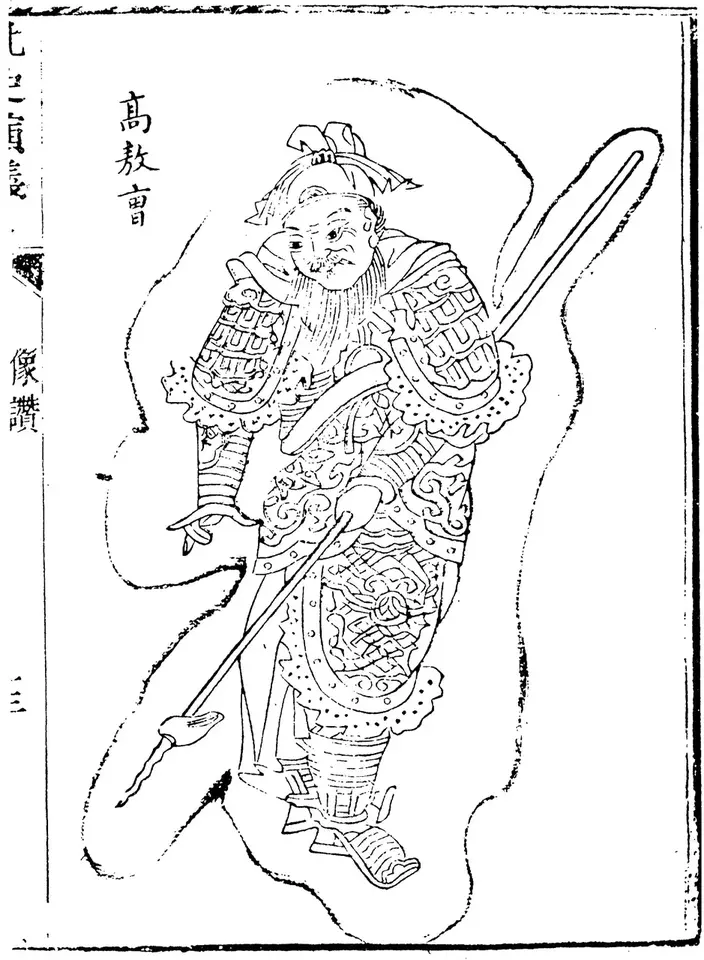
高敖曹
Gao Aocao (高敖曹, 501–538), personal name Gao Ang (高昂), courtesy name Aocao (敖曹), widely known by his courtesy name, was a native of Tiao County in Bohai (modern Jing County, Hebei Province). He was the premier martial champion of the Eastern Wei dynasty and the supreme warrior in the service of Gao Huan (Emperor Shenwu). Hailing from the prominent Bohai Gao clan, Gao Aocao possessed titanic physical strength and…
Gao Aocao (高敖曹, 501–538), personal name Gao Ang (高昂), courtesy name Aocao (敖曹), widely known by his courtesy name, was a native of Tiao County in Bohai (modern Jing County, Hebei Province). He was the premier martial champion of the Eastern Wei dynasty and the supreme warrior in the service of Gao Huan (Emperor Shenwu). Hailing from the prominent Bohai Gao clan, Gao Aocao possessed titanic physical strength and extraordinary mastery of the heavy cavalry lance. In 528, following the Heyin Massacre perpetrated by Erzhu Rong, Gao Aocao and his elder brother Gao Qian raised an army in Hebei to champion justice. In 531, they welcomed Gao Huan at Xindu. Recognizing the anti-Han prejudice of nomadic troops, Gao Huan authorized Gao Aocao to organize an exclusive shock force of Han Chinese veterans, designated the "Han Army". At the decisive Battle of Hanling in 532, Gao Aocao spearheaded the assault that crushed the two-hundred-thousand-strong host of the Erzhu clan, earning him the title Duke of Jingzhao. Following the division of the realm into Eastern and Western Wei in 534, he was appointed Minister of Education. In 537, during the disaster at Shayuan, Gao Aocao's southern division captured Shangluo and returned intact with twenty thousand captives. However, in 538 at the Battle of Mangshan, he advanced rashly, was surrounded by Western Wei heavy cavalry, and died heroically on the banks of the Yellow River at the age of thirty-eight. Gao Huan mourned him as his own right arm, posthumously creating him Prince of Yongchang with the title "Zhongwu".
Born into the esteemed Bohai Gao lineage as the third son of Gao Yi.
Raised an army alongside his brother Gao Qian in response to the Heyin Massacre.
Slandered by Erzhu factions and jailed; released by Emperor Xiaozhuang to assist in slaying Erzhu Rong.
Welcomed Gao Huan at Xindu, forming the legendary elite all-Han cavalry force.
Led the decisive flank charge with three thousand Han horsemen, routing the grand host of the Erzhu warlords.
Elevated to Palace Attendant, Commander-in-Chief of the Southwest, and Duke of Jingzhao upon Eastern Wei's founding.
Successfully stormed Shangluo on the southern flank during the Shayuan campaign, capturing twenty thousand enemy personnel.
Led the vanguard across the Yellow River toward Mangshan, flying imperial standards in defiant bravado.
Surrounded by Yuwen Tai's heavy cavalry at Mangshan; fought to the last breath before dying at age thirty-eight.
Gao Aocao was born into the aristocratic Bohai Gao clan, his father Gao Yi having served as Governor of Eastern Ji Prefecture. As a youth, Gao Aocao displayed fierce independence and contempt for dry scholastic studies. When his father urged him to read classical histories, he replied: "A real man must gallop across the world with an eighteen-foot lance to seize wealth and glory; why should I waste my life staring at yellow scrolls!" He grew into a giant of a man, capable of wielding heavy cavalry spears with matchless dexterity.
His eldest brother Gao Qian gathered chivalric youths from across the region, and Gao Aocao joined him in leading several thousand armed retainers. In 528, warlord Erzhu Rong executed thousands of court aristocrats at Heyin. Outraged by the slaughter of their peers, Gao Qian and Gao Aocao raised an army in Hebei, seizing regional commanderies. When Emperor Xiaozhuang ascended the throne, he issued a general pardon, appointing Gao Aocao as Cavalier Attendant-in-Ordinary and Count of Wucheng.
In 529, when Chen Qingzhi captured Luoyang, Erzhu Rong returned to control the capital and, fearing Gao Aocao's immense regional popularity among Han gentry, had him imprisoned in the camel pens. In 530, Emperor Xiaozhuang secretly plotted to assassinate Erzhu Rong. On the eve of the coup, the emperor issued a secret decree releasing Gao Aocao. Gao rushed into the palace with drawn sword, slaying dozens of Erzhu guards to protect the sovereign.
Following the murder of Emperor Xiaozhuang by Erzhu Zhao in Jinyang, Gao Aocao and Gao Qian retreated to Bohai. In 531, Gao Huan advanced from Jinzhou to Xindu to oppose the Erzhu tyranny. Gao Aocao led thousands of battle-tested Hebei warriors to welcome Gao Huan, pledging allegiance to the righteous cause.
At that time, northern nomadic commanders routinely looked down upon Han Chinese soldiers. Gao Huan wisely entrusted Gao Aocao with organizing an elite, all-Han fighting force. Gao Aocao enforced unbending discipline, forbade plundering, and trained his men rigorously in shock cavalry tactics, turning them into the most feared assault division in the empire.
In 532, Gao Huan met the combined forces of Erzhu Zhao, Erzhu Shilong, and Erzhu Zhongyuan—numbering two hundred thousand cavalry—at Hanling Mountain. When Gao Huan's center was compressed by Erzhu Zhao's ferocious charges, Gao Aocao led three thousand heavy cavalry from the left wing, slicing directly through the enemy lines. Gao Aocao's lance proved irresistible, impaling dozens of enemy captains and cleaving the Erzhu formation in two. Gao Huan's main army capitalized on the confusion, crushing the Erzhu coalition completely. Grasping Gao Aocao's hand after the victory, Gao Huan proclaimed: "That we hold the realm today is entirely the fruit of Aocao's divine valor!"
Following the division between Eastern and Western Wei in 534, Gao Huan established Emperor Xiaojing at Yecheng. Gao Aocao was appointed Commander-in-Chief of the Southwest Circuit and elevated to Minister of Education.
In 537, Gao Huan's grand army suffered a catastrophic ambush against Western Wei forces under Yuwen Tai at the Battle of Shayuan. Yet on the southern front, Gao Aocao conducted a masterclass in independent command. Leading a separate detachment into the mountains of Shangluo, he captured over ten Western Wei fortified citadels, took enemy generals Du Zuan and Wang Yuangui alive, and returned to Yecheng with over twenty thousand prisoners without losing a single company.
Gao Aocao was famously fearless, openly scorning arrogant Xianbei aristocrats who mocked Han culture. When Censor-in-Chief Liu Gui sent an arrogant messenger to summon Governor Zheng Yanzu while Gao Aocao was playing board games with him, Gao had the messenger flogged and cursed Liu Gui, defying the power of court sycophants.
In the summer of 538, Eastern and Western Wei clashed in the colossal Battle of River Bridge and Mangshan along the Yellow River. Gao Aocao commanded the Eastern Wei vanguard across the river. Supreme in his self-confidence, he erected towering banners and ornate feather-crested flags over his command post, disdainful of concealment.
Western Wei supreme commander Yuwen Tai spotted his standards and recognized that eliminating Gao Aocao would break the spine of the Eastern Wei vanguard. He deployed several thousand heavy cavalry under commanders Li Bi and Da Xi Wu to encircle Gao's position under cover of morning fog.
Trapped without reinforcements from the disordered Eastern Wei center, Gao Aocao fought with superhuman fury. He slew dozens of enemy horsemen with his lance until his weapon shattered and his warhorse was killed. Fighting on foot with his sword, he retreated toward the floating bridge at River Bridge, only to discover that the pontoons had been severed. When he reached the gates of the southern fort, garrison commander Gao Ao refused to open the doors due to past personal grudges.
Surrounded by hundreds of enemy cavalry, Gao Aocao looked upon his pursuers, laughed loudly, and shouted: "Come forward! Take my head and claim your grant of a founding duke!" He then bared his neck and died with unyielding pride at the age of thirty-eight. When news reached Gao Huan, he wept bitterly, conferring upon him the posthumous title Prince of Yongchang and the posthumous name "Zhongwu".
His cavalry charge at Hanling Mountain in 532 remains one of the most celebrated tactical breakthroughs in medieval Chinese warfare. Leading three thousand Han shock troops against the famed cavalry of the Erzhu coalition, his audacity smashed the nomadic hegemony and enabled Gao Huan to establish the foundations of Eastern Wei.
During the disastrous Shayuan campaign of 537, Gao Aocao demonstrated that he was far more than a mere brawler. His independent capture of Shangluo and safe extraction of his army illustrated operational maturity, safeguarding the southern geopolitical flank of Eastern Wei.
FIGURES ASSOCIATED WITH THIS DYNASTY