Insurrection in Shu
Rose in armed revolt against Liu Zhang; after defeat, led eight hundred retainers into Jing Province.
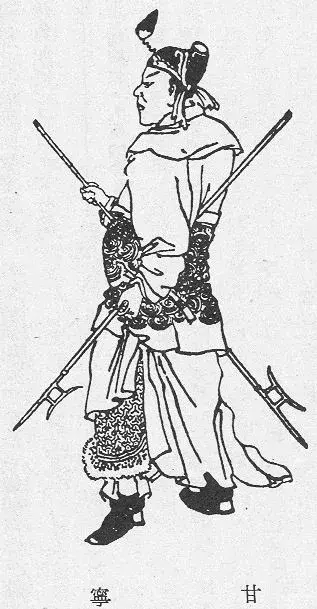
175 CE–220 CE
甘宁
Gan Ning (甘宁, ?–220 AD), courtesy name Xingba, was a native of Linjiang in Ba Commandery and one of the most celebrated military commanders of Eastern Wu during the Three Kingdoms Period. In his youth, he led bands of adventurous young outlaws adorned with bells and feathers who plied the Yangtze on boats tied with brocade ribbons, earning him the moniker "Brocade-Sailed Pirate." Turning to classical scholarship in early…
Gan Ning (甘宁, ?–220 AD), courtesy name Xingba, was a native of Linjiang in Ba Commandery and one of the most celebrated military commanders of Eastern Wu during the Three Kingdoms Period. In his youth, he led bands of adventurous young outlaws adorned with bells and feathers who plied the Yangtze on boats tied with brocade ribbons, earning him the moniker "Brocade-Sailed Pirate." Turning to classical scholarship in early adulthood, he entered local service as Assistant of Shu Commandery, but fled eastward to Jing Province after participating in an unsuccessful regional insurrection against Liu Zhang. Finding Liu Biao lacking strategic vision and Huang Zu unappreciative of his martial talents, Gan Ning defected to Sun Quan with the assistance of his friend Su Fei. Welcomed by Sun Quan on the enthusiastic recommendation of Zhou Yu and Lu Meng, Gan Ning presented a visionary grand strategy: eliminate Huang Zu, conquer Jing Province, advance west to absorb Ba-Shu, and confront Cao Cao for dominance of all China. During the campaign against Huang Zu in 208 AD, Gan Ning struck down the enemy vanguard Deng Long. In the aftermath of Red Cliffs, he seized Yiling with a few hundred men and held the isolated fortress with unshakable composure against thousands of besieging Wei troops. During the Battle of Ruxu in 213 AD, Gan Ning executed his legendary night raid on Cao Cao's sprawling encampment with merely one hundred elite cavalrymen, inflicting heavy casualties and returning without losing a single man, which prompted Sun Quan to declare that Gan Ning was the equal of Zhang Liao. In 214 AD, he scaled the walls of Wan City first under heavy missile fire, capturing Wei administrator Zhu Guang, and in 215 AD, he deterred Guan Yu from crossing the stream at Yiyang. Renowned for his fearless valor, generous treatment of his soldiers, and reconciliation with his former enemy Ling Tong, Gan Ning was celebrated as one of the quintessential "Tiger Generals of Jiangdong."
Rose in armed revolt against Liu Zhang; after defeat, led eight hundred retainers into Jing Province.
Garrisoned Jiangxia under Huang Zu, shooting and killing Wu vanguard general Ling Cao during a rear-guard action.
Escaped Huang Zu's neglected service with Su Fei's aid, presenting the strategic plan for taking Jiangxia to Sun Quan.
Fought in Sun Quan's third offensive against Jiangxia, slaying Deng Long and saving Su Fei's life from execution.
Fought alongside Zhou Yu and Cheng Pu in the fire attack against Cao Cao's armada at Red Cliffs.
Captured Yiling with a small force, holding out laughing and eating amidst heavy enemy arrows until relieved.
Led one hundred elite horsemen on a daring nighttime assault into Cao Cao's grand encampment without suffering a single casualty.
Served as assault commander against Wan City, climbing the ramparts first with iron ropes to capture Zhu Guang.
Deployed one thousand warriors along the upper rapids, deterring Guan Yu from crossing by night.
Fought fiercely with bow and blade against Zhang Liao's sudden charge, escorting Sun Quan across the broken bridge.
Died of illness in camp; mourned bitterly by Sun Quan and posthumously honored as Marquis of Qiting.
Gan Ning was born in Linjiang County of Ba Commandery, possessing formidable physical strength and a passionate, unruly temperament from early youth. In his formative years, he disdained ordinary labor, gathering together a band of daring young men under his leadership. Adorning their headgear with colorful feathers and wearing brass bells at their waists, they roamed highways and waterways. Whenever villagers heard the ringing bells, they knew Gan Ning and his followers had arrived. On land, Gan Ning rode with grand cavalcades of carriages and horses; on water, he led fleets of sleek river galleys rowed by attendants wearing fine embroidered silks.
When mooring their vessels, they used lavish strips of patterned brocade as docking cables; upon departure, they cut the ribbons and left them adrift in the current to display their ostentatious defiance of conventional thrift. Consequently, regional boatmen and merchants dubbed him the "Brocade-Sailed Pirate." Toward local magistrates who treated him with lavish hospitality, Gan Ning was warm and protective; toward officials who snubbed him, he unhesitatingly unleashed his followers to plunder their goods and strike them down.
Upon reaching his twenties, Gan Ning underwent a profound transformation. Regretting his outlaw past, he disbanded his band, took up classical scholarship, and immersed himself in ancient philosophical and historical texts. Entering administrative service, he was appointed Assistant of Shu Commandery. In 194 AD, following the death of regional governor Liu Yan, his weak and suspicious son Liu Zhang took control of Yi Province. Secretly encouraged by Liu Biao of Jing Province, Gan Ning joined local officials including Shen Mi and Lou Fa in launching an armed revolt. The insurrection was suppressed by government forces, compelling Gan Ning to lead eight hundred personal retainers through the Yangtze Gorges into Jing Province to seek sanctuary under Liu Biao.
Arriving in the central Yangtze, Gan Ning quickly discovered that Liu Biao was a pedantic scholar lacking military insight and political determination. Observing that regional warlords were carving out independent realms across the realm, Gan Ning concluded that Liu Biao's passive administration would inevitably collapse and bring disaster to his subordinates. He sought to march east to join the Sun family in Jiangdong, but transit corridors were blocked, forcing him to halt in Jiangxia Commandery and place his men under the command of regional administrator Huang Zu.
Gan Ning remained in Jiangxia under Huang Zu for three full years. Huang Zu was an arrogant aristocrat of an entrenched local clan who regarded Gan Ning as a coarse river bandit, denying him meaningful command or tactical responsibility. In 203 AD, Sun Quan led a powerful amphibious army west to assault Jiangxia. Huang Zu's naval fleet was routed, and the warlord fled in panic. Wu vanguard general Ling Cao pursued aggressively, pressing close behind the retreating vessels.
At this critical moment, Gan Ning volunteered to cover the retreat. Concealed along the gunwales of his galley, he drew his composite bow and loosed a single deadly arrow directly through Ling Cao's throat, killing the pursuing commander instantly. Shocked by the loss of their vanguard general, the Eastern Wu fleet suspended operations and withdrew. Through his solitary marksmanship, Gan Ning had saved Huang Zu's life and preserved Jiangxia from immediate destruction.
Yet despite this lifesaving feat, Huang Zu failed to reward Gan Ning, remaining deeply suspicious of his martial vigor and attempting to entice away his veteran troops. Area Commander Su Fei, who recognized Gan Ning's genius, repeatedly petitioned Huang Zu to promote him, but Huang Zu obstinately refused. Su Fei hosted a private banquet for Gan Ning, candidly advising him: "Brother, your extraordinary deeds have gone unrewarded. A heroic warrior must choose an enlightened master to fulfill his destiny. I will arrange for your transfer to govern Zhu County, whence you may find a way to cross into Jiangdong."
Profoundly moved by Su Fei's loyalty, Gan Ning accepted the post at Zhu County. Gathering his eight hundred veteran soldiers, and aided by Su Fei's quiet cooperation, he slipped past frontier pickets by night and crossed the river to Chai Sang to submit to Sun Quan. Eastern Wu Grand Commander Zhou Yu and senior general Lu Meng received him with immense delight, presenting him to Sun Quan as a peerless warrior capable of conquering vast realms.
Sun Quan granted Gan Ning an audience with exceptional honors, asking his views on grand strategy. Gan Ning delivered a famous strategic assessment: "The Han dynasty is on the brink of ruin, and Cao Cao will inevitably usurp supreme authority. Liu Biao lacks long-term vision, and his heirs are incapable. Huang Zu is aged and incompetent, his troops are rebellious, and his arms are decayed. Your Lordship must strike first to destroy Huang Zu, seize Jiangxia, and push west to conquer Jing Province. Thereafter, you may march up the gorges to conquer Ba-Shu, securing the entire Yangtze River to confront the north. This is the true foundation of imperial grandeur!" Thrilled by this sweeping vision, Sun Quan resolved to invade Jiangxia at once.
In the spring of 208 AD, Sun Quan launched his third campaign against Jiangxia. Huang Zu chained two massive, rawhide-armored assault ships across the mouth of the Mian River, mounting thousands of heavy crossbows that poured deadly fire on the approaching fleet. Gan Ning led commandos in swift skiffs through the barrage, severed the heavy iron mooring cables with broadswords, and boarded the flagships, decapitating Huang Zu's vanguard commander Deng Long in hand-to-hand combat. The Wu armies surged into Jiangxia, capturing the fortress and slaying Huang Zu.
After the triumph, Sun Quan prepared to execute the captured Su Fei to avenge his father Sun Jian. Hearing of this, Gan Ning prostrated himself before Sun Quan, weeping and declaring: "Su Fei showed me life-saving benevolence; without him, my bones would have rotted in Jiangxia, and I could never have served Your Lordship. If Su Fei must die, I beg that my own rank and head be accepted to redeem his life!" Deeply moved by Gan Ning's integrity, Sun Quan spared Su Fei's life, giving Gan Ning command over his own division and appointing him Commandant of Folding the Assault stationed at Dangtu.
In the winter of 208 AD, Cao Cao marched south, triggering the Battle of Red Cliffs. Gan Ning fought alongside Zhou Yu at Wulin, annihilating Cao Cao's fleet with fire. Following this victory, Zhou Yu besieged Cao Ren at Jiangling, but the campaign stalled. Gan Ning proposed bypassing the stronghold to seize Yiling in Cao Ren's western rear. Leading a few hundred men, Gan Ning stormed Yiling and gathered local recruits to hold it with one thousand soldiers. Enraged, Cao Ren sent five to six thousand elite infantry and cavalry to surround Yiling, constructing elevated firing towers that rained arrows into the compound. While his soldiers trembled, Gan Ning sat in his tent, dining, drinking, and joking with total equanimity. Zhou Yu followed Lu Meng's advice and dispatched reinforcements under Ling Tong to relieve Yiling, breaking the siege and forcing Cao Ren to abandon southern Jing Province.
In the spring of 213 AD, Cao Cao led an army of four hundred thousand troops south to Ruxukou, threatening to overrun Jiangdong. Sun Quan concentrated seventy thousand elite soldiers to defend Ruxu dock. In the opening skirmishes, Cao Cao captured Wu general Gongsun Yang, and his vast encampments stretched for dozens of leagues along the northern shore. To puncture the enemy's aura of invincibility and restore confidence, Sun Quan ordered Gan Ning to launch a night attack on the imperial camp.
Accepting the mission, Gan Ning handpicked one hundred of his most courageous warriors. He organized a feast in his barracks, personally pouring wine and carving roast beef for each commando while laying his sword across his knees to swear a blood pact of mutual sacrifice. He instructed each warrior to affix a white goose feather to his helmet as a recognition sign in the darkness. At the second watch, Gan Ning led the one hundred horsemen silently through the outposts, tearing down abatis barricades and plunging straight into the heart of Cao Cao's sprawling headquarters. They set fire to tents, cut down sentries, and slew dozens of high-ranking guards, throwing the northern camp into chaotic alarm. Seeing that panic had spread, Gan Ning rallied his men and galloped back through the perimeter. All one hundred horsemen returned alive without a single loss. Exultant, Sun Quan awarded him a thousand bolts of silk and a hundred fine swords, laughing: "Mengde has Zhang Liao, but I have Xingba; we are fully matched!"
In May 214 AD, Sun Quan attacked the Cao Wei bastion of Wan City in Huai River territory. Protected by high stone walls and deep moats, the city was vigorously defended by administrator Zhu Guang. With heavy monsoon rains causing river levels to surge, Lu Meng urged a rapid storming assault, selecting Gan Ning to serve as assault commander. At dawn, with Lu Meng personally beating the war drum, Gan Ning stripped off his heavy armor, seized thick iron climbing ropes, and braved heavy stones and crossbow bolts to scale the parapet first. Slashing down several defending officers on the ramparts, he opened a breach that allowed Wu storming columns to flood the city, capturing Zhu Guang alive. For his bravery as first over the wall, Gan Ning was promoted to General of Folding the Assault.
In 215 AD, after Liu Bei refused to return southern Jing Province, Sun Quan dispatched Lu Su to Yiyang to confront Guan Yu. Guan Yu concentrated thirty thousand veterans, selecting five thousand elite troops to stage a night crossing at a shallow ford ten miles upriver. Lu Su summoned his generals for counsel. Though commanding merely three hundred men, Gan Ning declared: "Give me five hundred more troops, and with eight hundred men I will face Guan Yu. I guarantee that when Guan Yu hears my coughing, he will not dare cross the water; if he dares cross, I will take him captive!" Lu Su allocated one thousand troops to him. Gan Ning marched through the night to fortify the rapids. Hearing that Gan Ning held the crossing, Guan Yu refrained from crossing and encamped on the opposite shore, giving the site its historic name, "Guan Yu's Shallows."
In the autumn of 215 AD, Sun Quan besieged Hefei. Frustrated by stubborn resistance and facing an outbreak of disease, he ordered a general withdrawal. After the main armies had departed, Sun Quan remained behind on the north bank of Xiaoyaojin with only Lu Meng, Jiang Qin, Ling Tong, Gan Ning, and approximately one thousand personal guards.
Cao Wei commander Zhang Liao observed the vulnerability and led eight hundred shock cavalry out of Hefei in a sudden charge directly toward Sun Quan's camp. The surprise attack threw the escort into disarray, and the musicians dropped their instruments in terror. Gan Ning drew his broadsword and bellowed at the drummers to beat their drums to steady the formation. Drawing his bow, Gan Ning shot down several charging Wei cavalrymen, joining Ling Tong's elite bodyguards in a desperate fight to the death. Because of Gan Ning's fierce archery and Ling Tong's sacrificial rear guard, Sun Quan was able to jump his mount over the broken bridge to safety.
Prior to this engagement, a bitter blood feud had separated Gan Ning and Ling Tong, whose father Ling Cao had been slain by Gan Ning at Jiangxia. Ling Tong had long sworn vengeance, and though Sun Quan had ordered him to cease hostilities, tension persisted. Once, during a banquet at Lu Meng's estate, Ling Tong rose to perform a sword dance, intending to strike down his rival; Gan Ning immediately seized a pair of halberds, saying he could match him with double blades, forcing Lu Meng to stand between them with a shield to avert bloodshed. Yet during the desperate fight at Xiaoyaojin, Gan Ning repeatedly loosed arrows to extricate Ling Tong from encircling cavalry. Deeply touched by Gan Ning's chivalry and devotion to the common cause, Ling Tong cast aside his hatred, embracing Gan Ning in tears and forging a lifelong brotherhood.
Although Gan Ning was rough-hewn and occasionally defied orders, he treated his subordinates with extraordinary generosity. Every reward of gold, silver, or silk he received from Sun Quan or Lu Meng was immediately distributed among his soldiers, inspiring his men to fight for him to the death. Around 220 AD, Gan Ning passed away of illness in camp. Sun Quan wept inconsolably upon receiving the news, lamenting the loss of an irreplaceable general. He granted Gan Ning's son Gan Gui the right to inherit his marquisate, ennobling Gan Ning as Marquis of Qiting.
The night raid at Ruxukou in 213 AD is celebrated as one of the most brilliant small-unit special operations in ancient Chinese military history. Confronting Cao Cao's formidable northern host of four hundred thousand men, the southern troops suffered from severe psychological apprehension. Gan Ning understood that his mission was not to achieve massive attrition, but to break the enemy's aura of invincibility.
By handpicking one hundred veteran volunteers, serving them meat and wine personally, and sharing a solemn oath of brotherhood, Gan Ning forged his squad into an indivisible fighting force. The attachment of white feathers to their helmets provided an effective visual identification marker in chaotic nighttime close-quarters combat.
Galloping into the heart of Cao Cao's sprawling encampment, Gan Ning's strike force set fires, severed command lines, and butchered sentries, sowing pandemonium throughout the northern ranks. Withdrawing without losing a single horseman, Gan Ning dealt a severe psychological blow to Cao Cao's invasion plans, earning Sun Quan's immortal comparison to Zhang Liao.
The assault on Wan City in 214 AD showcased Gan Ning's extraordinary physical bravery and inspirational battlefield leadership. As a fortified hub guarding the southern approaches to the Huai basin, Wan City possessed massive ramparts and ample supplies, designed to resist protracted sieges.
Appointed assault commander amidst torrential rains, Gan Ning discarded heavy protective armor to enhance agility. Seizing drenched iron ropes, he braved rolling boulders and dense crossbow fire to climb the stone battlements first. His arrival on the wall shattered the resolve of the defenders, enabling the main assault columns to pour through the gap and capture administrator Zhu Guang.
By scaling the walls first, Gan Ning took the city before northern reinforcements under Zhang Liao could arrive, delivering an indispensable tactical victory that expanded Eastern Wu's buffer zone in the Huai River basin.
During the confrontation at Yiyang in 215 AD, Gan Ning demonstrated strategic acumen and psychological warfare equal to his physical courage. Confronting Guan Yu, whose martial fame intimidated southern commanders, Gan Ning volunteered to hold the crossing with only eight hundred warriors.
Recognizing Guan Yu's cautious nature beneath his haughty exterior, Gan Ning openly pitched camp along the rocky shallows rather than concealing his presence. His bold deployment of archers among the reeds convinced Guan Yu that the crossing was heavily secured, dissuading the Shu general from risking a night river assault. Gan Ning's resolute deterrence preserved Eastern Wu's diplomatic leverage, securing the favorable partitioning of Jing Province along the Xiang River.
FIGURES ASSOCIATED WITH THIS DYNASTY