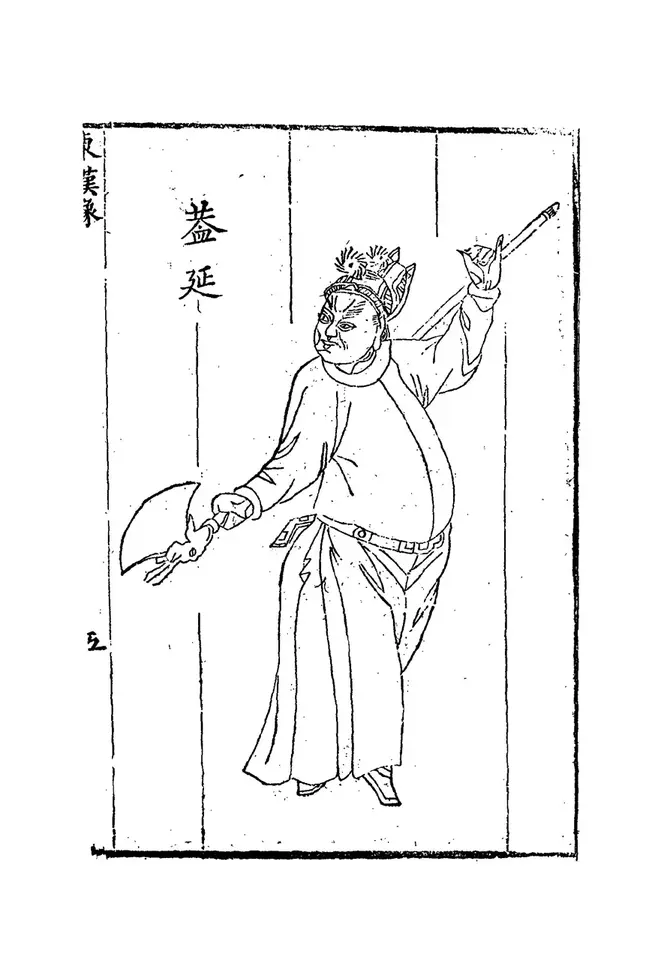
Biography
Frontier Warrior and the Yuyang Uprising
In his youth, Gai Yan served as an administrative clerk in the northern border commandery of Yuyang. Standing eight feet tall with extraordinary muscular strength, he possessed the rare ability to draw a war bow of three hundred catties. In the rugged and warlike frontier environment of Youzhou, Gai Yan was renowned for his exceptional horsemanship, archery, and fearless demeanor, serving under three successive commandery administrators with high competence.
In 23 CE, the Gengshi Emperor established the Xuanhan regime and dispatched envoys to summon the northern commanderies to surrender. Yuyang Administrator Peng Chong appointed Gai Yan as a barracks commandant and acting magistrate of Hunu County. That winter, Liu Xiu crossed the Yellow River to pacify Hebei. Meanwhile, the Handan diviner Wang Lang proclaimed himself emperor, rallying regional gentry and issuing bounties for Liu Xiu's capture.
Wang Lang dispatched emissaries to persuade Yuyang to support his cause. After secret consultations with Wu Han, Peng Chong resolved to support Liu Xiu instead. Peng Chong mobilized three thousand elite infantry and cavalry under the joint command of Wu Han, Gai Yan, and Wang Liang. Linking up with Shanggu cavalry led by Geng Yan, Gai Yan drove south, slaying over 400 enemy officers and capturing twenty-two counties before joining Liu Xiu at Guang'a. Delighted by the arrival of the northern cavalry, Liu Xiu appointed Gai Yan Major General (pian jiangjun) and Marquis of Jiangong.
Clearing Hebei and Subjugating Wang Lang
Gai Yan participated in the siege of Handan alongside the other commanders, fighting in the frontline assault day and night until Wang Lang was executed. Following the fall of Handan, Liu Xiu broke away from the Gengshi regime to pacify the chaotic Hebei plains and eliminate the roaming peasant rebel coalitions.
In June of 25 CE, Liu Xiu ascended the throne as Emperor Guangwu in Hao County, establishing the Eastern Han dynasty. Rewarding his veteran commanders, the emperor formally appointed Gai Yan General of Tiger Teeth (huya dajiangjun). Gai Yan joined Grand Minister of War Wu Han, General of Establishing Might Geng Yan, and Front General Jing Dan in relentless pursuit of the Tongma, Gaohu, Chonglian, and Youlai peasant rebel forces.
In fierce clashes around Ludong, Pinggu, and Shunyi, Gai Yan led elite cavalry charges that shattered the rebel formations, slaying more than 13,000 enemy combatants. The Han army pursued the fleeing remnants to Junmi, completely disintegrating the rebel coalitions. This pivotal campaign secured the Hebei heartland for Eastern Han rule, providing Emperor Guangwu with an unassailable northern base.
Solitary Southern Campaign and Night Escalade of Suiyang
In 26 CE, Liu Yong, the King of Liang under the former Gengshi regime, proclaimed himself emperor in Suiyang and occupied Shansang, amassing hundreds of thousands of followers across Henan and Shandong. Emperor Guangwu dispatched Gai Yan as commander-in-chief, directing General Who Pacifies the Di Pang Meng and other forces southward to subjugate the Liang insurgent state.
Gai Yan advanced directly upon Suiyang, encircling the city on all four sides. Relying on formidable walls and deep moats, Liu Yong resisted stubbornly for months, causing Han assaults to suffer severe attrition. Recognizing that direct frontal attacks were unsustainable, Gai Yan devised an ingenious night assault. By day, he ordered his troops to display flags openly and feign exhaustion; by night, he secretly selected several hundred agile shock troops and constructed scaling ladders.
Under cover of darkness, Gai Yan personally donned heavy armor and led the shock assault over the battlements. Caught completely unprepared, the defenders panicked as the Han vanguard breached the gates, forcing Liu Yong to flee into the night toward Pei Commandery. Gai Yan pursued relentlessly, slaying thousands of enemy soldiers and decisively routing Liu Yong's relief commander Su Mao.
Defeating Su Mao and Pacifying Liang and Chu
Following the fall of Suiyang, Liu Yong rallied his remnants in Yu County, while Su Mao and Zhou Jian attempted to coordinate a counteroffensive to relieve the siege. Gai Yan divided his army calmly, ordering the garrison to hold Suiyang while personally leading Youzhou shock cavalry to intercept Su Mao's main force in the open plains of Pei Commandery. Gai Yan executed flanking cavalry penetrations that smashed the enemy baggage trains, inflicting severe disorder and compelling thousands of enemy troops to surrender.
In 27 CE, besieged and cut off from supplies in Yu County, Liu Yong was assassinated by his own officer Qing Wu, who surrendered the severed head to Gai Yan. Commandery after commandery in the Liang region surrendered upon hearing the news, and Emperor Guangwu enfeoffed Gai Yan as Marquis of Anping for his decisive achievement.
However, Liu Yong's former generals Su Mao and Zhou Jian crowned his son Liu Yu as the new King of Liang at Chuihui, continuing armed resistance. General Pang Meng, who accompanied Gai Yan against Dong Xian, unexpectedly mutinied and attacked Gai Yan before defecting to Dong Xian. Emperor Guangwu personally launched an expedition, marshaling Wu Han, Gai Yan, and Ma Wu to encircle the insurgents. The imperial forces crushed Pang Meng and Su Mao at Taocheng, broke through Changlü, and routed Dong Xian. Liu Yu was subsequently killed by his subordinates at Tancheng. By 30 CE, Dong Xian and Pang Meng were both eradicated, fully pacifying eastern China.
Fierce Campaigns in Guanlong and Pacification of Ba-Shu
With the eastern provinces pacified, Gai Yan marched into Guanzhong and garrisoned Chang'an. At that time, the northwestern warlord Wei Xiao formed an alliance with Gongsun Shu in Ba-Shu to resist the Eastern Han. In 30 CE, Gai Yan joined Geng Yan, Ji Zun, and four other generals advancing west onto Longdi, clashing fiercely with Wei Xiao's general Wang Yuan before withdrawing due to rugged terrain.
In 32 CE, Emperor Guangwu launched a personal expedition into Longyou. While Lai She captured Lueyang, Gai Yan collaborated with Geng Yan in besieging Shanggui. After Emperor Guangwu returned to the capital, Wei Xiao counterattacked with Shu reinforcements, forcing Wu Han and Gai Yan to withdraw toward Chang'an when provisions were exhausted. Following Wei Xiao's death in 33 CE, Gai Yan joined Lai She in another major western offensive, capturing Jiequan, Lueyang, and Qingshui counties and wiping out enemy encampments. The following year, he aided Lai She in taking Luomenju, compelling Wei Xiao's son Wei Chun to surrender. Gai Yan subsequently crushed hostile Qiang tribes in Jincheng, slaying thousands and capturing over ten thousand head of livestock, fully securing the Guanlong region.
In 35 CE, Emperor Guangwu launched a full-scale conquest of Shu. Lai She and Gai Yan advanced south from Longyou, breaking Hechi and Xiabian and marching into Ba-Shu. Due to chronic physical exhaustion from years of war, Gai Yan was relieved from field command and appointed Left Supporter (zuofengyi), while retaining his commission as General of Tiger Teeth.
Governing Guanzhong and Renown in the Yuntai Pavilion
Assuming office as Left Supporter, Gai Yan relocated to govern the strategic metropolitan region of Guanzhong. He governed with a balance of strict discipline and benevolent administration, pacifying displaced refugees, suppressing banditry, and earning deep reverence and affection from officials and commoners alike.
In 37 CE, Ba-Shu was completely subjugated, reunifying the empire. Emperor Guangwu hosted grand banquets for the armed forces in Luoyang and rewarded his meritorious officials, specially granting an increase of Gai Yan's estate to ten thousand households, an honor unmatched among his peers.
In 39 CE, worn down by decades of relentless military campaigning on horseback, Gai Yan passed away in office as Left Supporter. Emperor Guangwu mourned his death deeply, conferring upon him the posthumous title Marquis Qi (Qi hou). In 60 CE, during the reign of Emperor Ming, Gai Yan was commemorated among the founding commanders and had his portrait painted in the Yuntai Pavilion of the Southern Palace, ranked 11th among the Twenty-Eight Generals of Yuntai.
Shattering Enemy Formations and Valor in the Ranks
Throughout his decades of military service, Gai Yan stood out among Han commanders for his steadfast resolve and peerless frontline courage. In pivotal engagements at Suiyang, Shansang, and the mountainous terrains of Guanlong, Gai Yan routinely spearheaded assaults amid arrows and stones whenever the army faced hazardous situations. Inspired by his fearless example, officers and infantry fought with reckless abandon to break the enemy lines. The Youzhou shock cavalry under his command maintained impeccable order and disciplined tactical cohesion, serving as one of the indispensable pillars that established the Eastern Han empire.