Life and Career
Succession at Ili and Military Reforms
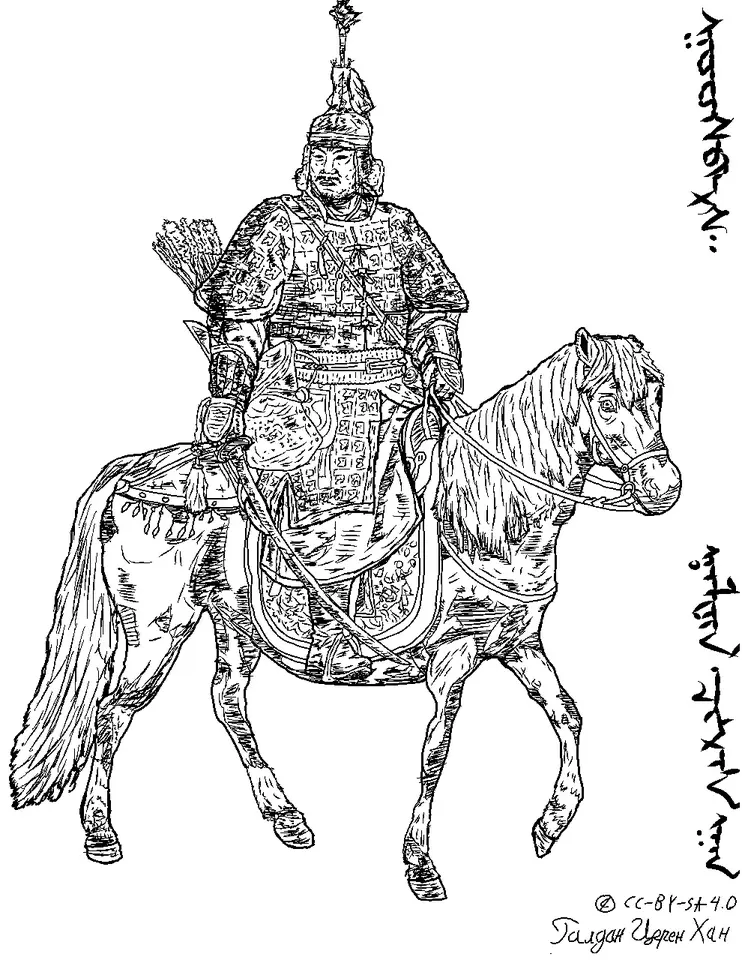
Galdan Tseren was born in 1695 into the Choros aristocracy of the Dzungar Khanate. Raised amid pastoral nomadism and equestrian warfare, he displayed sharp strategic intellect and fierce decisiveness. In 1727, following the sudden death of Tsewang Rabtan, his half-brother Lobsang Norbu launched a palace coup to usurp supreme leadership. Galdan Tseren mobilized loyal tribal levies, swiftly crushed the insurrection, and formally assumed the supreme mantle of Khong Tayiji.
Upon securing power, Galdan Tseren initiated sweeping military and economic modernizations. Employing Swedish artillery specialists and captured Tsarist Russian gunsmiths residing in Ili, he established domestic armories to manufacture modern bronze cannons, mortars, and matchlock firearms. He created specialized mobile artillery corps and enforced agricultural reclamation projects in the northern piedmont of the Tianshan Mountains by resettling southern oasis farmers, generating substantial grain reserves. These integrated reforms elevated the logistical self-sufficiency and tactical firepower of the Dzungar army, enabling sustained confrontation against the Qing Empire.
Heavy Blow at Hoton Nor and Collapse at Erdene Zuu
Provoked by Dzungar raids against Khalkha pastoral territories, the Yongzheng Emperor launched a major two-pronged counter-offensive in 1729. In the summer of 1731, Western Route General Furdan advanced aggressively beyond the Altai Mountains with ten thousand elite troops. Sensing the adversary overconfidence, Galdan Tseren feigned retreat, decoying Furdan army into a rugged mountain defile at Hoton Nor. Surrounding the Qing forces with thirty thousand mounted troops, Galdan Tseren unleashed heavy artillery fire. The battle resulted in near-total destruction of the imperial force; prominent Qing commanders fell in combat, and Furdan narrowly escaped with fewer than two thousand survivors. The disaster at Hoton Nor sent shockwaves through Beijing.
Buoyed by his triumph, Galdan Tseren launched a massive invasion across the Khangai Mountains in 1732, leading thirty thousand cavalry to subjugate the Khalkha Tusheet Khanate and menace northern China. However, Qing Deputy General Tsering, prince consort of Khalkha, organized a fortified defense at Erdene Zuu (Guangxian Temple). Luring the Dzungar columns into a lethal crossfire of field artillery and concentrated archers, Tsering cavalry counter-attacked decisively. Over ten thousand Dzungar warriors were killed or captured, forcing Galdan Tseren to abandon his eastern ambitions and flee back across the Altai. This decisive reversal permanently broke Dzungar offensive capacity in Mongolia.
Diplomatic Settlement and Frontier Markets
The defeat at Erdene Zuu convinced Galdan Tseren of the futility of seeking decisive military victory over the Qing Empire. Following the death of the Yongzheng Emperor and the ascension of the Qianlong Emperor in 1735, Galdan Tseren shifted his strategy toward diplomatic engagement. In 1736, he dispatched an official embassy to Beijing proposing armistice, demarcation, and bilateral trade.
Eager to relieve the state treasury from staggering military expenditures, the Qianlong court accepted the overture. Through protracted negotiations from 1738 to 1739, both sides finalized the Altai Mountain boundary agreement: Dzungar pasturage was strictly confined west of the Altai crests, while designated border markets were inaugurated at Suzhou in Gansu and Beijing. Dzungar merchants traded livestock and fur for Chinese tea, silks, and manufactured iron goods. This agreement fostered peaceful coexistence across the northwest frontier for more than a decade. In 1745, Galdan Tseren passed away in Ili at age fifty-one. His death triggered violent fratricidal warfare among rival princes, hastening the final extinction of the nomadic empire.