Birth in Kucha
Born into the prominent Bo family in the Western Regions state of Kucha.
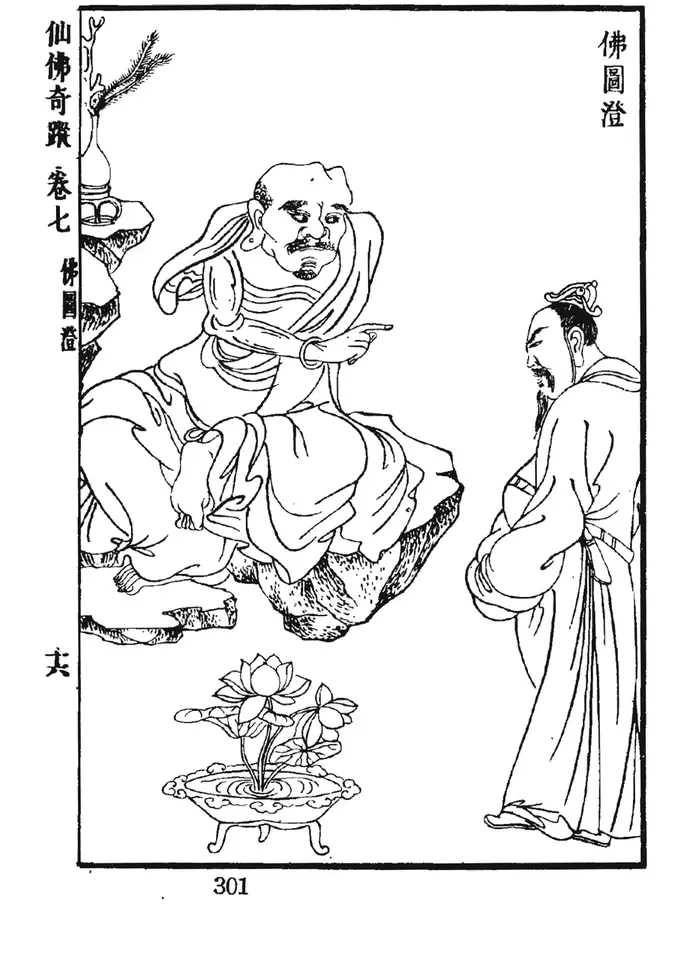
佛图澄
Fotucheng (232 – January 13, 348), originally of the Bo clan in Kucha (modern Kuqa, Xinjiang), was a monumental Western Regions Buddhist monk, translator, and religious statesman during the Sixteen Kingdoms period. He served as the imperial state preceptor of the Later Zhao dynasty, recognized as a founding patriarch of Chinese Buddhist monastic discipline and temple institutions. Ordained at the age of nine in Uddiyana,…
Fotucheng (232 – January 13, 348), originally of the Bo clan in Kucha (modern Kuqa, Xinjiang), was a monumental Western Regions Buddhist monk, translator, and religious statesman during the Sixteen Kingdoms period. He served as the imperial state preceptor of the Later Zhao dynasty, recognized as a founding patriarch of Chinese Buddhist monastic discipline and temple institutions. Ordained at the age of nine in Uddiyana, Fotucheng traveled twice across the Pamir Mountains to Kashmir (Jibin) to master the Tripitaka, becoming famed across Central Asia for scriptural erudition and meditative accomplishments. In 310, at the age of seventy-nine, he arrived in the Western Jin capital of Luoyang, intending to establish monasteries, only to witness the cataclysmic Disaster of Yongjia. Seeking to save humanity from barbarian slaughter, he entered the military encampment of Jie warlord Shi Le in 312, using miraculous demonstrations to win the monarch's boundless reverence. Serving as state preceptor under both Shi Le and his brutal successor Shi Hu, Fotucheng participated in imperial councils. Leveraging Buddhist tenets of compassion and non-violence, he courageously persuaded these ruthless nomadic rulers to halt indiscriminate massacres, preserving hundreds of thousands of innocent Chinese lives. Throughout the Later Zhao realm, he founded eight hundred and ninety-three temples, ordained over ten thousand disciples, and established strict monastic codes forbidding wine and afternoon meals. His illustrious disciples, including Shi Dao'an and Fahe, propagated his teachings across China, profoundly shaping the Sinification of Buddhism. He died at the Ye Temple in 348 at the remarkable age of one hundred and seventeen.
Born into the prominent Bo family in the Western Regions state of Kucha.
Ordained as a novice monk in Uddiyana at age nine, memorizing voluminous Sanskrit scriptures.
Arrives in Luoyang at age seventy-nine to propagate Buddhism, witnessing the fall of the capital.
Enters Shi Le's encampment at Gebi, manifesting the blue lotus miracle and becoming his counselor.
Interprets pagoda wind chime sounds predicting Shi Le's decisive victory over Liu Yao at Luoyang.
Shi Le assumes the title Heavenly King of Zhao, officially proclaiming Fotucheng the Grand Monk.
Accompanies Shi Hu to the new capital of Ye, receiving supreme honors and directing temple building.
Foreseeing the imminent collapse of Later Zhao, passes away peacefully at Ye Temple at age 117.
Fotucheng was born in 232, during the sixth year of the Taihe reign of Cao Wei, in the ancient oasis kingdom of Kucha along the Silk Road (modern Kuqa, Xinjiang). His family belonged to the prominent Bo lineage, long devoted to Mahayana Buddhism.
Precocious from infancy, Fotucheng mastered Sanskrit phonetics and regional dialects. In 240, at the age of nine, he received monastic ordination in the kingdom of Uddiyana. Following full monastic ordination, he demonstrated prodigious textual recall, reciting hundreds of scriptures running into millions of words. In early adulthood, he twice crossed the frozen passes of the Pamirs to study in Kashmir (Jibin), the foremost center of Sarvastivada and Mahayana scholarship, studying the Tripitaka while mastering astronomy, pharmacology, and dharani spells. Across Central Asia, he was revered as an accomplished Arhat. In 310, at the advanced age of seventy-nine, Fotucheng traveled across the Taklamakan Desert to the Western Jin capital of Luoyang. However, the Jin dynasty was disintegrating in the wake of the War of the Eight Princes. Shortly after his arrival, Liu Yuan and Shi Le overran and burned Luoyang, forcing Fotucheng into reclusion in the wild hills to await an opportunity for salvation.
During the late Jianxing era of Western Jin, Jie warlord Shi Le ravaged the Yellow River valley, massacring surrendered garrisons and displacing millions of refugees. Fotucheng resolved that only by domesticating the savage autocrat could he halt the slaughter of innocent Chinese.
In 316, Fotucheng approached Shi Le's headquarters at Gebi (modern Xincai, Henan), seeking lodging with Guo Heilüe, a Han general serving under Shi Le who secretly practiced Buddhism. Guided by Fotucheng's strategic foresight and medicinal healing, Guo won repeated battlefield victories. Astonished by Guo's sudden prescience, Shi Le demanded the source, learning of the venerable Western monk. When summoned, Shi Le challenged him: "What magical virtue does your Buddha possess that you dare enter my camp?" Knowing Shi Le was an illiterate soldier unsuited for abstract metaphysics, Fotucheng took an ordinary bronze begging bowl, filled it with fresh water, and burned incense while intoning dharanis. Within moments, a vibrant, fragrant blue lotus flower sprouted from the water, radiating dazzling light across the hall. Deeply shaken, Shi Le fell to his knees in reverence, declaring Fotucheng his honored state preceptor. For the next decade, Fotucheng accompanied Shi Le's campaigns, repeatedly using karmic retribution and divine omens to persuade Shi Le to abandon planned slaughters, rescuing hundreds of thousands of Jin prisoners from extermination.
In 330, having crushed Liu Yao of Former Zhao and unified northern China, Shi Le proclaimed himself Heavenly King of the Great Zhao dynasty at Xiangguo.
Shi Le issued an imperial edict honoring Fotucheng as "Da Heshang" (Grand Monk), mandating that all imperial councils consult him before implementation. In 334, Shi Le died, and his ruthless nephew Shi Hu seized the throne, relocating the capital to Ye (modern Linzhang, Hebei). Although Shi Hu was more vicious than his predecessor, his veneration of Fotucheng exceeded even that of Shi Le. Shi Hu decreed that all civil ministers and imperial princes must bow before Fotucheng during court assemblies, assigning princes to serve his meals. Despite this suffocating favor, Fotucheng fearlessly reprimanded court corruption, publicly confronting tyrannical officials like Zhang Li. Once, Shi Hu challenged Fotucheng: "The Buddhist dharma forbids killing. Yet as a monarch pacifying the realm, I rule by the sword. Does this not defy your Buddha?" Fotucheng sternly responded: "A sovereign serves Buddha by practicing compassionate benevolence and protecting the innocent, not through reckless slaughter. If a ruler indulges in homicidal cruelty, even if he empties treasuries to build golden pagodas, he will plunge straight into the deepest hells, acquiring no merit whatsoever!" Intimidated by the master's moral power, Shi Hu curtailed his murderous executions.
Backed by imperial patronage, Fotucheng engineered an unprecedented transformation in early Chinese Buddhist history.
Under ancient Han and Cao Wei statutes, native Chinese had been strictly prohibited from taking Buddhist monastic vows. Fotucheng seized the opportunity presented by the non-Han Jie regime, persuading Shi Hu to issue an imperial decree officially lifting this prohibition, granting all Chinese and non-Chinese subjects imperial permission to enter the sangha. This historic decree demolished the institutional barriers restricting Buddhism, allowing thousands of Han literati and commoners to join monastic communities. Across the Later Zhao empire, Fotucheng supervised the construction of eight hundred and ninety-three temples. In his twilight years, he focused on establishing rigorous monastic discipline, attracting extraordinary disciples from across China, including Shi Dao'an, Fahe, and Zhu Faya. In 348, as Shi Hu's sons butchered one another in palace coups, Fotucheng foresaw the impending collapse of the Zhao state. He assembled his disciples, predicted the coming civil wars, and passed away peacefully lying on his right side at Ye Temple at the age of one hundred and seventeen, mourned deeply by the entire realm.
Fotucheng's paramount contribution during the savage chaos of the Sixteen Kingdoms was deploying spiritual authority to domesticate nomadic tyranny and protect millions of Chinese civilians.
The Jie rulers Shi Le and Shi Hu ruled through terror, routinely putting entire conquered cities to the sword. Venturing unarmed into their military headquarters, Fotucheng risked his life daily. Tailoring his teachings to martial nomadic temperaments, he harmonized the Buddhist Five Precepts with Confucian humanitarianism. In the campaigns of Gebi, Pingyang, and Xiangguo, he repeatedly intervened before executions, invoking cosmic retribution to compel Shi Le to rescind orders of extermination. Records in the Biographies of Eminent Monks document that his compassionate intercessions saved hundreds of thousands of Chinese officials, commoners, and prisoners of war, standing as a miraculous shield preserving Chinese demographic survival during a dark era of foreign conquest.
In the institutional development of Chinese Buddhism, Fotucheng spearheaded an epoch-making legal revolution.
Ever since the Han dynasty, imperial authorities had restricted Buddhist monasticism to foreign Western merchants and envoys. Fotucheng recognized that the non-Han Later Zhao state offered a unique opportunity to overturn this archaic restriction. Persuading Shi Hu to issue the historic decree declaring that "Buddha is a foreign deity, whom we rightfully revere; let all subjects, Han and barbarian alike, take vows," Fotucheng permanently legalized Chinese monasticism. This decree allowed Chinese intellectuals and commoners to enter the sangha, giving birth to the first generation of indigenous Han Buddhist scholars and transforming Buddhism from an exotic foreign sect into a dominant indigenous cultural institution.
As a founding father of Chinese monastic discipline, Fotucheng instilled moral purity into early Chinese Buddhist communities.
Prior to his arrival, Chinese Buddhist communities were disorganized, blending haphazardly with folk Daoist magical practices. Fotucheng exemplified absolute personal discipline, adhering to strict vows: drinking no wine, consuming no food past noon, and never violating Vinaya codes. He established formal morning and evening chants, fortnightly confessional assemblies, and summer meditation retreats across hundreds of temples. Most significantly, he discovered and trained Shi Dao'an, who subsequently codified the earliest catalogue of translated sutras and standardized monastic rules for monks and nuns across China. Master Huijiao of Liang eulogized: "Though the dharma flowed east for centuries, it was only through Master Fotucheng that monastic discipline became complete, shedding immortal grace upon all subsequent generations."
Master Huijiao recorded in Biographies of Eminent Monks: "Master Fotucheng possessed profound spiritual wisdom. Living during the brutal reign of the Zhao monarchs, he practiced the compassionate dharma to rescue the world. Through subtle speech and secret remonstrance, he preserved countless lives. Since the introduction of Buddhism, no master has matched Fotucheng in transforming barbarians and Chinese alike."
Fang Xuanling wrote in Book of Jin: "Fotucheng was ordained in youth and endowed with divine gifts. Taking refuge under the Shi clan amid dynastic turmoil, he used skillful means to attract their reverence and compassion to curb their cruelty. Shi Le revered his virtue and Shi Hu feared his majesty; his merit in converting the Jie barbarians and rescuing the people from ruin was boundless."
Shi Dao'an eulogized his master: "Master Fotucheng's virtue was supreme and his spiritual power unfathomable. In explaining scriptures and discipline, his words flowed like an unceasing river. In regulating the sangha and enlightening the lost, he was truly the living incarnation of a Mahayana Bodhisattva."
Modern Buddhist and medieval Chinese historians assess Fotucheng as the foundational architect who facilitated Buddhism's transition from an alien Silk Road faith into a dominant Chinese cultural ideology. Operating at the heart of autocratic terror, he established the paradigm of using royal statecraft to protect the dharma, halting barbarian massacres and safeguarding Chinese civilization. His achievement in legalizing Chinese monasticism, establishing the Vinaya, and training Dao'an paved the way for the golden age of Buddhism in the Sui and Tang dynasties.
FIGURES ASSOCIATED WITH THIS DYNASTY