Birth in Yangqu
Born into a prestigious scholar-official family in Xicun, Yangqu County, Taiyuan Prefecture, on August 11.
傅山
[!NOTE] Fu Shan (August 11, 1607 – July 25, 1684), courtesy name Qingzhu (originally written with different characters) and pseudonyms including Shi Daoren, Zhuyi Daoren, and Qiaohuang Zhen Daoren, and Gongzhita, was a preeminent Chinese philosopher, master calligrapher, physician, poet, and epigrapher of the late Ming and early Qing dynasties. Hailing from Yangqu County in Taiyuan Prefecture (modern Jiancaoping District,…
[!NOTE] Fu Shan (August 11, 1607 – July 25, 1684), courtesy name Qingzhu (originally written with different characters) and pseudonyms including Shi Daoren, Zhuyi Daoren, and Qiaohuang Zhen Daoren, and Gongzhita, was a preeminent Chinese philosopher, master calligrapher, physician, poet, and epigrapher of the late Ming and early Qing dynasties. Hailing from Yangqu County in Taiyuan Prefecture (modern Jiancaoping District, Taiyuan, Shanxi Province), he hailed from a prominent scholar-official lineage renowned for classical Zuo Zhuan scholarship. In 1636, he gained national fame when he led over a hundred Shanxi scholars on foot to Beijing to petition the imperial court, successfully exonerating his revered mentor Yuan Jixian from trumped-up charges. Following the fall of the Ming dynasty in 1644, he refused to submit to the Qing dynasty's queue order, took Daoist vows under Guo Jingzhong at Mount Wufeng, and donned red robes, symbolizing unyielding resistance. Imprisoned and tortured during the 1654 anti-Qing uprising of Song Qian, he maintained unbroken fidelity. Academically, he pioneered the Qing revival of pre-Qin non-Confucian philosophical Masters (zhuzi), advocating the radical equality of the Confucian Classics and the Masters. In calligraphy, his revolutionary aesthetic principle of the "Four Prefers and Four Avoids" (Si Ning Si Wu) initiated the steleschool movement. In medicine, his seminal clinical treatise Fu Qing-zhu's Gynecology (Fu Qingzhu Nüke) remains a foundational classic of traditional Chinese obstetrics and gynecology. Forcibly summoned to Beijing for the 1678 Special Examination for Men of Eminent Learning (Boxue Hongru), he staged a hunger strike, refused an imperial title of Secretary of the Grand Secretariat (Neige Zhongshu), and lived out his days as an uncompromising commoner.
Born into a prestigious scholar-official family in Xicun, Yangqu County, Taiyuan Prefecture, on August 11.
Admitted as a student of the county school at fifteen; advanced to salaried licentiate (linsheng) in 1626.
Led over a hundred Shanxi scholars to Beijing to petition the throne, successfully exonerating his teacher Yuan Jixian.
Ming capital fell; refused the queue order and took Daoist ordination at Mount Wufeng as Zhuyi Daoren (Red-Robed Daoist).
General Jiang Xiang rebelled against the Qing; Fu Shan's close friends Xue Zongzhou and Zhang Sunxi died fighting at Jincibao.
Arrested and severely tortured in Fenzhou over suspected involvement in Song Qian's anti-Qing plot; acquitted after fifteen months.
Welcomed scholar Gu Yanwu to Taiyuan, forming a lifelong friendship dedicated to Ming loyalism and practical learning.
Founded the Zhenshuai Society with Dai Tingshi to manage loyalist networks and mutual intellectual pursuits.
Forcibly hauled by provincial authorities to Beijing for the Boxue Hongru examination; refused to enter the city and went on a hunger strike.
Granted the title Secretary of the Grand Secretariat (Neige Zhongshu) by Kangxi; adamantly refused the post and returned home as a commoner.
Following the untimely demise of his only son Fu Mei, Fu Shan passed away peacefully on July 25 at seventy-eight.
Fu Shan was born on August 11, 1607, in Xicun, Yangqu County, Taiyuan Prefecture, Shanxi, into a prominent clan that traced its literary ancestry through consecutive generations of classicists specializing in the Zuo Zhuan (Zuo Tradition of the Spring and Autumn Annals). His great-grandfather Fu Chaoxuan rose to Assistant Surveillance Commissioner of Shandong and Circuit Intendant of Liaohai, earning widespread acclaim for border defense governance; his grandfather Fu Lin held administrative office in Liaohai; and his father Fu Zimo declined official posts to devote his life to textual philology and classical scholarship.
Endowed with an extraordinary memory and a resolute temperament, Fu Shan could recite voluminous texts after a few readings. In 1621, at the age of fifteen, he passed the prefectural examinations to become a government student (xiucai), and by 1626 was selected as a stipendiary student (linsheng) at Yangqu County School. During the early Chongzhen reign, the famed Donglin-aligned scholar-official Yuan Jixian was appointed Education Intendant of Shanxi. Yuan restored the Sanli Academy in Taiyuan to revitalize regional learning, handpicking over three hundred exceptional talents. Among them, Fu Shan was deeply treasured by Yuan for his penetrating intellect and unyielding integrity.
In 1636, Yuan Jixian was falsely accused and arrested following a malicious conspiracy orchestrated by the corrupt Regional Inspector Zhang Sunzhen and military officer Shi Deyuan. Yuan was stripped of rank and transported in an iron cage to the imperial prison in Beijing. Outraged by this injustice, the thirty-year-old Fu Shan mobilized his fellow student Xue Zongzhou and over a hundred Shanxi scholars. Carrying handwritten petitions, they marched thousands of miles on foot to Beijing. Fu Shan composed fiery appeals, knelt before the Office of Transmission (Tongzheng Si), and mounted three successive petitions while plastering public notices across the capital exposing Zhang's treachery. Supported by Grand Coordinator Wu Shengzhen and Supreme Commander Liang Tingdong, the Chongzhen Emperor ordered a joint judicial review, which fully exonerated and restored Yuan. Fu Shan's heroic defense of his teacher made him famous across the empire. Declining all offers of official sponsorship, he returned to Taiyuan and secluded himself in an ancient monastery northwest of the city, mastering the Confucian canon, Daoist scriptures, medical classics, and ancient bronzes.
In 1643, Fu Shan was invited to serve as head lecturer at the Sanli Academy. However, in February 1644, Li Zicheng's Shun army swept across Shanxi and stormed Taiyuan. Fu Shan escorted his aged mother, wife, and infant son through the treacherous mountain passes of Pingding and Shouyang. In March, Beijing fell and the Chongzhen Emperor committed suicide on Coal Hill; weeks later, the Qing army crossed the Shanhai Pass and occupied northern China.
Devastated by the fall of the native Ming dynasty, Fu Shan wrote the grief-stricken lines: "Grieving for the fallen state, my book is hard to write; obeying my mother's command, I flee with borrowed life." When the regent Dorgon issued the brutal queue decree ordering all Han Chinese men to shave their foreheads and adopt Manchu dress upon pain of death, Fu Shan vowed never to submit. To legitimately preserve his native hair and attire, he sought out the venerable Quanzhen Daoist master Guo Jingzhong at Mount Wufeng in Shouyang, receiving ordination into the Longmen lineage. Adopting the Ming dynastic color of red, he donned crimson Daoist robes and took the sobriquet Zhuyi Daoren ("Red-Robed Daoist") and later Shi Daoren ("Stone Daoist"), symbolizing a loyalty as unyielding as granite.
Living in destitute rural temples across eastern Shanxi, Fu Shan practiced medicine while secretly coordinating with anti-Qing resistance networks. In 1646, his former mentor Yuan Jixian was captured by Qing troops at Jiujiang; when transported north in chains, Yuan smuggled farewell poems to Fu Shan urging mutual steadfastness. In 1647, Yuan was executed in Beijing for refusing to submit. Fu Shan covertly infiltrated the capital, gathered his mentor's remains, and arranged for the private printing of Yuan's posthumous writings. When General Jiang Xiang staged an armed uprising across Shanxi in 1649, Fu Shan's beloved classmates Xue Zongzhou and Zhang Sunxi joined the rebel ranks. Following the Qing siege of Jincibao, both died in desperate combat. Fu Shan risked imperial execution to retrieve their remains and penned the immortal Biography of the Two Masters of Fen (Fen Erzi Zhuan) in their honor.
In 1654, Song Qian, a Drafter of the Grand Secretariat (Zhongshu Sheren) under the Southern Ming Yongli court, clandestinely entered Shanxi to establish a military headquarters in the Taihang Mountains. Song sought out Fu Shan in Taiyuan to concert plans for a coordinated northern uprising. However, the conspiracy was compromised, and Song was captured on the Shanxi-Henan border with correspondence implicating Fu Shan.
Designated an imperial rebel, Fu Shan was seized at his ancestral village alongside his eldest son Fu Mei and younger brother Fu Zhi, and cast into the provincial prison in Fenzhou. Over the course of fifteen grueling months, Qing interrogators subjected Fu Shan to savage torture, including leg-crushers and iron whips, attempting to force a confession naming his loyalist conspirators. Fu Shan refused to utter a single name, going on a hunger strike while composing defiant verses behind bars. Because he had arranged consistent testimony with his kin beforehand, and because Song Qian refused to incriminate him prior to his own execution, the authorities lacked conclusive proof. Meanwhile, influential friends and students—including Wei Yi'ao and Dai Tingshi—spent immense fortunes lobbying local officials. Fu Shan was finally released in the autumn of 1655.
Recognizing that armed insurrection in the north had become untenable, Fu Shan channeled his energies into scholarship, epigraphy, and organizing loyalist intellectual circles. In 1657, the preeminent Jiangnan scholar Gu Yanwu, fleeing Qing persecution in the south, arrived in Taiyuan. The two towering minds formed an instant, profound brotherhood based on shared loyalty to the fallen Ming. Gu praised Fu Shan as "a peerless talent of the Three Jin, whose eternal integrity resides in quietude." Over the next two decades, Gu visited Shanxi six times, staying at Fu's residence and collaborating on geographical and epigraphic studies. Fu Shan, together with the wealthy bibliophile Dai Tingshi of Qi County, founded the Zhenshuai Society (Zhenshuai Hui), establishing agricultural estates and trading houses to covertly finance destitute loyalists and preserve Ming cultural heritage. He maintained intimate correspondences with prominent scholars across China, including Wei Xi of Jiangxi, Li Yindu of Shaanxi, and Yan Ermei of Shandong.
In 1678, seeking to conciliate the Han Chinese literati and legitimize his rule, the Kangxi Emperor decreed the inauguration of the Special Examination for Men of Eminent Learning (Boxue Hongru), ordering all senior provincial and metropolitan officials to recommend the empire's greatest living luminaries. Fu Shan's moral authority and universal erudition made him the primary candidate; high-ranking officials including Vice Minister of Justice Du Zhen and Administration Commissioner Liu Peixian unanimously placed his name at the top of their recommendations.
Now seventy-two years old and severely debilitated by chronic illness, Fu Shan repeatedly declined the summons. However, Yangqu Magistrate Dai Mengxiong, terrified of imperial displeasure, sent armed bailiffs to Fu's sickbed, forced him into an official palanquin, and hauled him across three hundred miles to the outskirts of Beijing. When the convoy arrived at Haidian, thirty miles outside the city, Fu Shan flatly refused to pass through the city gates. The magistrate was compelled to lodge him at the ancient Yuanjiao Temple outside the Qianmen gate. Once inside, Fu Shan bolted the doors, took to his bed, and embarked on a total hunger strike for seven days, drinking only water and feigning terminal paralysis.
In March 1679, the imperial examination convened at the Baohe Hall. Grand Secretary Feng Pu and numerous Manchu and Han ministers visited the temple to cajole Fu Shan, even preparing a cushioned litter to carry him into the palace. Fu Shan remained turned toward the wall with his eyes closed, refusing to acknowledge their presence. To preserve imperial dignity without executing an imperial icon, the Kangxi Emperor issued a special rescript: "Fu Shan's literary renown has long been established. Taking pity on his advanced age and infirmity, We grant him exemption from the examination and bestow upon him the rank of Secretary of the Grand Secretariat (Neige Zhongshu), permitting him to return home, where local magistrates shall inquire after his welfare." When the imperial patent and court robes were brought to his bedside, Fu Shan lay motionless, offering neither thanks nor obeisance. The following dawn, he departed Beijing for Shanxi.
Upon his return to Taiyuan, Fu Shan's uncompromising defiance was hailed throughout the country. Regional officials, eager to curry favor, thronged his residence in Yangqu, addressing him by his imperial title as "Secretary of the Grand Secretariat Fu." Fu Shan received them with closed eyes and stony silence. When Magistrate Dai Mengxiong erected a gilded imperial plaque inscribed "Phoenix Pavilion and Rush-Padded Carriage" (Fengge Pulun) above his doorway, Fu Shan ordered his family to tear it down and destroy it with an axe, strictly forbidding anyone in his household from using the imperial title. He designated himself an ordinary "Commoner" (pingmin) and "Old Man of Qiaohuang," denoting an exiled guest without an ancestral homeland.
In his final years, Fu Shan retreated to a humble thatched cottage called Songqiao in the eastern village of Songzhuang near Taiyuan. He spent his days annotating the Laozi and Zhuangzi, transcribing ancient inscriptions, and riding a donkey through rural villages to treat impoverished peasants without fee. In February 1684, his only son Fu Mei—himself a talented epigrapher, poet, and constant companion—tragically predeceased him at fifty-seven.
Devastated by this final loss, the seventy-eight-year-old father wept blood and composed fourteen heartbreaking elegies (Poems Mourning My Son). On July 25, 1684 (12th day of the 6th lunar month), Fu Shan passed away peacefully in Songzhuang. On his deathbed, he instructed his family that he must be shrouded in traditional Han Chinese Daoist robes rather than Qing garments, and that his gravestone on Huangdaoling ridge must bear only the inscription: "Tomb of Commoner Fu Qingzhu." Thousands of mourning townspeople and scholars in plain white robes walked in his funeral procession, honoring the passing of a peerless intellectual titan and loyalist sage.
Fu Shan's most revolutionary contribution to Chinese intellectual history was his decisive dismantling of the rigid hegemony of Song-Ming Neo-Confucianism (Cheng-Zhu lixue) and his pioneering of the Qing revival of pre-Qin non-Confucian philosophical Masters (zhuzi xue). In the late Ming and early Qing, Neo-Confucian dogma had degenerated into sterile moralizing that suppressed human nature and served despotic state control. Fu Shan fiercely denounced the Neo-Confucian maxim of "preserving heavenly principle and extinguishing human desires" as a hypocritical tool for social murder.
Among the various philosophical schools, Fu Shan devoted his deepest contemplative energies to Daoism, specifically the Laozi and Zhuangzi. He authored numerous pathbreaking treatises, including Critical Notes on the Zhuangzi Yi (Zhuangzi Yi Pizhu), Reading the Nanhua Classic (Du Nanhua Jing), Xun Qing's Appraisal of the Zhuangzi (Xunqing Ping Zhuangzi), The Laozi and Zhuangzi (Lao Zhuang Ershu), Explanations of Laozi (Laozi Jie), The Character Li in the Zhuangzi (Zhuangzi Li Zi), and The Character Qing in the Zhuangzi (Zhuangzi Qing Zi), as well as commentaries on Free and Easy Wandering (Xiaoyaoyou) and Fit for Emperors and Kings (Yingdiwang). In freezing winter blizzards, he transcribed chapters of the Zhuangzi in pristine regular script, declaring that going three days without reading the Laozi left his tongue stiff. He formulated the groundbreaking doctrine of "interpreting Zhuangzi through genuine human feeling" (yi qing jie Zhuang). Rejecting the conventional view that Zhuangzi preached indifferent fatalism, Fu Shan argued that the primal animating force of the cosmos was genuine emotion (qing), and that Zhuangzi's spiritual liberation (xiaoyao) represented humanity's ultimate defense of innate moral autonomy against authoritarian oppression.
Furthermore, Fu Shan became the first thinker in pre-modern China to articulate the revolutionary concept of the "Equality of the Classics and the Masters" (jing zi pingdeng). For millennia since the Han dynasty, the Confucian Six Classics had been venerated as immutable, sacred orthodoxy, while the Masters were marginalized as heterodox. Through rigorous philological textual analysis, Fu Shan demonstrated that the Confucian Classics were themselves historical artifacts of the Zhou dynasty and represented merely one branch of pre-Qin master thought. By demonstrating that the works of Mozi, Xunzi, Guanzi, and the Daoists possessed philosophical depth equal to the Confucian canon, Fu Shan shattered intellectual dogmatism, directly paving the way for the high Qing Qianlong-Jiaqing evidential research movement and modern enlightenment thought.
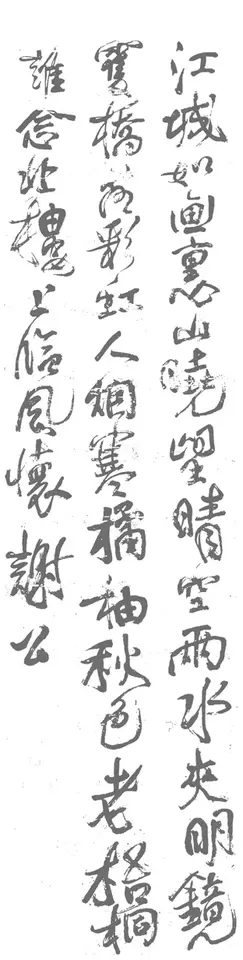
Fu Shan was a transcendent calligraphic titan whose wild cursive (dacao) and archaic stele-derived scripts (beixue) stood at the pinnacle of Qing art. Sharing equal historical stature with Wang Duo, he was venerated as one of the two great calligraphic masters of the Ming-Qing transition.
During the seventeenth century, the calligraphic arena was dominated by the slick, delicate, and accommodating styles of Zhao Mengfu and Dong Qichang. Fu Shan recognized that this aesthetic preference reflected the servile, spineless opportunism of late Ming literati who readily surrendered to foreign conquerors. Initiating a radical aesthetic rebellion, Fu Shan formulated his immortal calligraphic manifesto in his Exhortations on Script (Zixun):
"Prefer awkwardness over cleverness; prefer ugliness over charming sweetness; prefer fragmented disjunction over slick facility; prefer natural genuineness over calculated arrangement." (Ning zhuo wu qiao, ning chou wu mei, ning zhili wu qinghua, ning zhenshuai wu anpai).
This manifesto redefined artistic value. "Preferring awkwardness" rejected hollow technical virtuosity in favor of archaic gravitas; "preferring ugliness" championed tragic, raw inner vitality over submissive, decorative pleasantness; "preferring fragmented disjunction" allowed fractured, dynamic compositions rather than superficial, uniform elegance; and "preferring natural genuineness" held that art must be an uncalculated, unmediated outpouring of the artist's authentic existential experience. In his wild cursive scrolls, Fu Shan's brush moved with the tempestuous fury of a thunderstorm, twisting continuously with profound structural weight; in his seal and clerical scripts, he bypassed Tang and Song conventions to absorb the monumental gravity of pre-Qin bronzes and Han dynasty cliff carvings. His theory and practice laid the foundations for the 19th-century Stele Movement championed by Bao Shichen and Kang Youwei.
In accordance with the ancient Confucian ideal that "if one cannot be a good minister, one should be a good physician," Fu Shan devoted decades to clinical medicine, becoming celebrated as a divine healer throughout northern China. He practiced with profound humanism, refusing remuneration from impoverished patients and frequently purchasing herbal decoctions for destitute families out of his own pocket.
Fu Shan's most enduring clinical legacy lies in traditional Chinese obstetrics and gynecology (fuke). His medical masterworks—principally Fu Qing-zhu's Gynecology (Fu Qingzhu Nüke), Fu Qing-zhu's Andrology (Fu Qingzhu Nanke) (Fu Qingzhu Nanke), and Secrets of the Green Satchel (Qingnang Mijue)—fundamentally transformed clinical practice. Before him, gynecology was treated haphazardly as an adjunct to general internal medicine. Fu Shan established a comprehensive, systematic nosology of women's diseases, dividing disorders into categories including leucorrhea, uterine bleeding, irregular menstruation, infertility, pregnancy complications, and postpartum disorders.
He formulated dozens of renowned classic prescriptions that remain staples of clinical practice worldwide. For leucorrhea caused by spleen deficiency and dampness, he devised Wandai Tang (Discharge-Ending Decoction), which tonifies the spleen and disperses dampness without using harsh drying herbs. For postpartum retention of lochia and stasis pain, he perfected Shenghua Tang (Generation and Transformation Decoction), which nourishes blood and dispels stasis without injuring new tissue. His therapeutic approach prioritized the harmonization of qi and blood and the tonification of the spleen and kidneys, while emphasizing the psychological dimension of pathology. Today, Fu Qingzhu Nüke remains an indispensable textbook in Chinese medical academies globally.
Fu Shan was also a foundational pioneer of Qing epigraphy (jinshixue) and archaic philology. Recognizing that extant woodblock editions of ancient texts were rife with copyist errors, he insisted that bronze vessel inscriptions (jinwen) and stone steles (shike) provided the only untainted physical records of antiquity.
Over decades of travel across northern China, Fu Shan examined, rubbed, and deciphered thousands of ancient stone inscriptions and bronze vessels. Profoundly versed in Xu Shen's Shuowen Jiezi, he authored Postface to Shuowen (Shuowen Houxu) and Record of Extant and Lost Epigraphy (Jinshi Cunwang Biao). By synthesizing material epigraphic data with ancient institutional and geographical records, he rectified centuries of erroneous classical commentaries.
Fu Shan's literary genius is preserved in his forty-volume anthology Shuanghongkan Collection (Shuanghongkan Ji), which compiles over two thousand poems and numerous essays. Inheriting the tragic, historical realism of Qu Yuan and Du Fu, his poetry captures the brutal turmoil, massacres, and spiritual agony of the Ming-Qing dynastic cataclysm. Devoid of artificial ornament and overflowing with heroic, mournful power, his verses read like clashing bronze, securing his standing as one of the most powerful poetic voices of early Qing literature.
FIGURES ASSOCIATED WITH THIS DYNASTY