Uprising Against Sui
Banded together with lifelong sworn brother Du Fuwei in Qizhou to launch an agrarian rebellion against Sui tyranny.
辅公祏
Fu Gongshi (d. 624), a native of Linji in Qizhou, was a prominent rebel leader and separatist monarch who dominated the Jianghuai region during the Sui-Tang transition. In his early years, Fu Gongshi formed a close bond with fellow countryman Du Fuwei. In 613, the two gathered impoverished fugitives to launch an armed uprising against the Sui dynasty. Combining Du Fuwei's personal bravery with Fu Gongshi's strategic acumen,…
Fu Gongshi (d. 624), a native of Linji in Qizhou, was a prominent rebel leader and separatist monarch who dominated the Jianghuai region during the Sui-Tang transition. In his early years, Fu Gongshi formed a close bond with fellow countryman Du Fuwei. In 613, the two gathered impoverished fugitives to launch an armed uprising against the Sui dynasty. Combining Du Fuwei's personal bravery with Fu Gongshi's strategic acumen, they routed imperial commanders such as Song Hao and Chen Leng, absorbed rival insurgent forces, and established absolute control over Liyang and Danyang (present-day Nanjing, Jiangsu). In 619, Fu Gongshi submitted to the newly established Tang dynasty alongside Du Fuwei, receiving appointments as Left Vice Director of the Huainan Branch Department of State Affairs and Duke of Shu. However, as Fu Gongshi's prestige among the veteran troops grew, Du Fuwei became intensely suspicious and systematically stripped him of military commands. Fu Gongshi feigned retirement and practiced Daoist fasting alongside occultist Zuo Youxian to deflect suspicion. In 623, when Du Fuwei was summoned to Chang'an, Fu Gongshi orchestrated the murder of Du's adopted general Wang Xiongdan, assumed supreme command in Danyang, and proclaimed himself Emperor of Song under the era name Qiande. Tang Gaozu dispatched Prince of Zhaojun Li Xiaogong and celebrated general Li Jing to launch a massive pincer offensive. Following decisive defeats at Qinglin and Bowang, Fu Gongshi fled Danyang but was captured by local peasants in Wukang and executed in 624.
Banded together with lifelong sworn brother Du Fuwei in Qizhou to launch an agrarian rebellion against Sui tyranny.
Personally persuaded rival insurgent leader Miao Haichao to surrender his thousands of followers to Du Fuwei's forces.
Annihilated Sui imperial armies under Song Hao and Chen Leng; appointed Chief Clerk of the Jianghuai rebel administration.
Formally submitted to Emperor Gaozu of Tang alongside Du Fuwei, receiving the title Duke of Shu.
Appointed Left Vice Director of the Huainan Branch Department of State Affairs amid growing friction with Du Fuwei.
Relinquished military posts and feigned Daoist fasting with Zuo Youxian to disarm Du Fuwei's growing paranoia.
Took advantage of Du Fuwei's journey to Chang'an to ambush Wang Xiongdan; proclaimed himself Emperor of Song with the era name Qiande.
Dispatched generals across Henan and Jiangnan, rapidly recovering dozens of prefectures under his imperial authority.
Crushed by Tang armies under Li Xiaogong and Li Jing at the heavily fortified positions of Qinglin and Bowang.
Abandoned Danyang to flee toward Kuaiji; captured by local villagers in Wukang and executed by Li Xiaogong at Danyang.
Fu Gongshi was born in Linji, Qizhou. Impoverished and reckless in his youth, he shared an unyielding friendship with fellow countryman Du Fuwei. Fu Gongshi's maternal aunt operated a sheep pastoral estate; witnessing Du Fuwei's destitution, Fu Gongshi frequently stole sheep from his aunt's pasture to feed his friend. When the theft was uncovered and local magistrates initiated an arrest warrant, the two youths fled into the mountains. In 613, as Emperor Yang's disastrous Goguryeo campaigns sparked peasant unrest across Shandong, Fu Gongshi and Du Fuwei rallied a company of fugitives and officially raised an armed insurrection.
During their initial skirmishes, Du Fuwei proved fearless in melee combat, always spearheading charges and covering withdrawals. Acknowledging his friend's battlefield prowess, Fu Gongshi voluntarily ceded the supreme military command to Du Fuwei, assuming the role of chief strategist and logistical coordinator. When a rival bandit chieftain named Miao Haichao amassed several thousand warriors in Xiapi, Du Fuwei dispatched Fu Gongshi alone as an envoy. Fu Gongshi coolly reasoned that dispersed bands would inevitably be crushed piecemeal by imperial armies, boldly challenging Miao Haichao to either assume the supreme command if capable or surrender his host. Shaken by Fu Gongshi's commanding demeanor and sharp ultimatum, Miao Haichao surrendered his forces without drawing a blade.
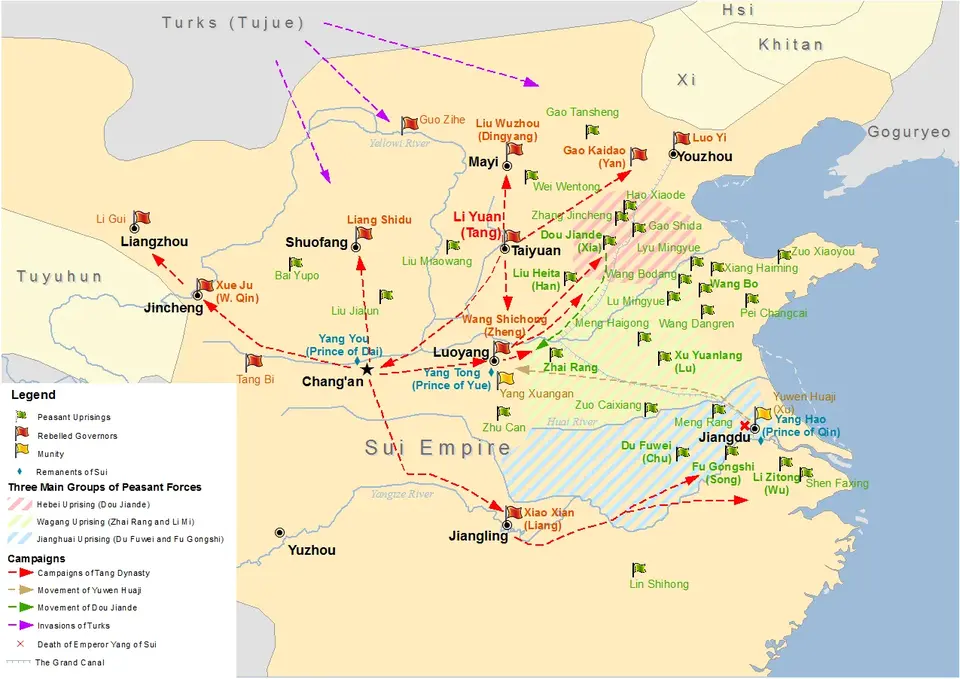
With their expanded host, Fu Gongshi and Du Fuwei crossed the Huai River to carve out territory across southern China. The Sui imperial regent at Jiangdu dispatched Guard Officer Song Hao with an elite army to suppress the rebellion. Fu Gongshi devised an ambush: Du Fuwei feigned retreat into dense reed marshes, whereupon insurgent troops ignited the dry vegetation downwind, incinerating the trapped imperial regiments. Soon afterward, bandit commander Zhao Pochen invited Du Fuwei to a feast with the intent of assassinating him. Fu Gongshi arrayed battle formations outside the stockade while Du Fuwei entered with ten guards; during the banquet, Du assassinated Zhao Pochen and Fu Gongshi stormed the gates, absorbing thousands of enemy troops.
In the first month of 617, the rebel army engaged Sui Right Imperial Guard General Chen Leng outside Liyang. Fu Gongshi directed multi-pronged flank assaults while Du Fuwei fought through severe arrow wounds, shattering the imperial army and capturing Liyang (present-day He County, Anhui). Du Fuwei proclaimed himself Supreme Commander and appointed Fu Gongshi as Chief Clerk. Following the regicide of Emperor Yang at Jiangdu in 618, the rebel army swept southward across the Yangtze, capturing Danyang (present-day Nanjing) and establishing it as their operational capital.
In 619, recognizing that Li Yuan had consolidated control over Guanzhong, Fu Gongshi and Du Fuwei dispatched emissaries to submit to the Tang throne. Emperor Gaozu created Du Fuwei Prince of Wu and Southeast Grand Area Commander, bestowing the imperial surname Li upon him. Fu Gongshi was created Duke of Shu and appointed Left Vice Director of the Huainan Branch Department of State Affairs.
However, as the regional administration stabilized, Fu Gongshi's prestige among founding veterans posed an increasing threat to Du Fuwei. The rank-and-file revered Fu Gongshi as the co-founder of the enterprise, often seeking his counsel over that of Du. Paralyzed by suspicion, Du Fuwei outwardly treated Fu Gongshi as an elder brother but systematically engineered administrative maneuvers to alienate him from armed commands. Du Fuwei placed his elite guards under his adopted son, General Wang Xiongdan, completely marginalizing Fu Gongshi.
Perceiving imminent danger, Fu Gongshi adopted an elaborate strategy of political dissimulation. He voluntarily relinquished his remaining offices, feigned chronic illness, and shuttered his residence. Associating with the Daoist occultist Zuo Youxian, he built a secluded hermitage where he claimed to devote his days to incantations and breath-fasting. Convinced that Fu Gongshi had abandoned secular ambitions, Du Fuwei relaxed his vigilance.
In the spring of 623, Emperor Gaozu summoned Du Fuwei to Chang'an to pay court homage. Before departing, Du Fuwei nominally appointed Fu Gongshi to supervise civil affairs in Danyang but secretly transferred all military authority and imperial tallies to Wang Xiongdan, instructing him to monitor Fu Gongshi closely. Following Du Fuwei's departure, Zuo Youxian repeatedly urged Fu Gongshi to exploit the power vacuum.
Fu Gongshi fabricated a secret edict purportedly sent by Du Fuwei from Chang'an, claiming that the Tang court had imprisoned Du and ordered the Jianghuai garrisons to revolt immediately. Wang Xiongdan, recognizing Du Fuwei's unwavering loyalty to the Tang, suspected foul play and refused to mobilize. Fu Gongshi thereupon invited Wang Xiongdan to a banquet, ambushed him with concealed swordsmen, and subsequently had him strangled in prison.
Having eradicated his primary rival, Fu Gongshi consolidated the Danyang garrison. In the eighth month of 623, Fu Gongshi ascended the throne in Danyang, proclaiming the founding of the Song state and adopting the era name Qiande. He appointed Zuo Youxian Director of the Secretariat and Minister of War, while issuing proclamations that he was executing Du Fuwei's secret commands to liberate Jiangnan. Swept by momentum, dozens of prefectures across southern China renounced Tang authority and recognized Fu Gongshi's sovereignty.
Outraged by the rebellion, Emperor Gaozu placed Du Fuwei under house arrest in Chang'an (where he died under mysterious circumstances) and appointed Prince of Zhaojun Li Xiaogong as commander-in-chief, with the brilliant strategist Li Jing as second-in-command, mobilizing more than one hundred thousand troops to advance along the Yangtze. Tang commanders Li Shiji and Zhou Faming coordinated attacks from Huainan and Hubei, tightening an unyielding encirclement around the fledgling Song regime.
Fu Gongshi dispatched generals Feng Huiheng and Zhang Jingda with tens of thousands of veteran troops to construct fortified fortresses at Qinglin and Bowang along the Yangtze, barring river passage with iron chains. In the second month of 624, Li Xiaogong and Li Jing reached Qinglin. Recognizing that the Song garrisons suffered from acute food shortages, Li Jing severed their supply routes and mounted surprise attacks against relief convoys. Desperate and starving, the Song troops sallied forth in disarray. Li Jing launched armored cavalry strikes, crushing the Song positions; over ten thousand defenders perished, and both strongholds fell.
Upon receiving news of the catastrophe, Fu Gongshi abandoned Danyang with a few hundred horsemen, intending to cross the sea from Kuaiji. However, his retinue disintegrated during the retreat. When Fu Gongshi reached Wukang in Changzhou, local villagers ambushed and bound the fugitive monarch, delivering him in chains to Li Xiaogong's camp. Following a brief tribunal in which Fu Gongshi defiantly defended his rebellion, Li Xiaogong ordered his immediate execution at Danyang, severing his head for display in Chang'an and terminating the Song state.
Amid the chaotic collapse of the Sui dynasty, Fu Gongshi collaborated with Du Fuwei to forge an agrarian uprising into a formidable regional power. Through brilliant tactical ambushes—such as the conflagration at Song Hao's encampment—and persuasive diplomacy that absorbed warlords like Miao Haichao and Zhao Pochen, Fu Gongshi provided the indispensable strategic and administrative leadership that established the Jianghuai hegemony.
Confronted with Du Fuwei's jealousy, Fu Gongshi demonstrated remarkable patience and cunning by concealing his ambitions behind Daoist fasting for years. When the strategic opportunity arose, he struck decisively to eliminate Wang Xiongdan and proclaim the Song dynasty, rallying dozens of prefectures in a matter of weeks and proving himself a formidable contender for imperial power in southeastern China.
FIGURES ASSOCIATED WITH THIS DYNASTY