Born in Yecheng
Born into a humble commoner family and entered the imperial palace quarters as a maidservant in her youth.
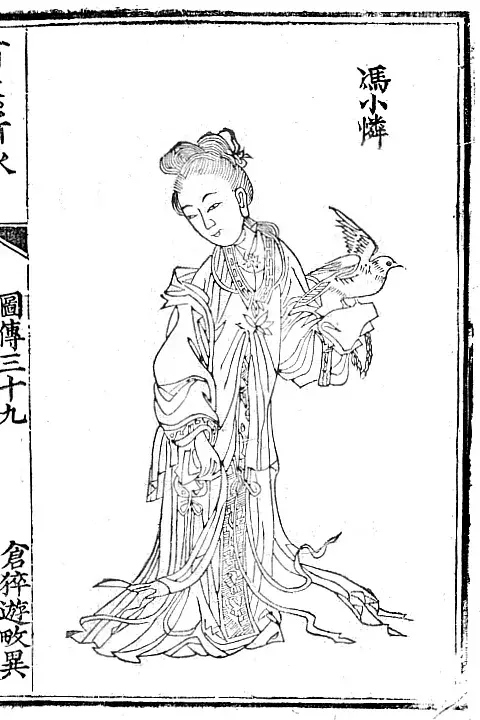
冯小怜
Feng Xiaolian (冯小怜, c. 550–581), a native of Yecheng in Northern Qi, was the most beloved imperial consort of Emperor Houzhu (Gao Wei) of Northern Qi. She held the prestigious court titles of Pure Consort and was later proclaimed Left Empress. In her early years, she entered the palace as a personal attendant to Empress Mu. Endowed with quick wit, extraordinary beauty, and unmatched mastery in playing the pipa and performing…
Feng Xiaolian (冯小怜, c. 550–581), a native of Yecheng in Northern Qi, was the most beloved imperial consort of Emperor Houzhu (Gao Wei) of Northern Qi. She held the prestigious court titles of Pure Consort and was later proclaimed Left Empress. In her early years, she entered the palace as a personal attendant to Empress Mu. Endowed with quick wit, extraordinary beauty, and unmatched mastery in playing the pipa and performing palace dance, she earned the fervent adoration of Emperor Gao Wei. During the critical final years of the Northern Qi dynasty, Emperor Gao Wei became obsessively infatuated with her, riding side by side with her on horseback and insisting on her presence even at dangerous military frontlines. In 576, when Emperor Wu of Northern Zhou (Yuwen Yong) launched a massive invasion besieging the strategic garrison of Jinzhou, Gao Wei was hunting with Feng Xiaolian at Sandui. Urgent military dispatches arrived three times within a single quarter of an hour, yet Gao Wei delayed deploying troops merely to satisfy her whim to "slaughter one more round of game." Later during the siege of Pingyang, when Northern Qi sappers successfully breached the defensive ramparts, Gao Wei halted the decisive assault to wait for Feng Xiaolian to finish her elaborate cosmetics and dress up to watch the spectacle, allowing Northern Zhou reinforcements to arrive and crush the Northern Qi army. In 577, Northern Zhou armies captured Yecheng and toppled Northern Qi; Feng Xiaolian and Gao Wei were captured in Qingzhou and transported to Chang'an. Following Gao Wei's execution, Emperor Wu of Zhou bestowed Feng Xiaolian upon his brother Yuwen Da, Prince of Dai. After the founding of the Sui dynasty, Emperor Wen of Sui transferred her to the mother of Li Xun. Harboring deep resentment over Feng Xiaolian's past persecution of Li Xun's sister, Li's mother forced her to wear rough burlap and pound grain daily, driving Feng Xiaolian to commit suicide by hanging. The Tang dynasty poet Li Shangyin immortalized her in verses on national ruin, turning her into an iconic literary and historical archetype of imperial downfall in traditional Chinese culture.
Born into a humble commoner family and entered the imperial palace quarters as a maidservant in her youth.
Served as a close lady-in-waiting to Empress Mu Huanghua, demonstrating extraordinary skill in pipa and palace dance.
Presented to Gao Wei by Empress Mu to regain imperial favor; Gao Wei showered her with lavish affection and titled her Pure Consort.
Northern Zhou troops besieged Jinzhou; Gao Wei delayed dispatching relief armies while hunting with Feng Xiaolian at Sandui.
Halted a decisive assault on Pingyang so Feng Xiaolian could dress up and watch; Zhou reinforcements counterattacked, routing Qi forces.
Yecheng fell; Gao Wei abdicated and fled south with Feng Xiaolian toward the Chen dynasty, but was intercepted and captured by Zhou cavalry.
Following Gao Wei's execution, Emperor Wu granted Feng Xiaolian to Yuwen Da, Prince of Dai, where she gained his deep affection.
After the Sui dynasty was established, she was transferred to Li Xun's mother, who severely abused her, leading to her suicide by hanging.
Feng Xiaolian emerged from a humble commoner background in Yecheng during the Eastern Wei and Northern Qi eras. As a young girl, she was selected into the imperial palace harem to serve as an ordinary laborer and was subsequently assigned to the personal entourage of Empress Mu Huanghua. Feng Xiaolian possessed breathtaking beauty, a graceful posture, exceptional intelligence, and virtuosic talent in playing the pipa, accompanied by an acute sensitivity to court psychology.
Following Gao Wei's accession to the throne, the monarch sank into decadence, luxury, and palace indulgence. By the middle of the Wuping era, Empress Mu gradually lost imperial favor while other consorts gained precedence. Hoping to reassert her standing, Empress Mu carefully attired her attendant Feng Xiaolian on the Dragon Boat Festival in 575 and presented her to Emperor Gao Wei under the auspicious name "Life-Extending Lady." Upon laying eyes on Feng Xiaolian, Gao Wei was completely mesmerized by her breathtaking charm and musical virtuosity, quickly favoring her over all other consorts. He promptly granted her the noble rank of Pure Consort. In the palace, they sat knee to knee and rode abreast on horseback, never parting from each other. Gao Wei even pledged an oath that they would "share delight in life and share the tomb in death."
In October 576, taking advantage of internal decay within Northern Qi, Emperor Wu of Northern Zhou (Yuwen Yong) marshaled an imperial force of 140,000 troops and launched a comprehensive eastern expedition. Vanguard forces led by Northern Zhou general Liang Shiyan drove straight toward the vital military stronghold of Jinzhou (modern Linfen, Shanxi) and completely enveloped it. Jinzhou was the indispensable shield guarding Taiyuan and the capital Yecheng; the inspector of Jinzhou urgently dispatched distress missives that reached the imperial tent three times in a single quarter hour.
At that time, Emperor Gao Wei was absorbed in hunting wild animals alongside Feng Xiaolian in the Sandui marshes near Qilian Lake. When urgent military dispatches arrived before the throne, Gao Wei was shaken and ordered the troops to assemble for a relief march. However, Feng Xiaolian, still in high spirits from the sport, coquettishly urged: "The garrison has its own generals to defend it; daylight is still abundant, why not let us kill one more round of game?" The foolish monarch capitulated to her entreaty and continued pursuing beasts across the marshland with joyous laughter, squandering half a day before indolently marching out. By the time Gao Wei's army reached the fortress of Chenggao, the crucial garrison of Jinzhou had already surrendered to Northern Zhou due to the complete severance of outside relief.
Following the fall of Jinzhou, Gao Wei, pressured by remonstrating generals, mobilized more than 100,000 elite troops to lay siege to Pingyang in an attempt to recapture it. Northern Qi soldiers fought desperately, excavating dozens of underground tunnels beneath the city walls, which successfully collapsed a section of ramparts over a hundred feet wide. Qi vanguard warriors shouted triumphantly and prepared to pour into the breach, while defending Zhou forces appeared panic-stricken and on the verge of surrender.
Yet at this critical turning point, Gao Wei ordered the drums to cease and suspended the final assault. He sent fast couriers back to the imperial pavilion specifically to invite Feng Xiaolian to witness the grand capture of the city. Feng Xiaolian was still applying her cosmetic powder, penciling her eyebrows, and arranging her ceremonial garments, delaying her departure for hours. Northern Qi troops stood shivering in the biting wind for two long intervals, giving the defenders inside Pingyang precious time to transport timber and stones to seal off the gaping breach firmly. By the time Feng Xiaolian arrived at the frontline in her imperial carriage, Pingyang had become completely impregnable. Shortly thereafter, Emperor Wu of Zhou arrived with his main army and joined battle outside Pingyang. During intense clashes, a minor retreat occurred in the Qi vanguard. Watching from the rear, Feng Xiaolian cried out in terror: "Our army is defeated! Our army is defeated!" Paralyzed with fear upon hearing her scream, Gao Wei abandoned his fighting troops and fled alongside Feng Xiaolian. Seeing their sovereign flee, the morale of the entire Northern Qi army collapsed like an avalanche; more than 100,000 soldiers disintegrated into chaos, leaving tens of thousands dead along the retreat.
After the catastrophic rout at Pingyang, Northern Qi completely lost its capacity for organized resistance. Gao Wei retreated with Feng Xiaolian to Yecheng, where he formally invested her with the title of "Left Empress." In January 577, Northern Zhou armies surrounded Yecheng. Gao Wei hastily abdicated in favor of his eight-year-old son Gao Heng, proclaimed himself Grand Emperor, and fled south with Feng Xiaolian and a small mounted retinue toward Qingzhou, attempting to seek refuge in the southern Chen dynasty. While resting at an imperial lodge in Qingzhou, Northern Zhou pursuing cavalry arrived unexpectedly and took both Gao Wei and Feng Xiaolian prisoner, escorting them under guard to Chang'an.
Upon arrival in Chang'an, Emperor Wu of Zhou initially granted Gao Wei the nominal title of Duke of Wen to pacify surrendered northern populations. Soon afterward, Emperor Wu used alleged treason as a pretext to execute all male members of the Gao imperial lineage. Following Gao Wei's death, recognizing Feng Xiaolian's peerless talents in music and dance, Emperor Wu bestowed her as a spoil of war upon his younger brother, Yuwen Da, Prince of Dai. In Yuwen Da's princely manor, she once again won profound favor; however, she grew arrogant and repeatedly slandered Prince Yuwen Da's mother and primary consort, Princess Li (sister of Li Xun), nearly driving Princess Li to death.
In 580, the regent Yang Jian consolidated supreme authority over Northern Zhou and founded the Sui dynasty the following year, ordering the execution of Yuwen Da and his brothers. In 581, to settle old grievances among Northern Zhou nobility, Emperor Wen of Sui transferred Feng Xiaolian to Li Xun's mother. Li's mother harbored bitter hatred toward Feng Xiaolian for her past mistreatment of her daughter; she banished Feng Xiaolian to the millhouse, stripped off her silk gowns, clothed her in rough burlap, and forced her to pound grain and perform exhausting menial labor under constant lashings and humiliation. Unable to endure such devastating degradation, Feng Xiaolian hanged herself in the millhouse, bringing a tragic and ignominious close to her tumultuous life.
Feng Xiaolian's meteoric ascent and absolute dominance over the Northern Qi inner court represented an extreme pinnacle of female favoritism and court corruption in Chinese imperial history. To win her smiles, Emperor Gao Wei discarded long-established imperial rituals and treated supreme state titles and aristocratic offices as playthings.
Under Feng Xiaolian's influence, the foundational moral codes and administrative boundaries of the Northern Qi imperial family collapsed completely. Gao Wei not only designated her Left Empress but also permitted her to intervene in external court deliberations, even ordering her to sit beside him on the throne during official audiences with foreign envoys. This bizarre dissolution of outer and inner court boundaries alienated senior ministers, disillusioned common subjects, and accelerated the institutional degeneration of the Northern Qi realm.
Although confined to the palace by convention, Feng Xiaolian repeatedly acted as a direct historical catalyst for the destruction of Northern Qi's armies and territory during its life-and-death struggle with Northern Zhou. At the Battle of Jinzhou, she subordinated critical military movements to frivolous personal leisure, allowing a crucial frontier bastion to fall into enemy hands. At the Battle of Pingyang, she delayed an imminent breakthrough for private cosmetic dressing, handing the enemy a golden opportunity to repair their defenses.
Most fatally, at the height of the clash outside Pingyang, her panic-stricken screaming triggered Gao Wei's reckless flight from the battlefield, precipitating the wholesale collapse of a 100,000-man elite army without a fight. Historians have consistently noted that Northern Qi forces still retained the tactical strength to inflict severe damage on Northern Zhou; it was Feng Xiaolian's catastrophic interference at decisive turning points that pushed the dynasty irrecoverably into the abyss.
In traditional Chinese cultural memory and literary reception, Feng Xiaolian left an indelible imprint as an emblem of dynastic downfall. The celebrated Tang dynasty poet Li Shangyin composed a famous pair of poems on Northern Qi, capturing the historical drama in stark, biting lines: "Her charming smile was known to rival ten thousand soldiers, her city-toppling delight turned toward the evening spring; while Xiaolian's jade body lay bare through the night, reports had already arrived of Zhou troops entering Jinyang."
Li Shangyin's verses juxtaposed her breathtaking beauty with the instantaneous collapse of the Northern Qi empire, creating an unforgettable portrait of moral decay and historical reckoning. Subsequent generations of literati, when contemplating the downfall of states and the perils of sensual indulgence, consistently placed Feng Xiaolian alongside legendary figures such as Mo Xi of Xia, Da Ji of Shang, and Bao Si of Zhou, establishing her as one of the most prominent cultural tropes of fatal feminine charm in imperial historiography.
FIGURES ASSOCIATED WITH THIS DYNASTY