Birth of Feng Congwu
Born into an esteemed scholar-official family in Chang'an, Shaanxi, exhibiting strict moral decorum and profound classical focus.
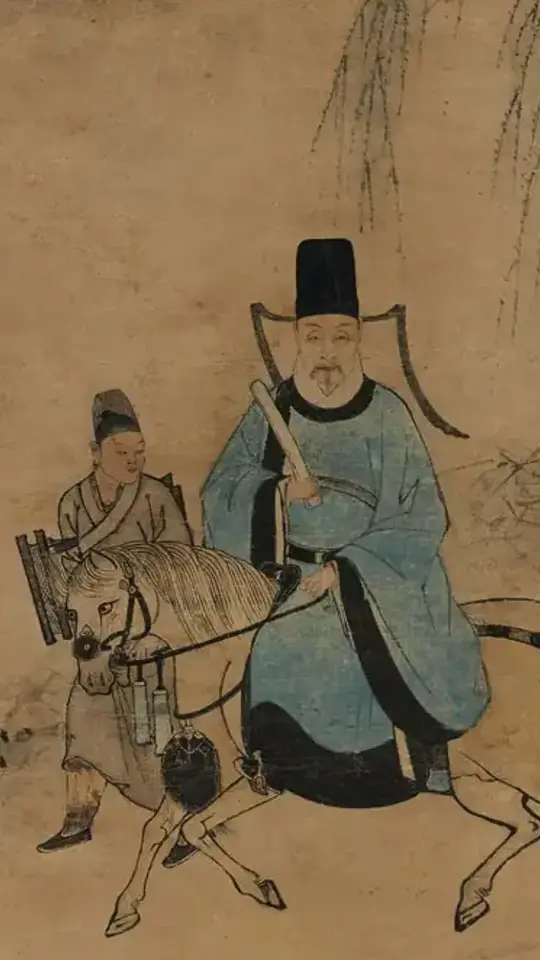
冯从吾
Feng Congwu (January 28, 1557 – 1627), courtesy name Zhonghao, art name Shaoxu, native of Chang'an, Shaanxi, was an eminent late Ming dynasty Neo-Confucian master, educational reformer, and incorruptible statesman. Passing the metropolitan examination in 1589 as a jinshi, he was appointed Investigating Censor, gaining national renown for submitting an uncompromising memorial that rebuked the Wanli Emperor for neglecting…
Feng Congwu (January 28, 1557 – 1627), courtesy name Zhonghao, art name Shaoxu, native of Chang'an, Shaanxi, was an eminent late Ming dynasty Neo-Confucian master, educational reformer, and incorruptible statesman. Passing the metropolitan examination in 1589 as a jinshi, he was appointed Investigating Censor, gaining national renown for submitting an uncompromising memorial that rebuked the Wanli Emperor for neglecting imperial court audiences and impeached Senior Grand Secretary Shen Shixing. Retiring to Shaanxi after confronting royal intransigence, Feng engaged in rigorous self-cultivation and lecturing for over two decades. In 1609, he established the Guanzhong Academy (Guanzhong Shuyuan) in Xi'an, erecting the Yunzhi Hall, formalizing comprehensive academy statutes, and reviving the regional Guan School (Guanxue) founded by Zhang Zai, earning praise from Li Erqu as the "consummate synthesizer of the Guan School." Recalled under Emperor Xizong in 1621, he served as Left Assistant Censor-in-Chief (Zuo Qian Du Yushi), vigorously resisting the despotic eunuch Wei Zhongxian. When the eunuch faction ordered the nationwide demolition of academies and stripped Feng of all titles, he died in moral anguish in 1627. Posthumously rehabilitated under Chongzhen with the title Gongding, his major writings include Shaoxu Ji and Guanzhong Shuyuan Yulu.
Born into an esteemed scholar-official family in Chang'an, Shaanxi, exhibiting strict moral decorum and profound classical focus.
Passed the metropolitan examination, serving as Hanlin Bachelor and Supervising Secretary before becoming Investigating Censor.
Submitted an outspoken memorial censuring the Wanli Emperor's prolonged absence from audiences and impeaching Chancellor Shen Shixing.
Stationed as Regional Inspector of Henan, curbing bureaucratic graft, punishing corrupt imperial kinsmen, and winning local gratitude.
Resigned in protest against aggressive eunuch tax-collectors, remaining in strict nine-year seclusion to synthesize Neo-Confucian metaphysics.
Established the Guanzhong Academy with support from Shaanxi provincial officials, drafting statutes and instructing thousands of scholars.
Summoned by the Tianqi Emperor to serve as Vice Minister of the Court of Judicature and Left Assistant Censor-in-Chief.
Memorialized against eunuch interference in imperial governance; facing fierce hostility from Wei Zhongxian, he resigned to return home.
The eunuch dictatorship ordered all private academies razed; Guanzhong Academy was dismantled, and Feng was stripped of all honors.
Passed away at his Chang'an residence at seventy-one; fully rehabilitated in 1628 with the posthumous title Gongding and Junior Protector.
Feng Congwu was born into a prominent scholarly family in Chang'an County, Shaanxi, imbued with the austere moral ethos of the regional Guan School. From youth, he immersed himself in the Cheng-Zhu Neo-Confucian tradition and the seminal ethical doctrines of Northern Song philosopher Zhang Zai, embracing the ideal of establishing moral consciousness for Heaven and Earth and securing livelihoods for the people. In 1588, he passed the Shaanxi provincial examinations, and in 1589, achieved the jinshi degree. Inducted into the Hanlin Academy as a Bachelor, he was appointed Supervising Secretary in the Office of Scrutiny for Works and soon transferred to Investigating Censor of the Guizhou Circuit.
As a newly appointed censor, Feng took his surveillance duties with grave seriousness. At this juncture, the Wanli Emperor had retreated into the inner quarters, indulging in imperial indolence and neglecting morning court assemblies. Imperial appointments remained unfilled, memorials were withheld without response, and bureaucratic discipline collapsed across the provinces. While elder ministers remained timorous, Feng submitted a blistering memorial in 1591 directly censuring the sovereign's withdrawal from sacred sacrifices, classical lectures, and imperial audiences. Furthermore, he launched a fierce indictment against Senior Grand Secretary Shen Shixing, accusing him of cowardly accommodation and deceptive sycophancy. The emperor reacted with fury, imposing financial penalties; yet scholars across the empire marveled at his courage, declaring that as a censor his unbending voice shook the realm.
In 1592, Feng was commissioned as Regional Inspector (Xunan Yushi) of Henan. Inspecting the Central Plains, he aggressively prosecuted extortionate magistrates, restrained predatory local gentry, and disciplined imperial princes who encroached on commoners' estates. He eliminated illegal surcharges on grain transport, checked official corruption, and restored fair governance, prompting local peasants to erect living shrines and stone steles in his honor. Upon returning to Beijing, he witnessed the emperor unleashing eunuch mining commissioners to terrorize merchants and extort taxes. Recognizing that his repeated protests could not sway the court, Feng resigned in 1596, returning to Chang'an.
Retiring to his ancestral home, Feng resolved to combat the creeping nihilism of late Ming intellectual life, where popularized Chan Buddhism and distorted interpretations of Wang Yangming's School of the Mind led scholars to abandon practical morality. Feng shuttered his studio, entering strict seclusion for nine years without crossing his threshold. Immersing himself in the Book of Changes, the Four Books, and the writings of Zhang Zai, he synthesized the Cheng-Zhu emphasis on investigating things (gewu) with Wang Yangming's doctrine of innate moral knowing (liangzhi). He developed an austere philosophy of practical learning (shixue) anchored in constant self-reflection, moral dignity, and social responsibility.
Emerging from his nine-year retreat, Feng responded to eager requests from regional scholars by holding public lectures at Baoqing Temple near the southern gate of Xi'an. His profound scholarship and moral stature drew thousands of listeners, including governors and surveillance commissioners. Because the temple could not accommodate the surging crowds, Shaanxi Provincial Administration Commissioner Wang Keshou and Judicial Commissioner Li Tianlin allocated land at the nearby Xiaoxiyuan in 1609 to construct the Guanzhong Academy (Guanzhong Shuyuan).
The academy was conceived on a grand scale, centered on the Yunzhi Hall (derived from the Doctrine of the Mean), with lecture halls, dormitories, and the Sidao Zhongtian Pavilion housing Confucian classics. Feng presided over the academy for over a decade, drafting the Guanzhong Shuyuan Xueyue (Academy Statutes) to demand daily moral introspection, modest living, and active social duty. His guidance revived the dormant Guan School, transforming Xi'an into the premier center of Neo-Confucian resurgence in northwestern China.
In 1621, following the accession of the Tianqi Emperor, the court sought to restore its moral prestige by recalling revered elder statesmen. Feng was summoned to Beijing, serving successively as Vice Minister of the Court of Judicature and Left Assistant Censor-in-Chief (Zuo Qian Du Yushi). At this time, the Ming border collapsed in Liaodong, while the court was overtaken by the eunuch dictator Wei Zhongxian and Empress Wet-Nurse Madam Ke.
Unbending in his rectitude, Feng presented the Memorial on Restoring the Laws, demanding the elimination of inner-court usurpation, the strict enforcement of statutory law, and the appointment of principled generals. Wei Zhongxian viewed Feng as a dangerous roadblock, orchestrating slanders through eunuch partisans. Realizing that the court was irredeemably compromised, Feng submitted his resignation and returned to Shaanxi in 1623. In 1625, Wei unleashed the nationwide campaign to exterminate private academies. Imperial agents arrived in Xi'an, forcibly demolishing Guanzhong Academy, shattering steles, and stripping Feng of all ranks and commoner status. Heartbroken by the destruction of his life's work, Feng fell gravely ill, passing away in Chang'an in 1627 at seventy-one years of age. Upon Emperor Chongzhen's accession in 1628, the court reversed the verdicts, posthumously conferring the titles Junior Protector to the Crown Prince, Minister of Works, and the posthumous name Gongding.
Feng Congwu's preeminent intellectual contribution was the theoretical and institutional resurgence of the Guan School (Guanxue). Originally established by Northern Song philosopher Zhang Zai, the school had languished for centuries under the dominance of Zhu Xi's commentaries and the southern rise of the Lu-Wang school.
Witnessing late Ming scholars degenerating into frivolous, nihilistic rhetoric that severed ethical study from social governance, Feng championed "anchoring in fundamentals and valuing substantial practice" (dunben shangshi). He integrated the cosmic vitalism (qixue) of Zhang Zai with the meticulous self-examination of Zhu Xi, arguing that moral enlightenment must be verified through daily familial and civic action. The early Qing master Li Erqu declared: "The Guan School was pioneered by Master Zhang Zai, continued by Master Lu Jingye, and brought to consummate synthesis by Master Feng Shaoxu!" Feng transformed the school into an enduring pillar of early modern Chinese practical learning.
Guanzhong Academy, founded by Feng in 1609, stood as one of the most significant institutions of higher learning in late imperial China. In architectural layout and operational philosophy, it embodied the integration of Confucian cosmology and ethical discipline.
The statutes formulated by Feng prohibited frivolous literary games and partisan agitation, demanding that students dedicate themselves to moral rectitude, filial piety, and community welfare. He instituted interactive seminars, mutual critique sessions, and regular personal mentoring, nurturing generations of statesmen and scholars across Shaanxi, Shanxi, Henan, and Sichuan. The academy endured through the Qing dynasty as the preeminent cultural and educational center of northwestern China, laying the groundwork for the modern educational institutions of Shaanxi.
Throughout his administrative career, Feng exemplified the highest standards of the Confucian supervisory official. In an age of imperial autocracy and bureaucratic compliance, he risked execution to challenge the Wanli Emperor's irresponsible withdrawal from governance. As regional inspector in Henan, he championed the poor against entrenched local elites; and as Left Assistant Censor-in-Chief in the Tianqi era, he stood unflinching against the terrifying ascendancy of the eunuch dictatorship. His fearless memorials remain celebrated models of imperial remonstrance.
In philosophical debate and social education, Feng Congwu consistently championed Confucian orthodoxy. In his Self-Praise (Zi Zan), he proudly proclaimed himself a follower of Zou and Lu while opposing Buddhist and Daoist quietism, sternly critiquing the rampant syncretic tendencies of late Ming intellectuals. He insisted that scholars must anchor themselves in Confucian moral duties, rectifying hearts and minds through ritual and musical education.
Feng brought educational transformation directly into rural communities across Shaanxi. Confronting competitive extravagance and superstitious funeral customs, he advocated frugality and moral restraint, personally formulating community wedding and funeral compacts to eliminate wasteful expenditures. He mediated local civil disputes, encouraged agricultural water conservancy, and established community granaries to relieve famines, fundamentally reforming local customs across the Guanzhong plain.
Throughout his lifetime, Feng was a prolific author who produced an extensive corpus of Neo-Confucian scholarship. His major works include the Shaoxu Ji, Discourses of Guanzhong Academy (Guanzhong Shuyuan Yulu), Memorial Drafts of the Southern Ministry, and detailed philosophical commentaries on the Classic of Changes and the Four Books.
His masterpiece Guanzhong Shuyuan Yulu faithfully recorded deep philosophical deliberations between Feng and his disciples, characterized by clear, unadorned prose focused on practical self-cultivation free from the speculative emptiness of late Ming philosophy. His disciples Nan Juyi and Zhang Zongmeng compiled his surviving writings into the Collected Works of Duke Feng Gongding, which was later fully cataloged in the Siku Quanshu as essential source material for late Ming intellectual history.
FIGURES ASSOCIATED WITH THIS DYNASTY